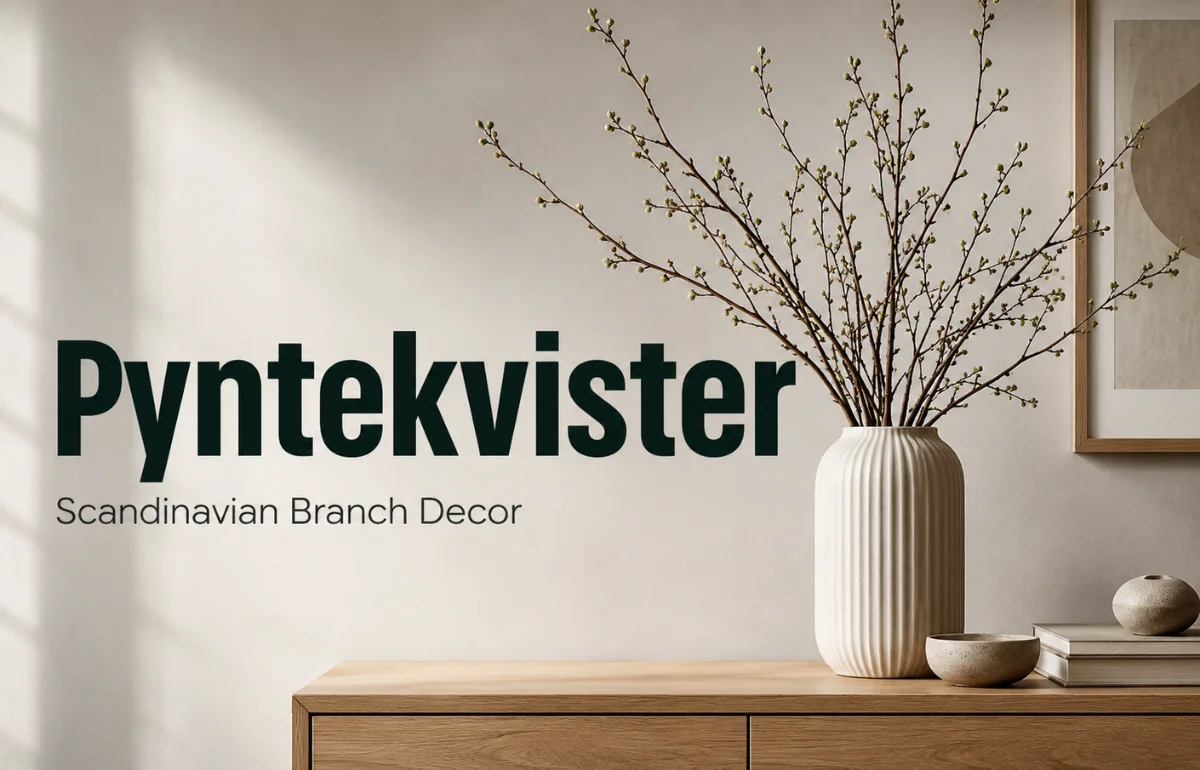
Pyntekvister is a Scandinavian decorating tradition of bringing bare or budding branches indoors and arranging them as a natural, sculptural piece of home decor. The word comes from Norwegian and Danish — pynte means “to decorate,” and kvister means “twigs or branches” — so pyntekvister translates literally to decorative branches.
Unlike a bouquet of flowers, pyntekvister branches are chosen for their shape and structure rather than their bloom, and they can sit in a vase for weeks or even months without wilting.
I started doing this myself almost by accident, long before I knew there was a name for it. It was only after I looked into where the idea came from that I realized how much more there was to it than just standing a stick in a jar of water.
What Does Pyntekvister Actually Mean?
Break the word down and it gets simple fast. Pynte is the verb “to decorate” in both Norwegian and Danish. Kvist means a single twig or small branch, and kvister is the plural form.
Put them together and you get a compound word that Scandinavians use in a fairly matter-of-fact way — not as a trendy design term, but as the plain, everyday name for something people have done in their homes for generations.
I first came across it after a weekend of pruning in my own garden. I’d cut back an overgrown shrub and ended up with a pile of branches that were too interesting to throw on the green waste pile.
A few had that slightly curved, almost sketched-in-pencil quality. I brought a handful inside, put them in a tall vase, and only later found out I’d unknowingly recreated something with a specific Scandinavian name and a history stretching back further than I expected.
Where Pyntekvister Comes From
The tradition has deep roots in Nordic folk culture, and it grew out of necessity as much as aesthetics. Winters across Norway, Denmark, and Sweden are long and low on daylight, so bringing a piece of the outdoors in became a way of keeping some connection to nature alive through the colder months.
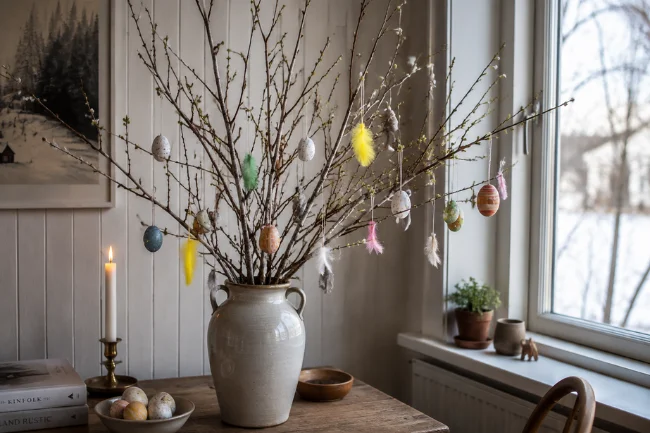
One of the clearest examples is påskeris, the Danish and Norwegian Easter tradition of decorating birch branches with feathers, small ornaments, and sometimes painted eggs. It’s essentially a seasonal version of pyntekvister, and it’s still common in Scandinavian homes every spring.
In deep winter, bare branches were painted white to echo the snow outside, then stood in a corner or on a mantel. Come late February and March, people would cut budding branches — cherry, forsythia, pussy willow — and bring them indoors in water, coaxing early blossoms out weeks before spring actually arrived outside.
None of this was ever purely ornamental. It was a quiet way of tracking the seasons from inside the house, at a time of year when going outside to notice them wasn’t always appealing.
Why Pyntekvister Works So Well in Modern Homes
There’s a reason this idea has aged well outside of Scandinavia, and it isn’t just that it looks nice in a photo.
A branch adds height and line to a room without adding visual weight. It introduces a curve into spaces that are otherwise full of straight furniture edges and flat walls, and because the shape is irregular, it never reads as static the way a piece of furniture does.
It also changes with the light. The shadow a branch throws across a wall at nine in the morning looks nothing like the one it throws at four in the afternoon, so the same arrangement quietly shifts throughout the day.
This ties into two ideas that sit at the center of Scandinavian design more broadly — hygge, the sense of coziness and contentment, and lagom, the Swedish idea of “just the right amount,” neither too much nor too little. Pyntekvister fits both. A single well-shaped branch can do more for a corner than a cluster of ornaments, and it does it without asking for maintenance.
I keep a branch arrangement near my desk in the room I use as a workspace, and I notice the difference on the days I’ve let it go untended versus the days I’ve just refreshed the water or turned the vase slightly. It’s a small thing, but a considered corner tends to make the rest of the space feel more considered too.
Pyntekvister Compared to Other Natural Decorating Styles
People often lump pyntekvister in with other nature-based decorating traditions, but the materials, intent, and upkeep are genuinely different. Here’s how it stacks up against the styles it gets confused with most.
| Style | Origin | Core Material | Typical Maintenance | Best Suited For |
|---|---|---|---|---|
| Pyntekvister | Norway / Denmark | Bare or budding branches | Little to none | Minimalist corners, long-term display |
| Ikebana | Japan | Flowers, branches, leaves | Daily water changes | Deliberate, asymmetrical arranging |
| Dried flower styling | Global / boho | Dried flowers, grasses | Occasional dusting | Soft, textured, warm interiors |
| Hygge home styling | Denmark | Candles, textiles, timber, branches | Varies by element | Overall cozy atmosphere, not one specific object |
Ikebana is the closest relative, but it’s a formal practice with its own rules about balance and asymmetry, usually built around fresh cut flowers alongside branches. Pyntekvister is looser. There’s no set technique to learn — the branch itself is doing most of the work, and the arranging is closer to instinct than method.
Best Branches for Pyntekvister: A Species Guide
Not every branch behaves the same way once it’s indoors, and this is where a lot of guides stop short. Shape matters, but so does species, because it affects how long a branch lasts, whether it will bud, and how it looks once it dries out.
| Branch Type | Visual Character | Best Season to Cut | Indoor Lifespan | Notes |
|---|---|---|---|---|
| Birch | Fine white bark, delicate lines | Winter | Several months | The classic pyntekvister choice in Scandinavia |
| Pussy willow / curly willow | Curved, sculptural, soft catkins | Late winter to spring | Weeks to months | Will often bud further if kept in water |
| Hazel (especially corkscrew varieties) | Twisted, characterful | Autumn to winter | Several months | Suits rustic or studio-style interiors |
| Cherry or apple | Delicate blossom once forced | Late winter | 1–2 weeks once bloomed | Needs a warm room to encourage blossom |
| Dogwood | Red or yellow-toned stems | Winter | Several months | Adds color without needing bloom |
| Eucalyptus | Silvery-green, fragrant, sturdy | Year-round | Weeks, then dries in place | A practical substitute in regions where birch and hazel aren’t native |
That last one matters more than most guides let on. Birch and hazel are Northern Hemisphere species, and if you’re arranging pyntekvister somewhere like Australia, New Zealand, or parts of the southern United States, you’re not going to find them growing in your backyard. Eucalyptus, native grasses, and gum branches with interesting bark texture do a similar job and hold up just as well once cut.
The species matters less than the shape, though. A thick branch with a strong forking pattern reads as architectural. A fine, single-stem twig reads as delicate. Look at the line before you look at the label.
How to Forage Branches the Right Way
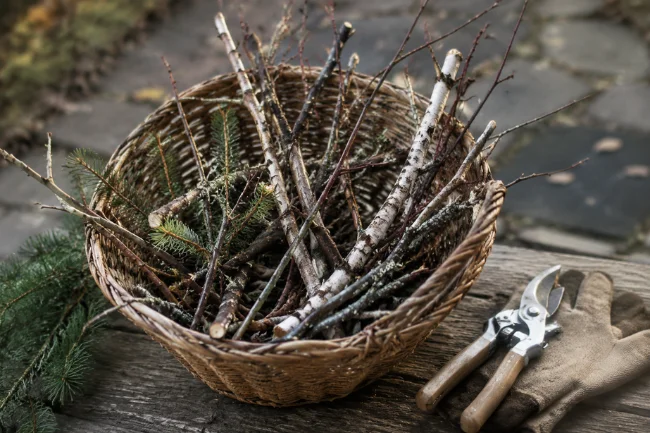
You don’t need to buy anything to start, but there’s a right and wrong way to go about collecting.
The easiest source is your own garden after pruning. Offcuts that would otherwise go into green waste are usually the best material, since they’re fresh and you already know where they came from.
Storm-fallen branches after a wind are another good option, as are pruning offcuts from a neighbor’s hedge if you ask first. What you want to avoid is stripping live growth off a healthy tree just for the shape of it, or taking anything from protected land, national parks, or conservation areas, where foraging is often restricted even for something as small as a twig.
I’ve had the best luck simply walking my own street after a windy night. Most of what ends up in a vase in my house was never intentionally cut by anyone — it just needed someone to notice it before the council did.
How to Prepare and Preserve Your Branches
Once you’ve got something worth bringing inside, a bit of prep makes a real difference to how long it lasts.
Rinse branches under water first to knock off dirt, moss, or any insects hiding in the bark, then let them dry fully before arranging. Skipping this step is the single most common reason people end up with bugs indoors that they didn’t invite.
For most woody branches, doing nothing further is fine. Birch, hazel, and dogwood will simply dry out slowly over weeks and hold their shape indefinitely afterward.
If you want to preserve branches with their leaves still soft and pliable rather than crisp and brittle, the glycerin method works well. Mix one part glycerin to two parts warm water, stand the cut ends in the solution, and leave them for one to three weeks in a cool spot out of direct sun. The branch draws the glycerin up through its stem, replacing the moisture that would otherwise evaporate, and the leaves stay flexible rather than curling and dropping.
Painting is the other main preservation option, and it does double duty — a coat of white or chalk-toned paint both preserves the branch and gives it a more deliberate, finished look. Matte finishes tend to suit the Scandinavian aesthetic better than anything glossy.
Styling Ideas for Every Season
Pyntekvister isn’t a one-look decorating idea, and the same branches can be restyled through the year without buying anything new.
In winter, bare or white-painted branches in a tall, narrow vase work best, kept minimal and left mostly alone. This is the closest to the original Scandinavian version of the practice.
Around Easter and into spring, hang small ornaments, painted eggs, or feathers from the branches, echoing the Danish påskeris tradition. Budding cuttings like cherry or willow also suit this period, since they’ll often bloom indoors just as the season is turning outside.
In autumn, seedheads, dried grasses, or a scattering of dried leaves tied on with thread bring in some warmth and texture without needing fresh flowers at all.
Beyond seasonal display, branches also work structurally. Hung horizontally from the ceiling on thread, a sturdy branch becomes a display rail for postcards, drawings, or small hanging plants. Leaned into a corner, it fills empty space without blocking light the way a piece of furniture would.
Where to Buy Pyntekvister Branches If You Can’t Forage
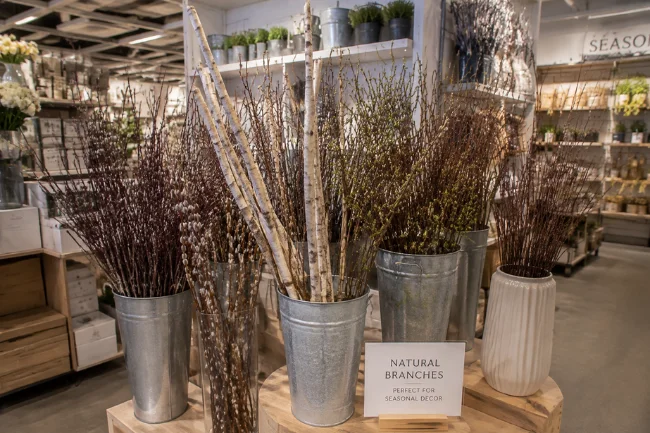
If foraging isn’t practical, plenty of florists carry seasonal branches, particularly around Easter and in the lead-up to winter, when birch and willow are in demand.
Garden centers often sell dried or fresh branch bundles, and larger home stores — IKEA is a reliable one — stock artificial and preserved birch branches year-round for a consistent, low-maintenance option. Online marketplaces like Etsy also have small sellers offering dried, painted, or preserved branches by the bundle.
Prices vary widely depending on length and species, but a bundle of a few real branches is usually cheaper than a single bouquet of flowers, and it lasts considerably longer.
Common Mistakes to Avoid With Pyntekvister
A few things trip people up when they try this for the first time.
Overcrowding the vase is the most common one — three or four well-shaped branches usually look better than a dozen crammed together, since the whole point is to let the line of each one stand out.
Choosing a vase that’s too small or too light for the branch is another issue, especially with anything thick or top-heavy. A wide, weighted base or a layer of stones inside the vase keeps everything upright.
It’s also worth checking what you’re bringing inside before you commit to it. Some ornamental garden plants, like oleander or yew, carry berries or sap that are toxic if handled by curious kids or pets, so it’s worth identifying a branch before it goes anywhere near a coffee table.
Finally, skip fresh, very green cuttings if you want something low-maintenance. Green wood tends to shed leaves and needs regular water changes, while a properly dried or seasoned branch will sit untouched for months.
FAQs About Pyntekvister
What does pyntekvister mean in English?
It translates to “decorative branches,” from the Norwegian and Danish words pynte (decorate) and kvister (twigs).
How long do pyntekvister branches last indoors?
Most woody branches like birch or hazel last several months indoors; budding cuttings like cherry last one to two weeks once they bloom.
Can you use any branch for pyntekvister?
Almost any branch with an interesting shape works, though it’s best to avoid toxic species like oleander and to skip diseased or pest-ridden wood.
Do pyntekvister branches need water?
Not usually. Most dried or seasoned branches look fine without water; water is only needed if you’re trying to force buds or blossoms open.
Is pyntekvister the same as hygge?
No. Hygge is a broader Danish concept of coziness and contentment, while pyntekvister is one specific decorating practice that happens to fit within it.
A Branch Is a Reasonable Place to Start
What makes pyntekvister worth trying isn’t the Scandinavian pedigree or the word itself — it’s how little it asks of you. No specialist tools, no ongoing care, no cost if you’re willing to walk around your own garden or street after a windy day.
If you’ve got a corner in your home that’s felt a little unfinished, that’s usually all the invitation you need. Pick up a branch that catches your eye, bring it inside, and give it a few days in a vase before deciding whether it needs anything more. Most of the time, it won’t.

Olivia Parker is a home improvement research writer with 8+ years of experience covering home design, renovation ideas, maintenance tips, and practical living solutions. She creates easy-to-follow content to help readers make informed decisions about improving their homes.