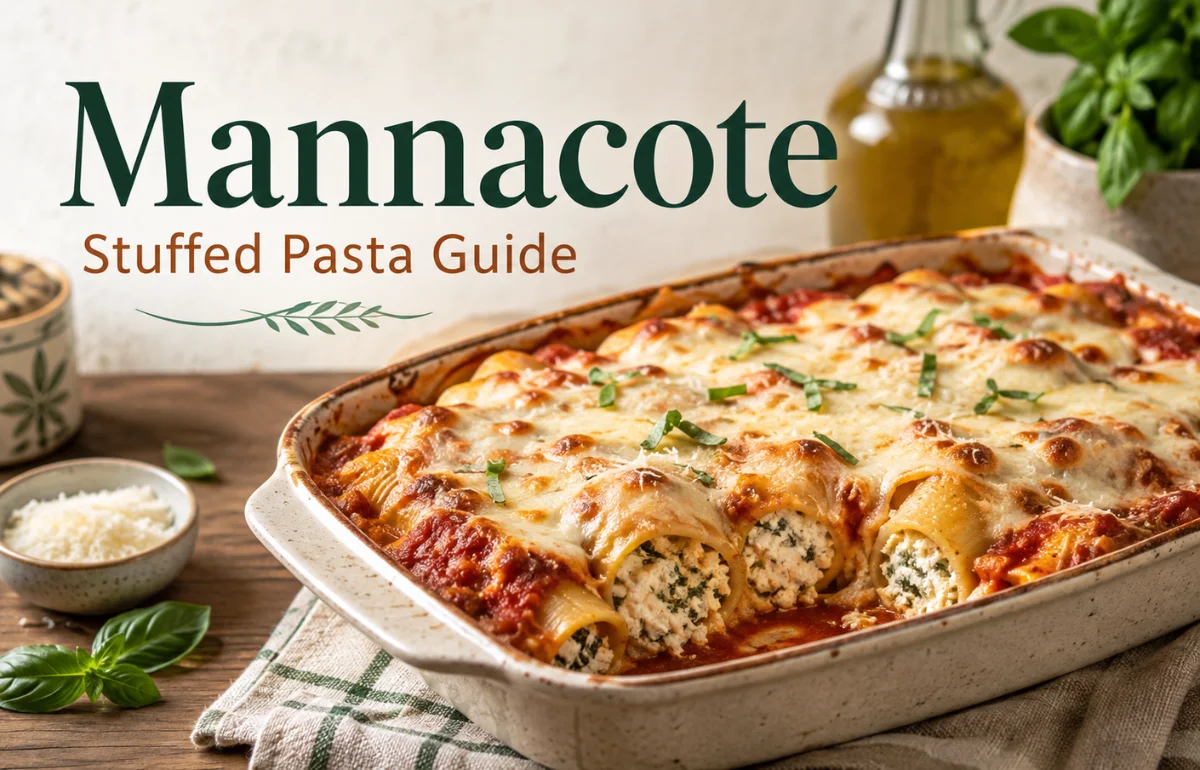
Mannacote is best understood as an Italian-American spelling or pronunciation-based variation of manicotti, the familiar baked dish made with large pasta tubes or thin crepes filled with ricotta, cheese, meat, spinach, or a combination of those ingredients. I would not treat Mannacote as a separate, formally recognized Italian pasta shape. Major dictionary and language references recognize manicotti, while the spelling “Mannacote” appears mainly in informal, regional, family, and internet usage. Merriam-Webster defines manicotti as tubular pasta shells that may be stuffed with ricotta or meat and baked, usually with tomato sauce.
That distinction matters because people searching for Mannacote are usually trying to identify a dish they heard named aloud, saw on a family recipe card, or encountered online. In practical cooking terms, they are usually looking for manicotti: a comforting Italian-American baked pasta with a rich filling, sauce, and melted cheese.
Is Mannacote a Real Italian Pasta Name?
When I research food terms like this, I separate established culinary vocabulary from regional speech and phonetic spellings. In this case, the standard documented word is manicotti. Merriam-Webster traces it to the Italian plural of manicotto, which comes from manica, meaning “sleeve.” The image fits the food: the pasta or crepe forms a sleeve around the filling.
I could not find Mannacote listed as a standard pasta term in the major English and Italian-language references I checked. Treccani, for example, discusses manicotti among Italian food terms adopted into English, not Mannacote. That does not mean nobody uses the alternative spelling. It means the spelling is better understood as informal rather than as the name of a distinct traditional pasta.
There is also a strong Italian-American language angle. Food words carried to the United States by immigrants from Southern Italy often changed in pronunciation over generations. Final vowels could disappear, and consonants could shift in everyday speech. Linguistic discussions of Italian-American food vocabulary document patterns such as ricotta becoming something closer to “rigot” and capocollo becoming “gabagool.” Similar regional speech helps explain why manicotti may be heard as “manigot,” “manacott,” or a spelling such as Mannacote.
A Philadelphia-area chef has even noted hearing “Mannacote” used locally for manicotti, which supports the idea that the word survives as a regional or family pronunciation rather than a separate recipe.
Mannacote vs. Manicotti vs. Cannelloni
The easiest way to understand Mannacote is to compare it with the two names people most often confuse with it.
| Term | What it usually means | Typical form | Where the name is most familiar |
|---|---|---|---|
| Mannacote | Informal or phonetic spelling associated with manicotti | Large tube or rolled crepe | Italian-American family or regional usage |
| Manicotti | Italian-American baked stuffed pasta dish | Ridged dried tubes or thin crepes | United States |
| Cannelloni | Italian baked cylindrical stuffed pasta | Pasta sheets rolled into tubes or prepared tubes | Italy and internationally |
The line between manicotti and cannelloni is not perfectly fixed. American cooks often distinguish manicotti by its ridged, ready-made tubes and cannelloni by smoother pasta sheets or tubes. Other culinary sources point out that historical usage is less tidy, especially because crepe-style manicotti has a long place in Italian-American cooking.
Serious Eats notes that American manicotti may be made from either tubular pasta or thin crepes, while La Cucina Italiana has also documented crespelle-style versions.
For a home cook, the useful rule is simpler: if someone says Mannacote, they are very likely talking about the same family of baked, filled dishes Americans call manicotti.
What Does Mannacote Look and Taste Like?
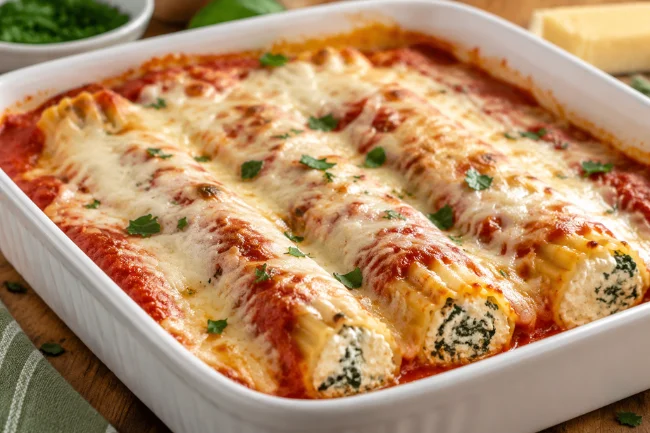
A typical Mannacote dish contains filled tubes or rolled crepes covered with sauce and melted cheese. The pasta should be tender but sturdy enough to hold a creamy filling, usually built around ricotta, mozzarella, and Parmesan or Pecorino. Traditional and modern manicotti recipes commonly use this cheese-centered approach.
Marinara gives the dish a bright, familiar Italian-American flavor; meat sauce makes it heartier, while béchamel creates a softer, richer finish. Crepe-style versions may also combine tomato sauce and béchamel.
The Italian-American Story Behind Mannacote
Mannacote makes the most sense when viewed through Italian-American food culture rather than as an obscure pasta secretly preserved in Italy.
Manicotti is firmly established in American English. Merriam-Webster records its first known English use in 1940, while modern dictionaries define it as large pasta tubes stuffed with cheese or meat and usually baked with tomato sauce.
The dish is closely related to Italian preparations built around filled pasta sheets, cannelloni, and crespelle. Italian-American cooks adapted those ideas to local ingredients and commercially available pasta, which helps explain why one family may insist on homemade crepes while another considers ridged boxed tubes standard. Crepe-style manicotti remains well documented in Italian-American cooking.
That history also explains why the name can be confusing. Recipes travel through families differently from dictionary words. A grandmother may teach a dish by sound rather than by writing, and a pronunciation can survive for decades even after younger generations lose familiarity with the dialect that shaped it.
Mannacote is a good example of that process: the spelling may vary, but the food remains recognizable.
What Goes Into Traditional Mannacote?
Most versions begin with four components: the wrapper, filling, sauce, and topping.
For the wrapper, cooks commonly use dried manicotti shells or homemade crespelle. The filling usually starts with ricotta, then adds mozzarella and a grated cheese such as Parmesan or Pecorino. Eggs, parsley, spinach, herbs, sausage, or ground meat may also appear depending on the household and recipe.
The filled tubes are placed in sauce so the pasta remains moist as it bakes. More tomato sauce and cheese usually go over the top before the dish enters the oven.
Barilla’s manicotti guidance also presents the pasta as suitable for cheese, meat, vegetable, and sauce-based fillings, which shows how flexible the dish has become in American kitchens.
How Mannacote Is Prepared
Using Dried Manicotti Tubes
Dried tubes are the easiest option for many home cooks. If the package calls for boiling first, I recommend stopping while the pasta is still firm rather than letting it become very soft.
The reason is practical: the shells continue cooking in sauce inside the oven, while very soft tubes are harder to fill without tearing. Recipe developers likewise commonly recommend keeping manicotti shells on the firm side before baking.
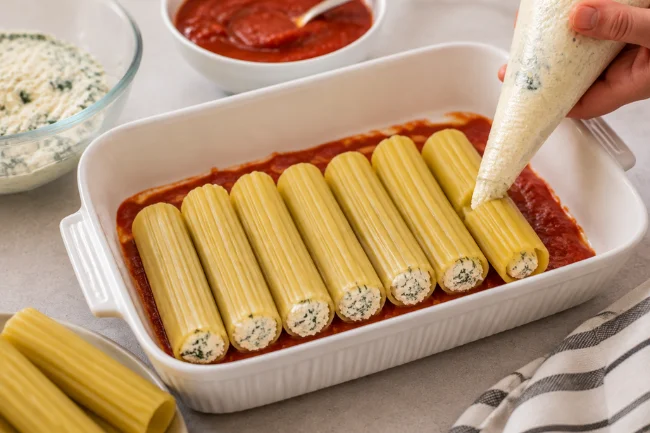
Once the shells are cool enough to handle, the filling can be spooned or piped inside. A piping bag or sturdy food-storage bag with a corner cut off makes filling narrow tubes easier.
I also recommend spreading sauce across the bottom of the baking dish before arranging the Mannacote. The sauce provides moisture underneath the pasta while the dish bakes.
Using Crespelle Instead of Pasta Tubes
Crepe-style manicotti is worth knowing because it explains why arguments about the “correct” shell never really disappear.
A crespella is thin and tender. Instead of forcing filling into a rigid tube, the cook spreads filling across the crepe and rolls it into a cylinder before baking it in sauce.
La Cucina Italiana has published a crespelle-based preparation using ricotta, spinach, Pecorino, tomato sauce, and mozzarella. Serious Eats has explored another crepe-style manicotti filled with veal ragù and baked with tomato sauce and béchamel.
Neither approach needs to cancel out the other. They represent different branches of a closely related Italian and Italian-American stuffed-pasta tradition.
Popular Mannacote Fillings and Sauce Pairings
| Filling style | Main ingredients | Sauce that works well | Overall character |
|---|---|---|---|
| Three-cheese | Ricotta, mozzarella, Parmesan or Pecorino | Marinara | Classic, creamy, balanced |
| Spinach and ricotta | Ricotta, spinach, grated cheese | Tomato sauce or béchamel | Lighter and earthy |
| Sausage and cheese | Italian sausage, ricotta, mozzarella | Marinara or meat sauce | Rich and savory |
| Beef | Ground beef, herbs, cheese | Tomato or ragù-style sauce | Hearty |
| Mushroom and spinach | Mushrooms, spinach, ricotta | Tomato, béchamel, or light cream sauce | Deep vegetarian flavor |
One practical detail makes a large difference: moisture control. Very wet ricotta, spinach that has not been drained, or an unusually thin filling can create excess liquid in the baking dish.
For spinach-and-ricotta Mannacote, squeezing excess moisture from cooked spinach before mixing the filling is a particularly useful habit. La Cucina Italiana gives the same instruction in its crespelle preparation.
Common Mannacote Mistakes
Overcooked tubes become slippery and tear easily, so keeping them slightly firm before filling is usually safer. Overstuffing can also split the pasta; filling from both ends is often easier than pushing everything through a single opening.
At the other extreme, too little sauce can leave exposed pasta dry. Keep sauce beneath and over the filled tubes, then bake until the filling is heated through and the cheese on top is melted and browned to your preference.
Can Mannacote Be Vegetarian, Gluten-Free, or Made Ahead?
Yes. Cheese-and-spinach Mannacote is naturally meat-free, while vegetarian variations can also use mushrooms, roasted vegetables, squash, or additional greens.
For a gluten-free version, use manicotti or cannelloni shells specifically labeled gluten-free and follow the manufacturer’s cooking instructions. Different pasta formulations can soften and handle differently, so package directions matter more than applying the timing from a standard wheat-pasta recipe.
A dairy-free version requires more substitutions, but plant-based ricotta-style fillings and melting cheeses can be used if they suit the recipe.
Mannacote is also convenient for advance preparation. The components can be assembled in a baking dish and refrigerated before baking. Crepe-style manicotti recipes are likewise suitable for advance assembly, making this type of baked pasta useful when cooking for family meals or gatherings.
What Should You Serve With Mannacote?
Because Mannacote is rich, I recommend sides that provide contrast: a crisp green salad, roasted broccoli, sautéed greens, or simple roasted vegetables.
Garlic bread works for a traditional comfort-food meal, but a fresh vegetable side can balance a cheese-heavy filling particularly well.
For sauce, marinara is an easy match for classic three-cheese Mannacote. Meat-filled versions already carry plenty of savory depth, so they also work well with a straightforward tomato sauce rather than an overly heavy topping.
How to Find Mannacote on a Menu or in a Store
If you search a grocery aisle or restaurant menu for “Mannacote,” you may come up empty even when essentially the same dish is available.
Look for manicotti first. Major pasta manufacturers sell the shape under that name, and dictionaries, recipes, and restaurant menus are much more likely to use manicotti than Mannacote.
In Italian restaurants, also look for cannelloni or crespelle. The dishes are not automatically identical, but they belong to the same broader family of cylindrical or rolled stuffed pasta preparations.
That vocabulary shift is useful: Mannacote is a word you may encounter through family or regional Italian-American speech, while manicotti is the spelling most likely to help you find recipes, pasta packages, and menu listings.
FAQs About Mannacote
Is Mannacote the same as manicotti?
In most uses, yes. Mannacote appears to be an informal or pronunciation-based Italian-American spelling for manicotti rather than a separate pasta dish.
Is Mannacote an authentic Italian word?
I could not verify Mannacote as a standard Italian culinary term. Manicotti is the documented form, derived from Italian manicotto and associated with the meaning of a sleeve.
What is Mannacote usually filled with?
The most common filling is ricotta mixed with mozzarella and Parmesan or Pecorino, sometimes with spinach, herbs, egg, sausage, or ground meat.
What is the difference between Mannacote and cannelloni?
Mannacote generally refers to manicotti in Italian-American usage, while cannelloni is an established Italian name for a similar cylindrical stuffed pasta; their shells, fillings, and preparation can overlap.
Do you have to boil Mannacote shells before baking?
It depends on the pasta and recipe. Standard dried manicotti shells are often partially cooked first, while some recipes use no-boil methods designed around additional sauce and moisture.
A Practical Way to Think About Mannacote
If you remember one thing, make it this: Mannacote is better understood as an Italian-American variation of the word manicotti than as a newly discovered or separate Italian pasta.
The food itself is wonderfully adaptable: a pasta tube or crepe, a savory filling, enough sauce to keep everything tender, and cheese baked over the top. What changes from kitchen to kitchen is the shell, filling, pronunciation, and family tradition.
If you found “Mannacote” on an old recipe card or heard the word around the dinner table, search for manicotti as your starting point rather than looking for an entirely different pasta. Then choose the preparation that suits your table—classic ricotta, spinach and cheese, a meat-filled version, or tender crespelle baked in sauce.

Dr. Hannah Collins is a nutrition and diet specialist with 13+ years of experience helping people make informed food choices and develop healthier eating habits. She shares evidence-based nutrition guidance focused on balanced diets, meal planning, healthy lifestyles, and sustainable wellness.