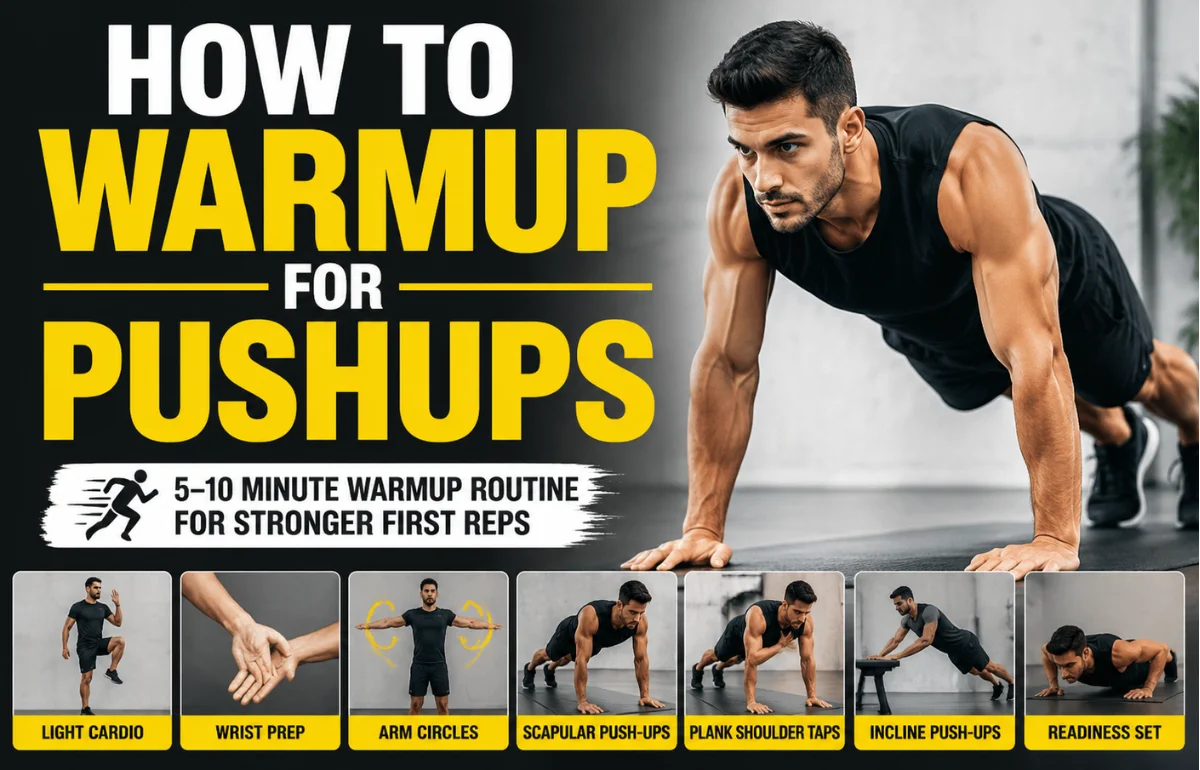
If you want to know how to warmup for pushups, the goal is simple: raise your body temperature, loosen the wrists and shoulders, activate the muscles that control your shoulder blades, and rehearse the push-up pattern before hard reps. A useful push-up warm-up usually takes 5–10 minutes and includes light movement, wrist preparation, shoulder mobility, scapular activation, and a few easy practice push-ups. You should finish feeling more mobile and coordinated, not tired.
I like to treat a warm-up as a rehearsal rather than a mini workout. Push-ups use the chest, triceps, shoulders, core, wrists, and upper back together, so warming up only the chest misses part of the job. A few targeted movements can make the first working set feel smoother and help you maintain better push-up form from the start.
Why Warm Up Before Push-Ups?
Push-ups look simple, but several joints and muscle groups have to cooperate. Your wrists support your body in extension, your shoulders handle the pressing motion, your shoulder blades glide around the rib cage, and your core keeps the torso from sagging or twisting.
A dynamic warm-up prepares those areas for the positions they are about to use. It also gives you a chance to notice stiffness before adding more load or volume.
My rule is simple: the warm-up should improve readiness without stealing strength from the workout. If your arms are already shaking before your first real set, you did too much.
The Best 5–10 Minute Push-Up Warm-Up
This routine works before standard, incline, decline, diamond, and most other bodyweight push-up variations.
| Warm-up exercise | Reps or time | Main purpose |
|---|---|---|
| Light cardio or marching | 60–90 seconds | Raise body temperature |
| Wrist circles and palm rocks | 30–45 seconds each | Prepare wrists and forearms |
| Arm circles | 10–15 each direction | Mobilize shoulders |
| Scapular push-ups | 8–12 reps | Activate shoulder-blade control |
| Plank shoulder taps | 6–10 per side | Engage core and shoulder stability |
| Incline or knee push-ups | 5–8 easy reps | Rehearse the push-up pattern |
| Standard push-up readiness set | 3–5 reps | Check technique before working sets |
1. Start With Light Movement
Spend 60–90 seconds marching in place, doing gentle jumping jacks, walking briskly, or performing slow mountain climbers.
You do not need a long cardio warm-up for a normal push-up session. The purpose is simply to move from resting to active without creating fatigue.
2. Prepare Your Wrists
Standard push-ups place the wrists in extension while they support part of your body weight. Start with slow wrist circles for about 20–30 seconds in each direction.
Then place your hands on a wall, bench, table, or floor and gently rock forward until you feel mild tension through the wrists and forearms. Keep it controlled rather than forcing a deep stretch.
If flat-palmed push-ups repeatedly bother your wrists, an incline or neutral-grip setup may feel better. Sharp or persistent pain is a reason to stop and address the problem rather than trying to “warm through” it.
3. Mobilize the Shoulders
Do 10–15 arm circles forward and backward, starting small and gradually making the circles larger. A few controlled arm swings across the chest can also help.
The goal is not aggressive stretching. You are moving the shoulders through a comfortable range before asking them to support repeated pressing.
4. Do Scapular Push-Ups
Scapular push-ups are one of my preferred push-up warm-up drills because they prepare shoulder-blade movement without tiring the chest and triceps much.
Start in a high plank or use an incline. Keep your elbows straight. Let your chest sink slightly as your shoulder blades move toward each other, then push the floor away so they spread apart.
Perform 8–12 controlled reps. The motion should be small and come from the shoulder blades, not from bending the elbows.
5. Add Core and Shoulder Stability
Push-ups are essentially moving planks. If your trunk loses position, your hips may sag or your body may twist during the press.
Do 6–10 plank shoulder taps per side. Keep your hips as still as possible and use a wider foot stance if needed. Beginners can place their hands on a bench or other stable elevated surface.
6. Rehearse With Easier Push-Ups
Perform 5–8 easy incline push-ups or knee push-ups before your working sets. Move slowly enough to notice your hand position, elbow path, shoulder comfort, and body alignment.
These reps are practice, not a test. Stop well before fatigue.
7. Use a First-Rep Readiness Check
Here is one useful addition that many warm-up routines miss: perform 3–5 standard push-ups at an easy effort, pause briefly, and evaluate how they felt.
Ask yourself:
- Did my wrists and shoulders feel comfortable?
- Could I keep a controlled body position?
- Did the movement feel smooth rather than stiff?
If yes, begin your working sets. If not, repeat the mobility or activation drill that matches the stiff area instead of adding random exercises.
How Long Should You Warm Up Before Push-Ups?
For most people, 5–10 minutes is enough. A light technique session may need only a few minutes, while weighted, explosive, advanced, or high-volume push-ups may benefit from a longer and more gradual buildup.
| Push-up session | Suggested warm-up | Extra preparation |
|---|---|---|
| Easy technique practice | 3–5 minutes | Wrist prep + easy rehearsal reps |
| Normal strength workout | 5–10 minutes | Full routine + readiness set |
| High-volume push-ups | 7–10 minutes | Add gradual warm-up sets |
| Explosive push-ups | 8–12 minutes | Add progressive speed |
| Weighted or advanced push-ups | 8–12 minutes | Use several submaximal sets |
The better question is not only “How many minutes?” but “Am I ready for the exact push-up variation I am about to perform?”
Should You Stretch Before Push-Ups?
Dynamic mobility is usually a better fit before push-ups than long, aggressive static stretching.
I would prioritize wrist rocks, arm circles, scapular movement, planks, and easy push-up variations because they prepare positions similar to the workout. If you enjoy longer chest, shoulder, or forearm stretches, they often fit more naturally after training or in a separate mobility session.
How to Warm Up for Push-Ups as a Beginner
Beginners do not need a harder warm-up. They need an easier version of the same movement pattern.
Try this:
- 60 seconds of marching
- 10 arm circles each way
- 20–30 seconds of wrist circles
- 8 wall scapular push-ups
- 6–8 wall or incline push-ups
- 20 seconds of an elevated plank
Then begin your planned push-up variation. Using a wall, countertop, sturdy table, or bench reduces the amount of body weight you have to support while still preparing the same basic pattern.
How to Warm Up for High-Rep or Hard Push-Up Workouts
For weighted push-ups, decline push-ups, archer push-ups, explosive reps, or near-failure sets, increase intensity gradually.
After your general warm-up, do two or three specific warm-up sets. Start with an easier variation, then perform a few reps of the planned variation well below fatigue.
The key is to climb toward training intensity without reaching it too early. Your final warm-up set should leave you prepared, not pre-fatigued.
Common Push-Up Warm-Up Mistakes
Doing Too Many Reps
Warm-up push-ups can quickly become a workout. Keep the reps easy and comfortably below failure.
Ignoring the Wrists
The hands and wrists are your contact point with the floor. Even 30–60 seconds of wrist preparation can make the setup feel more comfortable.
Stretching Too Aggressively
Do not chase your deepest stretch before pressing. Use controlled movement and stay away from painful ranges.
Skipping Shoulder-Blade Movement
Push-ups are not just about elbow bending. Your shoulder blades should move naturally around the rib cage, which is why scapular push-ups are so useful.
Never Adjusting the Routine
Your body will not feel identical every session. Keep the basic structure, but spend a little more time on whichever area feels stiff that day.
Push-Up Form Cues to Rehearse During the Warm-Up
Use your easy warm-up reps to practice technique before fatigue appears.
Place your hands around shoulder-width apart or slightly wider, depending on comfort. Keep your torso firm and avoid letting your hips sag.
As you lower, allow your elbows to travel at a comfortable angle rather than forcing them straight out to the sides. At the top, push the floor away and finish under control.
There is no single hand width or elbow angle that suits every body and every push-up variation. A repeatable position that feels controlled and pain-free is more useful than copying an arbitrary “perfect” setup.
A 3-Minute Push-Up Warm-Up When You Are Short on Time
If you need a quick version, use this sequence:
- 30 seconds of brisk marching or jumping jacks.
- 30 seconds of wrist circles and palm rocks.
- 10 arm circles forward and backward.
- 8 scapular push-ups.
- 6 plank shoulder taps per side.
- 5 easy incline or standard push-ups.
That covers temperature, mobility, activation, stability, and movement-specific practice in a small amount of time.
The principle I would remember is this: warm up the movement you plan to train. A gradual rehearsal of the push-up pattern is more useful than collecting random stretches.
Frequently Asked Questions
Do I need to warm up before push-ups?
A brief warm-up is especially useful before hard, high-volume, explosive, or advanced push-up sessions because it prepares the wrists, shoulders, core, and pressing pattern.
What is the best warm-up for push-ups?
Use light movement, wrist mobility, arm circles, scapular push-ups, core activation, and 5–8 easy rehearsal push-ups.
How many push-ups should I do to warm up?
For many people, 5–10 easy reps are enough. Keep them well below failure so the warm-up does not reduce performance.
How do I warm up my wrists for push-ups?
Use wrist circles followed by gentle palm rocks on a wall, bench, or floor. Increase pressure gradually and avoid painful ranges.
Should I do arm circles before push-ups?
Yes, arm circles can be a useful part of shoulder preparation. Pair them with scapular activation and easy push-up reps for a more complete warm-up.
Ready for Your First Working Set?
Knowing how to warmup for pushups does not require a complicated routine. Raise your temperature, prepare the wrists and shoulders, activate the shoulder blades and core, then rehearse a few easy reps.
Try this 5–10 minute routine before your next push-up workout and compare how your first working set feels. If your movement is smoother and your technique is easier to control, the warm-up is doing its job.

Lauren Mitchell is a fitness and exercise specialist with 11+ years of experience helping people build strength, improve mobility, and maintain healthier lifestyles. She provides evidence-based fitness guidance focused on effective workouts, injury prevention, and sustainable exercise habits.