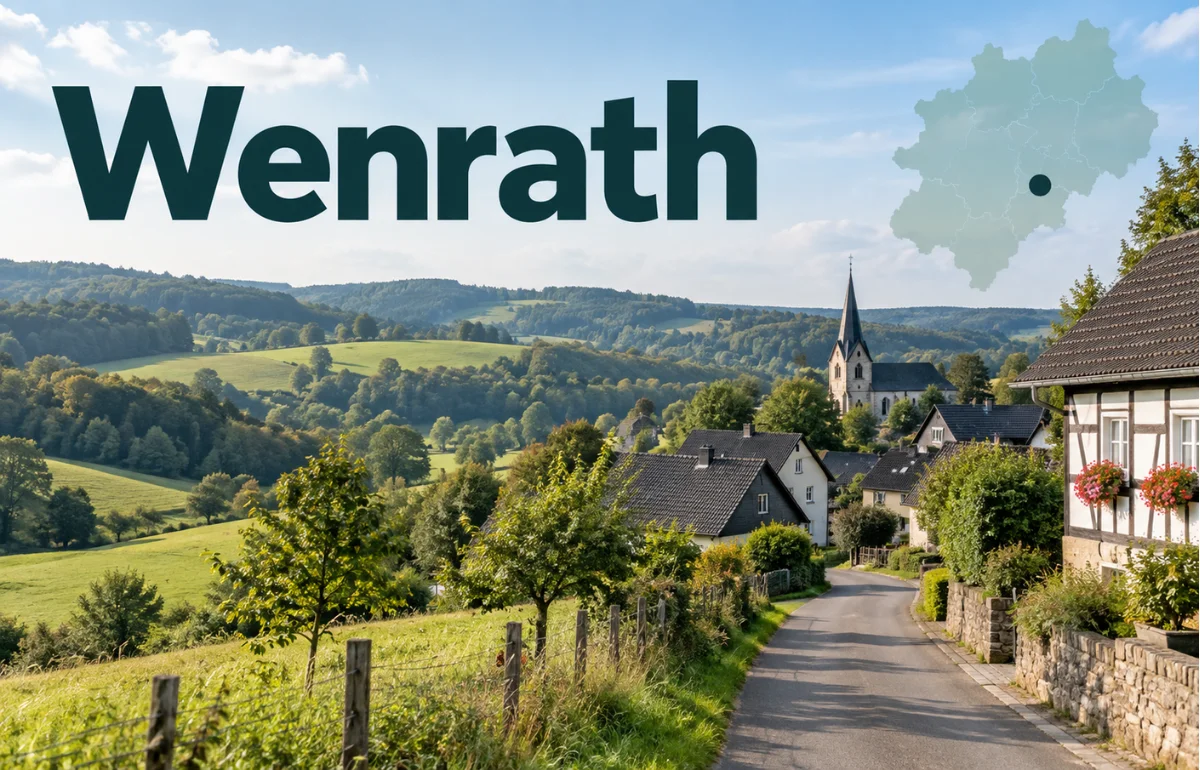
Wenrath most commonly appears to be a spelling variation or misspelling of Wehnrath, a small locality in the municipality of Reichshof in North Rhine-Westphalia, Germany. Modern maps, geographic databases, local businesses, and official company addresses consistently use the spelling Wehnrath. The form Wenrath still appears in some English-language business records, search results, and online articles, which explains why people continue to search for it.
In simple terms, if you encountered Wenrath in a German address, company document, map reference, or historical record, Wehnrath is probably the place you are looking for. However, the surrounding context should always be checked before treating the two spellings as interchangeable.
What Is Wenrath?
Wenrath is not a commonly recognized English word, technical term, or major town. Based on the available geographic and business evidence, it is best understood as a search term connected with Wehnrath, a locality within Reichshof.
I reached that conclusion by comparing exact-match searches for both spellings rather than accepting the first definition presented online. The difference is revealing: searches for Wenrath return scattered articles and occasional business references, while searches for Wehnrath produce geographic records, local addresses, established companies, and historical information.
That does not prove that every use of Wenrath refers to the German locality. An unusual word can also appear as a surname, username, fictional name, brand, transcription error, or internal company label.
Still, the Wehnrath connection is the strongest documented interpretation currently available.
Wenrath or Wehnrath: Which Spelling Is Correct?
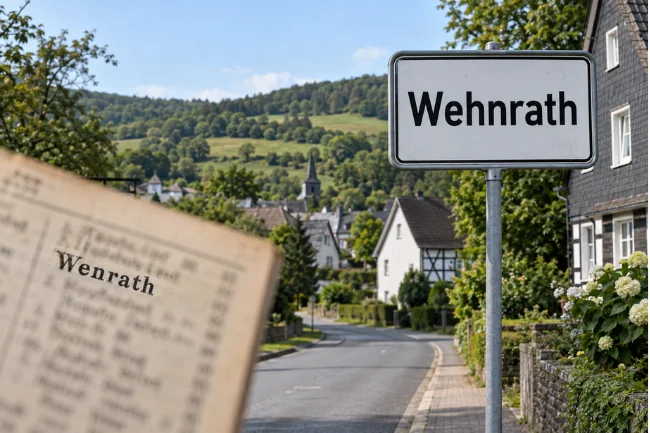
For the locality in Reichshof, the recognized modern spelling is Wehnrath.
The spelling appears in the GeoNames geographic database, local business addresses, employment pages, and regional references. Companies operating in the area also use “Reichshof-Wehnrath” in their contact information.
Wenrath appears less consistently. In many cases, it may result from:
- A missing “h” during typing or data entry
- An incorrect transcription of a German address
- A spelling carried over from an older business article
- Automatic extraction from a scanned document
- A database or directory formatting error
- Confusion with an earlier form of the place name
One example comes from older English-language industry coverage that described a company as being based in “Reichshof-Wenrath.” Modern local sources, however, overwhelmingly favor Wehnrath.
Wenrath vs. Wehnrath at a Glance
| Feature | Wenrath | Wehnrath |
|---|---|---|
| Modern geographic status | Not clearly established as a separate locality | Recognized locality in Reichshof |
| Common online use | Search term, spelling variation, occasional business reference | Maps, addresses, local history, businesses and geographic records |
| Connection to Germany | Indirect or context-dependent | Clearly documented |
| Recommended search approach | Check the original document and test alternative spellings | Use for maps, directions, history and local information |
| Likely interpretation | Possible misspelling or variant | Standard modern place-name spelling |
The safest editorial approach is not to say that Wenrath and Wehnrath are automatically identical. A better statement is that Wenrath frequently leads to Wehnrath, and the original context determines whether that connection is valid.
Where Is Wehnrath Located?
Wehnrath is a locality in the municipality of Reichshof, within the Oberbergischer Kreis district of North Rhine-Westphalia. This part of western Germany belongs to the Cologne administrative region.
The locality sits in the hilly Oberbergisches Land landscape. GeoNames places it at approximately 50.962° north and 7.656° east, at an elevation of about 293 metres.
Wehnrath is northeast of the Wiehltalsperre, a reservoir surrounded by wooded and rural terrain. The Aggerverband, which manages water infrastructure in the region, identifies the Wiehltalsperre as a drinking-water reservoir and the largest reservoir operated by the association.
Nearby urban centres include Gummersbach, Siegen and Cologne. Wehnrath itself should not be described as a large town or an independent municipality. It is one of the local settlements belonging to Reichshof.
Key Location Facts
| Detail | Information |
|---|---|
| Recognized name | Wehnrath |
| Municipality | Reichshof |
| District | Oberbergischer Kreis |
| State | North Rhine-Westphalia |
| Country | Germany |
| Administrative region | Cologne |
| Postal code | 51580 |
| Telephone area code | 02265 |
| Approximate coordinates | 50.962° N, 7.656° E |
| Approximate elevation | 293 metres |
| Nearby landscape feature | Wiehltalsperre |
These details are much more useful than simply describing Wenrath as an “unusual name.” They tell a reader what kind of place it is, where it belongs administratively, and how to locate it.
The Historical Origin of the Name
The history of Wehnrath reaches back several centuries. A commonly cited local-history reference records the settlement’s first known documentary mention in 1357.
The early written form was Wenegenroede. The record reportedly refers to Eckhardt von Wenegenroede in connection with Wilhelm von Gennep, the Archbishop of Cologne, and a conflict involving the Count of Arnsberg.
This historical spelling matters because it shows that the name has changed over time. It also demonstrates why similar-looking versions found in old records should not immediately be dismissed as mistakes.
However, Wenegenroede does not by itself prove that modern Wenrath is an official historical form. A credible name-history article must distinguish among three things:
- A documented historical spelling
- A modern recognized place name
- A recent spelling variation found online
For Wehnrath, those categories currently look like this:
- Wenegenroede is a documented early form associated with the year 1357.
- Wehnrath is the recognized modern geographic spelling.
- Wenrath is an occasional variant whose origin must be checked document by document.
I would avoid assigning a precise linguistic meaning to every part of the medieval name without a specialist source. German place names often evolved through regional speech, changing writing conventions, and the judgment of clerks who recorded names as they heard them.
A plausible-looking explanation is not the same as verified etymology.
Is Wenrath a Village, Town, or District?
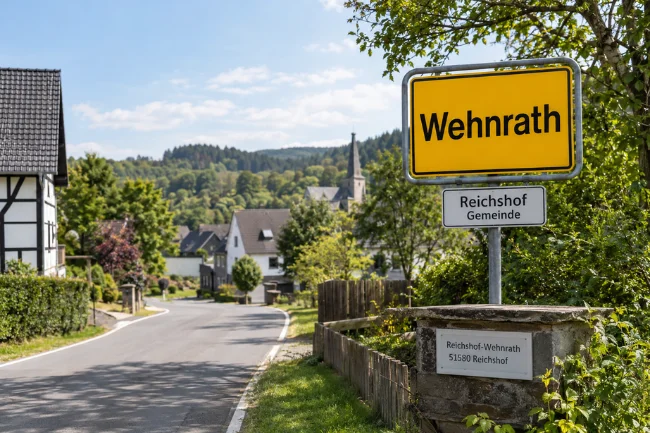
This is one of the most useful distinctions for someone reading a German address.
Wehnrath is generally described as an Ort or Ortschaft within Reichshof. In English, “locality,” “settlement,” or “village” may be appropriate depending on the context. It is not a separate municipality with its own independent town administration.
Reichshof is the municipality. Wehnrath is one of its constituent localities.
That distinction explains addresses written in forms such as:
Reichshof-Wehnrath
51580 Reichshof
North Rhine-Westphalia, Germany
A company may use Reichshof as the postal town while adding Wehnrath to identify the specific locality. Someone unfamiliar with German address conventions can easily interpret the locality as a company name or overlook it entirely.
Why Does Wenrath Appear in Business Records?
Wehnrath is not only a residential locality. It is also associated with commercial and industrial activity.
The Gewerbepark Wehnrath, or Wehnrath business park, gives the place greater visibility than its size might suggest. A person searching for a manufacturer, laboratory, employer, supplier, or historical company address may therefore encounter the locality without having searched for the village itself.
For example, MED LaborUnion lists an address in 51580 Reichshof-Wehnrath. Bühler also maintains employment information for its Reichshof-Wehnrath location.
The area is closely connected with the bicycle-tire company Schwalbe. According to Schwalbe’s company coverage, its headquarters in Reichshof-Wehnrath was completed in 1995, with later expansion reflecting the company’s international growth.
This business context helps explain several otherwise confusing search situations:
- Wenrath may appear after a company’s name in an old article.
- A directory may treat it as a city rather than a locality.
- An address database may omit the “h.”
- A translated company profile may use Reichshof and Wenrath interchangeably.
- Search engines may surface business results before geographic information.
If the word appears beside a street address, postal code 51580, Reichshof, or a German company name, the geographic interpretation is especially likely.
Could Wenrath Be a Surname?
Wenrath has the shape of a Germanic surname, but appearance alone is not proof of an established family name.
A surname claim should be supported by genealogical records, civil registers, church books, immigration documents, census material, or a reputable name-distribution database. Without that evidence, stating that Wenrath has a particular family origin would be speculation.
The same caution applies to claims that it is a first name. I did not find enough reliable evidence to present Wenrath as a commonly established given name.
If you encountered it in a family record, check whether it appears:
- In the surname field
- As a birthplace or residence
- After the name of a municipality
- Beside a company or employer
- In a handwritten line that may have been transcribed incorrectly
Place names are frequently mistaken for surnames in digitized records, particularly when columns, punctuation, or labels have been lost during scanning.
How to Identify What Wenrath Means in Your Source
The most reliable interpretation comes from the words surrounding it. I use a context-first method for rare names because an isolated search term often produces confident but contradictory explanations.
Start with the exact spelling
Record the word exactly as it appears, including capitalization, punctuation and any nearby hyphen. “Reichshof-Wenrath” provides far more information than “Wenrath” alone.
Search the recognized variation
Run a second search for Wehnrath. If the same company, address, person, or historical event appears under that spelling, you have a meaningful connection to investigate.
Check nearby identifiers
Look for:
- Postal code 51580
- Reichshof
- North Rhine-Westphalia or Nordrhein-Westfalen
- Oberbergischer Kreis
- German street names
- Company registration information
- Map coordinates
- Dates attached to the document
These identifiers can confirm a location even when the place name has been copied incorrectly.
Match the source to the question
A geographic database can confirm coordinates, but it may not explain medieval history. A company website can confirm a current address, but it cannot establish surname origins.
Use municipal or regional material for administration, historical archives for old spellings, company websites for business addresses, and genealogical collections for family-name questions.
Preserve uncertainty when evidence is incomplete
Sometimes the responsible answer is “probably Wehnrath, but not proven from this document.” That wording is more useful than turning a likely association into a false fact.
Common Misleading Claims About Wenrath
Rare keywords invite websites to fill gaps with unsupported stories. Several claims deserve extra scrutiny.
“Wenrath has one definite dictionary meaning”
There is no strong evidence that Wenrath functions as an ordinary English dictionary word. Its meaning depends on whether it is being used as a place reference, spelling variation, personal identifier, or invented name.
“Wenrath is the official name of a German town”
Current geographic evidence supports Wehnrath as a locality within Reichshof. Calling Wenrath an official independent town would be inaccurate without stronger documentation.
“Wenrath and Wehnrath are always interchangeable”
They are closely connected in many search results, but they should not be merged automatically. Exact spelling can matter in archives, legal records, genealogy and company registration.
“The name has a proven modern translation”
The medieval form Wenegenroede may offer clues for a qualified place-name researcher, but a neat word-for-word translation should not be published as fact without linguistic documentation.
What Makes This Small Place Relevant?
Wehnrath illustrates how a small locality can develop a digital footprint larger than its population might suggest.
Its visibility comes from several overlapping sources: local history, the Wehnrath business park, company headquarters, employment listings, addresses, the surrounding Oberbergisches Land and proximity to the Wiehltalsperre.
It also provides a useful lesson in online research. Search engines group similar spellings, translated documents and copied business records together. That is helpful for discovery, but it can blur the difference between a verified name and a recurring typo.
For readers, the solution is simple: treat Wenrath as a query that needs identification, then use Wehnrath when researching the recognized German locality.
Visiting or Researching Wehnrath
Wehnrath is more relevant to local, business, historical and rural travel than to conventional sightseeing. Visitors should plan around the wider Reichshof and Oberbergisches Land area rather than expecting a major tourist centre inside the locality.
The surrounding region offers reservoirs, wooded landscapes, small settlements and routes suitable for walking or cycling. Access rules around the Wiehltalsperre should be checked before a visit because it serves as drinking-water infrastructure and environmentally sensitive areas may have restrictions.
I have not visited Wehnrath personally, so I would not present second-hand landscape descriptions as first-hand travel experience. My assessment is based on comparing current geographic records, regional information and official business sources.
Before travelling, verify the exact destination in a mapping service and use the spelling Wehnrath. A business located in the commercial area may not be near the residential centre, even though both use the same locality name.
Frequently Asked Questions
What is Wenrath?
Wenrath is most often a spelling variation or misspelling connected with Wehnrath, a locality in Reichshof, North Rhine-Westphalia, Germany.
Is Wenrath a real place in Germany?
The recognized place name is Wehnrath. Wenrath appears in some articles and records, but it is not clearly established as a separate official locality.
What is the difference between Wenrath and Wehnrath?
Wehnrath is the standard modern geographic spelling. Wenrath is an occasional variant that may result from transcription, translation, data entry or older business coverage.
Where is Wehnrath located?
Wehnrath is part of Reichshof in the Oberbergischer Kreis district of North Rhine-Westphalia, near the Wiehltalsperre.
When was Wehnrath first mentioned?
The locality is commonly reported as first appearing in a document from 1357 under the historical spelling Wenegenroede.
What to Do Next
If Wenrath appears in an address, archive, family record or company document, keep the original spelling but search for Wehnrath as well. Compare the postal code, municipality, date and surrounding names before deciding what it refers to.
For the German locality, begin with a current map or geographic database, then consult Reichshof, regional archives, or the relevant company directly when accuracy matters.

Liam Anderson is a travel research writer with 9+ years of experience covering destinations, travel planning, cultural experiences, and practical travel guides. He creates informative content to help readers discover places with better insights and preparation.