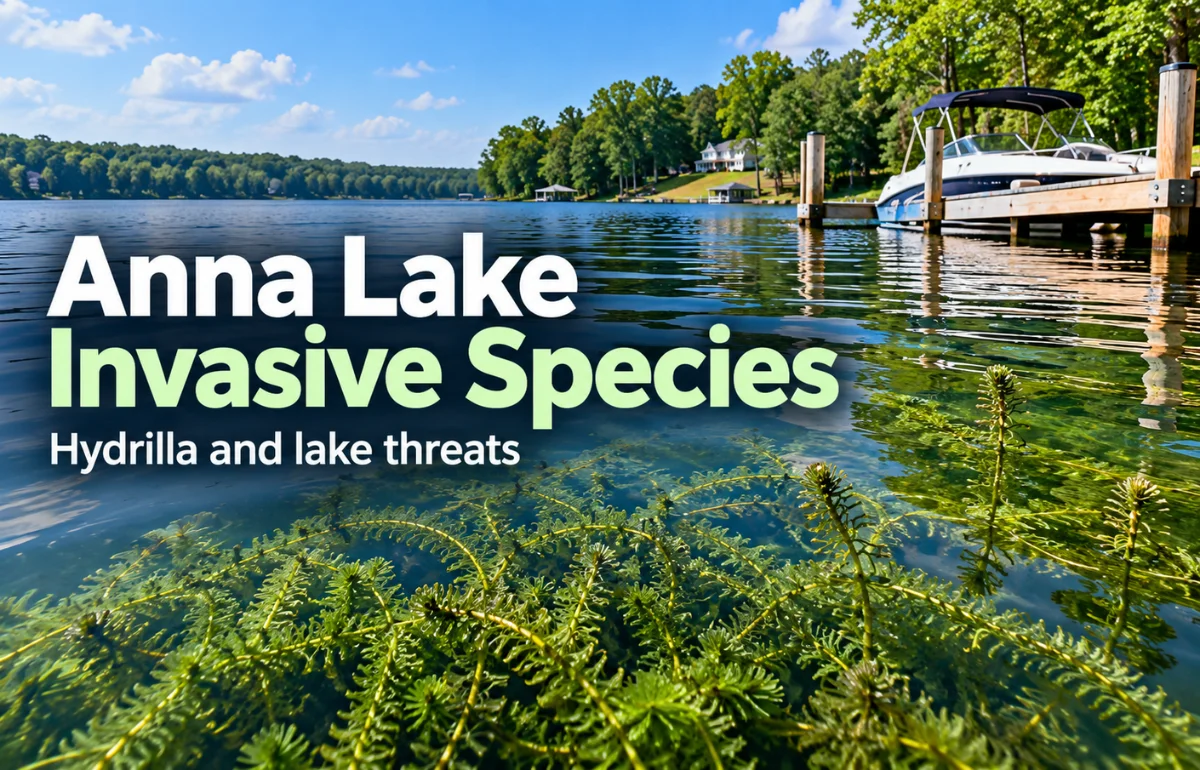
Anna Lake invasive species are non-native plants or animals that spread in or around Virginia’s Lake Anna and can damage aquatic habitats, recreation, or local wildlife. The most clearly documented aquatic invader here is hydrilla, a fast-growing underwater plant that can form thick mats around docks and shallow coves. Other organisms, including zebra mussels, deserve attention as potential introductions, but they should not be described as established in the lake without evidence. I think that distinction matters: understanding what is already present, what might arrive, and what is simply part of a healthy lake leads to better decisions. For homeowners, anglers, and visitors, the priorities are identifying suspicious growth, preventing its spread on equipment, and following locally approved management plans.
Why Lake Anna Is Vulnerable to Invasive Species
Lake Anna is a 9,600-acre reservoir spanning Louisa, Orange, and Spotsylvania counties in central Virginia. Completed in 1972, it supports fishing, boating, swimming, waterfront homes, and the North Anna Power Station. The Virginia Department of Wildlife Resources (DWR) describes a busy fishery with largemouth bass, striped bass, crappie, and several catfish species.
Boats and fishing gear arrive from other waters, while waterfront maintenance can disturb submerged plants. A fragment caught on a trailer or a small organism hidden in standing water may start a problem. I focus on those everyday pathways.
Hydrilla: The Main Confirmed Aquatic Invader
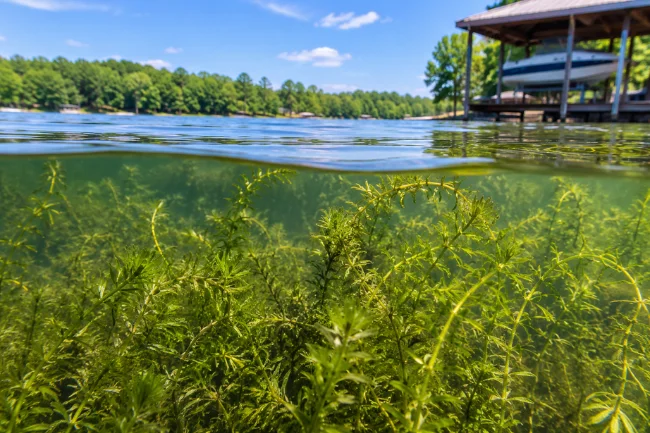
Hydrilla (Hydrilla verticillata) is the species at the center of Lake Anna’s current management program. It is a rooted, submerged perennial that grows toward the surface and branches outward. When growth becomes dense, it creates a near-surface canopy that can catch fishing lines, interfere with propellers, and make access to docks difficult.
Unlike pond scum, hydrilla has stems, leaves, and roots below the sediment. It can persist after visible growth disappears in winter.
How to recognize hydrilla
According to DWR’s identification guidance, hydrilla typically has:
- Slender, branching stems growing underwater.
- Narrow leaves arranged in circles, or whorls, around each stem.
- Usually four or more leaves per whorl, often with tiny serrations along their edges.
- A slightly rough feel that helps distinguish it from some similar native plants.
Native waterweed can resemble hydrilla. I would photograph the leaves and surrounding area, then ask a local expert to confirm the identification.
Why cutting hydrilla can make it worse
Hydrilla spreads through broken stem fragments and persistent reproductive structures, including turions and underground tubers. A mower, rake, or boat propeller may chop one patch into many mobile pieces.
Those pieces can travel with water movement or equipment and establish elsewhere. Louisa County’s hydrilla guidance specifically advises against mechanical raking in Lake Anna and its private-side waters because fragmentation increases the spread risk.
An apparently clear dock after raking may conceal a worsening infestation.
Which Other Invasive Species Should People Watch For?
Not every invasive species listed for Virginia has been confirmed in Lake Anna. That is the most important caveat when reading broad lists online. I separate documented local concerns from statewide prevention priorities.
| Species or issue | What the evidence says about Lake Anna | Main concern |
|---|---|---|
| Hydrilla | Confirmed; subject to a formal lake management plan | Dense underwater growth and plant fragments spreading |
| Blue catfish | Documented in the reservoir by DWR, historically at low abundance | Potential ecological effects warrant monitoring; not equivalent to a proven local infestation |
| Zebra mussels | A serious prevention concern, not a confirmed Lake Anna population | Attachment to hard surfaces and disruption of food webs |
| Eurasian watermilfoil | Known invasive aquatic plant in Virginia; local establishment should not be assumed | Vegetation fragments transferred between water bodies |
| Japanese honeysuckle | Identified by the Lake Anna Civic Association among problematic shoreline plants | Smothering and competing with native vegetation |
Zebra mussels and other hitchhikers
Zebra mussels are small, striped mollusks that attach to boats, pipes, rocks, and native mussel shells. They can alter aquatic food webs and create expensive maintenance problems.
Yet DWR states that Virginia does not currently have a known zebra mussel population. Claiming they have invaded Lake Anna would be misleading. The practical message is prevention: inspect and dry vessels, including places a quick visual check cannot reach.
Northern snakehead, rusty crayfish, and invasive snails are also statewide concerns, not proof of local outbreaks.
Shoreline invaders matter, too
The problem does not end at the waterline. Japanese honeysuckle and Chinese bush clover can compete with native vegetation on disturbed land near the lake. The Lake Anna Civic Association’s plant guide discusses these invasive plants alongside useful native shoreline species.
Suitable native replacements can support pollinators and shoreline stability; check identification and local rules before removing plants.
Harmful Algal Blooms Are a Different Problem
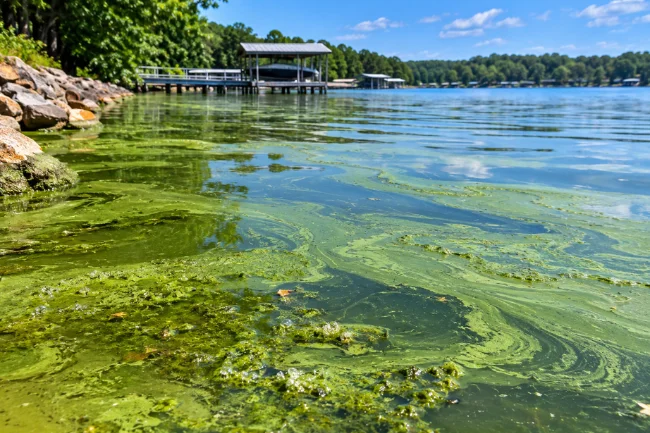
I often see invasive aquatic weeds and harmful algal blooms discussed as if they were interchangeable. They are not. Hydrilla is an invasive rooted plant; a harmful algal bloom is excessive growth of algae or cyanobacteria that may pose health risks.
Lake Anna has experienced repeated bloom-related concerns, and the U.S. Geological Survey studies how nutrients, water conditions, and weather contribute. Hydrilla can absorb nutrients and provide habitat, so removing every submerged plant is not automatically a water-quality improvement.
Visitors should check the Virginia Department of Health’s current bloom dashboard before water-contact activities. A bloom advisory is location- and time-specific; an old headline cannot tell you whether a particular cove is safe today.
What Damage Can Hydrilla Actually Cause?
Boating, swimming, and waterfront access
The most immediate effects appear in shallow recreational areas. Thick mats can obstruct boat movement, foul motors, and make paddling or casting frustrating. Vegetation around a dock can also change how comfortably people use nearby water.
Not every sprig is an emergency. Location, coverage, depth, and effects on navigation determine the response.
Fish habitat and ecological balance
Submerged plants create cover for young fish and surfaces for small aquatic organisms. Moderate vegetation can support a productive fishery. But heavy, single-species growth may shade other plants, change habitat structure, and produce oxygen problems when large quantities decay.
For me, the central question is how to retain valuable habitat while reducing the most disruptive growth.
Costs for the community
Surveys and treatments cost money and volunteer time. Public programs and homeowners may share expenses, and delayed identification can complicate future control.
What Lake Anna’s 2026 Hydrilla Plan Says
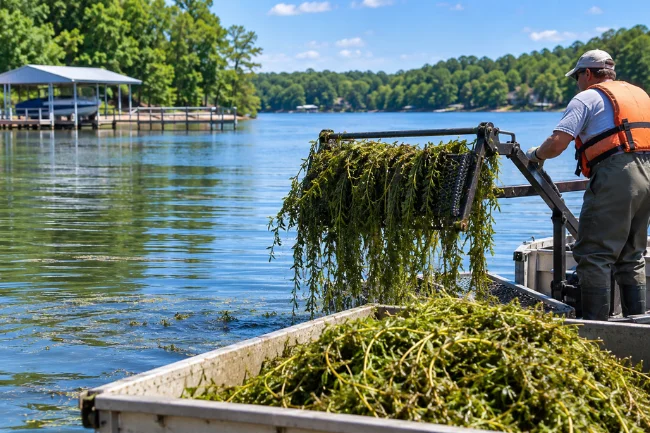
The Lake Anna Advisory Committee’s January 2026 treatment plan is more useful than general claims about an unchecked invasion. It identifies a $30,000 committee budget and combines sterile grass carp replenishment with proposed chemical treatment in three public-reservoir areas.
The plan lists carp replenishment for Mitchell Creek, Upper North Anna, and Freshwater Creek. Proposed chemical treatment areas include the Duke’s Plantation/Rockland Creek vicinity, Lake Anna Plaza POA, and a small Scott McCoy experimental area.
It also records 13 privately funded treatment requests and calls for volunteer surveys of other watch-list areas from June through September. These are plan provisions, not a claim that every proposed 2026 treatment was completed. For the latest status, readers should check the committee’s posted notices and meeting records.
The plan shows why each cove needs its own assessment, rather than a blanket claim about the reservoir.
Public side versus private side
Lake Anna’s main public reservoir and its Waste Heat Treatment Facility (WHTF), commonly called the private side, do not use identical approval channels. The Lake Anna Advisory Committee coordinates its public-side hydrilla program with relevant partners, while Dominion Energy is responsible for hydrilla management and funding in the WHTF.
The 2026 management protocol explains the distinct approval processes.
How Hydrilla Is Managed at Lake Anna
There is no universal treatment that works equally well in every cove. Managers weigh plant density, recreation, ecological value, permits, costs, and follow-up monitoring.
| Management method | Where it fits | Limitation or safeguard |
|---|---|---|
| Approved aquatic herbicide | Targeted problem areas affecting access or navigation | Licensed application, approvals, and follow-up surveys are essential |
| Sterile grass carp | Selected areas suitable for biological vegetation control | Requires DWR authorization; feeding can affect desirable plants, too |
| Surveying and mapping | Early identification, prioritization, and measuring change | Does not remove plants, but prevents poorly targeted action |
| Uncontrolled raking or chopping | Not recommended for Lake Anna hydrilla control | Can scatter fragments and spread the infestation |
The aim is management rather than complete eradication. DWR’s guidance also makes clear that sterile grass carp stocking requires a permit and that aquatic herbicides must be used according to applicable requirements.
A Practical Way to Spot a New Problem Early
For a waterfront owner, an observation made in May may be much more useful than a complaint made after a dock becomes inaccessible in August. Hydrilla commonly grows from spring into fall, with conditions influencing the timing and intensity.
I suggest keeping a simple record of three things: the exact location, the date, and the change observed. Take a wide photo showing the affected cove, then a closer image showing leaf shape. If safe, estimate whether the patch is expanding and whether it obstructs an actual route.
Avoid identifying a species solely from a blurry surface photo. Do not pull up large samples, drag vegetation to another cove, or apply chemicals on your own. Give the information to the appropriate lake-management contact for confirmation.
Preventing the Spread: What Every Visitor Can Do
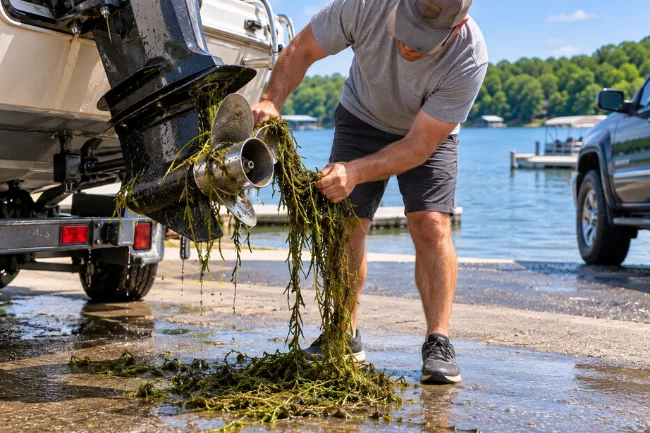
Virginia’s freshwater boating and fishing guidance emphasizes a straightforward habit: clean, drain, and dry equipment when moving between waters. Removing aquatic vegetation from boats, trailers, and gear when leaving a waterbody is a legal requirement in Virginia.
Before leaving the launch ramp
- Check the propeller, lower unit, trailer bunks, anchor, ropes, and fishing gear for vegetation.
- Remove and dispose of attached plants where they cannot wash back into the lake.
- Remove required drain plugs and empty bilges, livewells, and other compartments as directed by state rules.
- Clean equipment and allow it to dry thoroughly before launching in another waterbody.
- Never release unwanted bait, aquarium organisms, or ornamental pond plants into natural water.
Cleaning gear also reduces movement between Lake Anna’s coves.
Anglers and tournament organizers
Fishing clubs can make prevention routine by reminding participants to check livewells, nets, and trailers during check-out. Tournament traffic brings many boats together, making a shared inspection message particularly effective.
Never transport fish to stock another waterbody: unauthorized introductions can permanently reshape a fishery.
What Waterfront Homeowners Should Do Differently
Homeowners have the advantage of noticing small changes across seasons. They can also accidentally create spread pathways through dock maintenance, landscaping, and hired contractors.
Before arranging weed removal, ask whether the plant has been identified, whether the proposed method is approved, and who will monitor the site afterward. A contractor offering to rake everything out immediately may create more problems than the service solves.
I would ask neighbors to compare observations. Homeowner associations can submit shared photographs and dates because treatment at one dock may affect the surrounding cove.
On land, prevent soil and fertilizer runoff where possible. Keeping vegetated shoreline buffers and avoiding unnecessary nutrient inputs can support water quality, although these actions are not substitutes for targeted hydrilla control.
How to Report Suspected Invasive Species
For hydrilla on the public reservoir, the county directs homeowners and associations to the Lake Anna Advisory Committee’s Environmental and Water Quality Subcommittee at laac.ewq.subcommittee@gmail.com. Private-side WHTF treatment inquiries go through Dominion Energy’s reservoir-management process.
When reporting a possible new invasive species, provide a clear photograph, approximate location, date, and description of what you saw. DWR also provides a route to report suspected new invasive populations. Do not spread an organism while trying to collect proof.
If the concern is green scum or discolored water rather than an identifiable plant, use the VDH harmful algal bloom reporting system. Keep children and pets away from suspicious water while checking current guidance.
What Long-Term Success Would Look Like
The best measure of progress is not simply how many acres received treatment. I would look for navigable access, stable native plant communities, lower spread between coves, and evidence that treated areas remain manageable in later surveys.
Repeated photographs, survey maps, and transparent treatment records help residents understand results.
Lake Anna needs both active management and restraint. Overreacting to every aquatic plant can harm valuable habitat; ignoring dense hydrilla can make recreation and future control more difficult. The right response depends on a confirmed identification and the conditions at a particular site.
Frequently Asked Questions
What invasive species are in Lake Anna?
Hydrilla is the best-documented managed aquatic invader. DWR also documents blue catfish in the reservoir, while other statewide invasive threats should not be assumed present without confirmation.
Is hydrilla dangerous to swimmers?
Hydrilla is mainly a navigation and habitat-management problem, not the same thing as toxic algae. Dense underwater growth can still create an uncomfortable or unsafe swimming environment.
Are zebra mussels in Lake Anna?
There is no confirmed Lake Anna population in the DWR guidance reviewed here. Preventing their introduction remains a priority for anyone moving boats between waters.
Can I rake hydrilla away from my dock?
Lake Anna officials advise against mechanical raking because broken pieces can establish elsewhere. Contact the appropriate management authority before attempting treatment.
Who controls invasive plants on Lake Anna’s private side?
Dominion Energy handles hydrilla management and funding in the Waste Heat Treatment Facility, while public-reservoir requests follow the Lake Anna Advisory Committee process.
Protecting Lake Anna Starts With Accurate Information
Anna Lake invasive species are a real concern, but the strongest response begins with precision. Hydrilla is established and actively managed; potential newcomers require vigilance; harmful algal blooms call for a separate health response.
If you boat, clean and dry your gear. If you own waterfront property, photograph suspicious growth and report it before attempting removal. And before visiting or treating a cove, check the latest official Lake Anna management notices. Small, informed actions across thousands of lake users can protect both recreation and the ecosystem that makes this reservoir worth visiting.

Liam Anderson is a travel research writer with 9+ years of experience covering destinations, travel planning, cultural experiences, and practical travel guides. He creates informative content to help readers discover places with better insights and preparation.