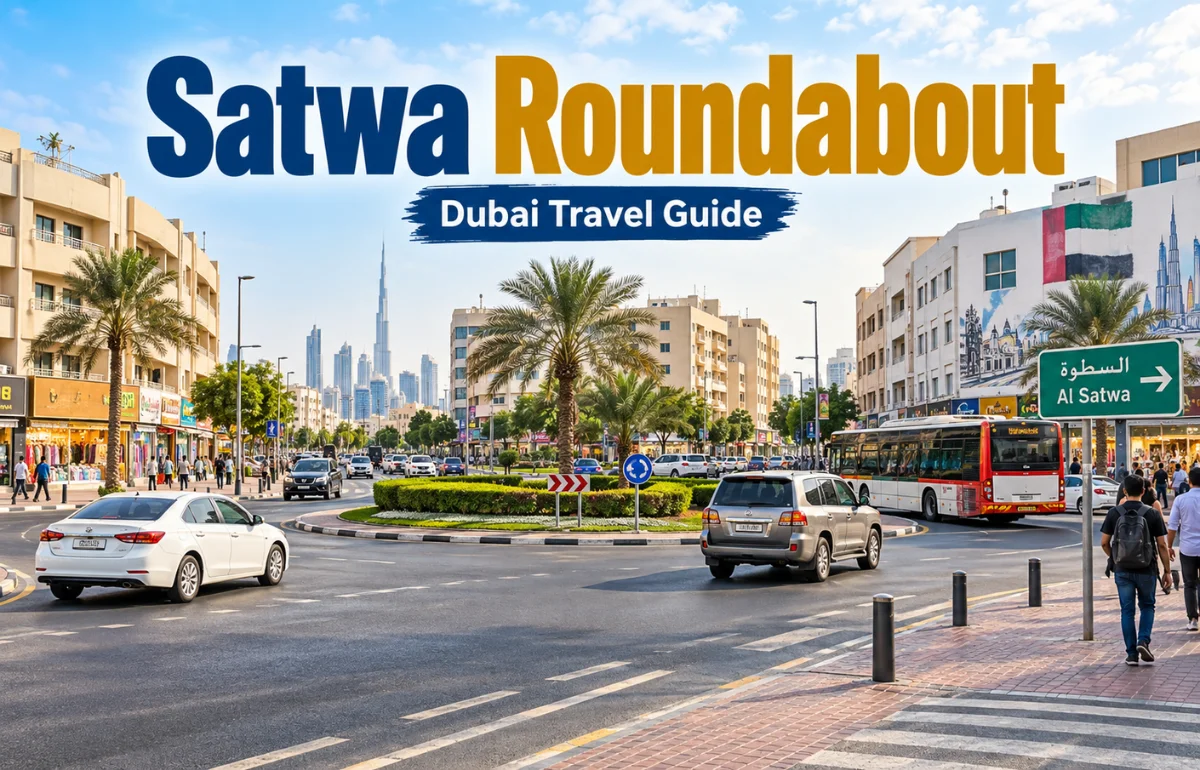
Satwa Roundabout is a well-known road junction and local reference point in Dubai’s Al Satwa district. It sits around the meeting of 2nd December Street, formerly called Al Diyafah Street, and Al Satwa Road, linking neighbourhood streets with routes toward Jumeirah, Bur Dubai, Al Jafiliya and the Trade Centre area. Residents also use the name for the nearby bus stops and surrounding commercial streets, not only for the traffic circle itself.
That distinction matters. If you search for Satwa Roundabout in a journey planner, you may see separate stops called Satwa, Roundabout 1 and Satwa, Roundabout 2. These are opposite-direction boarding points rather than two different landmarks. I treat the roundabout as a navigation anchor: useful for reaching Satwa’s shops, restaurants and homes, but specific enough that visitors should confirm their exact stop or building before travelling.
Where Is Satwa Roundabout in Dubai?
Satwa Roundabout is in the western-central part of Dubai, within the wider Al Satwa area. It is close to 2nd December Street and Al Satwa Road, with Jumeirah to the west, Al Jafiliya and Bur Dubai to the east, and the Sheikh Zayed Road corridor farther south-east.
A useful approximate map reference for the roundabout-side bus stops is 25.2343, 55.2803. Coordinates should be treated as an orientation point, not as a parking entrance or building address, because different map services place the landmark pin slightly differently.
The junction is surrounded by low- and mid-rise buildings, grocery stores, cafeterias, tailoring businesses, pharmacies and everyday services. This is not an isolated tourist attraction with a formal entrance. It is part of a working neighbourhood where people commute, shop, eat and run errands throughout the day.
Satwa Roundabout Is Not the Same as Every “Satwa” Stop
One of the easiest mistakes is to assume Satwa Roundabout, Al Satwa Bus Station and Satwa Square are interchangeable. They are separate navigation labels, even though they serve the same general district.
When I cross-checked route listings, I found that using the precise stop name produced more reliable directions than entering “Satwa” alone. Before boarding a bus or booking a taxi, copy the full destination name from your map and check which side of the road your building is on.
| Map label | What it usually refers to | When to use it |
|---|---|---|
| Satwa Roundabout | The road junction and surrounding landmark area | General driving, taxi and neighbourhood navigation |
| Satwa, Roundabout 1 | A directional public-transport stop | When your route specifically lists the “1” stop |
| Satwa, Roundabout 2 | The stop serving the opposite direction or carriageway | When your bus itinerary names the “2” stop |
| Al Satwa Bus Station | A larger bus boarding and interchange point elsewhere in the district | For routes beginning or ending at the station |
| Satwa Square | Another local stop/reference point | Use only when it appears as your selected destination |
This small check can prevent an unnecessary walk across busy roads, especially in summer.
Why Satwa Roundabout Matters
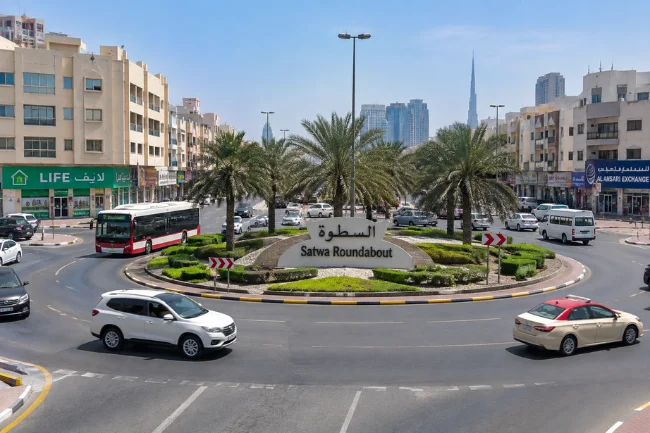
The roundabout is important because it connects a dense residential and commercial neighbourhood with several larger parts of Dubai. It helps channel local traffic toward Bur Dubai, Jumeirah, Al Mina, Al Jafiliya, the World Trade Centre district and Sheikh Zayed Road connections.
Its second role is social rather than purely technical. Long-time residents, taxi drivers and delivery riders use Satwa Roundabout as a shared point of reference. A person may say that a shop is “near the roundabout” even when its formal address uses a street number or a nearby building name.
I find that this explains why the landmark appears so often in rental advertisements, business addresses and transport directions. The name communicates a recognisable part of Satwa more quickly than a building number that few people remember.
How to Reach Satwa Roundabout
There is no single best transport method for every visitor. Your choice should depend on the weather, time of day, luggage and final destination within Satwa.
| Travel option | Best for | Practical consideration |
|---|---|---|
| RTA bus | Budget travel and direct access to local stops | Confirm whether you need Roundabout 1 or Roundabout 2 |
| Metro plus bus | Travellers coming from another Red Line area | Max Metro Station is a practical transfer point for many journeys |
| Taxi or ride-hailing | First-time visitors, families and people carrying bags | Give the driver a building or shop name as well as the roundabout |
| Private car | Multi-stop errands or travel outside peak periods | Parking close to the exact destination may be limited |
| Walking | Exploring nearby streets in cooler weather | Heat and wide roads can make a short map distance feel much longer |
Reaching the Area by Bus
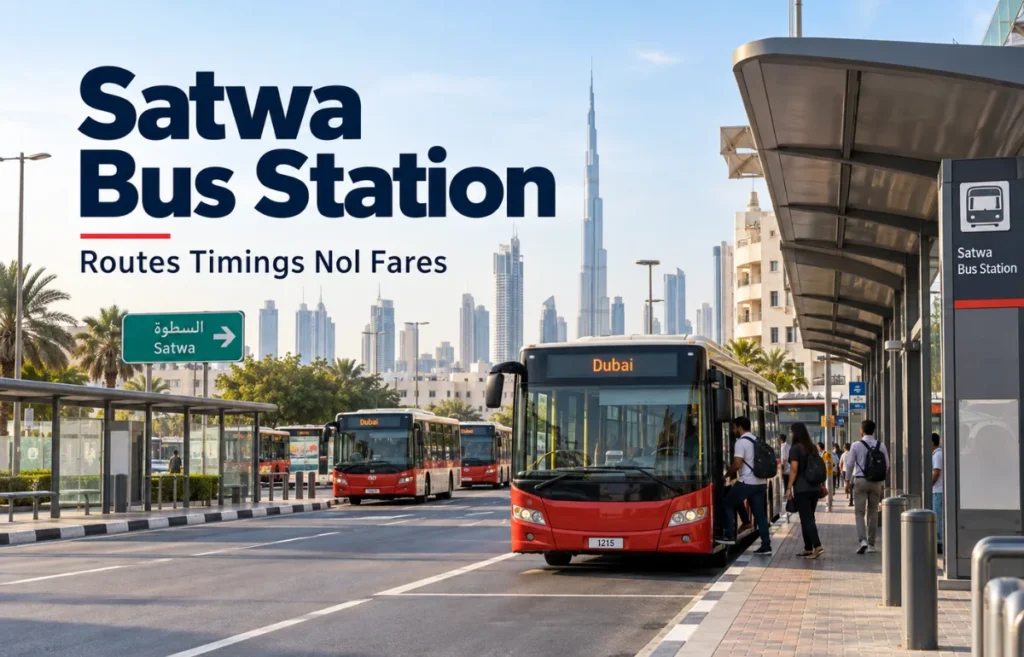
Bus access is one of Satwa Roundabout’s strongest advantages. Current transport directories associate stops around the junction with routes such as C26, E304, F09, F12, F27, X28 and 55. Services and stopping patterns can change, so I would not choose a bus from an undated blog list alone.
Search the exact stop in the RTA journey planner or S’hail app shortly before leaving. Check the direction, destination displayed on the bus and final walking route. The stop on the other side of the roundabout may serve a different direction even when the names look almost identical.
Nearest Metro Connection
Satwa Roundabout does not have a Metro station at the junction. Max Metro Station on the Red Line is generally a practical connection for the roundabout, with route planners placing the journey at roughly 1 to 1.5 kilometres by road depending on the selected stop. A connecting bus can be easier than walking, particularly at midday.
World Trade Centre Metro Station may also be useful for some routes or destinations on the eastern side of the district. The “nearest” station can therefore change with the exact pin you select. For a visitor, the best question is not simply which station is closest, but which station provides the simplest final bus or taxi connection.
Going by Taxi
Most Dubai taxi drivers will recognise Al Satwa, but “Satwa Roundabout” may still cover a larger area than you expect. I recommend giving a second reference: the business name, building, street or numbered bus stop.
This is especially helpful at night, when both sides of the junction are active and a drop-off on the wrong side can leave you facing an awkward crossing.
Driving from Major Areas
From Jumeirah, drivers commonly approach through local connections toward 2nd December Street or Al Satwa Road. From Bur Dubai or Al Jafiliya, the route usually comes from the east through the road network around 2nd December Street. Drivers arriving from Sheikh Zayed Road should follow live navigation rather than assuming the same exit will always be quickest.
Dubai road conditions can change because of construction, diversions or an incident. Save the exact destination before starting, then let live navigation select the approach. Searching only for the roundabout can take you to the landmark without guiding you to the correct parking area.
Traffic and the Best Time to Travel
Satwa is busy because it combines homes, shops, schools, restaurants and commuter routes within a compact street network. Traffic commonly builds during the weekday morning commute, often around 7:30 a.m. to 9:30 a.m., and again from late afternoon into the evening, roughly 5:00 p.m. to 8:00 p.m. These are planning ranges, not fixed guarantees.
The character of congestion changes during the day. Morning traffic is more commuter-led, while evening delays can include shoppers, restaurant customers, delivery riders and residents returning home. Weekends may feel easier during the morning but become active after sunset.
If my appointment were time-sensitive, I would add at least 15 minutes for the final kilometre, drop-off and walk. This buffer is more useful than relying on a citywide journey estimate that ends at the roundabout pin.
Driving Safely Through the Roundabout
Read the road markings before entering and choose the correct lane early. Give way as directed by the signs and markings, maintain a predictable speed and signal before leaving. Avoid cutting across lanes at the last moment if you miss an exit; continue safely and allow navigation to recalculate.
Drivers should also expect pedestrians, cyclists and delivery motorcycles near the surrounding streets. At night, shop signs and roadside activity can compete for attention, so the safest approach is calm, deliberate driving rather than a late change of direction.
Parking Near Satwa Roundabout
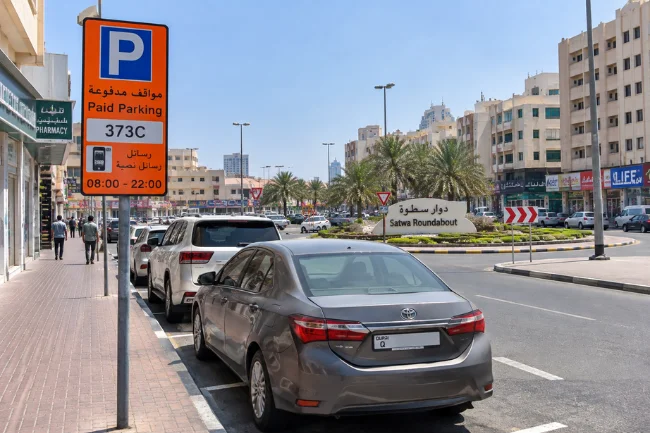
Parking is available on surrounding streets and in paid public or private areas, but availability varies block by block. A space near one side of the roundabout may not be convenient for a destination on the other side.
Look for the parking sign beside the actual bay and confirm the zone, tariff and chargeable hours before paying. Dubai’s official Parkin platform supports public-parking searches and payments, while some buildings and businesses operate their own spaces. Do not assume that an apparently open forecourt is public parking.
My practical rule is to choose parking near the final business, not near the landmark name. During the evening, it may be faster to park legally one or two blocks away and walk than to circle the busiest retail streets waiting for a front-door space.
What Is Around Satwa Roundabout?
Satwa’s appeal comes from ordinary street life rather than a single headline attraction. Within the wider area, visitors will find fabric and tailoring shops, mobile-phone repair stores, groceries, pharmacies, typing centres, salons, laundries and inexpensive restaurants.
The food mix reflects the neighbourhood’s diverse population. Pakistani and Indian restaurants sit alongside Filipino cafeterias, Arabic grills, bakeries and karak tea shops. Ravi Restaurant on Al Satwa Road is one of the area’s best-known dining references, but the surrounding side streets contain many smaller options.
Nearby points of interest include Satwa Park, the 2nd December Street corridor, the murals associated with the street’s public-realm improvements, Union House and the Etihad Museum area. Jumeirah Mosque is farther toward the coast. Some of these places are better reached by a short taxi or bus ride than by treating them all as immediate walking-distance attractions.
A Better Way to Plan a Short Visit
Rather than building an itinerary around the traffic circle, choose one purpose and one side of the neighbourhood. For example, combine tailoring and fabric shopping with lunch on Al Satwa Road, or pair the 2nd December Street area with a visit toward Union House and the Etihad Museum.
This approach reduces repeated road crossings and unnecessary backtracking. It also leaves time to explore the independent shops that make Satwa distinctive.
Living Near Satwa Roundabout
The area appeals to people who value centrality, public transport and everyday services. Housing around Al Satwa includes older low-rise buildings, mid-rise apartment blocks, studios, one-bedroom homes and shared accommodation. The exact quality, parking arrangement and maintenance standard can vary considerably between buildings.
Residents can reach several employment districts without living inside a high-rise business zone. Groceries, affordable meals, tailoring, pharmacies and personal services are close at hand, which can reduce the need for long shopping trips.
The trade-off is activity. Traffic noise, delivery movements, evening crowds and limited building parking may affect homes close to the main roads. Anyone considering a rental should inspect the street at both commuting time and after 8:00 p.m., not only during a quiet daytime viewing.
Questions to Ask Before Renting
Ask whether the advertised home is genuinely near Satwa Roundabout or simply somewhere in Al Satwa. Check the walking route to your bus stop, whether the building has allocated parking, and whether the bedroom faces a main road or an internal lane.
I would also test the evening journey to work, because a flat that looks centrally located on a map may require a transfer or a difficult road crossing. The most useful rental comparison is door-to-door travel time, not straight-line distance.
The Character and History of Al Satwa
Al Satwa developed as Dubai expanded beyond its older Creek-side districts. Its low-rise homes, small commercial buildings and mixed communities created a street-based neighbourhood that feels different from the master-planned towers nearby.
Satwa Roundabout represents that older urban pattern: a junction functioning simultaneously as transport infrastructure, an address marker and a community landmark. Even as surrounding roads and buildings change, the name remains part of local language.
This is why the area deserves more than a list of nearby attractions. Satwa shows how Dubai works at ground level—through repair shops, neighbourhood cafés, family businesses, bus stops and late-opening stores. The experience is less polished than a mall, but more revealing of everyday city life.
Practical Tips for First-Time Visitors
Save your exact destination and a screenshot of the final walking route. Mobile data can be unreliable at the moment you need to identify the correct side street.
Carry a Nol card if your journey involves buses or the Metro, and check its balance before boarding. Route numbers, frequencies and stops should always be confirmed through a current RTA channel.
Wear comfortable shoes, but do not underestimate Dubai’s heat. A one-kilometre walk that feels easy in winter can be uncomfortable in summer, especially when shade is limited.
For evening visits, decide how you will leave before arriving. Knowing the nearest correct-direction bus stop or a suitable taxi pick-up point avoids standing beside a busy junction while searching for options.
A Practical Final Word
Satwa Roundabout is best understood as both a road junction and a local navigation landmark at the heart of one of Dubai’s busiest everyday neighbourhoods. It provides useful access to Al Satwa’s transport, shops, restaurants and residential streets, but successful travel depends on choosing the correct stop, street and side of the road.
Before you go, pin the specific business or building, verify the route with a live RTA journey planner and check parking or the return connection. That two-minute check will make your visit far easier than navigating with the roundabout name alone.
Frequently Asked Questions
Where is Satwa Roundabout located?
It is in Al Satwa, Dubai, around the junction of 2nd December Street and Al Satwa Road, between the Jumeirah, Al Jafiliya and Bur Dubai sides of the city.
What is the nearest Metro station to Satwa Roundabout?
Max Metro Station is generally a practical Red Line connection, followed by a short bus or taxi trip; the best station can vary with your exact destination.
Which buses stop near Satwa Roundabout?
Routes including C26, E304, F09, F12, F27, X28 and 55 appear in current stop directories, but check the RTA planner for live routing and direction.
Is parking available near Satwa Roundabout?
Paid public and private parking exists on surrounding streets, although spaces can be limited during busy shopping and evening periods.
Is Satwa Roundabout worth visiting?
Yes, if you want to explore local food, tailoring, practical services and everyday neighbourhood life rather than a conventional tourist attraction.

Liam Anderson is a travel research writer with 9+ years of experience covering destinations, travel planning, cultural experiences, and practical travel guides. He creates informative content to help readers discover places with better insights and preparation.