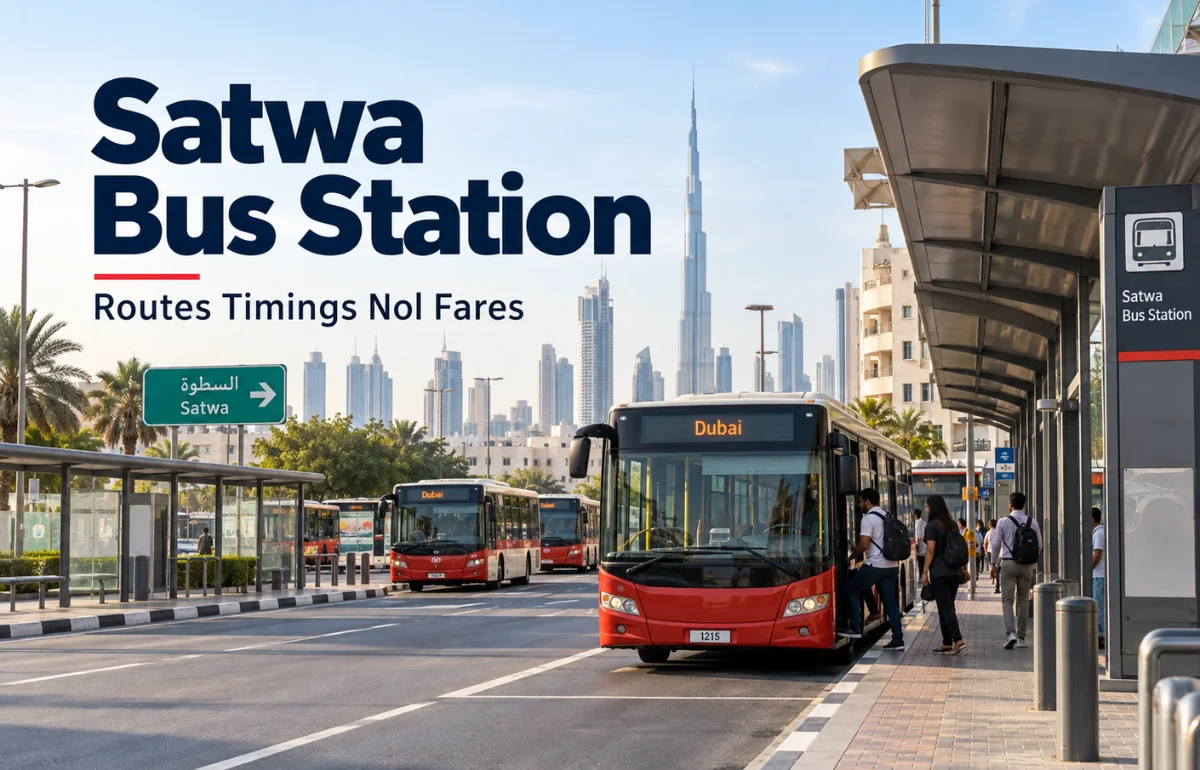
Satwa Bus Station is an RTA public transport hub in Al Satwa, Dubai, serving local bus routes, airport connections, metro feeder journeys and peak-hour services. It sits in a busy residential and commercial district between Jumeirah and the Sheikh Zayed Road corridor. Passengers use a Nol card to travel, and the correct fare is calculated from the number of zones crossed.
The station is useful because it connects an area without its own Metro station to places such as Dubai International Airport, Al Quoz, International City, Al Qusais, Jumeirah and several Red Line transfer points. It is not a single-route terminal with one fixed timetable: each bus has its own operating hours, direction and frequency. I therefore treat the station as a connection point and always check the exact route before travelling.
Information in this guide was reviewed in September 2026. Bus operations can change, so live RTA information should take priority over any static route list.
Where Is Satwa Bus Station?
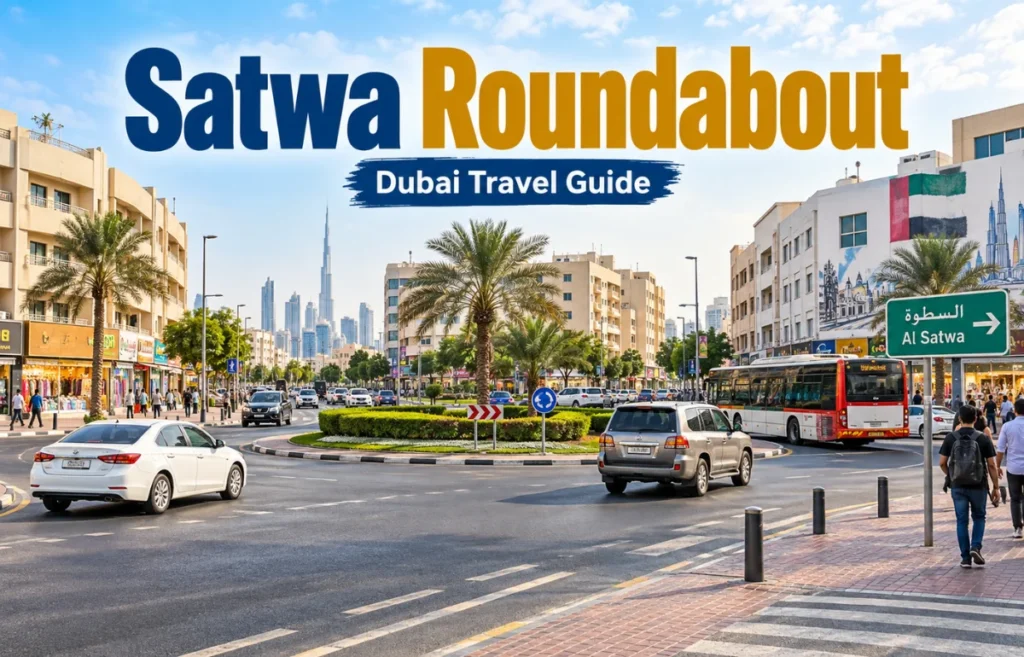
Satwa Bus Station is in the Al Satwa neighbourhood, close to Al Satwa Road, Satwa Roundabout and 2nd December Street. The surrounding district is known for apartment buildings, textile and tailoring shops, supermarkets, cafeterias and inexpensive restaurants.
Its central position is the main advantage. Jumeirah lies to the north, while the World Trade Centre and Sheikh Zayed Road corridor are to the south. Bur Dubai and Al Hudaiba are also within easy reach by road or bus.
When searching a map, I recommend using the complete name “Al Satwa Bus Station” rather than simply “Satwa.” The neighbourhood contains several numbered stops, and choosing “Satwa, Bus Station 7” or “Satwa, Bus Station 12” can place a passenger on a particular side of the terminal rather than at the desired boarding bay.
How to Reach the Station
Passengers can arrive by RTA bus, Dubai Taxi, ride-hailing service or on foot from nearby parts of Al Satwa. There is no Metro station physically attached to the terminal.
For a bus-to-Metro journey, the most practical connection may be one of Dubai’s Red Line stations, depending on the route and final destination. I would not choose a Metro station by straight-line distance alone; the bus frequency, walking distance and direction of travel matter more, especially in hot weather.
Why Satwa Bus Station Is an Important Dubai Transport Hub
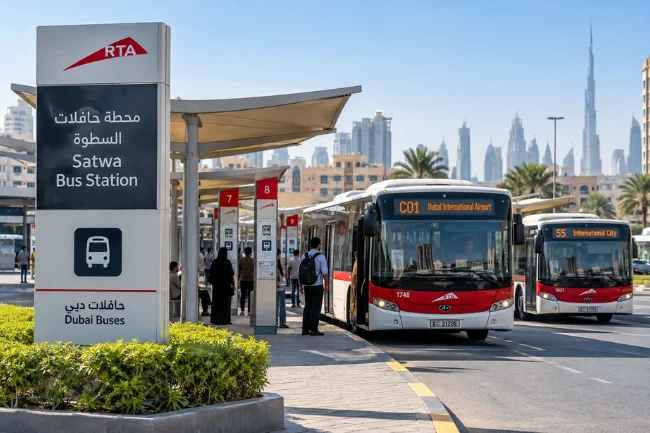
Al Satwa is densely populated and sits between major employment, shopping and leisure districts. The station gives residents a lower-cost alternative to taxis and helps visitors reach areas that are inconvenient to access directly by Metro.
It is also a useful interchange. A passenger may start on a local bus, transfer to the Red Line, and then continue by Metro or another bus. When the transfer follows RTA’s rules, the system can calculate the connected legs as one journey based on the total zones crossed.
The station’s role is easy to underestimate because it is smaller than terminals such as Al Ghubaiba or Union. In practice, its mix of local, feeder, cross-city and peak-direction routes makes it valuable for daily commuting.
Satwa Bus Station Routes and Main Connections
Route information is where many online guides become unreliable. A list copied from an old timetable may still contain a valid bus number while showing an outdated endpoint, stop sequence or operating period.
The table below groups the most useful Satwa connections identified in RTA announcements and recent station listings. It is a planning overview, not a substitute for the live timetable.
| Route or route family | Main connection | Why passengers use it | Important note |
|---|---|---|---|
| C01 | Dubai International Airport Terminal 3, with stops through Deira and Bur Dubai | Direct airport-side connection without starting on the Metro | Check the current terminal, direction and late-night schedule before departure |
| C09 | Hor Al Anz and Al Qiyadah area | Access to north-eastern Dubai and a Metro connection | RTA adjusted stops on C09 in January 2026 |
| 7, 15 and 98E | Al Quoz and Al Khail Gate corridors | Work and residential travel toward Al Quoz | Endpoints and stopping patterns differ; do not treat the three routes as interchangeable |
| 32C and C26 | Al Qusais and Qusais Industrial Area | Cross-city access toward north-eastern Dubai | Allow extra time at peak periods |
| 55 | International City | Direct access toward residential clusters in International City | RTA extended Route 55 within International City in January 2026 |
| 88 family | Jumeirah and the Financial Centre corridor | Coastal, commercial and Metro-linked travel | Includes directional peak services 88A and 88B |
| 93 family | Al Wasl and Al Ghubaiba corridor | Links Satwa with western Dubai connections | Includes directional peak services 93A and 93B |
| F11, F12 and F28 | Financial Centre, Wasl Park, World Trade Centre and Emirates Towers corridors | Feeder-style access to Metro stations and nearby districts | Confirm which side of the station serves the required direction |
| X02 and X13 | Deira/Union and Lulu Village corridors | Longer cross-city trips | Express-style route labels do not mean every stop is skipped |
New Peak-Hour Routes Introduced in 2026
RTA introduced four Satwa-related routes from January 9, 2026. Route 88A runs one way from Al Satwa Bus Station to Jumeirah 3 during the morning peak, while 88B operates in the opposite direction during the evening peak.
Route 93A runs from Al Satwa Bus Station to Al Wasl in the morning peak, and 93B returns from Al Wasl to the station in the evening peak. These are targeted services rather than all-day substitutes for Routes 88 and 93. That distinction matters: seeing a route number online does not mean it will be available at midday or in both directions.
RTA’s January 2026 route announcement is the authoritative source for these additions.
Which Bus Should I Take?
For Dubai International Airport, C01 is the first route I would check. For Jumeirah 3, I would compare the regular 88 service with 88A or 88B only if travelling in the applicable peak direction.
For Al Quoz, the destination name alone is not enough because Al Quoz covers a large area. Search for the exact building, street or bus stop, then compare routes 7, 15 and 98E where applicable. The same principle applies to Al Qusais and International City.
For Sharjah or another emirate, I would use the official journey planner rather than assume that an intercity bus departs directly from Satwa. The most reliable itinerary may involve a Dubai bus to Al Ghubaiba, Union, Deira City Centre or another interchange before continuing.
Satwa Bus Station Timings
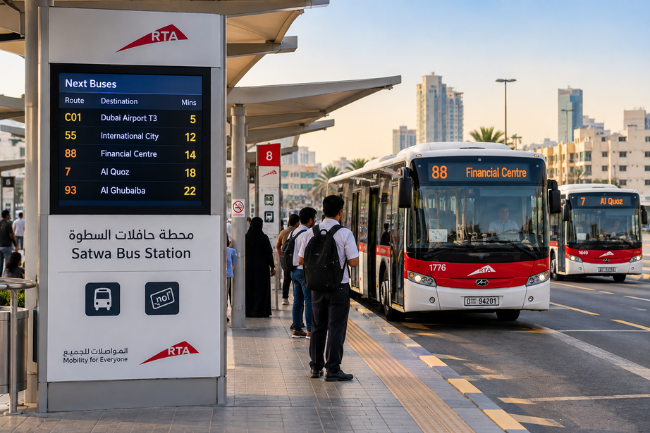
There is no single timetable that accurately describes every service at the station. Many buses operate from early morning until around midnight, and selected routes may start earlier, finish later or run differently on Fridays, weekends and public holidays.
Frequency also varies. A busy urban route may arrive every few minutes during part of the day, while a directional peak route operates only in a limited window. Traffic, road works, events and seasonal timetable changes can affect the actual arrival time.
I check timings in this order:
- Search the origin and exact destination in the S’hail app or RTA journey planner.
- Confirm the route number and direction.
- Check the first or last departure for that route, not the station’s general opening period.
- Look at the live display or stop information after arriving.
- Recheck on public holidays, during Ramadan or when a major event is taking place nearby.
RTA’s Wojhati journey planner allows users to choose a departure or arrival time and distinguishes regular days from Friday and holiday travel.
Nol Card Fares and Payment
Cash is not the normal payment method on Dubai public buses. Passengers should carry a Nol card or an eligible Nol ticket, tap in when boarding and tap out when leaving. Failing to tap out can result in the system charging an incorrect or maximum fare.
Dubai’s network has seven fare zones. The charge depends on the number of zones crossed during the complete journey, not simply the time spent on the bus.
| Journey type | Silver or Personal Nol card | Nol Red Ticket | What it means |
|---|---|---|---|
| Within one zone | AED 3 | AED 4 | Typical short local journey |
| Two adjacent zones | AED 5 | AED 6 | Journey crossing into the next zone |
| More than two zones | AED 7.50 | AED 8.50 | Longer cross-city journey |
These are the standard fares published on the RTA Nol fare page. Special or intercity services may follow different pricing, so the journey planner should be checked before travel.
How Transfers Are Calculated
RTA allows transfers between buses and the Metro within 30 minutes. A qualifying connected trip is charged according to the total zones covered rather than as unrelated journeys.
The published rules allow a maximum journey duration of 180 minutes and up to three transfers. I still keep enough balance for the complete trip before boarding; relying on a top-up machine during a tight connection is an avoidable risk.
Facilities at Satwa Bus Station
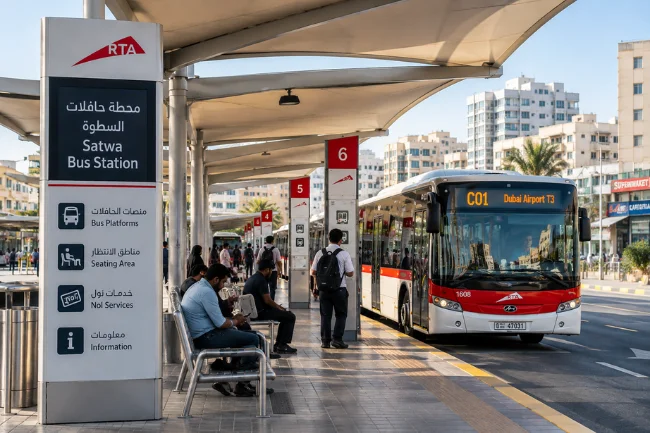
The station is designed for daily urban travel rather than long-distance waiting. Passengers can expect designated boarding areas, seating or waiting space, shade and access to Nol-related services. Digital information and staff assistance may be available within the station, while supermarkets, cafeterias and other everyday shops are close by in Al Satwa.
I would not assume the station offers luggage storage, long-stay parking or airline-style facilities. Travellers carrying large bags should check their bus route’s luggage rules and allow more time to move between stops.
Sensory Room for Children With Autism
One of the station’s most useful recent improvements is rarely mentioned in older guides. In April 2026, RTA launched a sensory room at Al Satwa Bus Station for People of Determination, particularly children with autism.
The room uses low-level smart lighting, calming music, natural scenes, colourful visuals and interactive elements such as swings to reduce sensory stress. RTA also received the Autism-Friendly Environment Certificate from the Dubai Autism Center for the initiative. Full details appear in the official RTA sensory-room announcement.
Families who may need the room should ask station staff about access and current availability rather than waiting until a child becomes overwhelmed.
Using Satwa Bus Station for the First Time
Start by saving the exact destination, not only the neighbourhood name. Large districts such as Al Quoz, Jumeirah and Al Qusais contain many stops, and the wrong route can leave a passenger several kilometres from the intended address.
After the app suggests a route, note the direction and final destination shown on the bus display. Two buses with related numbers may serve opposite directions or different operating periods.
Arrive about 10 minutes early when catching an unfamiliar service. At the terminal, match the route number with the bay or numbered stop and check the electronic display. If the app and station sign disagree, ask staff or use the latest live RTA update.
Keep the Nol card ready before boarding. Tap it once on entry, wait for confirmation, and tap out at the destination. I also keep the route visible on my phone for the first few stops; this makes it easier to spot an accidental wrong-direction journey early.
Common Mistakes to Avoid
Treating General Station Hours as a Route Timetable
A station may be accessible while the required bus has not started or has already finished. Check the route’s first and last trip.
Ignoring Letters After a Route Number
Routes 88, 88A and 88B are not identical. The letter may indicate a different direction, operating window or stopping pattern.
Choosing the Wrong Numbered Satwa Stop
Map results may display several “Satwa, Bus Station” stops. Confirm the stop number and roadside before walking to the pin.
Boarding With Insufficient Nol Balance
Top up before reaching the queue. Online recharges may also require activation or time to appear, so a last-minute digital top-up is not always the best plan.
Depending on an Old Screenshot
RTA adjusted more than 70 routes in January 2026, including Satwa-linked services. A saved timetable can become inaccurate even when the route number remains unchanged.
Practical Advice for a Smoother Journey
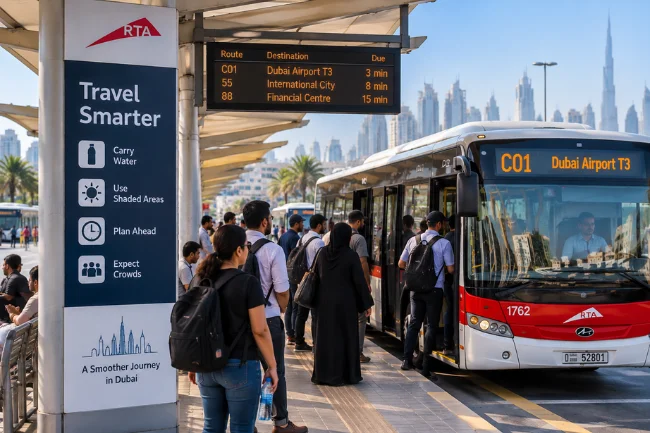
Peak commuting periods can bring longer queues and crowded buses. If my arrival time is flexible, I compare a departure just before or after the busiest window rather than assuming the first result is the best one.
Dubai’s heat also changes what counts as a convenient transfer. A route with one extra bus stop may be preferable to a long outdoor walk. Carry water, use shaded waiting areas and avoid planning a lengthy walk between the station and a Metro stop during the hottest part of the day.
For airport travel, leave a generous buffer for road traffic and terminal access. For an appointment, use the planner’s “arrive by” option so the calculation works backward from the required time.
If live information is unavailable, RTA can be contacted on 800 90 90 within the UAE. I would use that option for accessibility questions, lost property, major service disruption or a route that does not appear in the planner.
Frequently Asked Questions
Where is Satwa bus station located?
It is in Al Satwa, Dubai, near Al Satwa Road, Satwa Roundabout and 2nd December Street.
Which bus goes from Satwa bus station to Dubai Airport?
Route C01 is the main service to check for Dubai International Airport Terminal 3; confirm the live direction and timetable before travelling.
Is there a Metro station at Satwa bus station?
No. Passengers connect by bus to Red Line stations such as World Trade Centre, Emirates Towers, Financial Centre or Max, depending on the journey.
Can I pay cash on buses from Satwa?
Dubai public buses use the Nol system, so carry a valid card or eligible ticket with sufficient balance and tap in and out.
Is Satwa bus station open 24 hours?
Do not assume it is. Operating hours vary by route, and some buses finish around midnight while others follow different schedules.
Plan the Route Before You Leave
Satwa bus station is a practical gateway between Al Satwa, Dubai Airport, Jumeirah, Al Quoz, Deira-side districts and the Metro network. Its value comes from the range of connections, but those services do not share one universal timetable.
Before leaving, enter the exact destination in S’hail or the RTA journey planner, confirm the route suffix and stop number, and check the Nol balance. That two-minute check is the simplest way to avoid the wrong platform, an expired timetable or an unnecessary taxi fare.

Liam Anderson is a travel research writer with 9+ years of experience covering destinations, travel planning, cultural experiences, and practical travel guides. He creates informative content to help readers discover places with better insights and preparation.