
FCE stands for Functional Capacity Evaluation, a structured assessment of how well a person can perform physical activities needed for work or everyday life. A trained rehabilitation professional, often a physical or occupational therapist, observes tasks such as lifting, carrying, standing, reaching, and pushing. The aim is to document current abilities, limitations, and potential safety concerns—not simply to assign a diagnosis. Doctors, rehabilitation teams, employers, and insurers may use the findings when planning a return to work, workplace adjustments, or disability-related decisions.
I think the clearest way to understand an FCE is this: a medical diagnosis explains what condition you have, while a functional assessment explores what that condition allows you to do right now. Those answers can be different, and both matter.
What Does an FCE Actually Measure?
A Functional Capacity Evaluation connects real movements to real demands. Someone recovering from a shoulder injury may be able to carry a light bag at waist height but struggle to place a box on an overhead shelf. An FCE is designed to capture that difference.
Depending on the referral, an evaluator may assess strength, mobility, balance, coordination, stamina, and tolerance for repeated positions. They also document symptoms, the quality of movement, rest breaks, and signs that a task should stop for safety.
Physical Ability Is Not the Same as Work Endurance
One distinction I would want every reader to remember is the gap between completing a task once and repeating it across a shift.
Lifting a box successfully one time does not prove that a person can lift similar boxes throughout an eight-hour day. Fatigue, pain, pace, recovery time, and the frequency of movement all affect usable work capacity.
Even a lengthy assessment cannot perfectly reproduce every demand of a normal workweek.
Who May Need a Functional Capacity Evaluation?
An FCE is commonly requested when medical symptoms and job requirements need to be translated into practical work restrictions. It may be appropriate for people:
- Recovering from a workplace injury or an orthopedic operation.
- Living with persistent back, neck, shoulder, or joint problems.
- Returning after extended medical leave.
- Experiencing physical limitations that make previous duties difficult.
- Needing documentation for vocational rehabilitation or an insurance review.
- Considering modified duties, equipment changes, or a gradual return-to-work plan.
Not everyone with pain or a disability needs an FCE. If a clinician can already identify safe restrictions and a suitable work plan, extensive testing may add little value.
Who Requests the Test?
A physician may refer a patient, while a case manager, insurer, employer, or attorney may also be involved in arranging an assessment. The referral should describe the medical concern and the work activities being evaluated.
Before booking, I would ask one straightforward question: “What decision will this evaluation help make?” A clear answer helps ensure the testing is relevant instead of unnecessarily broad.
What Happens During an FCE Test?
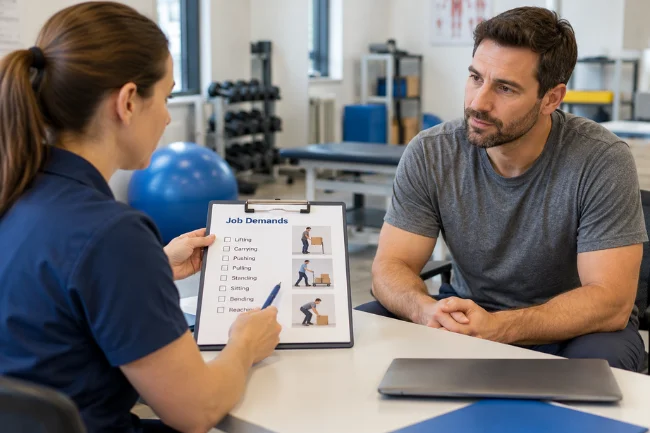
Clinics use different testing systems, but most evaluations follow a recognizable pattern.
1. Medical History and Job-Demand Review
The evaluator usually asks about your diagnosis, treatment, medications, symptoms, daily activities, and previous work. You may also discuss the tools you use, the weight of objects you handle, and how often you sit, stand, bend, or reach.
“Warehouse worker” tells a clinician less than “moves packages from floor to shoulder height, pushes loaded carts, and stands most of the shift.”
2. Physical Examination and Task-Based Testing
The clinician checks relevant physical findings before selecting simulated tasks appropriate to your health and referral.
| Test area | What you may be asked to do | What the evaluator learns |
|---|---|---|
| Lifting and carrying | Move weighted objects between heights or across a room | Safe handling ability and observed limits |
| Pushing and pulling | Move a cart or exert force on equipment | Force tolerance and movement control |
| Sitting and standing | Maintain or change positions | Positional tolerance and need for breaks |
| Bending and reaching | Crouch, kneel, reach overhead, or rotate | Mobility and task-specific restrictions |
| Walking and stairs | Walk a set distance or negotiate steps | Mobility, balance, and endurance |
| Hand function | Grip, pinch, or manipulate small objects | Hand strength and coordination |
Not every person receives every test. A desk-based employee with a wrist condition and a construction worker recovering from back surgery may need very different assessments.
3. Observation, Breaks, and Symptom Monitoring
The therapist observes movement quality and may record weight moved, repetitions, tolerance, fatigue, and reasons a task ended.
You should tell the evaluator when pain, dizziness, unusual breathlessness, weakness, or other concerning symptoms occur. Do not hide symptoms to appear capable, and do not push through a task that feels unsafe.
4. Report and Recommendations
Afterward, the clinician compares observed abilities with the relevant job demands and writes a report. It may recommend modified lifting limits, fewer overhead tasks, additional breaks, shorter shifts, or further rehabilitation.
How Long Does an FCE Take?

Many evaluations take several hours. Johns Hopkins Medicine describes a typical appointment of about four hours, although some assessments extend over two days when work demands or endurance need closer examination.
I would confirm the appointment length in advance, particularly if travel, caregiving, work leave, or medication timing could affect the day. Also ask whether food and rest breaks are built into the schedule.
How to Prepare for a Functional Capacity Evaluation
Preparing well does not mean training to beat the test. It means giving the evaluator a fair picture of your usual function and arriving with the information needed for safe assessment.
Before Your Appointment
- Bring the referral, relevant medical records, and any requested imaging or therapy reports.
- Take a detailed description of your actual job tasks, including weights, repetition, work hours, and awkward positions.
- Wear comfortable clothing and supportive footwear suitable for movement.
- Bring prescribed medications you may need during the visit and your usual glasses, brace, cane, or other assistive devices.
- Follow your clinician’s medication instructions; do not stop treatment or take extra pain medicine merely to change your performance.
- Explain recent surgery, new symptoms, falls, pregnancy, or medical restrictions before testing begins.
If your symptoms vary from day to day, a short record of recent good and bad days can help explain the broader picture. Include what triggered symptoms, how long they lasted, and whether rest helped.
On the Day of Testing
Be honest and consistent. Make a genuine, safe effort within the instructions given. Report symptoms when they happen rather than waiting until the end.
How to Read an FCE Report
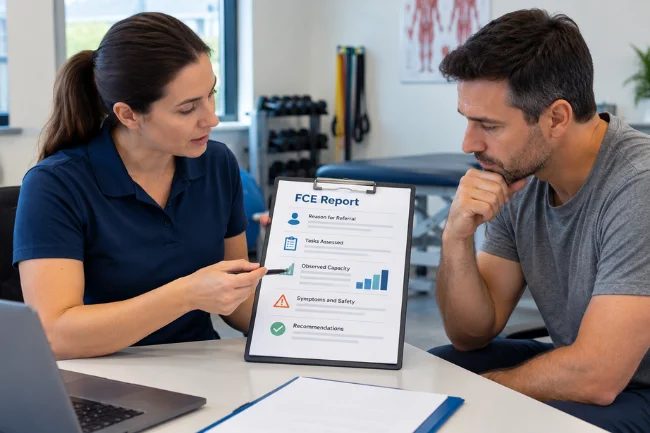
The final report can contain measurements, clinical observations, job-demand comparisons, and recommendations. The numbers are helpful, but their context matters just as much.
Here is the order in which I suggest reading it:
- Reason for referral: Which job or practical question was the test designed to address?
- Tasks assessed: Do they resemble your actual responsibilities?
- Observed capacity: How much, how long, and how often could you perform the tasks?
- Symptoms and safety: What pain, fatigue, technique changes, or stop reasons were recorded?
- Recommendations: Which duties are suitable now, which need modification, and what follow-up is advised?
Why Frequency Matters as Much as Weight
Imagine a report stating that a worker lifted 10 kilograms from waist to shoulder height. That figure alone leaves important questions unanswered.
Was the lift completed once or repeatedly? Did symptoms develop afterward? Was the movement controlled? Would the job require the same action every few minutes? These details determine whether the result matches the workplace.
This is an illustrative example, not a lifting target or medical recommendation. A safe limit must be individualized to the person, condition, and job.
What if the Report Does Not Match Your Experience?
Ask for clarification. Check whether the job description was accurate, whether symptoms were documented, and whether essential tasks were overlooked.
Discuss discrepancies with your treating clinician. Additional medical information, a workplace assessment, or a targeted follow-up may sometimes be more useful than repeating the entire FCE.
FCE vs. Other Medical and Disability Assessments
These related assessments answer different questions:
| Assessment | Main question | Typical outcome |
|---|---|---|
| Functional Capacity Evaluation (FCE) | What physical tasks can the person demonstrate under observed conditions? | Functional findings and possible work restrictions |
| Independent Medical Examination (IME) | What is an independent clinician’s opinion about the condition or disputed medical issues? | Medical opinion for the requesting party |
| Impairment rating | What degree of lasting impairment is present under a particular rating system? | Standardized impairment estimate, where applicable |
| Residual Functional Capacity (RFC) assessment | What work-related abilities remain despite medically established limitations? | Administrative assessment used in U.S. Social Security disability decisions |
An FCE may inform some of these processes, but it cannot replace every other examination or decision. In particular, a functional testing result is not the same thing as a percentage of permanent disability.
Can an FCE Help With a Return to Work?
Yes, when the assessment is linked to accurate job demands and interpreted alongside medical information. The practical goal is often to identify duties a person can perform and adjustments that may reduce unnecessary strain.
For example, a worker who struggles with repeated overhead lifting may be capable of ground-level stock handling. Another person may tolerate standing only when allowed to alternate with seated work. A phased schedule or adjusted equipment may also be considered.
I find it more useful to frame the question as “What work can be performed safely, and under which conditions?” rather than simply “Can this person work?” That leaves room for meaningful modifications.
What About Disability Benefits or Workers’ Compensation?
An FCE can provide supporting evidence about functional limitations, but it does not automatically approve or deny a claim. Insurance programs and legal systems use their own eligibility criteria.
In the United States, the Social Security Administration considers medical evidence, symptoms, work history, and the ability to perform past or other work when assessing disability. Its residual functional capacity assessment is broader than a single performance test.
For employer-requested examinations in the U.S., the Equal Employment Opportunity Commission explains when job-related medical testing may be required. Rules vary by country.
Is an FCE Accurate? Understanding Its Limitations

An FCE supplies structured observations, not a crystal-ball prediction. The quality of its findings depends on the testing method, the evaluator’s training, the person’s health that day, and how closely the tasks match actual work.
A systematic review of the WorkWell FCE found relatively consistent reliability for weight-handling and strength tests, while evidence for several mobility and posture measures was less consistent. That means the strength of the evidence varies by test and should not be generalized to every part of an evaluation.
Pain, sleep quality, medication effects, stress, and symptom fluctuations can influence performance. Someone may complete a task during a supervised visit yet have difficulty sustaining similar activity across consecutive workdays.
Does a Low Result Mean Someone Is Not Trying?
Not necessarily. Test performance may be affected by many factors, including pain, fear of reinjury, fatigue, neurological symptoms, and an unfamiliar task. Effort-related observations should be interpreted carefully and in context.
Similarly, a strong result does not prove that symptoms are absent. A person can show considerable strength and still experience pain or delayed fatigue.
Is the Evaluation Safe or Painful?
FCE testing involves physical exertion, so fatigue, temporary soreness, or an increase in familiar symptoms may occur. A responsible evaluator selects suitable tasks, monitors your response, and changes or stops activities when continuing would be unsafe.
Tell the clinician immediately about severe or unusual pain, dizziness, chest discomfort, or other alarming symptoms. Urgent symptoms may require immediate medical assessment rather than further testing.
The point is to observe present function without causing avoidable harm. You are not expected to ignore warning signs to reach a particular score.
How Much Does an FCE Cost, and Who Pays?
Pricing depends on the country, clinic, test length, report complexity, and payment arrangement. A limited assessment may cost less than a comprehensive one-day or two-day evaluation.
As one U.S. market example, MDsave listed upfront FCE prices of $660–$916 when checked in October 2026. That is a platform-specific listing, not an official or universal fee schedule.
An insurer, workers’ compensation administrator, employer, or patient may be responsible for payment, depending on the circumstances. Before booking, ask who authorized the service, whether prior approval is required, and whether the written report is included in the quoted price.
Five Questions to Ask Before You Agree to an FCE
A good referral should answer practical questions:
- What decision will this test inform? One job, modified duties, or broader capacity?
- Which work tasks will be simulated? Will frequency, height, and endurance count?
- Which medical records will be reviewed? Are current restrictions available?
- How are symptoms recorded? What happens if pain or fatigue stops a task?
- Who receives the report? Can I obtain a copy and correct factual errors?
Final Thoughts
An FCE helps turn uncertainty about work into a discussion of specific abilities, limits, and possible adjustments. Its value comes from relevant testing and careful interpretation, not a single number.
If an evaluation has been recommended, ask your clinician what question it needs to answer. Bring an accurate job description and discuss the finished report before major decisions are made.
Frequently Asked Questions About FCE
Can You Fail a Functional Capacity Evaluation?
An FCE is not a conventional pass-or-fail exam. It documents demonstrated abilities, limitations, and symptoms relative to the tasks being assessed.
How Many Hours Does an FCE Take?
Many appointments last about four hours, although some are shorter and comprehensive assessments may run across two days.
Should I Push Through Pain During an FCE?
No. Report pain or unusual symptoms immediately so the evaluator can document them and decide whether to modify or stop testing.
Does an FCE Determine Whether I Qualify for Disability?
No. It may support a claim, but the responsible insurer or public program makes its own decision using additional evidence and rules.
Can I Work After a Functional Capacity Evaluation?
Possibly, with or without restrictions. Your clinician and relevant workplace decision-makers should review the findings against your health and actual job demands.
Medical Disclaimer
This article is for informational and educational purposes only and should not be considered professional medical or legal advice. Functional Capacity Evaluation (FCE) procedures, results, and recommendations may vary depending on individual health conditions and circumstances. Always consult a qualified healthcare professional for personalized medical guidance.

Claire Morgan is a health and wellness writer with 7 years of experience creating clear, research-informed content on nutrition, sleep, movement, preventive habits, and everyday wellbeing. She focuses on making reliable health information practical and easy to understand. Her articles are educational and do not replace professional medical advice.