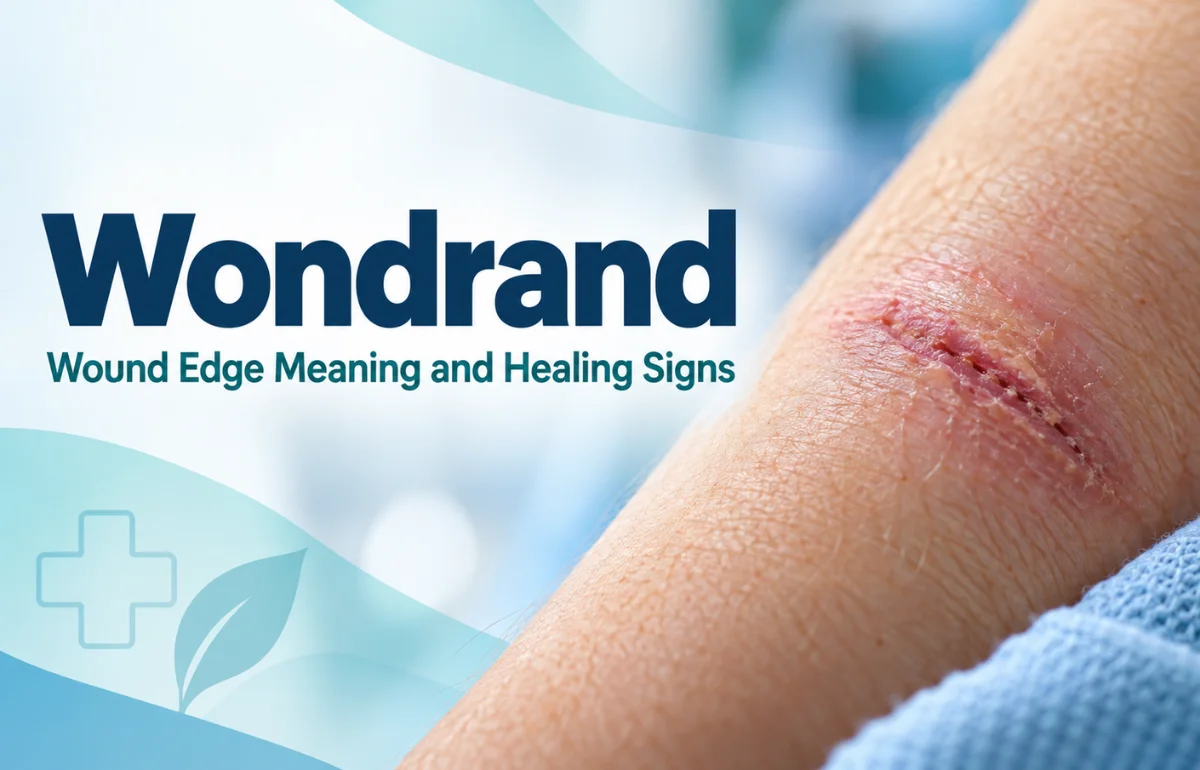
Wondrand is the Dutch word for the edge or margin of a wound: the boundary where injured tissue meets the surrounding skin. In healthcare, assessing the wondrand helps professionals understand whether a cut, ulcer, or other open wound is moving toward closure or showing signs of trouble. A healthy wound edge typically progresses inward as new skin forms. An edge that remains rolled, waterlogged, undermined, or increasingly inflamed may suggest that healing needs closer attention.
Wondrand is an anatomical description, not a medicine, brand, diagnosis, or treatment. I find it a useful term because it shifts attention from the center of a wound to a part people often overlook: the border where much of the visible closing process takes place.
What Does Wondrand Mean?
The word combines two everyday Dutch ideas: wond (wound) and rand (edge). Its plural is wondranden, meaning wound edges. In English medical writing, the closest expressions are “wound edge,” “wound border,” and “wound margin.”
The term also appears in Dutch clinical documentation. The Netherlands’ healthcare information standards include a WondRand code list for recording findings such as epithelialization, irritation, undermining, and macerated skin. That gives the word a specific practical purpose rather than a mysterious or invented meaning.
I would not confuse it with the similar-looking German word Wundrand, which also means wound edge but is spelled differently. Nor does every appearance of “Wondrand” online point to a website or app. Context matters: in wound-care material, it describes tissue, not a digital service.
Why the Wound Edge Deserves Attention
It is natural to look at the deepest or reddest part of a wound first. Yet the outer boundary can reveal whether the opening is getting smaller, whether fresh skin is advancing, and whether moisture or pressure is damaging nearby tissue.
A wound can look relatively clean in the middle and still fail to close. For example, thickened or curled edges may prevent new surface cells from moving across the open area. Conversely, a narrow, delicate rim of new skin can indicate progress, even while the center still needs time to heal.
I think of the edge as one clue in a larger picture. It does not independently prove that a wound is healing or infected. Pain, drainage, wound size, depth, circulation, and the person’s overall health all influence the assessment.
Wound Edge, Wound Bed, and Surrounding Skin: The Difference
| Area | Where it is | What an observer may notice |
|---|---|---|
| Wondrand (wound edge) | The boundary of the open wound | New skin, rolled edges, thickening, gaps, or undermining |
| Wound bed | The exposed tissue within the opening | Granulation tissue, slough, dryness, or drainage |
| Periwound skin | The intact skin around the wound | Irritation, swelling, discoloration, or moisture damage |
These areas interact. Excess wound fluid can soften the border and surrounding skin, while repeated rubbing can injure an otherwise healthy margin. A proper assessment considers all three, not just one photograph of the opening.
How Wound Edges Change During Normal Healing
First, the Body Controls Bleeding
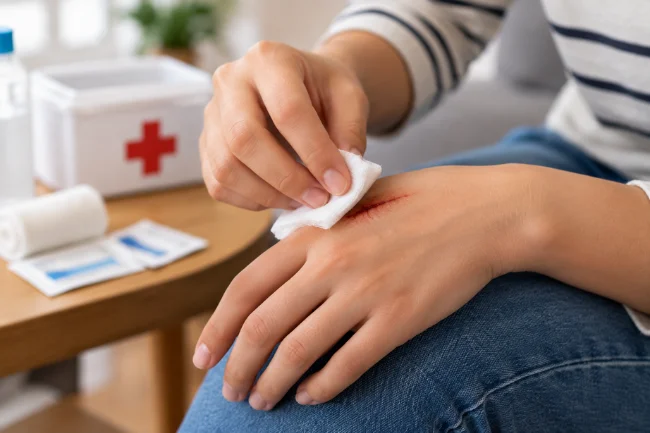
After a skin injury, clotting helps stop blood loss and creates the initial conditions for repair. The wound may look irregular, with a fresh cut or scraped border. A large, deep, or heavily bleeding injury needs medical attention rather than routine home observation.
Next Comes Inflammation
The body sends immune cells to clear damaged material and respond to contamination. Some early tenderness, warmth, and localized swelling can be part of this process. The key distinction is how symptoms develop: spreading redness, worsening pain, pus, or fever warrants medical assessment.
New Tissue Begins to Cover the Opening
During the proliferative phase, granulation tissue helps fill deeper areas, while epithelial cells move over a suitable surface to restore skin coverage. This movement is called epithelialization. Near the wondrand, new skin can appear thin and pink or slightly different in color from older skin.
Finally, the New Tissue Strengthens
After a wound closes, remodeling continues. The surface may be intact before it has regained much of its strength. That is why protecting healed skin from repeated friction and tension remains sensible, even when there is no longer an open gap.
What Does a Healthy or Unhealthy Wondrand Look Like?
No single color or shape tells the whole story. Skin tone, wound type, lighting, dressings, and how long an injury has been present all affect appearance. Still, certain patterns are useful to recognize.
| Appearance or change | Possible interpretation | Sensible response |
|---|---|---|
| Thin new tissue extending inward | Epithelialization and possible healing progress | Protect the fragile area and follow dressing advice |
| Edges gradually getting closer | The opening may be contracting | Track the trend over time |
| White, soggy, softened border | Maceration from too much moisture | Ask whether the dressing and moisture control need review |
| Thick, curled, or rolled border | Epibole, which can delay closure | Arrange a wound-care assessment; do not cut it yourself |
| A pocket beneath the visible border | Undermining, sometimes hidden from view | Have a clinician assess depth and underlying causes |
| Increasing heat, swelling, pain, or discharge | Possible infection or deterioration | Seek prompt medical advice |
I would place more weight on changes over several observations than on one isolated image. A border can appear pink without being infected, while a serious problem may be less visually obvious in darker skin or in someone with reduced sensation.
Common Reasons Wound Edges Stop Healing
Too Much Moisture or Too Little
Moist wound healing does not mean keeping the surrounding skin constantly wet. Fluid that stays against the border can cause maceration, leaving it pale, fragile, and vulnerable to breakdown. At the other extreme, an overly dry wound surface can make cell migration more difficult.
The aim is an appropriate moisture balance, usually supported by a dressing selected for the wound’s condition. I would avoid recommending one dressing for every injury: an actively draining leg ulcer has different needs from a small, clean scratch.
Pressure, Rubbing, and Repeated Movement
A wound on a heel, foot, elbow, or other high-contact area may reopen or stall if mechanical stress continues. Pressure injuries are particularly sensitive to ongoing pressure and shear. Footwear, bedding, mobility, and positioning may therefore matter as much as what is placed directly over the wound.
Infection or Persistent Inflammation
Bacteria can enter damaged skin, but the mere presence of bacteria does not establish that a wound is clinically infected. Professionals consider symptoms, surrounding tissue, drainage, and the person’s condition. Increasing pain, spreading inflammation, purulent discharge, or systemic illness needs evaluation.
Poor Circulation and Underlying Health Conditions
Diabetes, vascular disease, reduced mobility, and nutritional problems can complicate wound repair. Someone with neuropathy may not experience the degree of pain expected from an injury. A wound that is not shrinking despite appropriate care deserves an assessment of underlying causes, not just another dressing change.
How Healthcare Professionals Assess the Wondrand
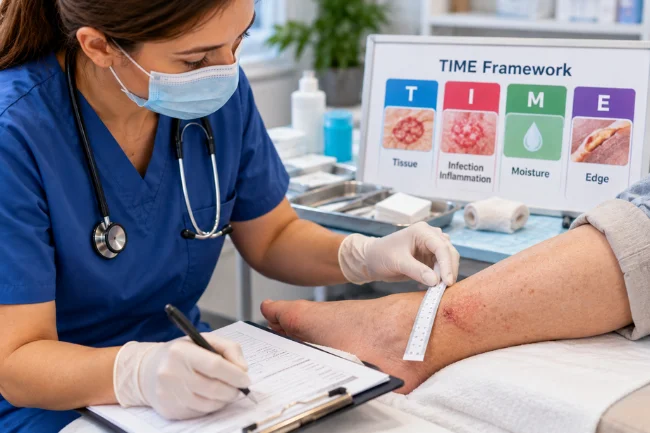
One established approach is the TIME framework: Tissue, Infection or Inflammation, Moisture, and Edge. The final letter directs attention to whether the wound margin is advancing, rolled, undermined, or otherwise unable to support closure.
A clinician may examine the wound bed, measure length and width, estimate depth when appropriate, assess drainage, and document changes to the edge and surrounding skin. For pressure injuries, NICE guidance specifically addresses documenting wound size, estimated depth, and undermining.
In practice, I find it helpful to translate this clinical framework into four plain questions: Is the tissue healthy? Are there signs of inflammation or infection? Is moisture controlled? Is the edge moving inward? These questions improve understanding, but they are not a substitute for a trained assessment.
Rolled Edges and Undermining Are Not the Same
Epibole describes an edge that has become rounded or curled rather than continuing across the wound. Undermining refers to a space extending underneath apparently intact skin at the margin. Both may occur in hard-to-heal wounds, but they represent different physical problems.
Neither should be explored with household tools. Cutting away thick skin, inserting objects into a pocket, or aggressively scrubbing a fragile edge can cause additional damage. Procedures such as debridement belong with appropriately trained professionals after the wound and its blood supply have been assessed.
Practical Wound Care That Protects the Edge
For an uncomplicated minor cut or graze, sensible first aid begins with clean hands, control of bleeding, gentle rinsing with clean water, and a suitable clean covering. The NHS advises keeping dressings clean and changing them as needed. Its recommendations are a useful baseline, but a postoperative incision, deep puncture, or chronic ulcer needs individual instructions.
I prefer a simple rule: protect the new skin without disturbing it unnecessarily. That means avoiding repeated picking, rubbing, or peeling away material that has adhered to the wound. If a dressing sticks, seek appropriate advice instead of forcefully pulling it away.
Watch how the dressing behaves, too. A covering that repeatedly becomes soaked, leaks onto healthy skin, or causes irritation may not be meeting the wound’s needs. Equally, layering on creams or antiseptics without guidance can complicate care. For people being treated by a wound clinic, the prescribed plan should come first.
An Easy Way to Record Changes Without Self-Diagnosing
For a wound already under professional care, I would keep a short observation log using three categories: edge, surroundings, and symptoms. Record the date, whether the opening looks smaller or larger, whether the border is newly soft or swollen, any noticeable change in drainage, and how the person feels.
Photographs can help when taken consistently and with consent, but they should never replace professional measurements or examination. Avoid probing or manipulating the wound to obtain better pictures. What matters most is having clear information to share if something changes.
Wondrand Concerns in Different Types of Wounds
Surgical Incisions
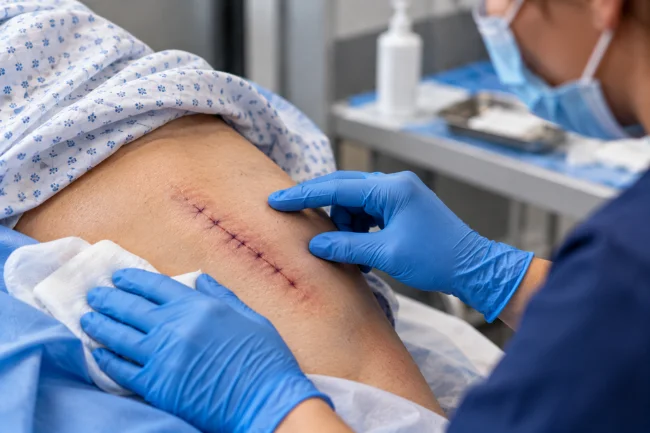
The two sides of a closed incision are expected to remain together as healing progresses. New separation, increasing redness, pus, or fever should be reported promptly to the surgical team. Follow the discharge instructions for washing, dressings, and activity rather than treating the incision like an ordinary scrape.
Diabetic Foot Wounds
Foot ulcers can become serious even when pain is limited. Callus, pressure, and reduced circulation may hide or worsen edge problems. I would recommend professional assessment for any new open foot wound in someone with diabetes instead of waiting to see whether the border improves on its own.
Pressure Injuries and Leg Ulcers
Pressure injuries may develop undermining, while certain leg ulcers produce enough fluid to damage the adjacent skin. In these cases, successful treatment usually requires attention to the underlying pressure, circulation, swelling, or mobility issue alongside local wound care.
Minor Household Injuries
A shallow cut or scrape is different. Many minor wounds begin improving within days when cleaned and protected. Even here, however, the location, depth, cause, contamination, and tetanus vaccination history can change what care is appropriate.
When Should You Seek Medical Help?
Do not wait for the wondrand to look dramatically different if warning signs are present. Seek urgent medical assessment when redness or swelling is spreading, pain is worsening, pus appears, the wound opens after surgery, or fever or general illness develops.
Emergency care is needed for uncontrolled bleeding, a very deep or large wound, loss of sensation or movement, or an embedded object that should not be removed at home. Bites, contaminated punctures, and wounds involving significant tissue damage also need timely assessment.
Tetanus protection deserves attention after an injury. The CDC bases recommendations on wound type and vaccination history; certain dirty or major wounds have different booster considerations from clean, minor ones. A clinician can check what protection is needed.
What I Would Remember About Wondrand
If I had to reduce the subject to one useful insight, it would be this: the wound edge is a changing boundary, not a decorative outline. Its direction of movement, texture, moisture, and relationship to nearby skin can tell a clinician something the wound’s center alone cannot.
I would also avoid judging progress by color alone. A pale border may be new skin, maceration, or a lighting effect. A red edge may reflect ordinary early inflammation or a developing problem. The pattern over time and the person’s symptoms make those details meaningful.
For readers encountering Dutch medical notes, recognizing wondrand, wondbed (wound bed), wondomgeving (surrounding area), and wondranden (wound edges) can make the documentation easier to follow. Understanding the words is useful; deciding what they mean medically remains a job for a qualified professional.
Conclusion
Wondrand simply means wound edge, but it describes an essential part of wound healing. Knowing what the border does—and recognizing when it is changing in an unusual way—can help you ask better questions and notice problems sooner.
If you are caring for a wound, follow the treatment plan you have been given, track meaningful changes, and contact a healthcare professional when healing seems to stall or warning signs appear.
Frequently Asked Questions About Wondrand
What does Wondrand mean in English?
Wondrand is Dutch for “wound edge” or “wound margin,” the boundary between an open wound and surrounding skin.
Is Wondrand a disease or a treatment?
No. It is an anatomical term used in wound assessment, not a diagnosis, medication, or treatment method.
What does a healthy wound edge look like?
It may show delicate new skin and gradually move inward as the wound closes, although appearance varies by wound and skin tone.
Why do wound edges turn white and soft?
A white, soggy border may be maceration caused by excess moisture; a clinician can determine whether dressing changes are needed.
When is a wound edge a cause for concern?
Increasing pain, spreading inflammation, pus, a newly opening incision, or stalled healing should prompt medical review.
Medical Disclaimer
This article is for informational and educational purposes only and does not replace professional medical advice, diagnosis, or treatment. Wound healing varies from person to person. Always consult a qualified healthcare professional for wound-related concerns, especially if you notice signs of infection or delayed healing.

Claire Morgan is a health and wellness writer with 7 years of experience creating clear, research-informed content on nutrition, sleep, movement, preventive habits, and everyday wellbeing. She focuses on making reliable health information practical and easy to understand. Her articles are educational and do not replace professional medical advice.