
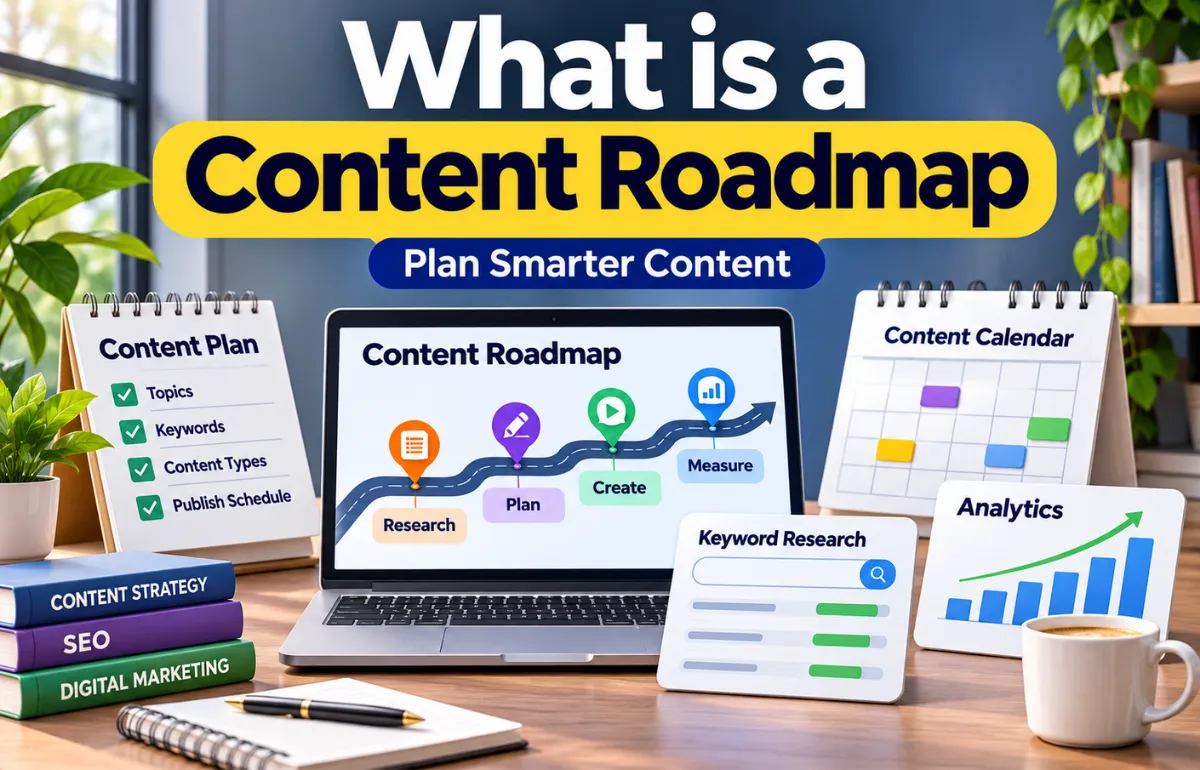
A content roadmap is a strategic plan that outlines what content a business or website should create, why it matters, when it should be published, and how it supports specific goals. If you’re wondering what is a content roadmap, think of it as a clear direction for your content marketing activities.
Instead of publishing random blog posts, videos, or social media updates, a content roadmap helps you organize topics, prioritize projects, assign responsibilities, and measure results.
It connects your content strategy with actual execution, ensuring every piece of content serves a purpose.
Whether you’re managing a personal blog, running an online business, or handling content for clients, a well-organized roadmap helps you work consistently without wasting resources.
More importantly, it gives you a practical way to turn content ideas into measurable business outcomes.
How Does a Content Roadmap Work?
A content roadmap works by connecting long-term business objectives with short-term content activities.
For example, suppose you operate a website selling fitness equipment. Your main objective might be to attract people interested in home workouts.
Instead of immediately publishing dozens of unrelated fitness articles, you’d identify the questions potential customers ask before purchasing equipment.
Your roadmap might prioritize beginner workout guides, equipment comparisons, buying advice, and product tutorials.
Each content piece would have a purpose, target audience, publication period, and expected outcome.
I prefer thinking about a roadmap as a decision-making tool rather than a publishing schedule. It should explain not only what comes next but also why one topic deserves attention before another.
That distinction makes content planning considerably more effective.
Why Is a Content Roadmap Important?

Publishing regularly doesn’t automatically produce meaningful results.
Without proper planning, businesses often create similar articles, overlook important audience questions, or spend valuable resources on content that contributes little to their goals.
A content roadmap addresses these problems by bringing structure to the entire content creation process.
It Keeps Content Aligned With Business Goals
Every article, video, or downloadable resource should support a recognizable objective.
That objective might involve increasing organic traffic, building brand awareness, generating leads, or improving customer retention.
A roadmap makes these connections visible before production begins.
It Improves Consistency and Team Coordination
When everyone understands upcoming priorities, writers, editors, designers, and marketing managers can coordinate their responsibilities.
This reduces last-minute decisions and unnecessary revisions.
Even for independent bloggers, having a roadmap makes it easier to maintain a realistic publishing routine.
It Helps You Use Resources Wisely
Content creation requires research, writing, editing, optimization, and promotion.
A roadmap helps you concentrate those efforts on opportunities with the greatest potential value.
It also encourages you to improve existing content instead of continuously creating new pages.
Content Roadmap vs. Content Strategy vs. Content Calendar
These three terms are often used interchangeably, but they perform different functions.
A content strategy establishes your overall direction. A content roadmap translates that direction into priorities, while a content calendar organizes the actual publishing schedule.
| Feature | Content Strategy | Content Roadmap | Content Calendar |
|---|---|---|---|
| Main purpose | Defines goals and direction | Prioritizes initiatives | Schedules content |
| Focus | Why and for whom | What and in what order | When and where |
| Timeframe | Usually long-term | Monthly, quarterly, or annual | Daily, weekly, or monthly |
| Key information | Audience, goals, positioning | Topics, milestones, resources | Dates, channels, assignments |
| Main benefit | Strategic clarity | Organized execution | Publishing consistency |
For instance, your strategy might focus on becoming a trusted source of personal finance information.
Your roadmap could prioritize budgeting, saving, and debt-management content over six months.
Your calendar would then specify when individual articles go live.
All three tools work best when they’re connected.
What Should a Content Roadmap Include?
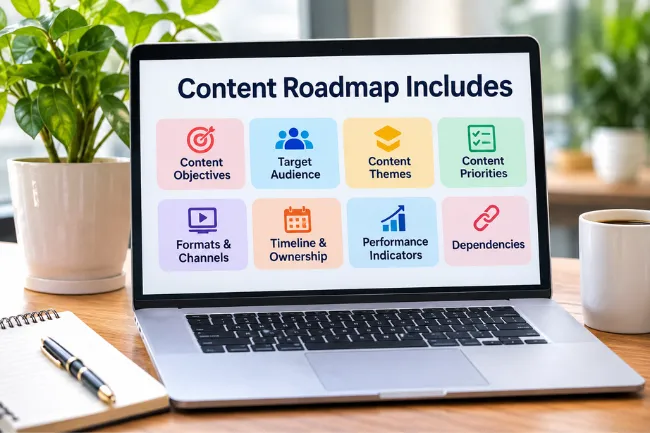
A useful content roadmap doesn’t need complicated software or an elaborate presentation.
However, it should contain enough information to guide meaningful decisions.
I recommend including these seven essential elements:
- Content objectives: The business or audience outcomes you want to achieve.
- Target audience: The readers, customers, or users your content should serve.
- Content themes: Broad subject areas that connect individual topics.
- Content priorities: The projects that deserve attention first.
- Formats and channels: Blog posts, videos, newsletters, social media, or other distribution methods.
- Timeline and ownership: Expected milestones and people responsible for completing work.
- Performance indicators: The metrics used to determine whether your efforts are successful.
One additional element I find particularly useful is a dependency column.
For example, a detailed product comparison may depend on completing hands-on testing first. A downloadable guide might depend on finishing three supporting articles.
Recording these dependencies prevents projects from moving forward before their essential information is ready.
How to Create an Effective Content Roadmap
Building a content roadmap becomes easier when you focus on business needs, audience interests, and realistic production capacity.
Here’s how I would approach the process.
1. Identify Your Main Content Goals
Before choosing topics, determine what your content should accomplish.
A website focused on advertising revenue may prioritize relevant organic traffic and reader engagement.
An online store might concentrate on attracting qualified visitors and supporting purchases.
A service-based business may need educational content that encourages consultation requests.
I would avoid selecting too many goals simultaneously.
Choose two or three primary objectives and make them measurable.
For example, instead of writing “increase website traffic,” establish a target for qualified organic visits over a defined period.
Your goals should guide every major roadmap decision.
2. Understand Your Target Audience
Knowing your audience goes beyond identifying age, location, or professional background.
You need to understand what people are trying to accomplish.
What problems do they experience? Which questions remain unanswered? What prevents them from making decisions?
I would examine search queries, customer feedback, website analytics, community discussions, and relevant search results.
Search intent deserves particular attention.
Someone searching “what is email marketing” usually wants an explanation.
Someone searching “best email marketing software for small businesses” may be evaluating products.
These readers require different content.
A strong roadmap considers informational, commercial, navigational, and transactional search intent when appropriate.
3. Audit Your Existing Content
Creating new material without reviewing existing pages can lead to duplication and wasted effort.
Start by identifying your website’s strongest and weakest content.
Look for articles that attract traffic, pages with outdated information, topics receiving impressions but few clicks, and content that no longer matches user expectations.
Google Search Console and Google Analytics can provide useful evidence.
I would classify existing content into four groups: keep, update, consolidate, or remove.
However, removal requires careful consideration. A page with little traffic may still answer an important customer question or support another valuable resource.
The purpose of a content audit isn’t simply to reduce your article count.
It’s to identify what deserves improvement before investing in additional content.
4. Research Keywords and Build Topic Clusters
Keyword research helps you understand how audiences describe their problems.
Use relevant search queries, competitor research, and tools such as Google Keyword Planner, Ahrefs, or Semrush to identify potential topics.
However, keyword volume shouldn’t be your only consideration.
A lower-volume keyword with strong relevance to your business may deliver greater value than a popular topic attracting unrelated visitors.
Organize closely related subjects into topic clusters.
For example, a digital marketing website might create a central guide about content marketing and support it with articles covering content audits, editorial calendars, keyword mapping, and content distribution.
Each supporting page should answer a distinct question rather than compete with another page for essentially the same purpose.
This creates a more logical experience for readers and provides opportunities for useful internal linking.
5. Prioritize Content Based on Value and Effort
One of the biggest content planning mistakes is treating every idea as equally important.
I prefer evaluating topics through four questions:
- How closely does this topic support the audience’s needs?
- How strongly does it connect to the website’s goals?
- Can I provide genuinely useful information?
- How much effort will creating it require?
A simple scoring approach can make prioritization easier.
Give each topic a score from one to five for audience relevance, business value, and available expertise.
Then consider the time and resources needed for production.
A highly relevant article backed by credible experience may deserve priority even when its search volume is modest.
I would also introduce an “evidence readiness” check.
If a topic requires original testing, expert input, or data you don’t yet possess, record that requirement before approving production.
This prevents research-heavy projects from becoming rushed, unsupported articles.
6. Create a Realistic Content Timeline
Once priorities are clear, organize them into achievable milestones.
For smaller websites, a 90-day roadmap is often practical because it provides direction without requiring every detail to be predicted far in advance.
Larger organizations may use annual roadmaps with quarterly reviews.
I would divide content work into preparation, production, publication, and improvement.
For instance, the first month could focus on researching and publishing foundational guides.
The second might introduce comparisons and detailed tutorials.
The third could concentrate on distribution, internal linking, and updating earlier publications.
Always leave some capacity for unexpected opportunities, technical problems, or important industry changes.
A roadmap should support flexibility rather than eliminate it.
7. Plan Content Distribution and Repurposing
Creating valuable content is only part of the job.
You also need a plan for helping the right people discover it.
A detailed article might support a newsletter, a short educational video, or several social media discussions.
However, every channel serves a different audience expectation.
I wouldn’t simply copy the same text everywhere.
Instead, I’d adapt the central idea to the platform while maintaining consistent information.
Your roadmap should specify which content deserves additional promotion and which channels are appropriate.
It should also identify opportunities to revisit older articles when new information becomes available.
8. Assign Ownership and Review Progress
Even an excellent roadmap can fail when nobody is responsible for execution.
Each major initiative should have a clear owner, expected milestone, and completion criteria.
For independent publishers, this can be as simple as a spreadsheet containing topics, deadlines, priorities, and current status.
For larger teams, project management platforms can help coordinate approvals and production stages.
I recommend checking production progress weekly and reviewing strategic priorities monthly.
A quarterly evaluation can then determine whether the roadmap still reflects audience needs and business objectives.
The key is to adjust based on evidence rather than following an outdated plan simply because it was approved earlier.
Content Roadmap Example: A Practical 90-Day Plan
Suppose you’re building a blog about productivity software.
Your objective is to attract readers researching digital tools and eventually encourage qualified newsletter subscriptions.
A simplified three-month content roadmap could look like this:
| Timeline | Content Priority | Example Content | Desired Outcome |
|---|---|---|---|
| Month 1 | Foundational education | What Is Task Management Software? | Build topical coverage |
| Month 1 | Beginner tutorials | How to Organize Digital Tasks | Answer practical questions |
| Month 2 | Product evaluation | Free vs. Paid Task Management Tools | Support informed decisions |
| Month 2 | Comparisons | Features to Compare Before Choosing an App | Attract relevant readers |
| Month 3 | Advanced education | Building a Weekly Productivity System | Encourage deeper engagement |
| Month 3 | Optimization | Update articles and improve internal links | Improve content usefulness |
This is an illustrative plan, not a performance forecast.
Notice how the topics move from basic understanding toward evaluation and practical application.
That progression helps the website serve readers at different stages of their research.
I would also record which articles depend on screenshots, software testing, or supporting examples.
This makes the roadmap more useful than a simple collection of proposed headlines.
How Content Roadmaps Support SEO and AI Search in 2026
Search optimization has evolved, but the purpose of effective content planning remains the same: provide information that genuinely satisfies user needs.
Google’s people-first content guidance emphasizes helpfulness, reliability, and evidence of experience, expertise, authoritativeness, and trustworthiness.
These principles are commonly described as E-E-A-T.
A content roadmap can support them by setting aside time for original research, expert review, factual updates, and clear authorship information.
For AI-powered search experiences, I would prioritize direct answers, meaningful examples, accurate explanations, and well-organized information.
Google’s guidance for generative AI search also encourages distinctive, valuable content rather than information that merely repeats existing sources.
There’s no special roadmap format that guarantees inclusion in Google AI Overviews, AI Mode, or another AI search experience.
Nor does using more keywords automatically improve visibility.
A better approach is to identify questions readers genuinely need answered and plan content that addresses them with sufficient depth.
I would also reserve time for maintaining crawlable pages, useful internal links, accessible content, and accurate supporting information.
A roadmap should treat content quality and technical accessibility as connected responsibilities.
Common Content Roadmap Mistakes to Avoid
A roadmap can look impressive on paper while contributing very little to actual progress.
Several mistakes are especially worth avoiding.
Planning Too Much Content
Publishing twenty weak articles may accomplish less than producing five genuinely useful resources.
I would choose realistic production targets and protect enough time for research, editing, and improvement.
Ignoring Existing Content
Many publishers focus entirely on new topics while older articles become outdated.
Include regular content updates in your roadmap, especially for subjects where information changes frequently.
Chasing Keywords Without Understanding Intent
High search volume doesn’t guarantee relevant visitors.
Every proposed article should have a clear audience, purpose, and reason to exist.
Refusing to Change the Plan
A roadmap isn’t a permanent commitment to every original idea.
If audience needs change or performance data challenges your assumptions, revise your priorities.
I also recommend establishing a simple stopping rule: if a proposed topic lacks sufficient audience value or reliable evidence, postpone it until those gaps can be addressed.
How to Measure the Success of Your Content Roadmap
The success of a roadmap shouldn’t be judged only by the number of articles published.
Publishing is an activity. Results depend on what those articles accomplish.
Useful performance indicators include organic impressions, relevant website visits, engagement, newsletter signups, qualified leads, and conversions.
The right metrics depend on your original objectives.
For example, an educational website might monitor returning readers and organic traffic, while a consulting business could measure inquiries generated by informational pages.
I would review results at both the individual article level and the broader topic-cluster level.
It’s also useful to record whether important milestones were completed, delayed, or abandoned.
Over time, these reviews reveal which topics deserve further investment and whether your publishing capacity is realistic.
A successful roadmap is one that helps you make better content decisions, not simply produce more content.
Final Thoughts
Understanding what is a content roadmap is the starting point for building a more organized and purposeful content marketing process.
A good roadmap connects audience needs, business goals, content priorities, and measurable outcomes without making your publishing process unnecessarily complicated.
My recommendation is to begin with a practical 90-day plan rather than trying to predict an entire year.
Choose your most valuable topics, assign realistic milestones, and review the results regularly.
Start with a small roadmap you can actually follow, then improve it as you learn what works for your audience.
Frequently Asked Questions (FAQs)
1. What is the main purpose of a content roadmap?
The main purpose of a content roadmap is to organize and prioritize content activities so they support audience needs, business objectives, and measurable results.
2. What is the difference between a content roadmap and a content plan?
A content roadmap highlights strategic priorities and milestones, while a content plan usually provides more detailed instructions about specific content projects and their execution.
3. How often should a content roadmap be updated?
I recommend reviewing progress monthly and reassessing major priorities quarterly, although rapidly changing industries may require more frequent adjustments.
4. What tools can I use to create a content roadmap?
Google Sheets, Microsoft Excel, Notion, Trello, and Asana can all work well. The best choice depends on your team’s size, workflow, and planning requirements.
5. Can a small business or beginner blogger benefit from a content roadmap?
Yes. A simple content roadmap helps small businesses and beginner bloggers prioritize valuable topics, maintain consistency, and avoid wasting time on disconnected content.

Midori Michael is an independent digital content research writer with 8+ years of experience creating well-researched articles on digital marketing, business, technology, and lifestyle topics. She focuses on simplifying complex information through accurate research and clear editorial writing.