Imagla is a name that appears in two different online contexts: the domain imagla.com and vehicle air-conditioning parts listed by an automotive retailer. Public information confirms that the domain has a registration history and that several replacement components are sold under the Imagla label.
However, I found no reliable evidence establishing that the website and the automotive listings belong to the same company. The domain has also attracted website-security warnings, while the parts listings raise separate questions about fitment, manufacturing, and seller support.
If you searched for Imagla, the useful question is not simply “Is it real?” but “Which Imagla am I looking at, and what can I verify about it?” Here is what the available evidence tells us, where it stops, and how to make an informed decision.
Why Does Imagla Appear in Different Search Results?
A name in a search result is not necessarily a legal company name, a trademark, or even a single business. It might identify a website, appear on a product label, or function as a retailer’s catalogue designation.
That distinction matters with Imagla. One group of results concerns a .com address and its technical reputation. Another concerns automotive air-conditioning components offered by Boom Auto Parts, a retailer operating in Kuwait.
I separate those two threads before drawing any conclusion.
| Question | Imagla.com | Imagla automotive listings |
|---|---|---|
| What is directly identifiable? | A registered internet domain | Product listings using the Imagla name or label |
| Evidence available | Registration information and a dated security report | Retail catalogue pages, part numbers, and OEM references |
| Main reader concern | Whether the website is trustworthy to visit or use | Whether a replacement component fits and is worth buying |
| What remains unclear? | Current operator, purpose, and relationship to a business | Manufacturer identity and any connection to imagla.com |
What Do We Know About the Imagla.com Domain?
Registration History Is a Starting Point, Not a Verdict
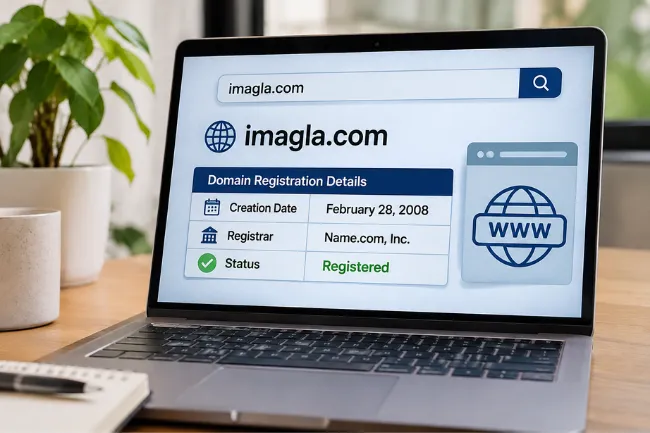
A publicly displayed Gridinsoft domain report records imagla.com’s creation date as February 28, 2008, with Name.com, Inc. identified as its registrar.
This distinction is easy to overlook. A domain can change owners, hosting providers, content, or purpose while keeping its original registration date.
I would not treat domain age as proof that a business is legitimate. The registration date is one clue, not a verdict.
Use Current Registration Records, Not Old Assumptions
For an updated registration check, I recommend ICANN Lookup. ICANN made the Registration Data Access Protocol, or RDAP, the definitive source for generic top-level domain registration information in January 2025, replacing the older WHOIS-centered approach.
RDAP can help identify a registrar, relevant dates, and available registration data. It usually cannot tell you whether an online store delivers orders, whether a support team responds, or who ultimately controls a privacy-protected registration.
For Imagla, a meaningful ownership claim would need more than a matching domain name. I would look for a verifiable company identity, consistent contact information, legal disclosures, and independent records that connect them.
What if the Website Displays a Server Test Page?
The security report identifies the page title as “HTTP Server Test Page powered by CentOS-WebPanel.com.”
It does not tell you what the domain previously offered, who owns it, or whether its visitors are safe. I could not retrieve independently usable live site content during this research, so I will not claim to have inspected a working Imagla storefront or account system.
Is Imagla.com Safe or Legitimate?
There is enough public information to justify caution, but not enough to make an absolute claim about the intentions of its operator.
The Gridinsoft assessment, dated March 30, 2026, assigned imagla.com a trust score of 35 out of 100 and classified it as suspicious. Its publicly displayed external-provider findings included warnings from Bitdefender and Fortinet. The report also said automated analysis could not fully access the site’s content.
That last detail matters. A reputation score is a risk indicator produced by a particular service, not a court finding, a confirmed purchase complaint, or proof that every visit causes harm.
My practical assessment is straightforward: I would not enter passwords, payment details, or personal documents on imagla.com without fresh verification of the site’s operator, purpose, and current security status. I also would not describe the domain as a proven scam on the strength of one automated report.
How I Would Check the Website Before Trusting It
I start with the exact address. A link in an email, message, or advertisement may include extra characters, a misleading subdomain, or an unfamiliar redirect.
Next, I check ICANN’s registration lookup, then consult more than one reputable security source. I pay attention to the date of each result and whether it describes malware, spam, phishing, or merely a lack of information.
I also look for a real organization behind the website: a named operator, working support channels, understandable privacy terms, and a consistent business presence elsewhere.
Finally, I match the level of caution to the action. Reading a public page is different from downloading software, creating an account, or sending money. If the evidence stays thin, I stop before sharing sensitive information.
This approach follows the same broad consumer-protection principles outlined by the Canadian Centre for Cyber Security, which advises checking seller identity, independent reviews, payment methods, and browser warnings.
What Is Imagla in Automotive Parts Listings?
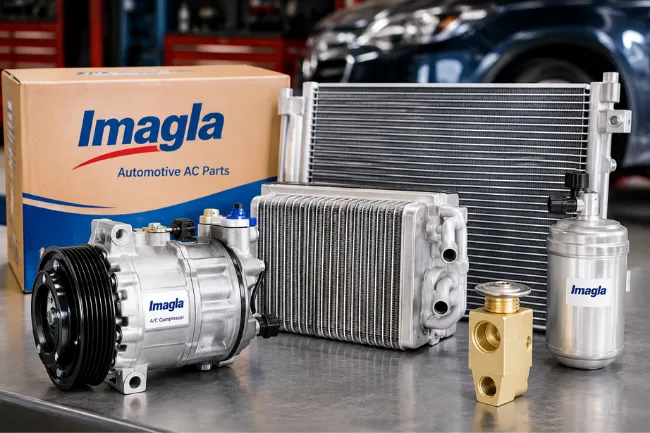
Imagla also appears as a label associated with replacement automotive air-conditioning components in the Boom Auto Parts catalogue. The retailer presents its inventory for the Kuwait market, with prices shown in Kuwaiti dinars and vehicle-selection tools for finding relevant parts.
During my research, I found publicly accessible listings for compressors, condensers, evaporator cores, receiver driers, and expansion valves.
Still, a catalogue label is not a manufacturing certificate. These pages do not independently establish where every component is made, whether Imagla owns production facilities, or what quality testing each item has passed. I would ask the seller for those details rather than infer them from the listing.
AC Compressors: The Part That Keeps Refrigerant Moving
The compressor circulates and compresses refrigerant in the vehicle’s AC system. When it fails, drivers may notice weak cooling, unusual noises, or a system that will not engage properly.
Boom Auto Parts lists an Imagla-labelled compressor with the part reference 64529217868-Imagla and BMW OEM cross-references. The listing is evidence of an offered product, not proof that it fits every BMW or that the retailer manufactured it.
AC Condensers: Releasing Heat Outside the Cabin
A condenser helps refrigerant release heat, usually near the front of the vehicle. Damage from road debris, corrosion, or leaks may reduce cooling performance.
One listed condenser carries the reference 2035001254-Imagla and a Mercedes-Benz OEM number. Before ordering, I would compare the full identifier and vehicle configuration, not just the manufacturer’s badge.
Evaporator Cores: Absorbing Heat Inside the Vehicle
The evaporator is where refrigerant absorbs heat from cabin air. A leak may require extensive dashboard work on some vehicles, making an incorrect purchase especially costly.
An Imagla evaporator-core listing shows reference 971392W000-Imagla and a Hyundai OEM cross-reference. The exact vehicle year, model, engine, and equipment still need to be checked.
Receiver Driers: Managing Moisture and Contamination
Receiver driers help remove moisture and trap contaminants in applicable AC-system designs. They are sometimes replaced when a system has been opened or repaired, following the manufacturer’s service guidance.
The retailer lists an Imagla-labelled receiver drier with reference A0998350000-Imagla and a Mercedes-Benz cross-reference. This is a distinct product category that can be missed when a catalogue is summarized too broadly.
Expansion Valves: Controlling Refrigerant Flow
An expansion valve regulates the refrigerant entering the evaporator. The correct valve depends on the system’s design and specifications; visual resemblance alone is not enough.
A listed expansion valve uses reference A2308300184IMS, displays the Imagla label, and provides a Mercedes-Benz OEM cross-reference. Notice that its stock code ends in “IMS,” not the full word “Imagla.”
Imagla Part Numbers: Verified Listing Examples
Here is a practical snapshot of five catalogue references I could locate. The “OEM reference” column reflects numbers displayed by the retailer; I have not independently authenticated manufacturer approval or individual vehicle fitment.
| Component | Retail listing reference | Listed OEM reference or brand |
|---|---|---|
| AC compressor | 64529217868-Imagla | BMW: 64529217868, among others |
| AC condenser | 2035001254-Imagla | Mercedes: 2035001254 |
| Evaporator core | 971392W000-Imagla | Hyundai: 971392W000 |
| Receiver drier | A0998350000-Imagla | Mercedes: A0998350000 |
| Expansion valve | A2308300184IMS | Mercedes: A2308300184 |
The value of this table is identification, not a shopping endorsement. A listing visible today also does not guarantee international shipping or that the item remains in stock when you order.
How Do You Know Whether an Imagla Part Fits Your Car?
I would start with the vehicle identification number (VIN), not a broad search for “BMW AC compressor” or “Hyundai evaporator.” Vehicle manufacturers may change components between model years, engine variants, production dates, and climate-control configurations.
The OEM number is the next useful checkpoint. It identifies a manufacturer-associated part reference, but an aftermarket listing’s cross-reference is still a claim made by the seller. One replacement item may be advertised against multiple original numbers; the real question is whether that substitution is approved for your exact vehicle.
I would compare the catalogue reference, original equipment number, connector or mounting design, and any relevant dimensions. For a compressor, details such as pulley configuration and refrigerant requirements may matter. For a condenser, connection positions and fittings deserve attention.
Boom Auto Parts itself asks visitors to select the make, model, year, and engine before choosing parts. That warning should be taken seriously. If the details do not match, I would send the VIN and existing part number to a qualified parts specialist or workshop and request written confirmation before paying.
Installation also affects results. Even a correctly matched component may perform poorly if the system has leaks, contamination, incorrect refrigerant charge, or an unresolved electrical fault. Professional diagnosis can prevent buying a replacement part that does not fix the original problem.
Can You Trust Imagla Automotive Parts?
I cannot give the whole label a meaningful quality rating without independent product tests, traceable manufacturing information, or a sufficiently documented record of customer experience. An online product page tells me what a seller offers. It does not tell me how that item will perform after months of heat, vibration, and regular driving.
Before buying, I would ask who manufactured the specific part, whether it is new or remanufactured, what warranty applies, and how a defective product can be returned. I would also check whether the seller can supply a specification sheet or packaging photographs showing the actual item.
The retailer’s geographic context matters as well. Boom Auto Parts displays Kuwait-based contact information and Kuwaiti-dinar pricing. Anyone ordering from another country should confirm shipping eligibility, customs charges, return costs, and the practical availability of warranty service before treating a catalogue price as the final cost.
A very low price is not automatically suspicious, and a high one does not guarantee quality. I find documented compatibility, transparent seller policies, and reachable support much more persuasive than vague marketing claims about “premium” performance.
What Is Still Unknown About Imagla?
The clearest limitation is identity. I could verify that imagla.com has public registration information and that the Imagla name appears on particular retailer listings. I could not establish an authoritative corporate connection between them.
I also could not verify a definitive company history, an official manufacturing location for the listed parts, independent durability tests, or a universal warranty policy covering everything sold under the name. Rather than fill those gaps with a neat-sounding story, I would leave them open until reliable documents become available.
That distinction helps readers avoid three common mistakes: assuming the domain is the brand’s official home, assuming a security warning applies to physical automotive components, and assuming an OEM cross-reference makes a replacement part genuine original equipment.
What Should You Do if You Have Already Used Imagla.com?
If you only viewed a page, there may be nothing further to do. If you downloaded a file, follow your device’s security guidance and scan it with reputable protection software. If you entered a password, change it on the affected account and anywhere you reused it, then enable multifactor authentication when available.
If you supplied payment details or made a suspicious transaction, contact your bank or card issuer promptly. Keep records of the website address, messages, receipts, and dates. The FTC’s online-shopping advice also explains safer payment practices and how to respond to potential shopping scams.
I would make decisions based on what actually happened, not solely on a search-engine warning or an old score.
Frequently Asked Questions About Imagla
What Does Imagla Mean?
Imagla does not have one verified, widely accepted definition in the sources I reviewed. It appears as a domain name and as a label on automotive AC-part listings.
Is Imagla.com a Safe Website?
A March 2026 Gridinsoft report assigned it a 35/100 trust score and flagged concerns. That is a reason for caution, not proof of fraud; check its current status before sharing information.
Is Imagla an Automotive Parts Brand?
Retail listings use the Imagla name on replacement AC components. I could not independently establish the label’s manufacturer or its relationship to imagla.com.
What Types of Imagla Car Parts Are Listed?
I found catalogue listings for AC compressors, condensers, evaporator cores, receiver driers, and expansion valves. Availability varies by product and retailer.
How Can I Check an Imagla Part’s Compatibility?
Match your VIN and existing OEM number against the seller’s fitment information, then ask a qualified parts specialist to confirm the replacement before ordering.
Final Thoughts
Imagla is easier to understand once the domain and automotive listings are treated as separate research questions. The available records offer useful clues, but they do not justify an invented company story or a blanket claim of safety or product quality.
If you are checking the website, verify current security and operator details before providing information. If you are buying a part, confirm the reference number, vehicle fitment, seller terms, and warranty. Those checks will take you further than the name alone.

Noah Sterling is a technology research writer with 8+ years of experience covering emerging technologies, software trends, digital tools, and innovation. He creates practical, research-based articles to help readers understand the evolving technology landscape.