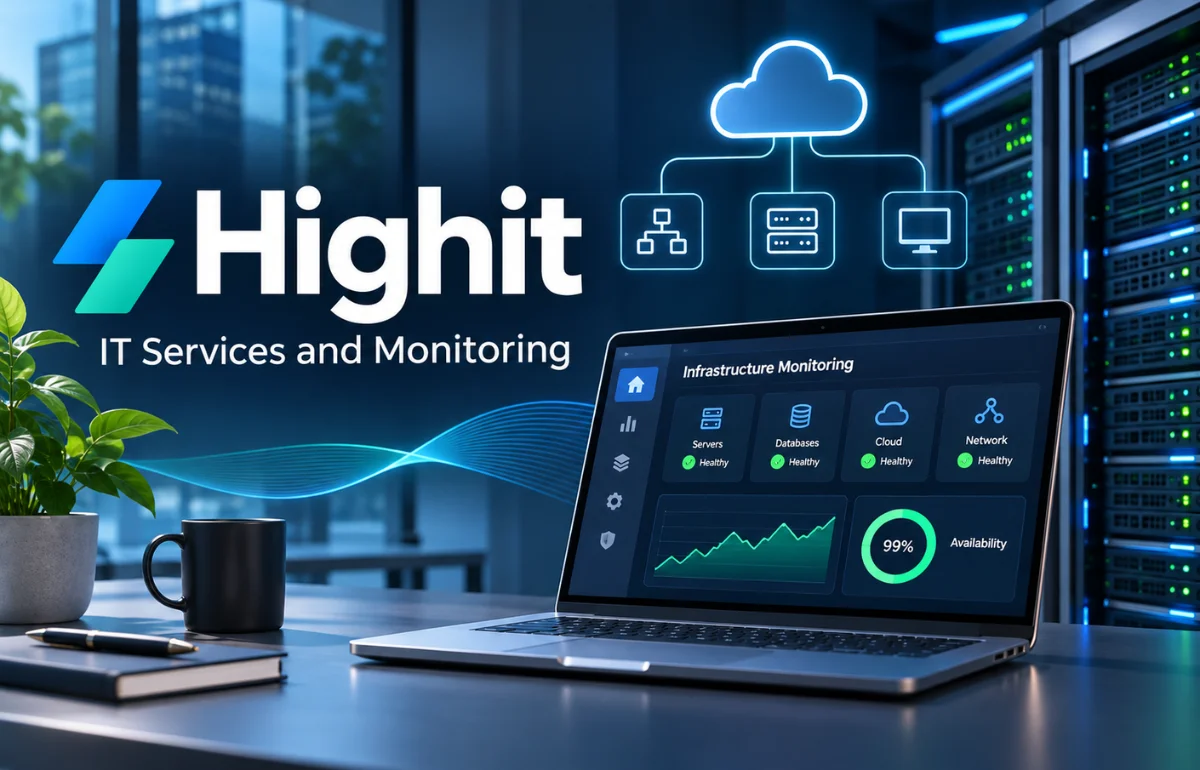
Highit refers to Highit Service, an information technology company that helps businesses monitor, manage, and maintain essential IT infrastructure. Its services include 24/7 network operations center (NOC) monitoring, database administration, middleware management, cloud services, and custom software development. The company says it operates in Mexico and Brazil, with a focus on organizations where system failures could interrupt important work, including healthcare facilities. Highit also offers Highit Monitor, a separate infrastructure monitoring product with free and paid plans.
If you’re evaluating Highit, the more useful question is what the company will monitor, maintain, or fix—and what remains your team’s responsibility. I’ll examine those details using published information, without treating marketing claims as guaranteed results.
What Is Highit Service, and What Does It Actually Do?
Businesses rely on networks, databases, applications, servers, backups, and cloud accounts. When one fails, the problem often travels. A database slowdown can make an otherwise healthy application seem broken; a network issue can prevent staff from reaching information that is still safely stored.
Highit Service positions itself as a provider of technical help across these connected layers. Some offerings involve monitoring systems and identifying problems. Others involve administering databases, supporting application connections, managing cloud resources, or developing software for a specific business need.
I find it useful to separate three activities that are often grouped under the phrase “IT support”: observation, intervention, and improvement. Observation finds unusual behavior; intervention investigates and resolves it; improvement changes the system to make future failures less likely. A contract may cover some or all three.
Highit’s Company Background and Operating Locations

According to its official website, Highit Service has more than 10 years of market experience, operates in Mexico and Brazil, and has carried out over 5,000 hours of project work. It also says it provides 24/7 infrastructure monitoring for more than 50 clients.
Those self-published figures are not independently audited evidence of uptime or customer satisfaction. Highit publishes a customer testimonial on its homepage; prospective buyers can request references relevant to their own industry and technical environment.
The website lists a business contact address on Avenida Insurgentes Sur in Mexico City. Service terms may vary by country. A buyer elsewhere should confirm coverage, service language, working hours, data handling, and whether support is remote or on-site.
Highit’s Five Main IT Services Explained
The company’s service portfolio is organized around five areas. Here is what each means and what I’d check before paying.
1. 24/7 NOC Monitoring
A network operations center monitors the health and availability of systems such as servers, network equipment, and business applications. Highit advertises continuous monitoring, performance reporting, failure prevention, and attention to security-related signals.
Imagine a hospital’s scheduling application becomes unusually slow at midnight. Monitoring might detect rising response times or resource usage before employees report the issue. What matters is who investigates the alert and how quickly.
I’d ask whether Highit’s service includes staffed incident triage at all hours, what counts as a critical alert, and whether engineers are authorized to make changes. Continuous monitoring should never be confused with a promise that every problem will be fixed immediately.
2. Database Administration
Databases hold information that applications need to function: orders, patient records, customer details, inventory, or financial transactions. Highit advertises database administration covering performance optimization, proactive maintenance, backups, recovery, security, and reporting.
An everyday example is an order-processing system that slows down as records accumulate. The root cause might be inefficient queries, inadequate capacity, or a configuration problem. Database administration aims to identify and address such issues while protecting information integrity.
Before hiring a provider, I’d confirm which database engines and versions it supports, who approves changes, how backups are tested, and whether restoration is included. Untested backups do not prove recoverability.
3. Middleware Management
Middleware is the software that enables different applications and services to communicate. Consider an online shop whose checkout, inventory, and accounting systems need to exchange data. If the integration fails, an order may be paid for but never appear in the fulfillment system.
Highit presents middleware management as a way to improve integration, performance, system compatibility, maintenance, and the security of communication between applications.
For me, the key question is ownership. When an integration breaks, is Highit responsible for diagnosing the entire transaction path, or only the middleware component? Clear responsibility is especially valuable when several software vendors are involved.
4. Cloud Infrastructure Services
Highit’s cloud services are described around availability, scalability, security, backup and recovery, and simplified infrastructure management. Cloud resources can make capacity easier to adjust, but they don’t eliminate operational work.
Someone still needs to manage access permissions, monitor spending, maintain configurations, secure sensitive information, and plan for outages. Cloud migration does not remove those responsibilities.
I’d ask which cloud platforms Highit supports, how it handles customer accounts and administrative access, and whether the engagement includes migration, everyday operation, or both. Recovery objectives should be stated in measurable terms, not described only as “fast.”
5. Custom Software Development
Standard applications don’t fit every workflow. Highit also advertises software development tailored to business requirements, including integration with existing systems, application security, and ongoing support.
This could be relevant to a company that needs a specialized reporting portal or a system linking several older applications. Still, development projects require different safeguards from infrastructure monitoring.
I’d expect written requirements, acceptance criteria, testing arrangements, deployment responsibilities, source-code access, and clear ownership of intellectual property. Ongoing maintenance and defect fixes should be priced or defined before the finished software becomes business-critical.
Highit Services at a Glance
| Service | Main purpose | Most useful question to ask |
|---|---|---|
| 24/7 NOC monitoring | Detects infrastructure problems and alerts operators | Who responds overnight, and within what timeframe? |
| Database administration | Maintains data availability and performance | Which platforms and recovery tests are included? |
| Middleware management | Keeps connected systems communicating | Who owns failures across vendor boundaries? |
| Cloud services | Supports cloud availability, management, and scaling | Which platforms, permissions, and costs are covered? |
| Custom software | Builds or adapts business applications | Who owns the code and handles post-launch defects? |
Buying “managed IT” does not cover every service. Define scope around actual systems and risks.
What Is Highit Monitor?
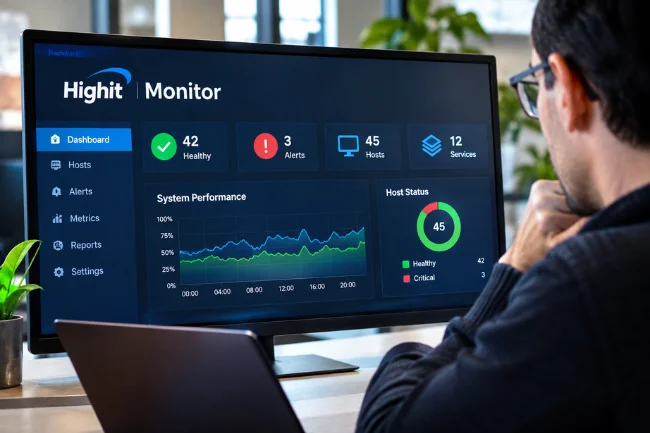
Highit Monitor is the company’s infrastructure monitoring offering, distinct from its broader managed IT service portfolio. Its official product page describes observation of networks, servers, applications, bandwidth, and security-related activity, alongside dashboards, alerts, metrics, and reports.
A dashboard can show that a server is running out of capacity. An alert can tell the responsible team that a threshold has been crossed. Historical metrics can help determine whether performance has been deteriorating for hours or weeks.
What a dashboard cannot do by itself is assign accountability. Someone must decide whether to restart a service, investigate a database, contact a vendor, or escalate a suspected security incident. Before subscribing, I’d identify who receives alerts, whether alerts can reach the right people, and how false alarms are handled.
Highit Monitor Pricing and Plan Comparison
The following prices and features are advertised on the company’s product page as checked in November 2026. They are not quotes for the full range of Highit managed services.
| Plan | Listed price | Advertised features or conditions |
|---|---|---|
| Free | Free | Up to 2 hosts, basic dashboards, 2 days of metrics retention |
| Pro | MXN 240 per host/month | Custom dashboards, alerts, more than 300 monitoring metrics |
| Enterprise | MXN 620 per host/month | Pro monitoring plus backup-process monitoring, 5 support hours monthly; 6-host minimum |
Here, a “host” usually means a monitored computing system, but buyers should confirm Highit’s billing definition. A virtual machine, database server, or cloud instance may not always be counted the same way.
I would also check taxes, setup charges, billing currency, renewal rules, data retention, integrations, and cancellation conditions. The listing does not establish that every plan includes around-the-clock human remediation. For multiple servers, request a total-cost quote.
Monitoring Is Not the Same as Incident Resolution
This is the distinction I’d put at the center of any purchasing decision. Consider three separate clocks: time to detect a problem, time for a person to acknowledge it, and time to restore the affected service. They measure different things, and a fast first clock does not guarantee a fast third one.
For example, a monitoring platform might report a failed backup at 2 a.m. The alert is valuable, but the business still needs someone assigned to investigate, rerun the job, and confirm a usable recovery point.
Ask for a written escalation path, severity levels, reporting frequency, and service-level agreements (SLAs). For systems that must recover after a major incident, establish a recovery time objective (RTO) and recovery point objective (RPO). These describe acceptable downtime and data loss, not guaranteed outcomes.
Which Businesses Might Benefit From Highit?
Highit’s emphasis on critical environments may appeal to organizations where outages affect people, revenue, or time-sensitive work. Healthcare facilities are one example named by the company. Others might include distributors, retailers, professional services firms, and businesses with several interconnected applications.
A smaller company with two servers may need straightforward monitoring and dependable access to a technician. A larger organization could need database specialists, integration support, and a formal incident-management process. Neither size alone determines whether Highit is a good fit.
I would assess business impact instead. Which system would cause the biggest disruption if it stopped for an hour? What work could continue manually, and what would come to a halt? The answers help determine whether basic visibility is enough or a managed response service is necessary.
How I Would Evaluate Highit Before Signing a Contract
First, I’d inventory the systems that matter: servers, databases, network connections, applications, backup jobs, and cloud accounts. Then I’d mark which ones Highit would monitor and which ones it would actually administer. This prevents a familiar problem: both the customer and provider assume the other party owns an incident.
Second, I’d ask for a short pilot on representative infrastructure. During the pilot, I’d want to see realistic alerts, a sample incident report, and a demonstration of escalation. For a non-production test system, the team could safely simulate a service interruption and record how the process works. I would not disrupt a live hospital or commercial system just to test a vendor.
Third, I’d review access and security. Technical providers may need privileged credentials, so permissions, logging, staff access, data location, and the process for revoking access all deserve written answers. Monitoring security events is not necessarily equivalent to a full managed cybersecurity service.
Finally, I’d compare proposals using the same requirements. Ask each vendor to state what is excluded, what is billed separately, and who owns documentation if the contract ends. Switching providers is easier when credentials, configurations, alert rules, and technical records remain accessible to the customer.
Highit vs. Monitoring Tools and Other IT Providers
Highit is not the only route to better infrastructure visibility. An internal IT team can operate its own monitoring tools; a managed service provider can take on defined response duties; and cloud-focused specialists can manage particular environments.
Products such as Zabbix and Datadog are associated with monitoring and observability, while firms such as Rackspace Technology offer managed technology services. These are different types of alternatives, requiring separate evaluation.
My comparison starts with a simple question: do I need information about a problem, or do I need another team to take responsibility for fixing it? Monitoring software can be appropriate for teams with their own engineers. Outsourced operations may be more useful when specialist staffing or after-hours coverage is the main constraint. Some organizations need both.
Strengths, Limitations, and What Remains Unverified
The apparent strength of Highit’s offering is its breadth. Monitoring, database work, middleware, cloud infrastructure, and software development address systems that often fail together rather than separately. Its public monitoring prices also give smaller teams a starting point for budgeting.
There are limits to what public information proves. The company reports experience, client numbers, and project hours, but those figures are self-published. The service pages do not establish universal response times, guaranteed uptime, full lists of supported technology versions, or independently audited customer outcomes.
I would treat these as questions to investigate, not automatic reasons to reject the provider. A credible supplier should be able to explain its technical boundaries, document commitments, and show how its work will be measured.
Final Thoughts: Is Highit Right for Your Business?
Highit Service lists its Mexico City office at Av. Insurgentes Sur 674, Piso 4, Col del Valle Nte, Benito Juárez, 03103 Ciudad de México. Its website provides a business contact form, the email address comercial@highitservice.com, and a telephone number. Published office hours are Monday through Friday, 9 a.m. to 6 p.m.; those hours should not be assumed to describe the entire 24/7 monitoring operation.
Highit may be worth considering if your systems need specialist monitoring or maintenance, but the right fit depends on documented responsibilities and service quality. Start with a one-page description of your systems, biggest risks, support needs, and host count. Request a written scope and itemized quote, then compare it against another provider.
Frequently Asked Questions About Highit
Is Highit a company or a person?
In this context, Highit refers to Highit Service, an IT infrastructure and technology services company, not a person’s biography.
Where is Highit Service based?
It lists a business contact address in Mexico City and says it operates in Mexico and Brazil.
Does Highit offer 24/7 IT monitoring?
Yes. Highit advertises continuous NOC monitoring, but specific incident-response and repair commitments depend on the agreed service scope.
How much does Highit Monitor cost?
Its advertised plans include Free, Pro at MXN 240 per host/month, and Enterprise at MXN 620 per host/month; confirm current terms directly.
Does Highit provide cybersecurity services?
Its pages describe security-related monitoring and controls, but buyers should verify whether any broader cybersecurity response or protection services are included.

Noah Sterling is a technology research writer with 8+ years of experience covering emerging technologies, software trends, digital tools, and innovation. He creates practical, research-based articles to help readers understand the evolving technology landscape.