

eDesign is a virtual interior design service that allows homeowners and renters to work with professional designers entirely online. Instead of arranging home visits, clients share room measurements, photographs, design preferences, and budgets through digital platforms. The designer then creates a personalized interior design plan, typically including furniture layouts, mood boards, color schemes, and shopping recommendations.
The biggest difference is that clients usually purchase furniture and arrange their rooms themselves, following the designer’s instructions.
I consider eDesign a practical option for anyone who wants professional decorating advice without committing to a traditional, full-service interior design project.
But how does the process actually work? What should you expect to pay, and is online interior design suitable for every home? Understanding these details can help you make a confident decision before investing in a design service.
What Is eDesign, and Why Is It Becoming Popular?
eDesign, also written as e-design, refers to interior design services delivered remotely using digital communication and design tools.
It combines professional design knowledge with the convenience of online collaboration. Clients can discuss their requirements through email, video meetings, questionnaires, or dedicated design platforms.
The appeal goes beyond convenience.
Many people struggle to choose furniture that fits properly, coordinate colors, or create a consistent decorating style. Others know what they like but cannot translate inspirational photographs into a functional living space.
Online interior design addresses these problems through customized recommendations.
Rather than hiring someone to manage an entire renovation, you receive a design plan that you can implement according to your schedule and financial situation.
The term eDesign can also describe certain digital design applications in other industries. However, in home improvement and decorating, it generally refers to virtual interior design.
How Does eDesign Work?

Although individual designers use different approaches, most virtual interior design projects follow a similar process.
1. Initial Consultation and Design Questionnaire
The process usually begins with a questionnaire or virtual consultation.
A designer asks about your preferred interior style, room dimensions, lifestyle, existing furniture, and spending limit.
You might also explain whether you have children, pets, accessibility requirements, or specific storage problems.
I would encourage anyone starting an eDesign project to describe how the room actually functions, not simply how they want it to look.
A living room used for daily family activities needs different furniture and materials from one reserved for occasional guests.
2. Sharing Room Measurements and Photographs
Next, you provide photographs, measurements, and sometimes a basic floor sketch.
Designers may request wall lengths, ceiling heights, window dimensions, door locations, and photographs from multiple angles.
These details help them understand the room’s proportions and physical limitations.
Accurate measurements are particularly important because the designer usually cannot inspect the property in person.
3. Creating the Design Concept
The designer develops an initial concept based on your preferences.
This may include a digital mood board, suggested furniture, decorative accessories, materials, and a coordinated color palette.
Some services also provide realistic 3D room renderings.
These visualizations help you understand how the proposed arrangement might look before purchasing anything.
4. Reviewing and Refining the Design
After receiving the initial concept, you review the recommendations and provide feedback.
Perhaps the sofa looks too large, the color palette feels too dark, or certain furniture exceeds your budget.
The designer can adjust the proposal within the agreed revision allowance.
I recommend discussing the number of included revisions before paying. Some services include one revision, while others offer several.
5. Receiving and Implementing the Final Plan
Once the design is approved, the designer delivers the final digital package.
You can then order recommended products, arrange furniture, paint walls, and complete the decorating work.
This is where eDesign differs from traditional interior design: the responsibility for purchasing and implementation usually remains with the client.
What Does an eDesign Package Include?
Not every online interior design package offers identical services.
However, several deliverables appear regularly in professional eDesign proposals.
Mood Boards and Color Palettes
A mood board brings together visual references that communicate the intended atmosphere of a room.
It may feature furniture styles, materials, paint colors, flooring ideas, lighting, and decorative elements.
I find that the real value of a mood board is consistency. It helps prevent individual purchases from pulling the room in conflicting directions.
Furniture Layouts and Space Planning
A floor plan illustrates where furniture should be positioned.
It considers the dimensions of the room, walking routes, door clearance, and the relationship between different furnishings.
A good layout should make everyday activities easier rather than simply produce an attractive image.
Shopping Lists and Product Recommendations
Most comprehensive packages include a curated shopping list.
This typically contains furniture descriptions, dimensions, retailer information, and purchasing links.
The recommendations should reflect your style, location, and available budget.
Styling Instructions and 3D Renderings
Some designers provide written guidance explaining how to position rugs, arrange accessories, or install window treatments.
Premium packages may include 3D visualizations, additional consultations, or extended support.
For example, LARU Interiors describes a virtual service incorporating mood boards, design plans, shopping information, revisions, and styling guidance.
Always check the exact deliverables instead of assuming every package includes these features.
eDesign vs. Traditional Interior Design: What’s the Difference?
Both approaches can produce an attractive, functional home. The main differences involve service delivery, client responsibilities, and project management.
| Feature | eDesign | Traditional Interior Design |
|---|---|---|
| Consultation | Online communication | Usually includes in-person meetings |
| Home visits | Generally not included | Commonly included |
| Design plans | Delivered digitally | Digital and physical presentations |
| Furniture purchasing | Usually managed by the client | May be managed by the designer |
| Installation | Client coordinates | May include professional oversight |
| Project flexibility | Often self-paced | Usually follows an agreed schedule |
| Design fees | Often lower for comparable design-only work | Usually higher for comprehensive services |
| Best suited for | Decorating and furnishing projects | Complex renovations and managed installations |
I would choose eDesign for a room that needs better furniture, lighting, colors, or accessories.
For extensive remodeling involving structural changes, plumbing, or major electrical work, I would look for qualified professionals who can assess the property directly and manage the relevant technical requirements.
How Much Does eDesign Cost?
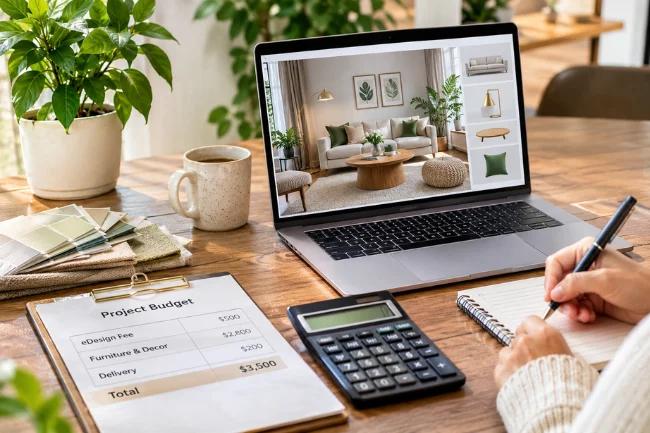
The cost of eDesign depends on the designer’s experience, project complexity, room size, and included services.
A short color consultation generally costs less than a comprehensive room design with detailed layouts and 3D renderings.
For perspective, Interiors by J.Curry advertises a $500-per-room eDesign service, while Reid Design lists full-room digital plans starting at $695.
These are individual US provider examples, not universal industry rates. Published prices and packages can change.
Some designers charge fixed fees per room, while others provide customized quotations.
What Determines the Final Cost?
Several factors can influence the price:
- Number of rooms and complexity of their layouts.
- Level of customization and detail required.
- Inclusion of 3D renderings or technical drawings.
- Number of revisions and consultation sessions.
- Additional product sourcing or post-design support.
Remember that the design fee and decorating budget are separate expenses.
Furniture, paint, delivery, installation, and applicable taxes may not be included.
How to Calculate Your Real Project Budget
I prefer looking at the total project cost rather than focusing only on the designer’s fee.
A realistic calculation includes:
Total project budget = Design fee + Furniture and materials + Delivery + Installation + Taxes + Contingency allowance
For example, a low-cost design package may become expensive if it recommends furniture beyond your available budget.
Ask whether the designer will select products within a fixed spending limit and suggest affordable alternatives if items become unavailable.
What Are the Main Benefits of eDesign?
Professional Guidance Without Geographical Restrictions
One major advantage is the ability to work with designers outside your immediate area.
You can select a professional whose portfolio matches your preferences rather than limiting yourself to nearby studios.
This can be particularly useful in locations where specialized interior design services are difficult to access.
Greater Control Over Spending
Because clients generally handle purchasing, they can spread expenses over several months.
You might buy essential furniture first and add decorative accessories later.
This flexibility makes it easier to prioritize purchases without abandoning the original design concept.
Convenience and Time Savings
Virtual meetings reduce the need to coordinate multiple in-person appointments.
You can review documents, compare product suggestions, and provide feedback from home.
However, the overall project may still require considerable time for shopping, delivery coordination, and installation.
Personalized and Practical Results
A well-developed digital design should reflect your individual needs.
It can accommodate existing furniture, storage requirements, household routines, and personal decorating preferences.
The goal should be a usable home, not merely a room that photographs beautifully.
What Are the Limitations of eDesign?
Despite its advantages, virtual interior design is not ideal for every project.
The most obvious limitation is the lack of physical inspection.
Designers rely on the measurements and photographs supplied by clients. Missing or inaccurate information can lead to unsuitable furniture selections.
Another challenge is product availability. A recommended item might sell out, increase in price, or become unavailable in your country.
Colors can also appear different on screens than they do under natural or artificial lighting.
I would always request physical samples when selecting expensive upholstery, flooring, or permanent finishes.
Finally, online decorating services generally do not replace licensed architectural, engineering, electrical, or construction professionals.
The Council for Interior Design Qualification emphasizes the professional responsibilities associated with safety, accessibility, building codes, and interior environments.
A virtual decorating plan should never be treated as automatic approval for construction work.
Which Rooms Are Best Suited for eDesign?
Virtual design works particularly well when the main objective is improving furniture placement, decoration, or visual consistency.
| Room | Useful eDesign Services | Main Consideration |
|---|---|---|
| Living room | Furniture layout, rugs, lighting | Walking space and seating comfort |
| Bedroom | Bed placement, storage, colors | Practical circulation and storage |
| Home office | Desk layout, lighting, organization | Ergonomics and screen glare |
| Dining room | Table selection, lighting, décor | Chair clearance |
| Nursery | Storage, furnishings, color schemes | Child safety |
| Rental apartment | Flexible furniture and décor | Landlord restrictions |
Kitchens and bathrooms can also benefit from virtual consultations about colors, finishes, and decorative details.
However, major changes to plumbing, electrical systems, ventilation, or structural elements require appropriate professional assessment.
How to Prepare for a Successful eDesign Project
Preparation strongly influences the quality of the final recommendations.
Before contacting a designer, I would organize the following information.
Measure the Entire Space
Record wall lengths, ceiling heights, door openings, windows, and architectural features.
Also measure furniture you intend to keep.
A detail people sometimes overlook is the delivery route. A sofa may fit inside the living room but fail to pass through a narrow staircase or entrance.
Photograph the Room Clearly
Take photographs from different corners and include the ceiling, flooring, doors, and windows.
Natural daylight can help communicate existing colors, although photos do not replace physical samples.
Define Your Priorities
Identify your main problems before selecting a decorating style.
Do you need additional storage? Better lighting? More seating? A dedicated workspace?
Knowing the functional objective makes design decisions easier.
Establish a Realistic Budget
Set a maximum amount for the entire project, including furnishings and unexpected expenses.
Tell the designer which existing items must remain and where you are willing to compromise.
How to Choose the Right eDesign Service
A beautiful portfolio is useful, but it should not be your only selection criterion.
I would evaluate a designer using five practical questions.
Does the portfolio reflect your preferred style? Look for complete, functional spaces rather than isolated decorative photographs.
What exactly will you receive? Request sample deliverables, including layouts, product lists, and styling instructions.
How are revisions handled? Understand which changes are included and what additional work costs.
Can the designer source products in your location? Shopping links are less useful if retailers do not ship to your country.
What happens after the final plan is delivered? Ask whether follow-up questions, alternative products, or implementation advice are available.
Also review the contract, payment terms, cancellation conditions, and expected delivery timeline.
Clear communication matters as much as visual creativity.
A Practical eDesign Example: Redesigning a Small Living Room
Imagine a small living room with an oversized sofa, limited storage, and poor lighting.
The homeowner likes contemporary interiors but cannot afford to replace everything.
Instead of recommending an entirely new furniture collection, I would approach the project around three priorities: better circulation, improved lighting, and retaining useful existing pieces.
The virtual designer might propose repositioning the sofa, adding compact storage, replacing heavy curtains, and introducing layered lighting.
A digital floor plan would show the suggested furniture arrangement, while a shopping list would identify suitable products.
The homeowner could purchase the essential items first and leave artwork or accessories for later.
This example illustrates an often-overlooked benefit of eDesign: a successful room makeover does not necessarily require buying more furniture.
Sometimes the most valuable recommendation is changing what is already there.
Common eDesign Mistakes and How to Avoid Them
One mistake is choosing a package based only on price.
An inexpensive mood board may provide inspiration but leave you without a reliable furniture layout or shopping guidance.
Another is purchasing recommended products before confirming measurements.
I would check furniture dimensions, access routes, return policies, and materials before placing expensive orders.
A third mistake is treating a 3D rendering as an exact representation of the finished room.
Digital visualizations can communicate design intent, but lighting, textures, colors, and proportions may differ from reality.
Finally, avoid changing too many products independently. Replacing several recommended pieces can weaken the overall design.
If substitutions become necessary, maintain consistent dimensions, proportions, and material relationships.
The Future of eDesign: AI, Sustainability, and Smarter Planning
Digital interior design tools are changing how clients visualize their homes.
AI-assisted room concepts, 3D modeling, and interactive design platforms can make experimentation faster.
However, an attractive AI-generated room is not necessarily physically achievable.
I believe the most useful role of technology is supporting informed decisions rather than replacing measurements, professional judgment, or safety checks.
Sustainability is another consideration.
Virtual design can encourage homeowners to reuse furniture, explore secondhand options, and select durable products instead of replacing everything.
Clients should also consider privacy when uploading photographs and floor plans. Review how design platforms store, share, and retain personal information.
The future of effective eDesign will depend on combining digital convenience with practical planning, responsible product choices, and genuine attention to household needs.
Frequently Asked Questions About eDesign
1. What does eDesign mean?
eDesign means virtual or online interior design, where a designer creates personalized room plans and decorating recommendations remotely.
2. Is eDesign cheaper than traditional interior design?
It is often less expensive because virtual packages typically exclude home visits, purchasing management, and installation supervision.
3. Can I use eDesign for a small apartment?
Yes. Online interior design can help maximize available space through suitable furniture layouts, storage solutions, and coordinated décor.
4. How long does an eDesign project take?
A single-room project may take a few weeks, depending on its complexity, the designer’s schedule, and the number of revisions.
5. Do I need special software to use eDesign?
Usually not. Most clients only need internet access, photographs, measurements, and a device for viewing plans and communicating with the designer.
Final Thoughts
eDesign offers a flexible way to access professional interior design advice without arranging traditional home visits or committing to full-service project management.
Its greatest advantage is the combination of personalized planning, digital convenience, and control over implementation.
However, accurate measurements, clear budgets, realistic expectations, and a carefully selected designer remain essential.
If you are considering an online room makeover, start by identifying one space that needs improvement. Define your priorities, establish your budget, and compare eDesign packages based on their actual deliverables.
A thoughtful design plan can help you create a more comfortable, functional, and visually appealing home without unnecessary spending.

Olivia Parker is a home improvement research writer with 8+ years of experience covering home design, renovation ideas, maintenance tips, and practical living solutions. She creates easy-to-follow content to help readers make informed decisions about improving their homes.