
Von Duprin is a leading American commercial door hardware brand specializing in panic bars, exit devices, fire exit hardware, and electronic access control solutions. Owned by Allegion, the brand manufactures safety hardware that allows people to exit buildings quickly while helping prevent unauthorized entry.
Von Duprin exit devices are commonly installed in schools, hospitals, offices, shopping centers, and other commercial buildings where safe emergency evacuation is essential.
Unlike ordinary door locks, these devices allow occupants to release a door’s latch by pressing a horizontal bar or push pad, without requiring a key.
With more than a century of innovation behind it, Von Duprin has become a recognized name in commercial building security. However, understanding its different products, safety ratings, and installation requirements is essential before choosing the right hardware.
What Is Von Duprin and Why Is It Important?
Von Duprin is more than a manufacturer of panic bars. Its products address an essential challenge in building design: keeping doors secure against unauthorized entry while allowing people to escape during emergencies.
Imagine a crowded auditorium during a fire alarm. If people needed to find keys or operate complicated locks, evacuation could become dangerous.
A properly installed exit device reduces that risk by allowing the door to open through a simple pushing action.
What I find particularly valuable about this design is the way it combines three functions: emergency escape, controlled entry, and everyday convenience.
The brand’s reputation comes from its focus on durable commercial hardware, including products designed for high-traffic environments.
The History of Von Duprin: How It All Started
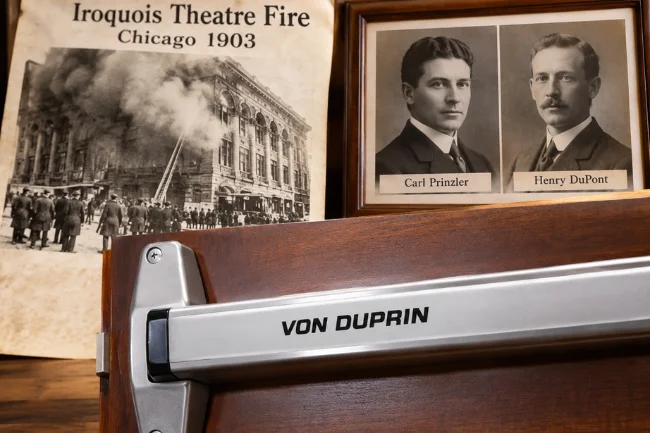
The history of Von Duprin dates back to the early twentieth century, following the devastating Iroquois Theatre fire in Chicago on December 30, 1903.
The disaster highlighted the dangers of poorly designed emergency exits.
In 1908, Carl Prinzler and Henry DuPont developed an emergency exit device that allowed a door to be released by pressing a bar.
The invention was commercialized with the involvement of the Vonnegut Hardware Company.
Interestingly, the name Von Duprin combines elements of three names:
- Vonnegut
- DuPont
- Prinzler
According to the Encyclopedia of Indianapolis, the invention helped establish modern emergency exit hardware.
Today, Von Duprin operates under Allegion, a global company specializing in security and access solutions.
How Do Von Duprin Exit Devices Work?
A Von Duprin exit device uses a mechanical releasing system connected to the door’s latch.
When someone presses the horizontal push pad or crossbar, the mechanism retracts the latch, allowing the door to open.
Once the pressure is released, the mechanism returns to its normal position. When the door closes correctly, the latch engages again unless an approved operating feature changes that behavior.
Main Components of an Exit Device
Most configurations contain several essential components.
The push pad or crossbar provides the interior operating surface. The latch mechanism secures the door, while the strike receives the latch when the door closes.
Exterior trim, when fitted, controls entry from outside through a lever, key cylinder, or another approved method.
Some models also include electronic switches, alarms, or motorized latch retraction.
I consider this combination especially useful because it allows security and emergency exit requirements to work together without making evacuation unnecessarily complicated.
Different Types of Von Duprin Exit Hardware
Not every commercial door requires the same locking arrangement. Von Duprin offers several device configurations to accommodate different door constructions and security needs.
| Exit device type | How it works | Common application |
|---|---|---|
| Rim exit device | Uses a surface-mounted latch that engages a frame-mounted strike | Single commercial doors |
| Surface vertical rod | Operates latches at the top and bottom through visible rods | Double doors and institutional entrances |
| Concealed vertical rod | Hides vertical locking components inside the door | Buildings requiring a cleaner appearance |
| Mortise exit device | Operates a lock mechanism installed within the door edge | Heavy-duty commercial openings |
| Concealed vertical cable | Uses concealed cables to operate remote latches | Selected double-door and architectural applications |
Rim Exit Devices
Rim devices are among the most straightforward configurations.
They are frequently selected for commercial doors because the primary locking mechanism is mounted on the door’s surface, making access for authorized maintenance relatively convenient.
Vertical Rod Exit Devices
Vertical rod devices provide additional latching points.
They can be useful on paired doors where a traditional central strike arrangement is unsuitable.
However, their effectiveness depends on correct alignment, compatible strikes, and the specific door assembly.
Mortise Exit Devices
Mortise configurations incorporate a lock case within the door.
They can offer a practical combination of security and architectural appearance, particularly in demanding commercial environments.
The correct choice depends on the opening rather than the assumption that one configuration is always stronger.
Popular Von Duprin Exit Device Series Compared
Von Duprin manufactures several product series for different traffic levels, door styles, and architectural requirements.
| Product series | Main characteristics | Suitable environments |
|---|---|---|
| 98/99 Series | Heavy-duty, wide-stile push-pad devices | Schools, hospitals, government buildings |
| 33A/35A Series | Heavy-duty, narrow-stile push-pad devices | Commercial and institutional doors |
| 22 Series | Economical option for medium- to low-traffic openings | Staff entrances, stairwells, retail facilities |
| 75/78 Series | Mid-priced options for narrow- and wide-stile doors | Warehouses, offices, commercial properties |
| 88 Series | Traditional wide-stile crossbar design | Historic and traditional buildings |
| 94/95 INPACT Series | Recessed push pads with reduced projection | Hospitals and high-traffic corridors |
Von Duprin 98 vs. 99 Series
One question buyers frequently ask concerns the difference between the Von Duprin 98 and 99 Series.
The primary difference is appearance.
The 98 Series features a smooth mechanism case, while the 99 Series has a grooved case.
According to Allegion’s technical guidance, neither series has a durability advantage over the other.
Von Duprin 33A vs. 35A Series
These models are designed for narrower door stiles.
The 33A features a grooved mechanism case, whereas the 35A has a smooth design.
Both offer heavy-duty performance and multiple configuration options.
For me, door compatibility and required functionality matter far more than cosmetic differences between closely related models.
Von Duprin Panic Hardware vs. Fire Exit Hardware
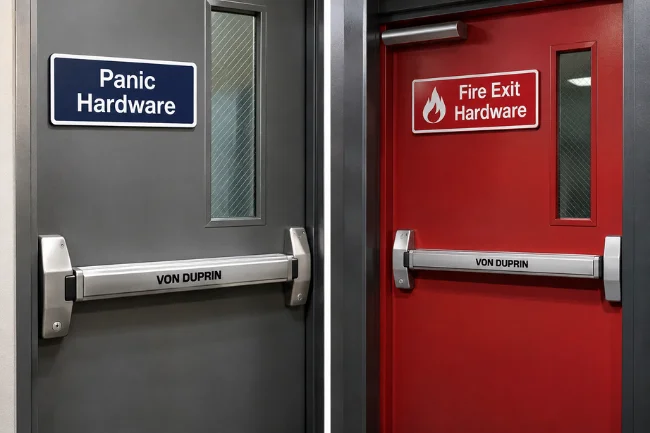
Although people often use these terms interchangeably, panic hardware and fire exit hardware serve different code requirements.
Panic Hardware
Panic hardware allows a door to open quickly through an approved releasing mechanism.
Some non-fire-rated devices include a feature called dogging.
Dogging temporarily holds the latch retracted, allowing the door to operate as a push-pull opening during normal business hours.
Fire Exit Hardware
Fire exit hardware must satisfy additional requirements for use on compatible fire-rated door assemblies.
Fire doors generally need positive latching so they can help limit the spread of fire and smoke.
For that reason, fire exit hardware cannot use ordinary mechanical dogging that leaves the latch permanently retracted.
Certain approved electric latch retraction arrangements can be used when the latches automatically project under the required fire-alarm conditions.
The distinction is not optional. Choosing a panic-only device for a fire-rated opening can create a serious compliance problem.
Building Codes and Safety Standards
Von Duprin products are available with certifications that support commercial building safety requirements.
Common standards include:
- ANSI/BHMA A156.3 for exit devices and their performance classifications.
- UL 305 for panic hardware.
- UL 10C for applicable fire-rated door assemblies and hardware.
- NFPA 80 for fire door assembly installation, inspection, testing, and maintenance.
- Applicable accessibility requirements under the Americans with Disabilities Act.
Many Von Duprin models carry ANSI/BHMA Grade 1 certification, although the exact listing must be verified for the chosen configuration.
Under Section 1010.2.8 of the 2024 International Building Code, panic or fire exit hardware is generally required for specified swinging doors serving Group H occupancies and rooms or spaces with 50 or more occupants in Groups A or E, subject to the stated exceptions.
Locally adopted codes may differ.
I would never treat a product’s general certification as proof that an entire door opening is compliant. The door, frame, latch, hardware, and installation all matter.
Electronic Access Control Features
Modern Von Duprin hardware offers more than mechanical emergency release.
Depending on the series and configuration, devices can be integrated with electronic security systems.
Quiet Electric Latch Retraction (QEL)
QEL allows compatible exit hardware to retract its latches electronically with reduced operating noise.
This can support automatic doors and controlled-entry environments.
Request to Exit (RX)
The RX feature monitors operation of the push pad and sends a signal when someone attempts to exit.
It is commonly used within electronic access control systems.
Latchbolt Monitoring (LX)
LX monitors latchbolt movement rather than simply detecting push-pad operation.
That distinction can help security personnel understand what is happening at an opening.
Alarm and Delayed-Egress Options
Certain configurations offer exit alarms or code-permitted delayed-egress functions.
These features can discourage unauthorized use of designated exits, but they require careful design and regulatory approval.
Electronic access control must never defeat required emergency egress. Power-loss behavior, fire-alarm integration, and approved release functions should be reviewed before installation.
How to Choose the Right Von Duprin Exit Device
Selecting exit hardware involves more than matching a product’s length to a door.
I would begin by understanding the complete opening and its daily operating conditions.
1. Identify the Door Type
Confirm whether the door is wood, hollow metal, aluminum, or another approved construction.
Measure the door width, thickness, and stile dimensions. Also determine whether it is a single door or part of a pair.
These details influence which models and fastening arrangements are suitable.
2. Determine Fire-Rating Requirements
Check the door and frame labels, approved hardware schedule, and applicable building requirements.
A fire-rated opening requires appropriately listed components, not merely a product described as heavy-duty.
3. Evaluate Traffic Levels
A hospital corridor may experience frequent movement of equipment, patients, and staff.
A secondary storage-room exit might operate far less frequently.
Selecting hardware appropriate to the expected usage can help avoid unnecessary repairs and premature replacement.
4. Consider Exterior Access
Not every emergency exit needs to allow entry from outside.
Some doors require exit-only operation, while others need keyed levers, card readers, or electrically controlled trim.
The desired outside function should be decided before ordering.
5. Plan for Future Maintenance
One overlooked consideration is long-term serviceability.
I recommend keeping a basic record for every important opening: its device series, model, fire rating, door dimensions, trim function, and electronic options.
This simple record can make future replacement-part identification considerably easier.
Von Duprin Installation: What Should You Know?
Proper installation is critical to the performance of any commercial exit device.
The process requires correct positioning, suitable fasteners, compatible strikes, and careful adjustment of the latching mechanism.
For fire-rated or electronically controlled openings, I strongly recommend qualified commercial door hardware professionals.
A poorly aligned strike can prevent full latching. Incorrect adjustments may also cause excessive operating force or unreliable door closing.
Installation should always follow the exact manufacturer’s instructions.
After installation, the complete opening should be tested for smooth operation, reliable latching, and any required electronic or fire-alarm functions.
Avoid drilling additional holes or modifying listed fire door assemblies without determining whether the modification is permitted.
Maintenance and Troubleshooting
Even durable commercial hardware needs periodic inspection.
Door alignment, repeated impacts, loose fasteners, and environmental conditions can affect performance over time.
Practical Maintenance Checks
I recommend incorporating the following checks into a facility’s maintenance program:
- Confirm that pressing the bar releases the latch smoothly.
- Verify that the door closes and latches consistently.
- Inspect the strike and visible fasteners for damage or looseness.
- Check that electronic monitoring and access functions operate correctly.
- Look for corrosion, unusual noise, or damaged components.
- Ensure that exit routes remain unobstructed.
Fire door assemblies also require inspections and testing in accordance with applicable regulations, including the adopted edition of NFPA 80.
Common Problems
A bar that feels unusually stiff may indicate misalignment or a mechanical problem.
A door that fails to latch could involve the strike, closer, latch mechanism, or door positioning.
Electronic faults can involve wiring, power supplies, or incompatible components.
I would avoid improvising repairs on emergency exit hardware. A trained technician should identify the cause and use approved replacement components.
Von Duprin Pricing and Long-Term Value
Von Duprin exit device prices vary considerably depending on the series, size, finish, trim, fire rating, and electronic functionality.
A basic mechanical rim device generally requires fewer components than a sophisticated electrified system with monitoring and access control.
Installation labor, power supplies, wiring, and modifications to existing doors also affect the total project cost.
For that reason, I prefer evaluating the total cost of ownership rather than comparing hardware prices alone.
A suitable product with accessible replacement parts and upgrade options may provide better long-term value than a cheaper device requiring extensive future modifications.
Common Mistakes to Avoid When Buying Von Duprin Hardware
One common mistake is purchasing replacement parts based only on visual similarity.
Two devices may look almost identical while having different internal components or installation requirements.
For example, Allegion advises that the newer 33A/35A center case is not interchangeable with the older 33/35 Series center case.
Another mistake is overlooking the importance of exterior trim, handing, or door thickness.
Buyers sometimes focus on the push bar and forget that the entire opening must function as a coordinated system.
I also recommend confirming the model identification and manufacturer-approved configuration before ordering replacement parts.
Von Duprin’s replacement-parts guidance explains that identification may be available through product markings, labels, stickers, or QR codes.
Is Von Duprin Worth Buying?
Von Duprin is a strong option for facilities that need dependable commercial exit hardware, multiple configuration choices, and support for future upgrades.
Its extensive range makes it suitable for everything from relatively simple staff entrances to demanding institutional applications.
However, premium hardware is not automatically necessary for every door.
I would judge the value by how well the selected device matches the opening’s safety requirements, expected traffic, available maintenance support, and budget.
The right specification matters more than choosing the most expensive model.
Final Thoughts
Von Duprin has played an influential role in commercial door safety for more than a century.
Its panic bars, fire exit devices, and electronic hardware solutions help buildings balance emergency access with everyday security.
If you’re planning a new installation or replacing existing hardware, start by identifying the door’s specifications and applicable safety requirements.
Then compare compatible Von Duprin models and consult a qualified hardware specialist before purchasing.
Frequently Asked Questions (FAQs)
1. What is Von Duprin used for?
Von Duprin manufactures commercial exit devices, panic bars, and fire exit hardware that provide emergency egress while supporting building security.
2. Is Von Duprin owned by Allegion?
Yes. Von Duprin is an Allegion brand specializing in commercial exit hardware, fire safety, and related access control solutions.
3. What is the difference between Von Duprin 98 and 99?
The 98 Series has a smooth mechanism case, while the 99 Series has a grooved case. Their durability is comparable.
4. Can Von Duprin panic bars be installed on fire doors?
Yes, but only appropriately listed fire exit hardware compatible with the fire-rated door assembly should be used.
5. How long do Von Duprin exit devices last?
Service life depends on usage, installation, environmental conditions, and maintenance. Regular inspections and approved repairs help maintain reliable operation.

Olivia Parker is a home improvement research writer with 8+ years of experience covering home design, renovation ideas, maintenance tips, and practical living solutions. She creates easy-to-follow content to help readers make informed decisions about improving their homes.