
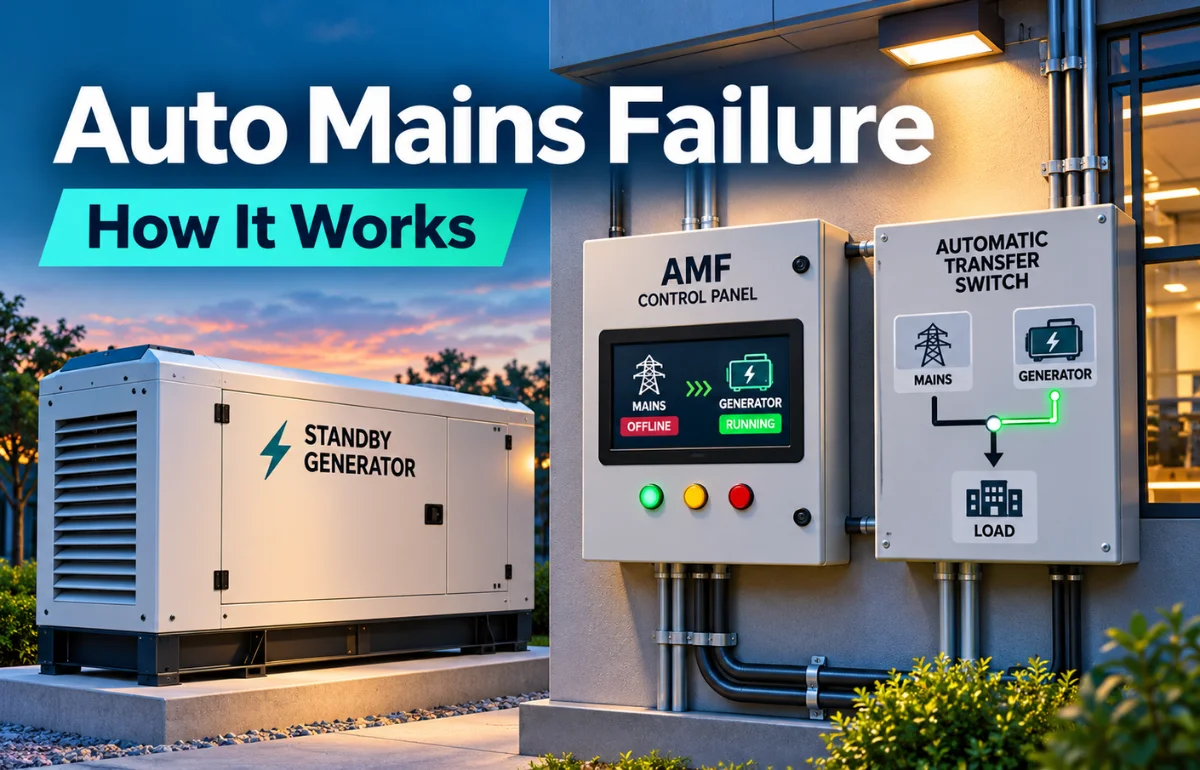
Auto Mains Failure (AMF) is an automatic power-control function that detects when the main electricity supply becomes unavailable or falls outside acceptable limits, starts a standby generator, and arranges for the electrical load to receive generator power. Once utility power returns and remains stable, the system transfers the load back and stops the generator after a cooling period. An AMF controller typically works with an appropriately rated transfer switch or interlocked contactors; the controller makes decisions, while the switching equipment connects the load to the selected source.
I find it useful to think of AMF as a supervisor for backup electricity. It watches the supply, checks whether the generator is ready, and controls when a changeover is permitted. That helps protect essential activities, although automatic operation does not mean zero interruption.
What Does Auto Mains Failure Mean?
“Mains” refers to electricity supplied by the utility grid. “Failure” covers more than a complete blackout: depending on the controller and its settings, it may include voltage that is too low or too high, unacceptable frequency, or a lost phase in a three-phase installation.
An AMF system responds to those conditions without requiring someone to start the generator manually. Advanced controllers also monitor engine oil pressure, coolant temperature, battery voltage, generator frequency, and alarms.
The goal is to supply designated circuits safely from an acceptable source. Exact behavior depends on the design and configuration.
How Does an Auto Mains Failure System Work?
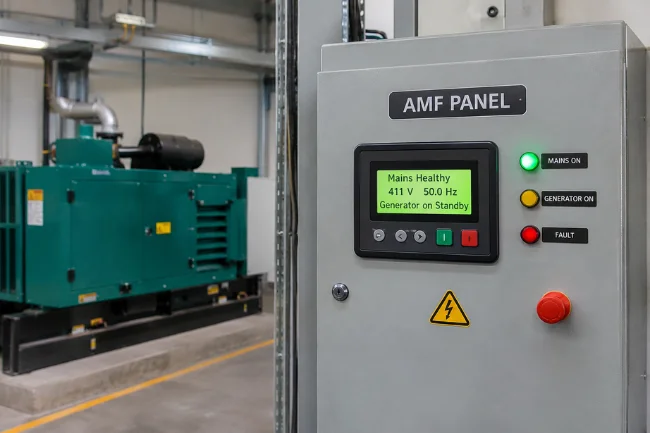
An AMF sequence is easier to understand when I separate the decision to start the generator from the decision to connect it to the building. Those are two different decisions, and a well-designed system checks both.
1. Monitoring Normal Utility Power
While grid electricity is healthy, the generator normally stays on standby. The controller measures the mains input against programmed operating limits. It may monitor all three phases rather than checking only whether a single indicator lamp is illuminated.
2. Confirming a Supply Failure
If the mains supply becomes unacceptable, a failure-confirmation timer may run before the generator receives a start command. This short delay helps prevent unnecessary starts during momentary disturbances. The delay must suit the installation.
3. Starting and Checking the Generator
The controller initiates the starting sequence. The battery, starter, and fuel system must work. After ignition, the system waits for the generator to produce acceptable voltage and frequency, with any required warm-up period.
A running engine alone is not proof that its electricity is safe to use. That explains why “generator running” does not always mean load transfer.
4. Transferring the Electrical Load
Once the alternate supply is acceptable, the controller or ATS commands the switching mechanism to disconnect the load from the utility and connect it to the generator. Standard open-transition systems disconnect one source before connecting the other.
Electrical and mechanical interlocking, as applicable, prevent accidental simultaneous connection. Safe isolation is essential because generator backfeed can endanger equipment, the utility, and workers.
5. Detecting Mains Restoration
When utility electricity returns, the controller checks whether it has stayed within acceptable limits for the configured return delay. This prevents the system from repeatedly changing sources during an unstable restoration.
After the required conditions are met, it transfers the load back to utility power. Retransfer behavior varies with the configuration.
6. Cooling Down and Returning to Standby
The generator usually continues running without the building load for a programmed cooling period, then shuts down. The controller remains ready for the next event. Alarm records and operating hours may be stored for maintenance review.
Main Components of an AMF Panel
An AMF panel combines sensing, control, switching, protection, and engine support.
AMF Controller
The electronic controller monitors the utility and generator, manages start and stop commands, applies time delays, and displays alarms. For example, Deep Sea Electronics’ DSE7320 MKII supports mains and generator sensing, engine protection, event monitoring, and configurable communications.
Transfer Switch or Interlocked Contactors
An automatic transfer switch (ATS), or suitably engineered contactor arrangement, physically selects the power source. It must be rated for the installation’s voltage, current, fault conditions, and applicable standards. The control module itself does not carry the building’s full electrical load.
Circuit Protection and Control Wiring
Breakers, fuses, wiring, relays, and protective devices help manage faults and control commands. Current transformers may provide extra load information.
Generator Starting and Support Systems
The battery, charger, fuel supply, engine controls, and generator alternator determine whether backup power will actually become available. A perfectly programmed AMF controller cannot compensate for an empty fuel tank or a failed starting battery.
Auto Mains Failure vs. Automatic Transfer Switch
AMF and ATS are frequently treated as interchangeable terms, but they describe different functions. In some products, an ATS contains the sensing and generator-start logic; in others, a separate AMF controller sends commands to external switching equipment.
| Feature | Auto Mains Failure (AMF) | Automatic Transfer Switch (ATS) |
|---|---|---|
| Main meaning | Control logic responding to unacceptable utility power | Equipment that transfers a load between power sources |
| Primary job | Detect, start, supervise, and manage the sequence | Connect the load to the selected acceptable source |
| Typical hardware | Generator controller or integrated control panel | Interlocked switching mechanism with controls |
| Works independently? | Needs suitable switching equipment for load transfer | May include its own detection and generator-start controls |
| Most useful question | “When should backup power be requested?” | “How is the load safely changed over?” |
The practical answer is not to choose AMF instead of ATS. It is to make sure the selected generator, controls, and transfer equipment operate as one compatible system. Eaton’s ATS fundamentals explain why the switching method matters, particularly for sensitive loads.
What Conditions Trigger AMF, and How Fast Is It?
A power cut is the obvious trigger, but a brownout can be just as disruptive. Low voltage may prevent motors from starting properly, while severe voltage or frequency deviations can make the utility supply unsuitable for connected equipment.
For a three-phase supply, loss of one phase or significant imbalance may also require action if the selected controller supports and is configured for that protection. Settings must reflect the equipment being supplied and the local electrical design.
Understanding the Total Changeover Time
I prefer to evaluate the complete outage timeline rather than quoting a single “AMF switching speed.” The total delay can include failure detection, generator cranking, stabilization, warm-up, and transfer-switch operation.
For example, if a system waits before starting, then the engine needs additional time to reach acceptable output; the building will experience more than the mechanical switch’s transfer time. Actual results vary by generator condition, settings, equipment, and load.
There is a second timing issue after restoration: the return delay. Setting it too aggressively may cause repeated switching if utility power flickers. Setting it too long keeps the generator operating unnecessarily. Both delays deserve commissioning tests rather than guesswork.
Where Are AMF Systems Used?
Homes and Residential Buildings
AMF can manage a fixed standby generator for selected household circuits, such as refrigeration, water pumps, lighting, and communications. Whether the generator can support air conditioning or other large appliances depends on proper sizing and load management.
Commercial Properties and Offices
Retail stores, offices, warehouses, and hotels use automatic backup arrangements to limit disruption to lighting, access control, security systems, and essential business operations. Priorities should be decided before installation.
Industrial and Critical Facilities
Factories may need controlled restarting of motors and machinery. Hospitals, laboratories, and data centers generally need more carefully engineered systems because some equipment cannot tolerate even a brief interruption. AMF may be one part of that design, alongside UPS equipment, redundancy, and facility-specific safety requirements.
Benefits and Limitations of Auto Mains Failure
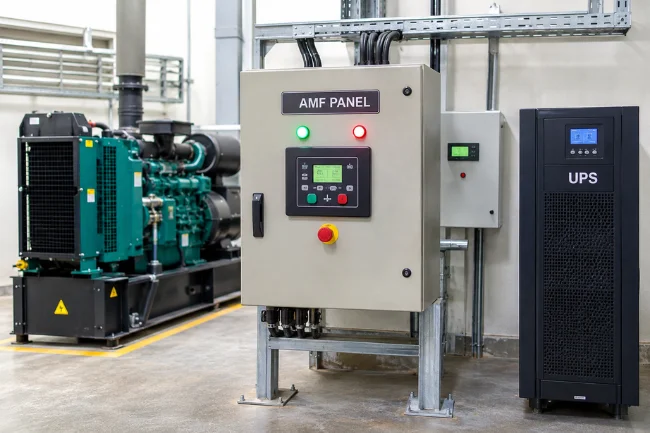
The largest benefit is unattended response. A suitable system can request generator power even when nobody is present to operate a manual changeover switch. It also supports repeatable startup and shutdown sequences and can reduce avoidable operator errors.
Monitoring and event logs are useful for maintenance teams, particularly when faults happen outside working hours. Some modern controllers also support remote status reporting, though communication features vary by model.
Still, AMF is not a guarantee of continuous electricity. It depends on fuel, battery health, generator readiness, functioning transfer equipment, and correct settings. A conventional standby generator may leave a gap between grid failure and backup power becoming available.
For computers, medical equipment, or process controls that require uninterrupted operation, a correctly sized uninterruptible power supply (UPS) may be needed to bridge that gap. The UPS and generator must be assessed together for compatibility and required runtime.
How to Choose the Right AMF Panel
I would start with the loads, not the controller’s screen or advertised feature count. A reliable design begins by identifying which circuits truly need backup power and how they behave at startup.
Match the Electrical Supply and Generator
Confirm whether the system is single-phase or three-phase, its nominal voltage and frequency, and the generator’s electrical and control interfaces. Verify the controller’s sensing range, supported engine type, start logic, and control supply requirements.
Account for Starting Current and Load Priorities
Generator sizing must consider more than adding up appliance wattages. Motors, pumps, and compressors can draw substantial starting current; power factor and load sequencing also matter. Critical circuits may need priority over comfort or nonessential loads.
Review Switching and Protection Ratings
Check the transfer equipment’s continuous current rating, voltage rating, short-circuit capability, number of poles, and neutral-switching arrangement where applicable. Select switching and protective devices through the appropriate electrical design process, not by matching only the generator’s kVA label.
Prioritize Serviceability
Readable alarms, event history, accessible documentation, compatible spare parts, and local technical support often provide more value than features that nobody uses. Ensure qualified technicians can commission the system and verify its configuration later.
Installation and Commissioning: What Should Be Tested?
AMF installation involves potentially lethal voltages and generator starting hazards. I would leave wiring, protective settings, phase verification, and load-transfer testing to qualified personnel working to applicable codes and manufacturer instructions.
A proper commissioning test should confirm utility sensing, generator starting, acceptable generator output, correct switching operation, safe source isolation, return-to-mains behavior, and engine cooldown. It should also check alarms and what happens when a start or transfer command fails.
A revealing test checks whether the complete system detects an outage, carries the intended load, and recovers safely. Schneider Electric’s example ATS test procedure demonstrates a complete start, transfer, retransfer, and cooldown cycle; its exact timing applies to that product, not every AMF installation.
Common AMF Problems and What They May Mean
| Symptom | Possible cause | Sensible next check |
|---|---|---|
| Generator does not start after utility failure | Controller not in Auto, weak battery, missing start signal, engine fault | Review operating mode and alarm history; arrange qualified diagnosis |
| Engine starts but load stays off | Generator voltage/frequency unacceptable, transfer inhibit, switch fault | Check displayed status and transfer alarms |
| Generator starts repeatedly | Unstable utility voltage, unsuitable delay settings, sensing fault | Review recorded mains values and controller settings |
| Utility returns but generator stays loaded | Return delay, utility still outside limits, retransfer setting | Confirm utility-healthy indication and programmed mode |
| Generator stops unexpectedly | Fuel, temperature, oil-pressure, overload, or other protective trip | Read shutdown code and correct the underlying fault |
I recommend recording alarms and events before resetting anything. “Generator failed” is less useful than knowing whether the controller issued a start command, whether the engine ran, and whether acceptable generator voltage appeared.
Do not bypass interlocks, defeat protective devices, or force a transfer to investigate a fault. Those actions can create a dangerous backfeed or equipment-damage condition.
AMF Maintenance: The Reliability Test That Matters
A standby generator can look ready for months and still fail on the day it is needed. I would keep maintenance focused on the complete power path rather than the engine alone.
Check the battery and charger, fuel condition, engine service intervals, controller alarms, transfer-switch condition, and relevant electrical connections according to manufacturer requirements. Record exercise results and investigate recurring warnings instead of simply clearing them.
Scheduled engine exercise is useful, but it may not verify the transfer mechanism or actual load performance. A supervised load-transfer test, performed at the manufacturer’s recommended interval and under site procedures, checks more of the system. Generac’s transfer-switch maintenance guidance illustrates why switching tests and inspections deserve separate attention.
A Better Way to Assess AMF Reliability
Here is a simple distinction I use when evaluating backup readiness: a generator start test measures engine readiness; a full transfer test measures system readiness. Neither test alone proves that every critical load will function correctly during a real outage.
For a more useful maintenance record, track three milestones: the time from utility failure to start command, the time until generator output becomes acceptable, and the time until essential circuits receive generator power. These pinpoint delays in sensing, starting, stabilization, or switching.
Compare results across several supervised tests. Any abnormal change deserves investigation by the service team.
Frequently Asked Questions
What is the full form of AMF in a generator?
AMF stands for Auto Mains Failure. It describes the function that detects unsuitable utility power and automatically manages standby generator operation.
Is an AMF panel the same as an ATS panel?
Not exactly. AMF refers to control and supervision; an ATS transfers the electrical load. Some panels combine both functions.
Does AMF start a generator automatically?
Yes, when it is correctly configured in automatic mode and detects a qualifying mains failure, provided the generator and its starting systems are healthy.
Can an AMF system work without a generator?
AMF logic can detect utility failure, but conventional generator-based backup cannot supply power without an available alternate source and suitable switching equipment.
Does an AMF panel provide uninterrupted power?
Usually not by itself. Starting and transferring to a standby generator takes time, so sensitive loads may need a UPS to bridge the interruption.
Final Thoughts
Auto Mains Failure makes standby power more responsive by coordinating utility monitoring, generator operation, and safe load transfer. Its real value comes from a correctly sized, properly installed, regularly tested system—not from automation alone.
If you’re planning or reviewing a backup-power installation, start with your essential load list and ask a qualified generator or electrical specialist to verify the AMF sequence, transfer arrangement, and test results before the next outage.

Noah Sterling is a technology research writer with 8+ years of experience covering emerging technologies, software trends, digital tools, and innovation. He creates practical, research-based articles to help readers understand the evolving technology landscape.