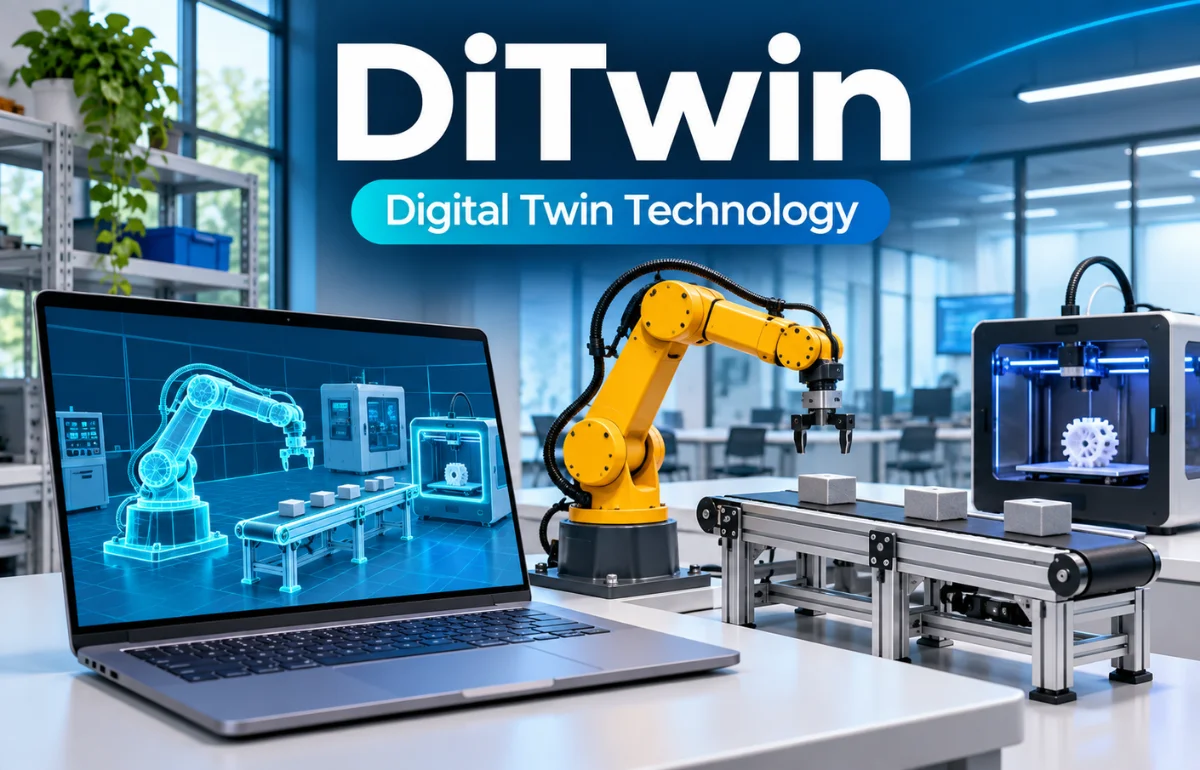
DiTwin is a name associated with several initiatives using digital twin technology, most notably a European educational project called “Digital Twin for VET Schools.” This project uses interactive virtual models connected to real industrial equipment, allowing students to learn about robotics, 3D printing, and automation through remote practical training. A digital twin is a virtual representation of a physical object, machine, or process that uses real-world information to support monitoring, simulation, and decision-making.
However, DiTwin is not simply another name for all digital twin technology. The term also appears in infrastructure research and industrial consulting. In this article, I’ll explain how the educational DiTwin platform works, what makes it useful, where the technology can be applied, and how to distinguish different projects using the same name.
What Is DiTwin, and What Does It Actually Mean?
The most clearly documented educational use of DiTwin refers to an Erasmus+ project created to make advanced industrial training more accessible to vocational education and training (VET) institutions.
Its central purpose is straightforward: help students gain practical technical experience even when their schools cannot afford expensive machinery or specialized laboratories.
Instead of relying entirely on traditional classroom demonstrations, teachers can introduce interactive models of industrial systems that connect with actual laboratory equipment.
For example, a student may develop instructions for a robotic arm inside a virtual environment and then observe those instructions being executed by a physical robot at a remote laboratory.
The European project began in October 2023 and had a scheduled completion date of January 31, 2026. Its educational resources include an online platform, technical learning modules, and teaching materials.
What interests me most about this approach is the connection between digital learning and physical results. Students are not limited to watching an animation. Under supervised conditions, they can test how their instructions behave on real equipment.
That distinction helps explain why DiTwin deserves attention beyond the educational technology market.
How Does DiTwin Technology Work?
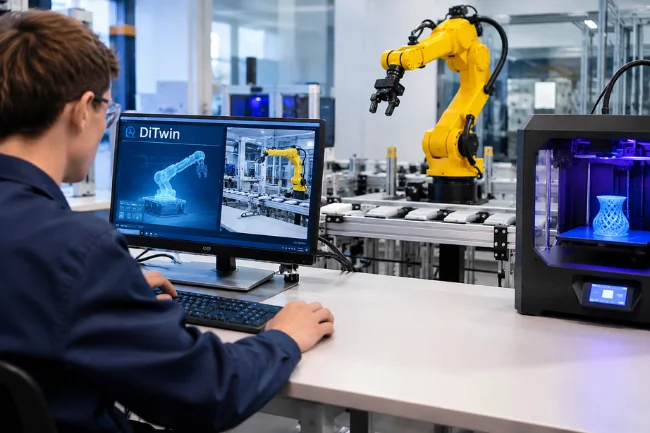
DiTwin combines digital modeling, simulation, remote connectivity, and physical equipment to create a learning environment where virtual activities can produce real-world results.
To understand its operation, I find it helpful to look at three connected elements.
1. Physical Machines and Industrial Equipment
Every practical training activity starts with equipment or a process that students need to understand.
This might be a robotic arm, an automated production system, or a network-connected 3D printer.
The physical machine follows real operating rules, including mechanical limitations, movement restrictions, and safety requirements.
2. Virtual Models and Digital Simulation
Software creates a digital representation of the equipment, allowing learners to explore its functions through a computer interface.
Students can examine system behavior, prepare instructions, and test supported operations before interacting with physical machinery.
Unlike an ordinary static 3D drawing, a connected digital twin can exchange relevant information with its physical counterpart.
The precise capabilities depend on the system. Some digital twins monitor equipment, while others support predictive analysis or controlled physical operations.
3. Communication and Real-World Feedback
The final connection allows information or commands to travel between the digital environment and the physical laboratory.
For instance, a learner may prepare robot instructions virtually, transfer them to the physical robotic cell, and observe execution through a webcam.
That feedback reveals differences between an expected outcome and actual machine behavior.
I consider this feedback loop one of the most valuable aspects of digital twin education. It turns abstract technical knowledge into something students can observe, question, and improve.
The Three Main Training Modules of DiTwin
The European DiTwin project developed three principal modules designed around technical competencies needed in modern industrial environments.
Each module addresses a different area of manufacturing or automation.
| DiTwin module | Main learning focus | Practical equipment |
|---|---|---|
| Additive Manufacturing Technician | 3D printing, file preparation, and production processes | Network-connected 3D printer |
| Automation Technician for Industry 4.0 | Automated production, control systems, and industrial processes | Modular smart factory |
| Robot Machines Technician for Industry 4.0 | Robotic programming, operation, monitoring, and safety | Robotic arm with sensors and conveyor |
These modules are documented in the project’s official 2026 training materials.
Additive Manufacturing Technician
Additive manufacturing involves producing physical objects by adding material, often layer by layer, based on a digital design.
Through this module, students learn about 3D printing systems, production preparation, file management, and machine operations.
The associated remote laboratory uses a connected 3D printer. Learners can prepare work digitally, send generated instructions to the equipment, and observe the printing process.
This helps connect computer-aided design knowledge with real manufacturing activities.
Automation Technician for Industry 4.0
Modern factories increasingly depend on interconnected machines, programmable controllers, and automated production processes.
This module introduces students to industrial automation, mechatronics, robotics, electrical engineering, and related control technologies.
Its remote laboratory incorporates a modular smart factory designed to reproduce industrial automation scenarios.
Students can explore how separate components operate together rather than treating every machine as an isolated device.
Robot Machines Technician for Industry 4.0
Industrial robotics requires more than understanding how a robotic arm moves.
Technicians also need to recognize operating limits, program tasks, monitor performance, and identify potential safety concerns.
DiTwin’s robotic laboratory includes a collaborative robotic arm, proximity sensors, and a conveyor system.
Learners can work with a digital representation of the robotic cell and, during supported remote sessions, observe corresponding physical operations.
One detail worth highlighting is that the wider DiTwin competence framework identified 11 professional profiles, but the published practical modules focus on three. The competence framework should not be confused with the number of available laboratories.
What Does Learning With DiTwin Look Like?
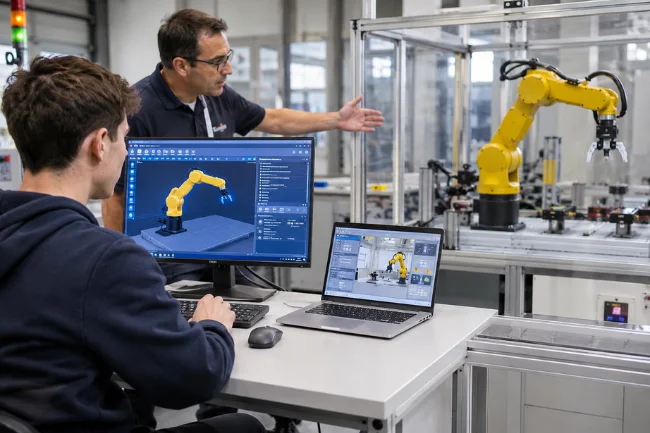
Consider a vocational student learning industrial robotics.
In a conventional classroom, the instructor might explain robotic movement using diagrams, recorded demonstrations, or limited laboratory exercises.
With a digital twin-based lesson, the student can interact with a virtual robotic system and examine how programmed instructions affect its behavior.
A teacher can then use the connected laboratory to demonstrate how those instructions perform on physical equipment.
Suppose the virtual program appears correct, but the physical operation produces an unexpected result.
That difference creates an opportunity to investigate the underlying issue.
Was the instruction sequence appropriate? Did the physical system have a limitation that the student overlooked? Was the expected movement consistent with the equipment’s configuration?
These are examples of questions I would build into a practical lesson, rather than claims about a particular completed DiTwin experiment.
The value comes from encouraging students to understand why something works, not merely memorize which commands to enter.
DiTwin vs. Traditional Simulation: What’s the Difference?
A digital twin and a traditional simulation can look similar on a computer screen, but their purposes and connections to physical systems may differ.
The following comparison helps clarify the distinction.
| Feature | Traditional simulation | DiTwin educational system |
|---|---|---|
| Main purpose | Analyze or practice modeled scenarios | Develop industrial skills through connected learning |
| Physical equipment | May operate without a physical connection | Supported modules connect to remote laboratory equipment |
| Feedback | Generated by simulation models | Can include observations from real equipment |
| Accessibility | Depends on the software | Online modules with scheduled laboratory access |
| Typical audience | Engineers, researchers, students | Primarily vocational teachers and students |
| Practical interaction | Usually remains within the simulation | Can include transferring instructions to physical machines |
A simulation is not automatically a digital twin simply because it contains a realistic 3D model.
However, the distinction is not absolute. Digital twins may also operate temporarily without a live connection while exploring hypothetical scenarios.
The UK government’s 2025 digital twin definition recognizes connected, semi-connected, and disconnected operating states.
For me, the more useful question is whether the virtual system accurately represents the relevant physical behavior and provides information that improves learning or decisions.
Key Benefits of DiTwin for Education and Industry
Greater Access to Expensive Equipment
Industrial machinery can be costly to purchase, install, operate, and maintain.
Smaller vocational institutions may struggle to provide every student with access to advanced robotic systems or automated manufacturing laboratories.
Remote laboratory arrangements offer a practical alternative.
Instead of requiring every school to own specialized equipment, students can access supported learning activities through shared facilities.
This does not eliminate operating costs, but it can reduce the need for duplicated physical infrastructure.
Safer Opportunities for Technical Practice
Industrial machinery demands careful supervision.
An incorrect instruction can damage equipment or create safety risks if executed without appropriate controls.
Virtual practice allows students to explore supported operations before physical execution.
However, simulation does not remove the need for proper supervision, safety procedures, and machine-level protections.
Stronger Connections Between Theory and Practice
A student may understand the definition of a programmable logic controller without knowing how its instructions affect a production process.
Interactive training helps make that relationship visible.
The same principle applies to robotic movement, machine monitoring, and manufacturing preparation.
Better Support for Technical Teachers
DiTwin also provides educational resources for instructors.
The project’s handbook includes guidance on digital twin technology, practical teaching strategies, virtual laboratories, and the integration of technical modules into classroom activities.
This is particularly useful because introducing unfamiliar equipment into a curriculum requires more than installing software.
Teachers need clear learning objectives, suitable activities, and reliable ways to assess student understanding.
Where Else Can Digital Twin Technology Be Used?
The technologies behind DiTwin extend well beyond vocational education.
In manufacturing, digital twins can help engineers monitor equipment, analyze production behavior, and evaluate possible improvements.
In infrastructure management, models can combine inspection information and sensor measurements to support maintenance planning.
Energy facilities can use virtual representations to examine system performance and investigate operational changes.
Buildings and transportation systems can also benefit from digital models that reflect relevant physical conditions.
These are broader digital twin applications, not necessarily features offered by the educational DiTwin platform.
I make that distinction because readers sometimes assume every digital twin solution provides predictive maintenance, artificial intelligence, remote control, and automatic optimization.
Actual capabilities vary considerably between products and projects.
Challenges and Limitations of DiTwin
Despite its potential, DiTwin is not a complete replacement for conventional technical education.
Connectivity and Equipment Availability
Remote training depends on functioning equipment, network connectivity, and access to the laboratory.
A student may be able to explore digital learning material independently while still needing a confirmed session to interact with physical machinery.
Connection problems or laboratory scheduling restrictions can interrupt the experience.
The Gap Between Virtual and Physical Behavior
A virtual model represents selected aspects of an actual system.
It may not reproduce every mechanical characteristic, environmental condition, or unexpected equipment fault.
Students therefore need opportunities to compare simulated outcomes with actual performance.
Cybersecurity and Operational Safety
Remote access creates additional security responsibilities.
Institutions must manage authentication, permissions, communication channels, and access to equipment controls.
Sensitive operational data should be protected, and remote instructions should never bypass physical safety systems.
The US National Institute of Standards and Technology specifically addresses cybersecurity and trust considerations in its 2025 report on digital twin technology.
Measuring Educational Effectiveness
Access to advanced technology does not automatically guarantee better learning.
A school should evaluate whether students demonstrate improved technical competence, problem-solving skills, and practical understanding.
I would also examine completion rates, instructor feedback, equipment availability, and the quality of student assessments before making claims about educational effectiveness.
How Can Students and Teachers Access DiTwin?
The European educational platform is available through its official website, ditwin.eu.
Its published access process begins with choosing a learning module and submitting a reservation request for the desired training period.
The laboratory team then coordinates the lesson, confirms arrangements, and provides the technical information required for participation.
The platform identifies the University of Málaga and Digital Smart as organizations involved in managing physical laboratory access.
For supervised remote sessions, the published instructions describe online communication with staff and the use of AnyDesk for remote desktop access.
Students should follow the current instructions provided by authorized laboratory personnel rather than attempting to connect directly to industrial equipment.
Although the project describes its online platform as free, the availability of a particular remote laboratory session should be confirmed through the official reservation process.
How to Evaluate Whether a DiTwin Solution Is Worth Using
When I assess the practical value of a digital twin learning system, I focus on its teaching purpose rather than the appearance of its interface.
A visually impressive model is useful only when it supports a meaningful learning objective.
For example, a robotics module should help students understand programming logic, movement constraints, equipment behavior, and operational safety.
I would also examine how closely the virtual model matches the physical equipment.
If a training exercise produces a different result in the laboratory, students should have enough information to investigate that difference.
Accessibility matters too.
An effective learning environment should provide understandable instructions, manageable technical requirements, and appropriate support for instructors.
Finally, I would consider whether the activities develop transferable skills.
Learning to operate one particular interface has value, but understanding industrial control principles is more useful across different workplaces and technologies.
Other Organizations and Projects Using the Name DiTwin
The name DiTwin is not exclusive to the European education initiative.
Understanding the differences helps readers avoid confusing unrelated projects.
DiTwin Road Infrastructure Research
An Austrian research initiative named DiTwin focuses on digital twin technology for road condition monitoring and infrastructure management.
The project investigates the integration of sensor information, pavement condition data, and predictive models to support maintenance decisions.
Its documented research approach includes road measurements, digital visualization, and analysis of potential infrastructure management improvements.
The project was scheduled to run from October 2023 through September 2026.
Unlike the educational platform, this DiTwin initiative focuses on road infrastructure and asset management.
Ditwin AB in Sweden
Ditwin AB is a Swedish industrial consulting company focused on digital transformation, product development, production processes, and sustainability.
Its services include industrial software, technical consulting, training, and support for manufacturing companies.
The company also identifies Siemens Digital Industries Software as a technology partner.
Although the name is similar, this business should not be confused with the Erasmus+ educational project or the Austrian infrastructure research initiative.
The Future of DiTwin and Digital Twin Learning
Digital twin technology offers opportunities to connect technical education more closely with changing industrial requirements.
For educational platforms such as DiTwin, future improvements could involve more realistic simulations, additional machinery, stronger assessment tools, and better integration with classroom curricula.
Artificial intelligence may also play a role in analyzing system behavior or providing personalized feedback, although these capabilities should not be assumed to exist in every DiTwin module.
A particularly promising direction is blended technical education, where students learn fundamental concepts locally and use shared remote laboratories for specialized practice.
The long-term value will depend on reliability, accessibility, instructor preparation, and demonstrable learning outcomes rather than technology adoption alone.
Frequently Asked Questions About DiTwin
What is DiTwin used for?
The European DiTwin platform supports vocational education through digital twin-based training in robotics, industrial automation, and additive manufacturing.
Is DiTwin free to use?
The educational project describes its online platform as free. Access to physical remote laboratories involves a reservation and confirmation process.
Who can benefit from DiTwin?
Vocational students, teachers, technical training institutions, and organizations interested in Industry 4.0 skills can benefit from its educational resources.
Is DiTwin the same as digital twin technology?
No. Digital twin is the broader technological concept, while DiTwin is a name used by specific educational, research, and industrial initiatives.
Does DiTwin require expensive hardware?
Students do not necessarily need to own industrial machinery. Supported activities use remote laboratory equipment, although a suitable computer and reliable internet connection are needed.
Final Thoughts
DiTwin demonstrates how digital twin technology can help connect technical education with real industrial practices.
Its educational platform offers a way to explore manufacturing, robotics, and automation through virtual models and remotely connected equipment.
I believe its strongest value lies in making specialized practical learning more accessible while preserving the connection to physical machinery.
If you’re interested in incorporating digital twin technology into technical education, explore the official DiTwin learning modules, review the teaching handbook, and identify which activities best match your learning objectives.

Noah Sterling is a technology research writer with 8+ years of experience covering emerging technologies, software trends, digital tools, and innovation. He creates practical, research-based articles to help readers understand the evolving technology landscape.