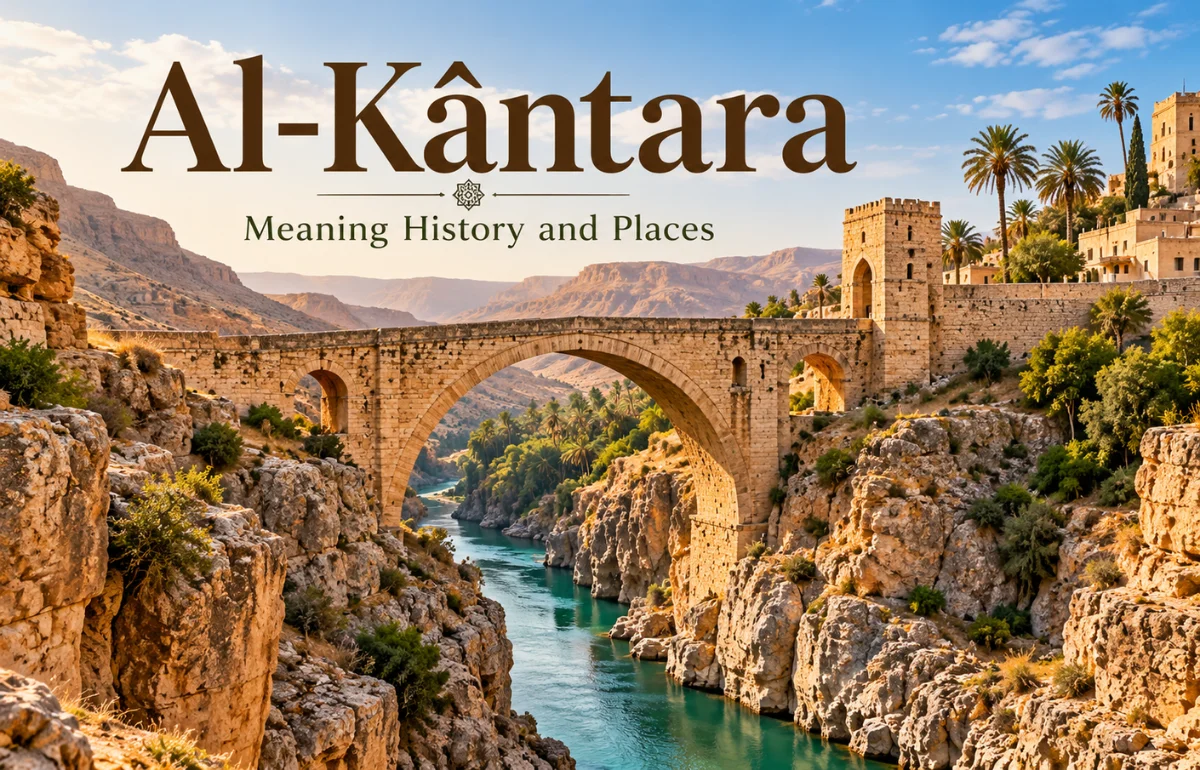
Al-Kântara is a spelling of the Arabic expression al-qanṭara (القنطرة), meaning “the bridge.” The term is associated with locations in North Africa, Egypt, Spain, and Portugal, but it does not identify one single monument or town. Depending on the context, a reference to Al-Kântara might point to a desert gateway in Algeria, a Roman bridge in Spain, or a crossing near the Suez Canal.
I find the most revealing part of this name is the question it raises: why did a crossing become important enough to name an entire place? The answer takes us beyond vocabulary into geography, engineering, settlement, and the ways people remember their landscapes.
What Does Al-Kântara Actually Mean?
The essential meaning is straightforward. In Arabic, qanṭara refers to a bridge, often one built in masonry or formed with an arch. Adding al- gives the definite sense “the bridge.” It is documented in Lane’s Arabic-English Lexicon and survives in geographic names.
Why Are There So Many Spellings?
You may encounter Al-Kântara, Al-Qantara, El Kantara, El Qantara, or Alcántara. These forms reflect different writing systems, regional pronunciation, and conventions for turning Arabic sounds into Latin letters.
The Arabic letter qāf is usually represented by “q” in scholarly transliteration, although “k” often appears in familiar place names. The article can be written al- or el-, while Spanish and Portuguese spelling developed their own established forms. The circumflex in “Kântara” is not part of a universal English transliteration standard.
A Word Is Not a Building Date
Here is a detail that changes how I read old maps: a bridge can be older than the language used to name it. A Roman crossing may have received an Arabic name centuries after its construction, and that name may have survived through later political changes.
The opposite assumption is risky. A name derived from Arabic does not automatically mean that Arabic-speaking builders constructed the surviving bridge. Dates, inscriptions, archaeological evidence, and restoration records are needed to establish who built what.
How Al-Kântara Became a Place Name
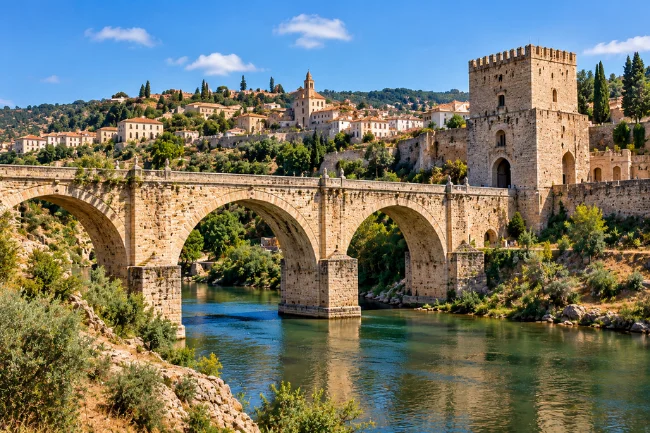
Once a bridge becomes a landmark, describing a destination as “the bridge” is perfectly practical. Over generations, the description can turn into the recognized name of a neighborhood or settlement. Even if the original structure is repaired, replaced, or lost, the name may continue.
That is why Al-Kântara belongs to the study of toponymy, the history and meaning of place names. It can reveal a landscape’s former function, but it should be read alongside physical and documentary evidence.
For a quick overview, these are some of the best-documented places connected with this family of names.
| Place or landmark | Location | What makes it distinctive |
|---|---|---|
| El Kantara | Near Biskra, Algeria | A mountain gorge, historic crossing, and oasis settlements |
| Alcántara | Extremadura, Spain | A monumental Roman bridge over the Tagus River |
| Alcántara Bridge | Toledo, Spain | A historic city entrance with Roman origins and later rebuilding |
| Alcântara | Lisbon, Portugal | An urban district whose name recalls a former stream crossing |
| El Qantara | Ismailia area, Egypt | A strategically significant route across the Suez Canal |
El Kantara, Algeria: A Gateway Between Two Landscapes
Among the most evocative examples is El Kantara in northeastern Algeria, north of Biskra. Here, the name is tied to a narrow passage through rocky terrain where an old crossing links the highlands with the country approaching the Sahara.
The setting explains much of its historical importance. Mountain walls create a restricted passage, while palms and cultivated land introduce an oasis landscape nearby.
The Gorge and the Historic Crossing
The bridge associated with El Kantara has Roman roots and a later history of repair. Older geographical accounts describe the site’s connection with an ancient route, although identifying every Roman-era place name with certainty is difficult.
I would avoid describing the existing masonry as untouched Roman construction. Bridges that remain useful for centuries often accumulate repairs, altered road surfaces, and structural interventions. Their historical significance comes partly from that continuing use.
The Villages Tell an Equally Important Story
The area’s cultural value goes beyond stonework. Research on traditional architecture describes settlements known as the Red, White, and Black villages, each associated with distinct parts of the local landscape and community history.
The Red Village, or Dachra Hamra, receives particular attention in architectural scholarship for its preserved traditional character. Local building forms reflect the meeting of mountain and oasis environments, including the use of materials and layouts suited to the climate.
For me, this is the more interesting way to understand El Kantara: not as a bridge photographed from one viewpoint, but as a living place where geography, everyday housing, and inherited routes interact.
Alcántara, Spain: A Roman Bridge With an Arabic Name
The town of Alcántara lies in Spain’s Extremadura region, in Cáceres province, near the Portuguese border. Its name comes from the same Arabic linguistic family, while its celebrated bridge belongs to the Roman period.
Spanning the Tagus River, the bridge was built in the second century CE. Spain’s official tourism information describes six semicircular arches and a central honorary arch dedicated to Emperor Trajan. A small temple also preserves the name of the builder, Gaius Iulius Lacer.
That combination makes the site especially useful for understanding Al-Kântara. Roman engineering survives beneath a place name shaped by later Arabic usage. Both histories are genuine; neither cancels the other.
Why the Alcántara Bridge Matters
Its design demonstrates how Roman engineers approached a substantial river crossing with carefully arranged stone arches. Medieval and early modern societies inherited the structure, made use of its location, and passed on a name that continued to identify the settlement.
The site illustrates how different periods can leave different kinds of evidence in the same place.
The Other Alcántara Bridge in Toledo
There is another Spanish landmark that regularly causes confusion: Toledo’s Alcántara Bridge. It is not the famous six-arched bridge near the Portuguese border.
Toledo’s crossing stands on the Tagus River beside the historic city. According to Spain’s official tourism portal, it has Roman origins and was rebuilt during the era of Almanzor. It also formed an important entrance into Toledo, where movement of people and goods could be controlled.
A bridge can be infrastructure, a defensive approach, and an administrative checkpoint at the same time. When researching Al-Kântara, specifying “Toledo” or “Cáceres” prevents two distinct monuments from being mixed together.
Alcântara, Lisbon: When the Bridge Disappears but the Name Remains
Lisbon offers a different kind of evidence. Alcântara is now an urban district, yet its name is associated with an old bridge over the Ribeira de Alcântara, a local stream.
Lisbon’s municipal history describes a stone bridge of Roman origin that disappeared amid changes to the area during the nineteenth century. The watercourse was subsequently altered and increasingly enclosed as transport and urban infrastructure expanded.
A visitor today may notice streets, railways, buildings, and modern activity rather than the original crossing. Nevertheless, the name preserves a memory of the former landscape.
What Lisbon Adds to the Bigger Picture
Unlike the bridge at Alcántara in Spain, the historic structure behind Lisbon’s name is no longer the obvious landmark. The word has outlived its original physical reference.
Place names may preserve evidence of old rivers, gates, markets, and routes long after urban redevelopment has changed what visitors can see. Sometimes the name is the first clue that a missing feature existed at all.
El Qantara, Egypt: A Modern Crossing With an Ancient Idea
In Egypt, El Qantara is associated with the Suez Canal area, a critical link between the African side of the country and the Sinai Peninsula in Asia.
The geography makes the name particularly fitting. Here, the story extends beyond ancient masonry into large-scale modern infrastructure.
The Suez Canal Peace Bridge, also called the Japan–Egypt Friendship Bridge, was completed in 2001. The Japan International Cooperation Agency records the project as an effort to strengthen access between Sinai and the rest of Egypt. Its central cable-stayed structure was designed to preserve clearance for shipping on the canal below.
I would not confuse this modern bridge with the origin of the much older place-name tradition. Instead, Egypt shows how a location historically understood as a crossing can remain strategically relevant even when the technology of crossing changes completely.
What Historic Bridges Reveal About Cultural Exchange
It is tempting to organize the history of Al-Kântara into separate boxes labeled Roman, Arab, medieval, and modern. Actual places are rarely that tidy.
A Roman road might later serve merchants speaking Arabic. A crossing could become part of a fortified medieval approach, then be repaired for vehicles in a later century. The bridge stays in approximately the same place because the terrain continues to make that route useful.
Geography Often Outlasts Political Borders
Rivers and mountain passes create practical constraints that rulers cannot simply remove. They encourage settlement at manageable crossing points. The Arabic name may reveal when a place entered a particular linguistic tradition, but the route beneath it could have a much longer history. In that sense, the history of the crossing and the history of its name are related, but not identical.
Bridges Also Connect Languages
Arabic left a lasting mark on Iberian place names. Alcántara and Alcântara are recognizable examples because they retain the sense of a bridge while following the spelling conventions of Spanish and Portuguese.
Rather than treating borrowed words as curiosities, I see them as evidence that ordinary speech can preserve historical relationships long after languages and political boundaries change.
How to Identify the Right Al-Kântara in Historical Sources
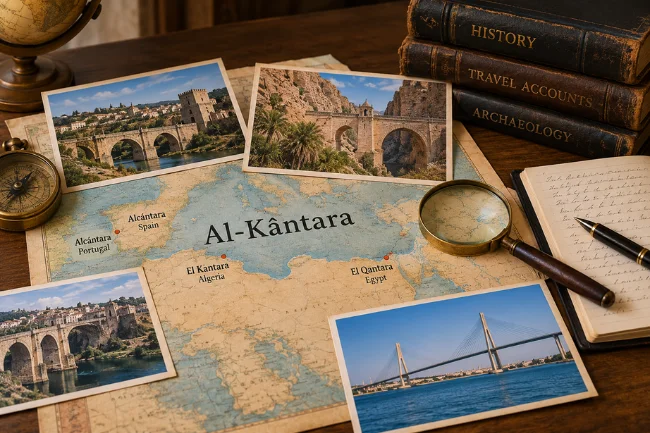
One problem rarely addressed in quick explanations of this name is how easily records from different locations can become entangled. A travel account mentioning “the bridge” may be referring to a town, an individual structure, or a wider district.
I use three questions to keep the evidence clear. First, which river, gorge, or road is nearby? Second, what date and political setting does the source describe? Third, is the author naming a settlement or the structure itself?
Compare the Evidence, Not Just the Spelling
A similar name is a starting point, not a complete identification. Consider the difference between the evidence available for several sites.
| Type of evidence | What it can tell us | What it cannot prove alone |
|---|---|---|
| Place name | A crossing was prominent in local memory | Who originally built the bridge |
| Inscription | A documented person, dedication, or period | That every visible stone is original |
| Architectural study | How a structure or village developed | The complete history of every resident |
| Historic map | Earlier roads, watercourses, and locations | That a crossing still exists today |
| Restoration record | When major work changed a structure | Its exact original appearance |
This distinction is useful for travelers, students, and anyone writing about heritage. It prevents an attractive story from becoming an unsupported claim.
Why Al-Kântara Still Matters Today
I believe the most valuable insight is that bridges are both physical solutions and cultural landmarks. They make movement possible, but they also shape where people meet, trade, settle, and remember.
In Algeria, the surviving oasis villages place local architecture alongside the famous crossing. In Spain, Roman structures carry names influenced by later Arabic-speaking communities. In Lisbon, a vanished bridge survives through an urban name. In Egypt, modern engineering keeps the importance of crossing a geographic divide in view.
The name helps us compare how different societies responded to different obstacles.
There is also a preservation lesson here. Protecting a historic bridge should involve its setting, access routes, and neighboring communities, not just its most photogenic arch. If a riverbank is damaged or a traditional settlement is neglected, part of the bridge’s story can disappear even while the structure remains standing.
Practical Advice for Exploring Al-Kântara Heritage
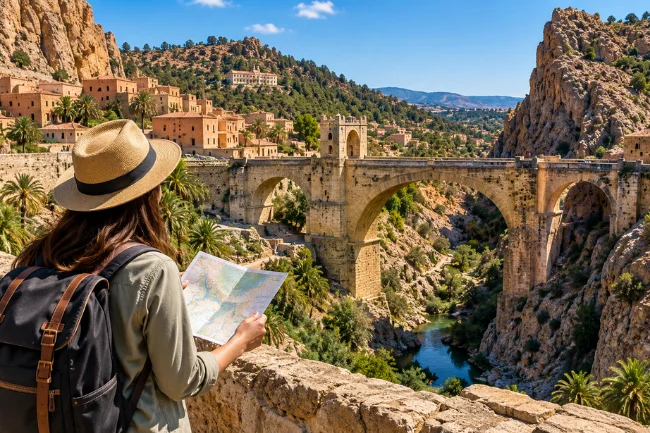
If I were researching one of these places for a visit, I would begin with its full geographic name rather than the general term alone. “El Kantara, Biskra” and “Alcántara Bridge, Cáceres” lead to very different travel plans.
For the Algerian site, the gorge and traditional settlements deserve attention alongside the bridge. For Spain, I would distinguish Alcántara in Extremadura from the bridge in Toledo. In Lisbon, I would explore the historical stream corridor and look for municipal accounts of how the district changed.
Travel conditions, access restrictions, and restoration work can change. Before going, check local heritage authorities and current transport information rather than assuming that a landmark or viewpoint is always accessible.
Common Misunderstandings Worth Avoiding
The first mistake is assuming every Al-Kântara refers to the same place. The name has several geographic descendants, each with a separate local history.
The second is assuming an Arabic-derived name proves Islamic-period construction. The Roman bridges associated with Alcántara in Spain show why that claim fails.
The third is treating a bridge as unchanged since antiquity. Even when the historic core survives, repairs and rebuilding can alter its appearance and function.
Finally, the name should not be confused with unrelated modern uses of “Alcantara,” such as the commercial name of a synthetic upholstery material. A shared spelling does not make a product part of a particular bridge’s architectural history.
A Name That Invites a Closer Look
Al-Kântara begins with a simple definition: “the bridge.” Its fuller meaning emerges when I look at the crossings, settlements, and languages connected with it. Some bridges remain visible, some have been rebuilt, and others survive mainly through place names.
If you encounter Al-Kântara on a map, in a book, or while planning a journey, start by identifying the exact location. Then look for the landscape and historical evidence behind the name. You may discover a much richer story than the translation alone suggests.
Frequently Asked Questions
What does Al-Kântara mean in English?
Al-Kântara comes from Arabic al-qanṭara and means “the bridge,” commonly referring to a bridge or a place named after one.
Where is Al-Kântara located?
It is not one location. Related names appear in Algeria, Egypt, Spain, and Portugal, among other places.
Is the Alcántara Bridge Roman or Islamic?
The famous Alcántara Bridge in Cáceres, Spain, is Roman. Its Arabic-derived name reflects a later layer of the region’s history.
What is El Kantara in Algeria famous for?
It is known for its dramatic gorge, historic bridge, oasis setting, and traditional villages near Biskra.
Are Al-Kântara and Alcántara the same word?
They belong to the same Arabic-derived name family, but their spellings and the places they identify differ by language and region.

Liam Anderson is a travel research writer with 9+ years of experience covering destinations, travel planning, cultural experiences, and practical travel guides. He creates informative content to help readers discover places with better insights and preparation.