MyMakeUp.com is a website address that appears in beauty-related searches, but its current operator, services, and shopping features could not be independently verified from an accessible official website during my October 2026 review. It is not the same address as Makeup.com, the beauty editorial website, or Match My Makeup, a separate foundation shade-matching service.
If you came across MyMakeUp.com while searching for cosmetics, makeup reviews, or a tool to find your foundation shade, the most useful first move is to establish which service you are actually visiting. I attempted to access the exact domain while researching this article, but it did not return a usable page.
I therefore cannot claim to have tested its features, placed an order, or examined its customer service. What follows separates what is known from what still needs checking—and helps you make a sound beauty decision either way.
Why Is There Confusion Around MyMakeUp.com?
The beauty internet is full of similar names. Add one word, remove a space, or rearrange a domain, and you can land on a completely different company. This matters more than it might seem. A positive review of one website does not establish anything about another, even when the names sound identical.
I found a third-party article describing “mymakeup.com” as a scientific shade finder with virtual try-on features. However, those specific functions are publicly described on the official website of Match My Makeup, which has a different domain. I could not establish that the two services are connected.
Likewise, Makeup.com is a beauty content website operated by L’Oréal. Its tutorials, product reviews, and editorial material should not be attributed to MyMakeUp.com. Similar branding is not proof of shared ownership.
| Name or address | What can be verified | What readers should remember |
|---|---|---|
| MyMakeUp.com | The exact domain could not be reviewed as an operating website during this check | Features, prices, ownership, and purchase policies remain unconfirmed |
| Makeup.com | An established L’Oréal beauty editorial website | It publishes beauty content; it is a different domain |
| MatchMyMakeup.com | A foundation and lip-color matching platform with a public explanation of its tools | Do not assume its technology belongs to MyMakeUp.com |
Domain spelling is part of the product identity, not a minor technicality.
What Can I Actually Verify About MyMakeUp.com?
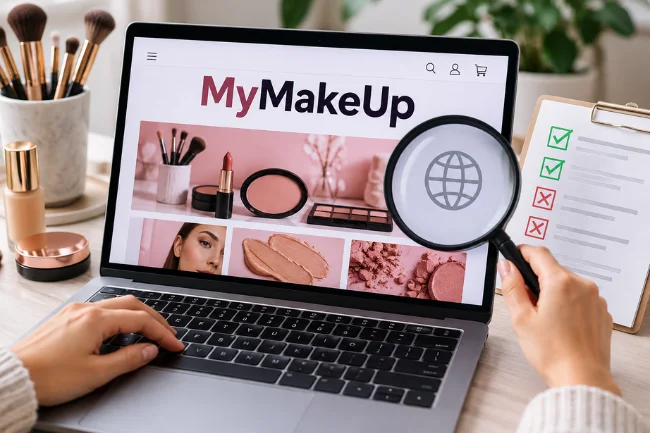
At the time of writing, I could not confirm a live catalogue, an About page, the legal operator, or an official list of services at the exact MyMakeUp.com address. I also could not verify claims about free accounts, a mobile app, supported makeup brands, subscriptions, international delivery, or a scientific matching algorithm.
This does not prove that the domain is fraudulent or permanently offline. Websites can be temporarily inaccessible, restrict automated requests, or change direction. It simply means there is not enough independently checkable evidence for an authoritative recommendation.
The Details I Would Look for First
Before treating MyMakeUp.com as an online makeup store or beauty tool, I would look for a clearly identified business, working contact details, transparent terms, and a consistent description of what the website does.
If it sells cosmetics, I would also expect product brands, ingredient information where applicable, shade names, quantities, delivery destinations, and a refund policy. If it offers virtual makeup try-on, I would expect a privacy notice explaining whether facial images are uploaded, stored, or shared.
None of those features should be assumed simply because a search result mentions them.
Understanding Online Foundation Shade Matching
One reason people may encounter this name is the growing interest in beauty technology. Buying foundation online is convenient, but screen colors, store lighting, and inconsistent shade names make choosing difficult.
Some genuine shade-finding services compare a foundation you already own with comparable shades in other brands. Others ask about skin depth and undertone, while certain virtual try-on experiences use a camera or photograph to simulate the result. These are categories of technology, not verified MyMakeUp.com features.
The official Match My Makeup website, for example, describes a questionnaire and color-analysis approach for matching foundation across brands. That is a useful illustration of the industry, but it is important to keep the services separate.
Skin Depth and Undertone Are Different
Skin depth describes how light or deep a complexion appears. Undertone refers to the subtler color quality beneath the surface, often described as warm, cool, neutral, or olive. Two foundations can look equally deep in a product photo yet behave very differently once applied.
I recommend treating shade names as hints, not measurements. “Beige” in one brand may be warmer than “beige” in another, and a numeric shade code often has meaning only within its own range.
Start with a foundation that already matches your face and neck. Record its exact brand, product line, and shade. That reference is more useful than a vague memory that a bottle was called “medium.”
Why a Digital Match Can Still Be Wrong
A camera image is affected by light temperature, exposure, filters, phone processing, and surrounding colors. A screen can also display the same shade differently from another screen. Even a sophisticated color-matching system is only as good as its inputs and product data.
For that reason, I consider a digital recommendation a shortlist, not a guaranteed match. Check swatches from more than one source, compare undertones, and test the actual formula whenever possible. Texture and wear time matter as much as color.
Which Method Is Best for Choosing a Makeup Shade?
There is no single ideal method for everyone. The right approach depends on whether you already own a good match, have access to physical stores, or need to shop entirely online.
| Method | Strongest advantage | Main limitation | Best use |
|---|---|---|---|
| Cross-brand shade finder | Narrows choices using a known foundation shade | Database may omit brands or formulas | Switching to a new brand |
| Photo-based virtual try-on | Helps visualize a general makeup look | Camera and lighting can distort color | Exploring possible colors |
| Brand shade quiz | Connects preferences to one company’s product range | Often recommends only that brand | Choosing within a known brand |
| In-store jawline test | Shows the real product against your skin | Requires access to testers and suitable light | Final color and texture check |
My preferred approach is to combine methods. I use the known-shade reference to narrow the choices, study formula reviews, and then check a physical swatch or sample if the purchase is expensive.
A Better Way to Check Your Match
If possible, compare foundation along the jawline rather than only on your hand. Look at it in indirect natural light and give it time to settle. Then compare how your face and neck look together instead of searching for an isolated patch that seems perfect.
I would keep a record of successful shades, including the formula, undertone, season, and finish. That record becomes more dependable than random online recommendations.
How I Would Evaluate an Unfamiliar Online Beauty Store
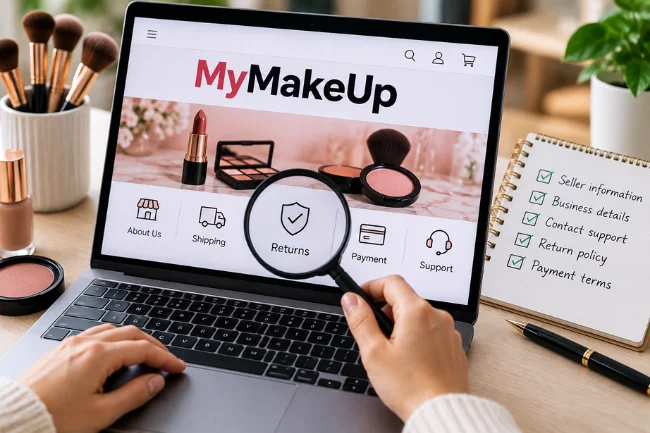
If MyMakeUp.com becomes accessible as a retail website, I would apply the same checks I use for any unfamiliar cosmetics seller. The aim is not to assume the worst; it is to avoid committing money before the essential questions have answers.
1. Identify the Seller, Not Just the Domain
Look for a business name, location, reachable support channel, and terms that identify who is responsible for an order. Check whether its social profiles consistently point to the exact website. A similar logo or a social handle is not sufficient confirmation.
If I cannot tell who will receive my payment or handle a complaint, I pause. A business should make that information easy to find without asking visitors to register first.
2. Read the Full Price and Return Terms
Cosmetics can have stricter return conditions once opened, so vague promises such as “easy returns” do not tell the whole story. Check refund eligibility, return shipping costs, deadlines, damaged-item procedures, and customs charges for international orders.
The US Federal Trade Commission’s online-shopping guidance also recommends researching sellers and reviewing refund policies before purchasing.
3. Choose a Payment Method with Protection
For unfamiliar sellers, I favor payment options that offer a meaningful dispute process. The FTC recommends credit cards where available because they can provide important protections if goods never arrive or a charge is incorrect.
A website using HTTPS encrypts information in transit, but that padlock does not prove the seller is honest. I would be particularly cautious if a retailer insisted on irreversible transfers, gift cards, or cryptocurrency.
4. Examine Reviews Outside the Website
I look for feedback across independent platforms and over time, including complaints about delivery, packaging, authenticity, and refund handling. A few enthusiastic comments copied across several pages tell me much less than detailed reports from verified buyers.
The FTC explains why online reviews require scrutiny, including the possibility of fake or manipulated feedback. I also avoid treating an influencer’s endorsement as independent evidence unless the commercial relationship is clear.
Beauty Product Authenticity Deserves Its Own Check
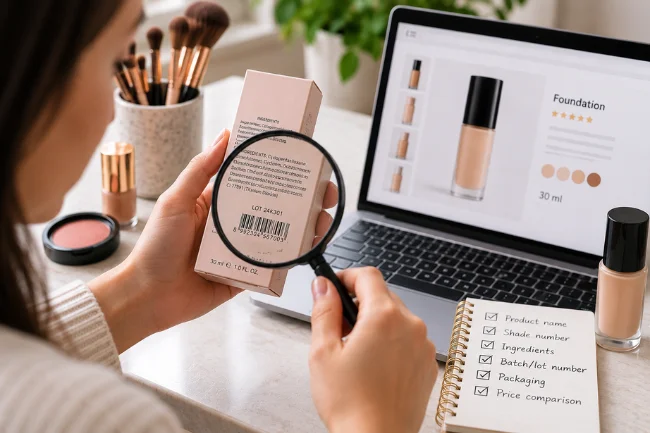
The risk of an unfamiliar beauty shop is not limited to a parcel arriving late. Cosmetics touch the skin, lips, or eyes. An item with uncertain origin, damaged packaging, or unclear labeling deserves extra care.
I would compare product photos and packaging details with information from the brand’s official website. Check the product name, shade number, ingredient list, stated quantity, and any batch or lot details. Packaging can change, so a difference alone is not proof of counterfeiting, but several unexplained inconsistencies are a reason to ask questions.
Unusually low prices also deserve context. They may reflect clearance, short-dated stock, smaller sizes, or legitimate promotions. They can also signal an unauthorized source. Rather than guessing, I would ask whether the retailer can establish where its inventory comes from.
The FDA’s consumer guidance recommends paying attention to product safety and reactions. In the United States, ordinary cosmetics generally are not FDA-approved before sale; claims that a lipstick or basic foundation is “FDA approved” should therefore be examined carefully. Rules vary by country.
Check Suitability, Not Just Authenticity
A genuine product can still irritate skin or perform poorly. Before buying, I look at the formula, fragrance, intended use, and whether a product suits my concerns. Someone seeking lightweight coverage and someone needing long wear in humid conditions may prefer completely different foundations.
For unfamiliar skin-care products, the American Academy of Dermatology advises testing on a small area first. Stop using a product if it causes a concerning reaction and seek professional advice when needed.
What About Selfies, Virtual Try-On, and Data Privacy?
If a beauty platform asks for a photograph, I want to know exactly what happens to it. A selfie is more personal than an ordinary product search, and a camera-based service may also request permissions unrelated to the final shopping decision.
Before uploading anything, read the privacy notice. Does processing happen on the device or a remote server? Are photos retained? Can they be used to train systems, shared with partners, or deleted on request? Is the service usable without creating an account?
I would avoid providing a full name, address, and facial image merely to preview a lipstick color unless those details were genuinely required and the privacy terms were acceptable. If the website cannot explain its data practices, the convenience of a virtual try-on is not worth guessing about.
This is another reason not to assume that MyMakeUp.com offers a camera tool just because a third-party page claims it does. The exact provider and its policies need to be checked directly.
My Practical Checklist Before Trusting MyMakeUp.com
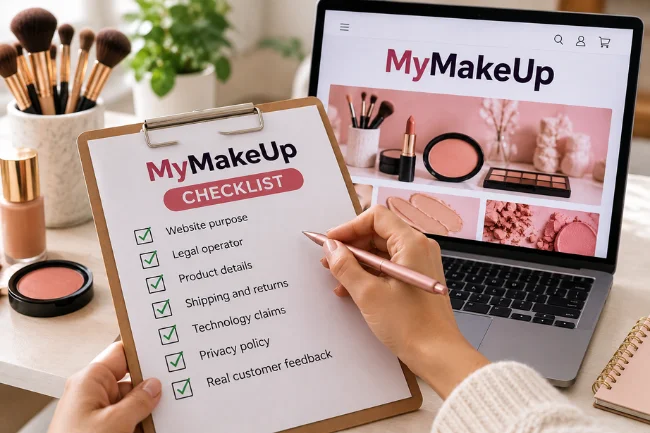
I find it helpful to separate a website’s visual appeal from the evidence behind it. If the exact domain becomes available, I would work through these questions in order:
- Does the homepage clearly say whether the service is a store, beauty magazine, app, or shade finder?
- Is the legal operator identifiable, and can customer support be reached?
- Do product descriptions, shades, ingredients, and availability agree with brand information?
- Are delivery costs, geographic restrictions, returns, and payment terms visible before checkout?
- Are claims about scientific matching or virtual try-on explained with realistic limitations?
- Does the privacy policy describe what happens to photos and other personal information?
- Can I find credible, recent feedback that refers to this exact domain rather than a similarly named one?
I would not require perfection on every design detail. Smaller businesses can have simple websites and still serve customers well. But missing seller identity, unclear payment terms, and unsupported technology claims are substantive gaps, not cosmetic flaws.
Final Thoughts
MyMakeUp.com is worth examining carefully precisely because the name is easy to confuse with other beauty services. During my review, I could not establish enough official information to recommend or dismiss it as an operating platform.
If you are researching the domain, begin by checking its current identity and policies. If your real goal is a better foundation match or a safer makeup purchase, use the comparison and verification checks above before committing. A few minutes spent confirming the source can save far more time than a wrong shade, an unclear return, or a risky checkout.
Frequently Asked Questions
What is MyMakeUp.com?
MyMakeUp.com is a beauty-related domain name whose current official services could not be verified during this review. Do not confuse it with Makeup.com or Match My Makeup.
Is MyMakeUp.com a legitimate website?
I found insufficient firsthand evidence to confirm its present operator or shopping reliability. That is not proof of a scam, but it is a reason to verify the site before sharing data or paying.
Does MyMakeUp.com offer a foundation shade finder?
Some third-party content makes that claim, but I could not confirm it on the exact domain. Match My Makeup is a separately identifiable shade-matching service.
Can I buy makeup products from MyMakeUp.com?
I could not verify a functioning product catalogue or checkout. Confirm the live store, seller details, shipping rules, and return terms before placing an order.
Is MyMakeUp.com free to use?
Its current pricing and account requirements are unverified. Do not assume free access, subscription fees, or app availability from descriptions of similarly named platforms.

Isabella Hart is a beauty and self-care writer with 7 years of experience creating practical content about skincare routines, beauty habits, personal care, and confidence-building practices. She focuses on sharing simple, research-informed guidance to help readers make informed choices and develop routines that support healthy, natural beauty.