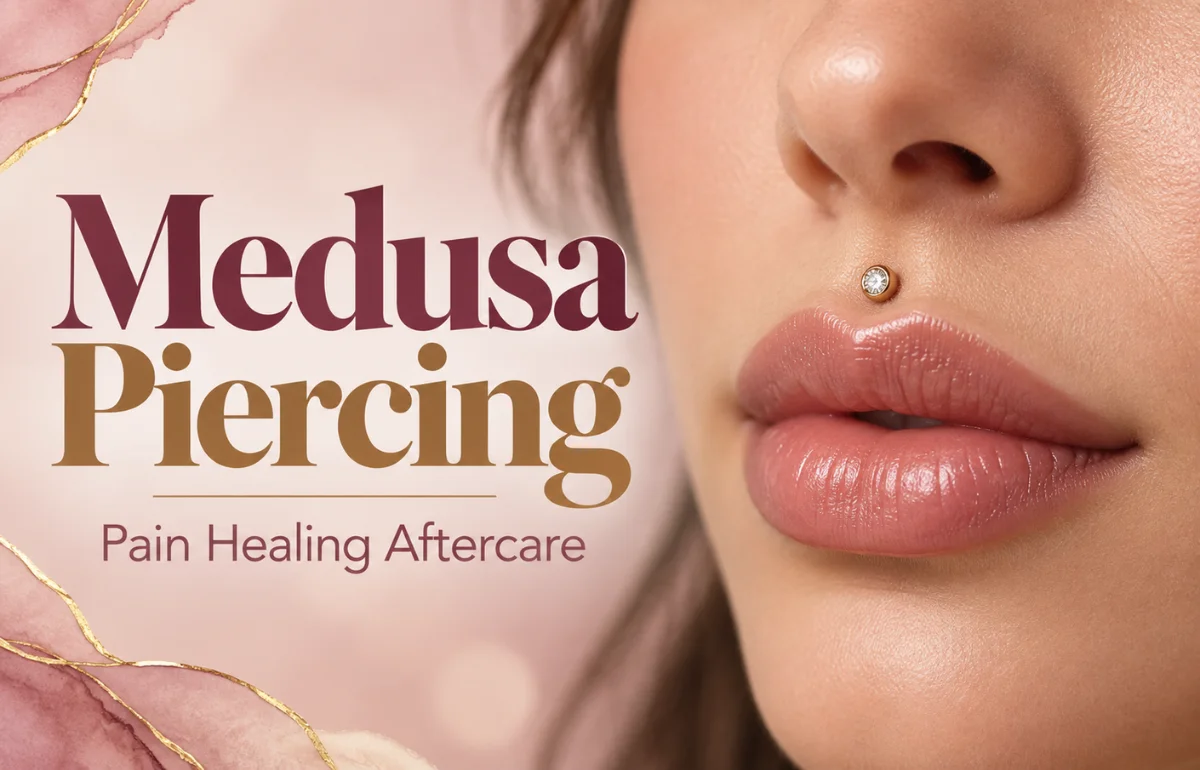
A Medusa Piercing is a facial piercing placed through the philtrum—the small vertical groove between the base of the nose and the center of the upper lip. It is also called a philtrum piercing. The jewelry usually sits directly above the Cupid’s bow, creating a centered, symmetrical look. A flat-back labret stud is commonly used, with a decorative end outside the lip and a flat disc inside the mouth.
I understand the appeal: a Medusa can look subtle with a tiny polished end or become the focal point of a facial setup with a gemstone. But it is also a perioral piercing, so part of the jewelry sits inside the mouth. That makes placement, jewelry fit, oral hygiene, healing, and dental health just as important as appearance.
What Is a Medusa Piercing?
A Medusa Piercing passes through the center of the philtrum, usually just above the upper lip. Unlike a nostril or eyebrow piercing, it has one external end and one end inside the mouth.
I never think of a Medusa as “just another facial piercing.” It heals in tissue exposed to movement, food, saliva, speaking, smiling, and contact with teeth and gums.
A professional piercer should assess your anatomy before marking the spot. The goal is not simply to hit the visual center. The angle and position should also allow the inside disc to rest as neutrally as possible rather than constantly scraping a tooth or pressing into gum tissue.
The Association of Professional Piercers (APP) says lip jewelry should be positioned so it rests in a neutral area inside the mouth and that posts should be shortened after swelling resolves to reduce tooth and gum contact.
What Does a Medusa Piercing Look Like?
From the front, the visible end sits above the Cupid’s bow and below the nose. Because it is centered, it tends to draw attention to the middle of the face and can visually emphasize the lips.
The look changes considerably with jewelry. A tiny bead feels minimal, a bezel-set gem looks brighter, and a larger ornamental end creates a stronger statement.
One practical point I put ahead of aesthetics is this: the decorative end is the part you see, but the hidden disc is the part that can affect comfort and oral health. Good Medusa jewelry has to work on both sides.
Medusa Piercing vs. Similar Lip Piercings
People often confuse the Medusa with Monroe, Madonna, labret, and vertical philtrum piercings. The biggest difference is placement.
| Piercing | Placement | Typical Jewelry | Inside-the-Mouth Contact | Look |
|---|---|---|---|---|
| Medusa/philtrum | Centered above upper lip | Flat-back labret | Yes | Symmetrical, centered |
| Monroe | Above upper lip, off-center | Flat-back labret | Yes | Beauty-mark style |
| Madonna | Upper lip, opposite side from a typical Monroe | Flat-back labret | Yes | Asymmetrical |
| Vertical philtrum / Jestrum | Vertical through upper lip/philtrum | Curved barbell | Usually no flat disc inside mouth | More dramatic |
| Labret | Centered below lower lip | Flat-back labret | Yes | Focuses lower lip/chin |
If limiting tooth and gum contact is a major concern, ask a qualified piercer whether a vertical philtrum is suitable for your anatomy. It is not “risk-free,” but its jewelry configuration is different because both ends are external.
How Painful Is a Medusa Piercing?
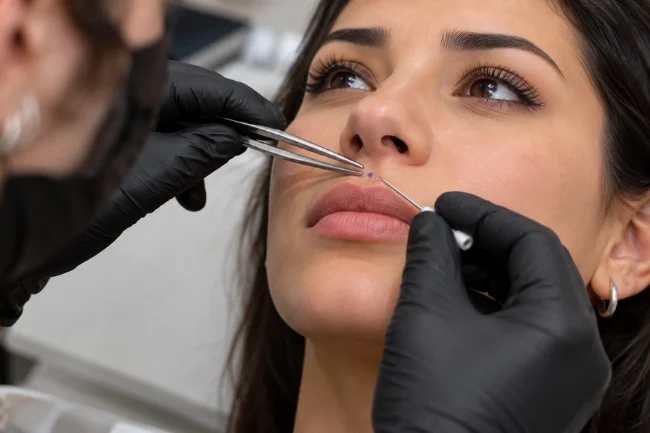
Pain is subjective, so I am cautious with guides that promise a precise number. Most people experience the needle pass as brief, sharp pressure or a strong pinch rather than long-lasting pain.
What often matters more is the period afterward. The upper lip can feel swollen, tight, tender, or awkward, especially while eating and speaking. The American Dental Association (ADA) notes that pain and swelling can occur during the first several days after oral or perioral piercing.
Your experience will vary with anatomy, swelling response, piercer technique, jewelry fit, and how much the area gets bumped or moved.
What Happens During the Piercing Appointment?
A good appointment should feel deliberate, not rushed.
The piercer should first discuss your anatomy, oral structures, jewelry options, healing expectations, and relevant health considerations. The location is cleaned and marked, and you should be able to inspect the mark before piercing.
A sterile, single-use needle is used rather than a piercing gun. After the channel is made, the starter labret is inserted. Initial jewelry is usually longer than the final post so there is room for swelling.
The APP advises choosing hygienic studios that use sterile single-use needles, properly sterilized tools, appropriate jewelry, and clear written aftercare.
My rule is simple: if a studio cannot explain its sterilization process, jewelry material, follow-up, and downsizing plan, a low price is not a bargain.
How Long Does a Medusa Piercing Take to Heal?
A Medusa Piercing is often discussed as if healing follows one fixed schedule, but bodies do not work that neatly. Lip piercings may look calm outside before the internal channel is fully stable.
I prefer to think about healing in stages.
Early Healing
During the first several days, swelling, tenderness, and minor bruising can occur. Eating and speaking may feel different while you adjust to the longer starter post.
Settling and Downsizing
As swelling decreases, the jewelry may begin to look too long. This is when a piercer can assess whether it is ready for a shorter post.
Ongoing Healing
Even when the outside looks normal, the tissue inside the channel may still be fragile. Do not assume “it looks fine” means it is ready for frequent jewelry changes or rough oral contact.
The APP stresses that downsizing after swelling subsides helps reduce unnecessary contact with teeth and gums.
Medusa Piercing Aftercare: Care for Both Sides
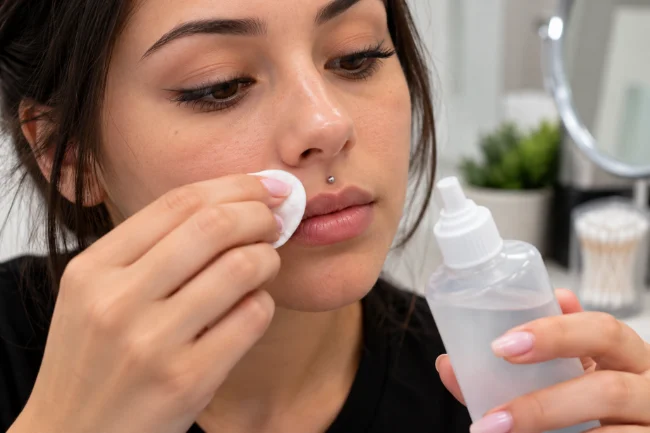
A Medusa has two care environments: external skin and the inside of the mouth. Treating only one side is an incomplete aftercare routine.
Outside the Lip
Keep the area clean and avoid unnecessary touching, twisting, picking, or rotating the jewelry. The APP recommends sterile saline for piercing aftercare and warns that over-cleaning and harsh products can irritate tissue.
Keep cosmetics, skincare products, sprays, and creams away from the fresh piercing unless a professional advises otherwise.
Inside the Mouth
Maintain good oral hygiene. The ADA recommends regular brushing, interdental cleaning, and alcohol-free mouthrinse for people with oral piercings. The APP also advises avoiding mouthwash containing alcohol or hydrogen peroxide during healing because it can irritate tissue.
Rinsing with clean water after eating or drinking can help remove debris. A new, soft-bristled toothbrush is a sensible choice during early healing.
Eating and Daily Habits
Take smaller bites and chew carefully until you are used to the jewelry. Cold foods and drinks may feel soothing. The APP advises avoiding very spicy, salty, acidic, or hot-temperature foods and beverages during early healing.
Avoid playing with the jewelry, wet kissing, oral sexual contact, and unnecessary trauma while it heals. Smoking, vaping, and excessive alcohol can also make healing less predictable.
The point people often miss is mechanical irritation. A piercing can be kept clean and still remain irritated if the post is repeatedly bitten, pulled, snagged, or pressed against oral tissue.
Normal Healing vs. Warning Signs
Not every crust, tender day, or swollen morning means infection. But symptoms that worsen rather than improve should not be ignored.
| Often Seen During Early Healing | Needs Professional Evaluation |
|---|---|
| Mild to moderate swelling that improves | Swelling that becomes severe or keeps worsening |
| Tenderness | Increasing or intense pain |
| Minor bruising | Spreading redness, heat, or marked inflammation |
| Small amount of pale/whitish secretion or crust | Thick, foul-smelling, unusual-colored discharge |
| Temporary awkwardness while eating | Jewelry embedding into tissue |
| Mild irritation after movement | Persistent gum injury, tooth pain, chipping, or recession |
If you develop fever, severe swelling, difficulty swallowing or breathing, or rapidly worsening symptoms, seek medical care. Do not automatically remove the jewelry yourself if infection is suspected; get professional guidance first.
Best Jewelry for a Medusa Piercing
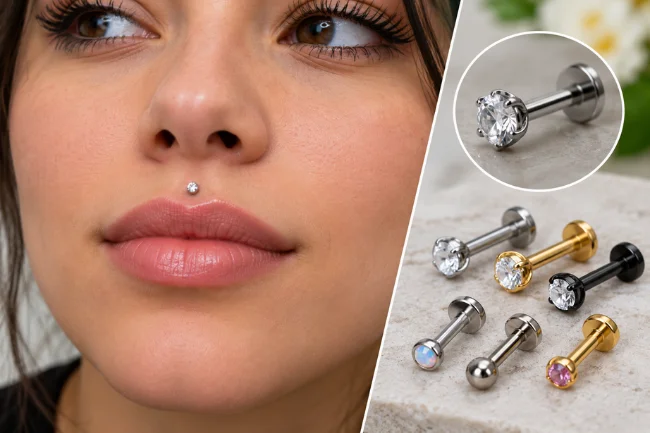
For a fresh Medusa, jewelry quality is not the place to cut corners.
A flat-back labret is commonly used because the inner disc offers a relatively low-profile surface inside the mouth. The starter post must allow room for swelling, then it should be downsized when your piercer determines the tissue is ready.
The APP lists implant-certified titanium such as ASTM F-136-compliant titanium among suitable materials for fresh piercings. It also recognizes certain compliant steels, niobium, platinum, glass, and appropriately alloyed solid 14k or higher gold. Gold-plated, gold-filled, and vermeil jewelry are not appropriate for a fresh piercing.
I recommend thinking about jewelry in this order: fit, material, surface quality, construction, then appearance. A beautiful top on a poorly fitted post is still a poor choice.
Internally threaded or threadless designs are preferable for initial jewelry because the surface passing through tissue is smooth rather than covered in exposed screw threads.
Why Downsizing Matters
Downsizing is not merely cosmetic.
Starter jewelry is longer to accommodate swelling. Once swelling falls, extra length can let the backing move more, catch on teeth, or repeatedly hit gum tissue. Properly fitted shorter jewelry can reduce that unnecessary movement.
Before getting pierced, I would ask one specific question: “When should I come back for you to assess me for a downsize?” A studio that treats follow-up as part of the process is offering more useful care than one that sends you home without a plan.
Can a Medusa Piercing Damage Teeth or Gums?
Yes. That risk deserves a direct answer.
Because the back of the jewelry sits inside the mouth, repeated contact can contribute to gum recession, enamel wear, chipped teeth, and soft-tissue irritation. The ADA advises against cosmetic intraoral and perioral piercings because of potential negative oral-health outcomes and lists gingival recession and damaged teeth among recognized complications.
Risk is influenced by placement, jewelry fit, anatomy, and behavior. Playing with the post or biting the disc increases unnecessary contact.
One useful self-check is what I call a “contact map”: notice where the disc rests when your face is relaxed, when you smile, when you speak, and when you eat. If it repeatedly strikes the same tooth or presses into the gumline, ask your piercer—and, when appropriate, your dentist—to assess it before obvious damage develops.
Who May Not Be a Good Candidate?
Not everyone has anatomy suited to the same placement or jewelry. A professional piercer may recommend a different angle or piercing style if the proposed setup creates poor contact, inadequate tissue support, or another anatomical concern.
I would discuss it with a dentist before booking if you already have significant gum recession, fragile or heavily restored front teeth, braces, or active oral-health problems.
If you are immunocompromised, taking medication that affects bleeding or healing, or managing a condition that changes wound-healing risk, seek individualized advice from an appropriate healthcare professional.
How Much Does a Medusa Piercing Cost?
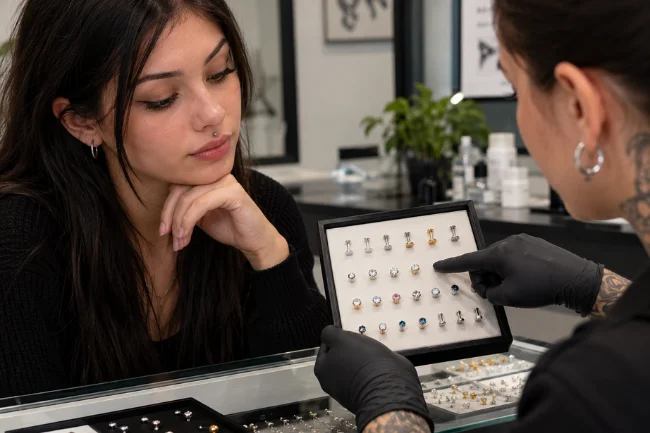
Pricing varies by location, studio, piercer experience, and jewelry choice. Instead of looking only at the piercing fee, ask for the total cost.
That may include the procedure, starter jewelry, decorative upgrades, aftercare products, and a later downsize. Solid gold or gemstone ends can increase the price considerably.
I would rather pay more for verified jewelry, safe sterilization, correct placement, and reliable follow-up than save on the appointment and spend weeks dealing with preventable irritation.
Will a Medusa Piercing Leave a Scar?
It can leave a small dot or indentation after removal. Visibility depends on your skin, how long you wore it, whether it experienced repeated irritation or infection, and how your body forms scar tissue.
A newer piercing may start shrinking quickly if jewelry is removed, and even healed channels can narrow. The APP notes that healed piercings may shrink rapidly enough to make reinsertion difficult or impossible.
If you are retiring the piercing, ask a piercer about safe removal. If you want to remove it because you suspect infection, get professional advice first.
Is a Medusa Piercing Worth It?
For the right person, a Medusa can be a striking, balanced piercing that works with both minimalist and decorative jewelry. I like its versatility, but I would never judge it on appearance alone.
The real decision is whether you are comfortable with aftercare, a follow-up downsize, possible scarring, oral-health risks, and the need to monitor how the jewelry contacts your teeth and gums.
If you get one, choose an experienced professional piercer who will evaluate your anatomy, use appropriate sterilized jewelry, explain oral aftercare, and schedule a follow-up. Keep regular dental checkups too, so changes to teeth or gums are noticed early.
Frequently Asked Questions
How long does a Medusa Piercing take to heal?
Healing varies, and the outside may look settled before the inner channel is fully stable. Follow your piercer’s timeline rather than appearance alone.
Can I kiss after getting a Medusa Piercing?
Avoid wet kissing and other oral sexual contact while it is healing because friction and exposure to bodily fluids can irritate the wound.
What jewelry is best for a Medusa Piercing?
A properly fitted flat-back labret made from a verified material such as implant-certified titanium is a common choice for a fresh piercing.
Does a Medusa Piercing damage your teeth?
It can. Poor placement, oversized jewelry, repeated contact, or playing with the jewelry may contribute to chipped teeth, enamel wear, or gum recession.
Will a Medusa Piercing close if I take it out?
It may shrink or close, sometimes quickly, especially when new. Even healed piercing channels can narrow enough to make reinsertion difficult.
Final Thoughts
A Medusa Piercing is more than a centered stud above the lip. It is a philtrum piercing that combines facial aesthetics with oral jewelry, swelling, downsizing, hygiene, and dental contact.
If you are seriously considering one, book a consultation with a reputable professional piercer rather than choosing by price or photos alone. Ask about your anatomy, jewelry material, placement inside the mouth, aftercare, and the timing of your downsize before you commit.

Isabella Hart is a beauty and self-care writer with 7 years of experience creating practical content about skincare routines, beauty habits, personal care, and confidence-building practices. She focuses on sharing simple, research-informed guidance to help readers make informed choices and develop routines that support healthy, natural beauty.