PuzuTask com is a multi-topic informational website that presents articles and practical guides on technology, finance, business, health, education, lifestyle, and related subjects. It is best understood as an online publication where visitors read and explore content, not as a proven task-management app or a platform that pays people to complete assignments. The word “Task” in its name can be misleading, especially if you arrived expecting a to-do dashboard or paid microjobs.
I looked into the website because descriptions of it online don’t always agree. Some call it a productivity service; others describe a blog. The available publishing records support the second description. Below, I’ll separate what can reasonably be established from the claims that still need evidence, so you can decide whether the site deserves your attention.
PuzuTask com at a Glance
| Question | What the available evidence shows |
|---|---|
| Website address | puzutask.com is the domain discussed in this review. |
| Main purpose | A general-interest digital publication with topic-based articles. |
| Content areas | Technology, finance, health, education, fashion, lifestyle, general interest, and other subjects. |
| Reading access | Public articles have been described as readable without mandatory sign-in. |
| Registration | A Register link has appeared in indexed navigation; its benefits are not established. |
| Task management | No verified public task-creation or project-tracking tool established. |
| Paid tasks or withdrawals | No verified earning program, payment rules, or withdrawal system established. |
| Overall reliability | Depends on the quality and sources of each individual article. |
What Does PuzuTask com Actually Do?
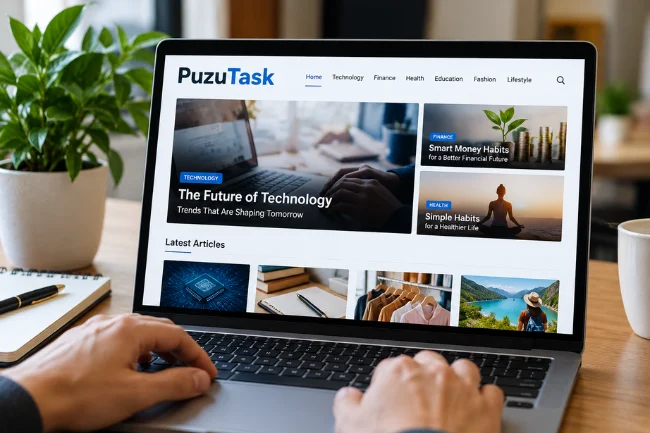
The straightforward answer is that it organizes reading material. A visitor can arrive through a search result, open an article, and potentially explore related subjects through categories and archives. That’s the normal experience offered by a content-focused website.
Articles Rather Than Interactive Assignments
In a task manager, you’d expect controls to create a task, set a due date, assign responsibility, and mark work complete. On a paid-task platform, you’d look for job listings, eligibility rules, compensation details, and an account balance. Published descriptions of PuzuTask.com instead identify headlines, dated posts, topic navigation, and article pages.
A Broad Reading Experience
One advantage of a multi-category website is discovery. You might start with an article on a technology trend and notice another about personal finance or an education topic. A specialist publication goes deeper into one field; a general publication invites readers to explore several.
The trade-off is editorial consistency. Expertise in software doesn’t automatically translate to expertise in medicine, investments, or law. I would assess each article on its own merits instead of assuming that every category meets the same standard.
What Topics Can You Find on PuzuTask com?
Publicly indexed descriptions and reviews have identified a broad range of categories. Menus can change, but these subjects explain the type of material associated with the site.
Technology, AI, and Digital Life
Technology coverage includes digital platforms, online tools, internet trends, and explanations of how modern services work. More recent descriptions of the site’s public identity also mention artificial intelligence, gaming, and digital developments.
For a reader who wants to understand unfamiliar terminology, a concise explainer can be useful. For choosing a software subscription or changing security settings, however, I’d want current screenshots, precise feature details, and links to the official provider.
Finance and Business
Finance and business topics may include trading concepts, investing, business operations, and economic changes. One article title referenced in published coverage concerns the effect of supply-chain disruptions on pricing and product availability. That’s a practical subject: shipping delays and limited supply can influence both costs and customer decisions.
Still, there’s a significant difference between explaining a financial concept and advising someone what to buy. Before acting on trading, tax, or investment information, I would check the date, country, assumptions, and original sources.
Health and Everyday Wellbeing
Health-oriented content has been described as covering wellness, medical awareness, and related consumer questions. This category deserves particular care. A readable article can help someone learn vocabulary or prepare questions for a professional, but it should not replace individualized medical advice.
I look for qualified contributors, credible medical references, a clear update date, and appropriate discussion of risks. Without those elements, I would use a health post only as an initial introduction.
Education, Fashion, and Lifestyle
Education material may address learning resources, qualifications, academic topics, or study-related questions. Fashion and lifestyle categories can cover style choices, products, personal routines, and practical everyday interests.
These topics are often approachable for casual reading, but the details still matter. Exam requirements change; product recommendations can become outdated; a style tip may be subjective rather than universally useful. A helpful article should make those differences clear.
How I Evaluated the Website in October 2026
I want to be precise about my research rather than present guesses as firsthand experience. During this review, direct retrieval of the live homepage was restricted by the website, so I couldn’t carry out a complete, interactive walkthrough or test a registered account. That access limitation doesn’t, by itself, indicate wrongdoing.
Instead, I compared publicly indexed descriptions of the domain with accessible independent reviews. Those sources consistently point to a publishing website. Some also describe category archives, dated posts, an About page, a privacy page, and a Register link. Because I couldn’t personally verify every live screen, I treat those as documented observations rather than promises about the current interface.
I also noticed an unusual problem in outside coverage: some pages illustrate PuzuTask with imagined earnings dashboards even while describing it as a blog. A graphic is not proof that a feature exists. For me, functional claims require something stronger, such as official instructions, working controls, or published terms.
This evidence-based approach matters more than a dramatic label such as “100% safe” or “guaranteed legitimate.” Neither can be established from a homepage description alone.
Is PuzuTask com Legitimate and Safe to Visit?
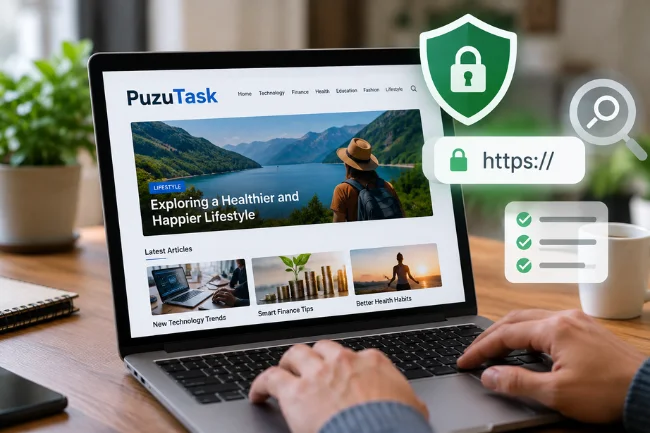
My assessment is narrower than a blanket endorsement: the available evidence supports the existence of a content-publishing website, but it does not establish a comprehensive security audit, the identity of every contributor, or the accuracy of every post.
A Real Publication Is Not Automatically a Trusted Authority
Category pages and article archives indicate publishing activity. They don’t tell you whether a particular health claim is correct or whether a finance article accurately explains its risks. Editorial reliability requires transparent sourcing, author accountability, and corrections when information changes.
For important decisions, I recommend finding the original source behind a statement. A certification article should lead you to the certifying organization. A legal explanation should identify the jurisdiction. A medical article should rely on credible clinical guidance, not unsupported assurances.
HTTPS Is Only One Part of Safety
A secure browser connection helps protect information in transit. It doesn’t certify the publisher’s honesty or guarantee that every advertisement, download, and outbound link is safe. This distinction applies to nearly every website, not just PuzuTask.
I would read publicly accessible articles with ordinary browsing precautions, avoid downloading unfamiliar files, and review requests for personal information separately. If a page unexpectedly asks for payment details to unlock a supposedly free article, I’d verify that request before proceeding.
What About Ownership and Privacy?
Public coverage refers to an About page and privacy policy, but that does not establish who is legally responsible for every article or how personal information is handled in practice. I couldn’t independently complete an ownership verification during this review.
If I were considering account registration, I’d check the stated operator, contact method, data collection practices, and any account-deletion instructions. Those questions matter more when you’re sharing personal data than when you’re simply reading an open article.
Is PuzuTask a Task Manager or Money-Earning Website?
This is where I would be especially careful about online claims. The similar-sounding concepts are easy to blend together, but they involve different services and different evidence.
| What you may expect | What would verify it | Current assessment |
|---|---|---|
| Task management | Working task lists, deadlines, editing, and completion controls | Not established by available public evidence |
| Team collaboration | Shared projects, assigned members, and documented permissions | Not established |
| Paid microtasks | Official job listings, rates, eligibility, and payout terms | Not established |
| Article reading | Published posts, subjects, archives, and search navigation | Supported by available publishing records |
| Member registration | An active form plus an explanation of account features | A Register link has been reported; functionality unclear |
I haven’t found verified official payment conditions that would justify calling PuzuTask.com an earning opportunity. Equally, the word “Task” isn’t enough to call it a productivity app. If another website promises daily income under a similar name, check its exact domain and the relationship it claims to have with puzutask.com.
Do You Need a Login to Read Its Content?
Independent reviews describe PuzuTask’s public articles as freely accessible without a mandatory account. At the same time, at least one review of its indexed navigation reports a Register link. Both observations can be true: many publishing websites offer optional registration while leaving ordinary articles open.
The unanswered question is what registration actually provides. It might support comments, contributor access, or another publishing function; those are possibilities, not verified PuzuTask features. I wouldn’t create an account simply because a review mentions a login. First decide what you need to do, and check whether registration is necessary for that specific action.
How to Tell Whether an Article Is Worth Trusting
This is the most useful test I can offer for PuzuTask or any general-interest publication. I use five questions when deciding whether a web article is strong enough to inform a real decision.
1. Does It Answer the Question Quickly?
A good article explains the main point near the top. If the introduction takes several paragraphs to say what a service is, that’s a sign the writing may prioritize length over usefulness. Look for a clear definition and a concrete explanation of what readers can do next.
2. Can I Identify the Source of Its Claims?
Specific sources beat vague statements. If an article says a certification has changed, it should point to the certification provider. If it mentions an economic trend, it should identify relevant data. Links alone aren’t enough; they need to support the actual claim.
3. Is the Information Current for the Subject?
A three-year-old explanation of a basic concept may still work. A three-year-old guide to software prices, legal rules, or admission requirements may be misleading. I check both the publication date and whether the body reflects subsequent changes.
4. Does the Writer Understand the Limits of the Topic?
Credible writing explains uncertainty. In health, finance, and law, I expect qualifications and relevant context. When every claim is delivered with absolute confidence, especially without sources, I become more skeptical.
5. Does the Article Help Me Verify or Act?
Useful content leaves you with an answer, an example, or a reliable next source.
PuzuTask com Compared With Specialist Websites
I wouldn’t judge this publication by whether it competes with a hospital website, a bank’s official help center, or a software company’s documentation. Its most reasonable role is introductory reading across different subjects.
For general discovery, broad coverage is convenient. For decisions involving money, health, legal rights, or technical configuration, specialist sources usually have a better claim to authority when they supply direct expertise and current documentation. A sensible research process can use both: start with an accessible overview, then verify critical details with the primary source.
Strengths and Limitations Worth Knowing
The main appeal of PuzuTask com is variety. Instead of focusing on one specialized audience, the publication aims to reach readers interested in everyday questions, technology, education, and business. Its recognizable domain name and category-based presentation also make its purpose as a reading destination relatively easy to understand once you look past the name.
The weaknesses are more significant if you’re expecting a service rather than content. I couldn’t verify an interactive task tool, earnings system, or the benefits of registration. Broad editorial coverage can also make it harder to judge the expertise behind an individual article.
Another limitation is inconsistent information elsewhere on the web. When third-party reviews contradict one another, I give more weight to the site’s documented public purpose than to attractive screenshots or confident descriptions with no proof.
Who Will Find PuzuTask Useful?
I’d consider it for readers exploring unfamiliar subjects, students seeking a starting point, or people who enjoy browsing short explainers across different categories. The value will depend on the individual article: some topics may be covered more thoroughly than others.
I wouldn’t recommend it as a substitute for professional guidance or as a confirmed destination for freelance jobs, team workflow management, or online payments. Those purposes require features and credentials that the available evidence doesn’t establish.
My Final Verdict on PuzuTask com
PuzuTask com is best approached as a general-interest article website. The evidence available in October 2026 supports its publishing identity, while claims about task tracking, paid work, and account features remain unverified. The sensible question isn’t simply whether the domain exists; it’s whether the specific page you’re reading is accurate, current, and useful.
My recommendation is to visit the exact domain, choose an article relevant to your question, and check its sources before relying on it. For consequential decisions, confirm the details with the appropriate official or specialist source.
Frequently Asked Questions
What is PuzuTask com used for?
It is primarily described as a multi-topic digital publication where visitors read articles about technology, finance, education, lifestyle, and other subjects.
Is PuzuTask com safe and legitimate?
Its publishing presence is documented, but that alone doesn’t prove complete security or editorial accuracy. Assess links, account requests, and article claims individually.
Can I earn money on PuzuTask com?
I found no verified official microtask program, payment terms, or withdrawal system associated with the .com website.
Is PuzuTask com free to use without registration?
Public articles have been described as free to read. A Register link has also been reported, but its purpose and current functionality aren’t confirmed.
Is PuzuTask com a productivity or task-management app?
No publicly verified task-creation dashboard or project-management feature was established in the material reviewed; its documented role is content publishing.

Noah Sterling is a technology research writer with 8+ years of experience covering emerging technologies, software trends, digital tools, and innovation. He creates practical, research-based articles to help readers understand the evolving technology landscape.