Wattios is a historical Spanish-language form connected with the watt, the standard unit used to measure power. It is not a separate modern electrical unit. In today’s scientific terminology, power is measured in watts, written with the symbol W, while modern Spanish commonly uses vatio or vatios. One watt means energy is being transferred or used at a rate of one joule per second.
That definition is the best place to start because the word Wattios can be misleading. It looks like the name of a new technology, energy platform, or special measurement, and it is also used by businesses as a brand name. When I encounter the term, I first check the context: is the page discussing electrical power, Spanish terminology, appliance energy use, or a particular company? That simple distinction prevents most of the confusion.
What Does Wattios Mean?
The Real Academia Española’s historical dictionary records wattios as an early variant associated with vatio, the Spanish word for watt. Its historical examples show the term appearing in older Spanish electrical writing, while vatio later became the standard form in Spain. The underlying physical quantity did not change: the word referred to power.
NIST defines the watt as a unit of power equal to one joule per second. In practical terms, watts tell me how quickly a device is using, delivering, or converting energy at a particular moment. A 1,000 W appliance is operating at a much higher power level than a 10 W lamp, although that fact alone does not tell me which one will cost more over an entire month.
The distinction between power and energy is the foundation for understanding Wattios correctly.
Wattios, Watts, Vatios, and kWh: The Terms Compared
Several similar-looking terms describe different things. This table keeps them separate.
| Term | What it means | How it is used |
|---|---|---|
| Wattios | Historical Spanish form associated with the watt; also used as a name by some organizations | Older language, search queries, brand names |
| Watt (W) | SI-derived unit of power; 1 W = 1 joule per second | Appliance ratings, electronics, motors, solar panels |
| Vatio / vatios | Modern Spanish term for watt / watts | Spanish-language technical and everyday usage |
| Kilowatt (kW) | 1,000 watts of power | Larger appliances, EV chargers, solar systems, generators |
| Watt-hour (Wh) | Energy equal to 1 watt used for 1 hour | Batteries and smaller energy measurements |
| Kilowatt-hour (kWh) | 1,000 Wh; a unit of energy | Electricity bills and household energy consumption |
I find this distinction more useful than treating Wattios as a vague synonym for “energy awareness.” Watts describe a rate of power. Kilowatt-hours describe accumulated energy use. Those two ideas are related, but they are not interchangeable.
Why a Watt Measures Power, Not Your Electricity Bill
A watt answers a “how fast?” question.
If a device is rated at 100 W, it is using or transferring energy at a rate of 100 joules per second while operating at that level. The watt is part of the International System of Units, and its symbol is W. BIPM’s SI materials identify the watt as the derived unit of power, expressed as joules per second.
Your electricity bill, however, is normally based on energy consumed over time. That is why utility usage is expressed in kilowatt-hours rather than watts alone.
A 2,000 W heater sounds expensive to run, but if it operates for only five minutes, its total energy use may be lower than that of a 100 W device left on for an entire day.
That leads to the calculation I use most often:
Energy in kWh = Power in kW × Time in hours
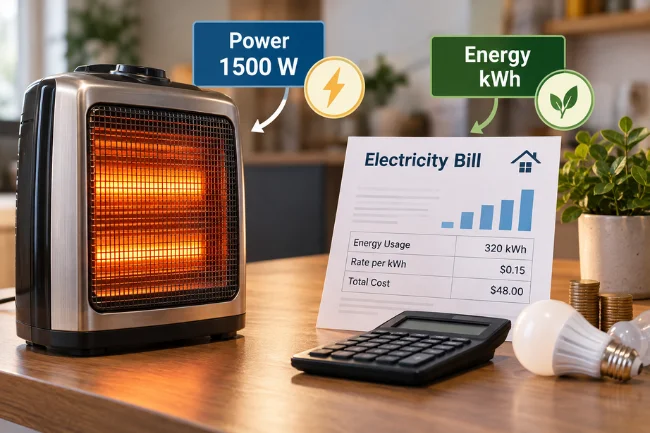
Since 1,000 W equals 1 kW, a 1,500 W appliance is a 1.5 kW appliance.
If it runs for two hours:
1.5 kW × 2 hours = 3 kWh
To estimate cost, multiply the energy used by your electricity price:
Electricity cost = kWh used × price per kWh
This is far more useful than judging an appliance from its wattage alone.
Watts, Volts, and Amps Are Not the Same Thing
People often see watts, volts, and amps on the same label and assume they are different ways of showing electricity consumption. They measure different electrical quantities.
Voltage, measured in volts (V), can be thought of as electrical potential difference. Current, measured in amperes or amps (A), describes the flow of electric charge. Power, measured in watts (W), describes the rate at which energy is transferred or used.
For a simple DC circuit, power can be calculated as:
P = V × I
where P is power in watts, V is voltage, and I is current in amps.
For example, a 12 V device drawing 2 A uses 24 W under those conditions.
With AC equipment, the real calculation can be more complicated because power factor may matter. For everyday consumers, the safest shortcut is usually to use the manufacturer’s stated wattage when it is available rather than assuming that volts multiplied by amps always equals the device’s actual real power.
That nuance is often skipped in basic explanations, but it matters when comparing motors, air conditioners, power supplies, and other AC loads.
How to Read Wattage on an Appliance Label
When I check an appliance label, I do not look at the largest number and immediately treat it as monthly consumption. I ask three questions:
- What is the rated power?
- How long does the device actually operate?
- Does it run continuously or cycle on and off?
That third question changes the calculation considerably.
A refrigerator may carry a particular power rating, but its compressor does not necessarily run at full power every minute of the day. An air conditioner may cycle or use variable-speed technology. A laptop power adapter can show a maximum output even when the computer usually draws less.
The label still matters because it gives useful technical boundaries and comparison data. It just should not be confused with a precise measurement of real-world energy use.
For the best estimate, I prefer actual metering data when available. A plug-in energy meter can show how consumption changes over hours or days, which is more informative than a maximum rating for devices with variable loads.
Practical Wattage and Energy Examples
The examples below are illustrative calculations, not universal appliance ratings. Actual devices vary by model, size, settings, efficiency, temperature, and usage.
| Example device | Example power | Example daily use | Calculated daily energy |
|---|---|---|---|
| LED bulb | 10 W | 5 hours | 0.05 kWh |
| Laptop | 60 W | 6 hours | 0.36 kWh |
| Television | 100 W | 4 hours | 0.40 kWh |
| Electric kettle | 1,500 W | 12 minutes | 0.30 kWh |
| Portable heater | 1,500 W | 3 hours | 4.50 kWh |
The kettle is a good example of why high wattage is not automatically the same as high monthly energy use. It draws a lot of power while heating, but it may run only for a few minutes.
The heater has the same wattage, yet three hours of operation produces 4.5 kWh of energy use. Time changes the picture.
This is the practical value behind searches for Wattios: once the word is connected to watts correctly, it becomes a gateway to understanding real electricity consumption.
A Simple “Wattios Context Check” Before You Trust a Page
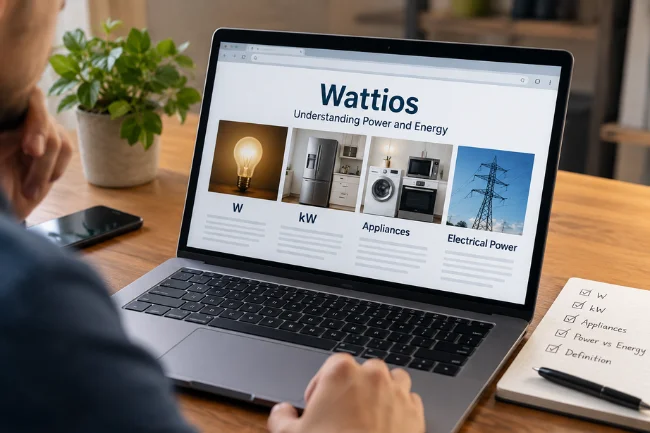
Because Wattios is ambiguous online, I use a quick context test before interpreting it. This is especially useful when a page never defines the term clearly.
If the Page Mentions W, kW, Appliances, or Electrical Power
It is probably using Wattios in connection with watts or wattage. Check whether the writer distinguishes power from energy and whether the scientific definition is correct.
If the Page Is Written in Spanish or Discusses Historical Terminology
The word may be an older or variant form related to vatio. The RAE’s historical record is the strongest clue here because it directly documents wattios in that linguistic history.
If the Page Discusses Solar Installation, Quotes, Services, or a Named Organization
Wattios may be a company or brand rather than a unit.
For example, the Better Business Bureau maintains a profile for Wattios LLC and categorizes it under solar energy products. BBB also states that the business is not BBB accredited. That commercial use of the name should not be confused with the scientific meaning of watt.
This three-part check is useful because the same spelling can lead to completely different search intents.
How Wattios Relates to Energy Efficiency
A lower wattage can indicate lower instantaneous power consumption, but lower wattage does not automatically mean “more efficient.”
Efficiency compares useful output with the energy put into a system. Two devices can have different power ratings because they have different capacities, sizes, or performance targets.
Consider two air conditioners. A smaller unit may use fewer watts simply because it has less cooling capacity. That does not prove it is more efficient than a larger unit.
The same principle applies to computers, pumps, heaters, appliances, lighting, and electric motors.
When I compare products, I look beyond wattage and consider:
- the useful output or capacity;
- expected operating hours;
- energy-efficiency ratings;
- standby consumption;
- load or duty cycle;
- product size;
- climate or operating conditions;
- expected lifetime.
Wattage is one piece of the decision, not the entire decision.
Wattios and Solar Power
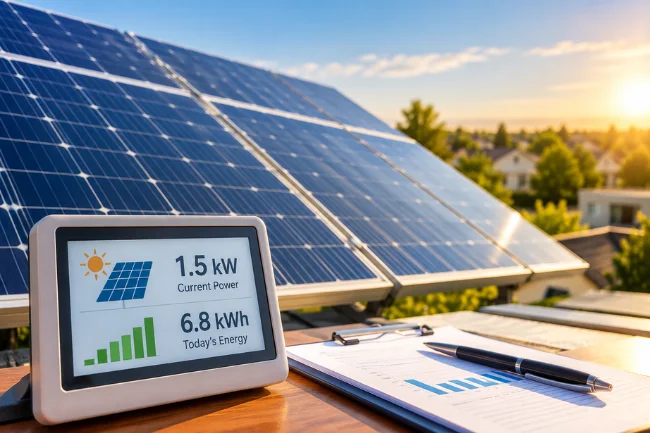
Watts and kilowatts are especially important in solar energy because solar panels and systems are commonly described by power capacity.
A solar panel might have a rated output expressed in watts, while an entire rooftop array is often discussed in kilowatts. The energy that system produces over time is measured in watt-hours or kilowatt-hours.
This distinction helps prevent a common mistake: comparing a solar system’s kW capacity directly with a home’s monthly kWh consumption as though the numbers represented the same thing.
They do not.
Power capacity tells you how much power a system can deliver under specified conditions. Energy production tells you how much electricity it actually generates over a period of time. Solar output also depends on sunlight, orientation, shading, temperature, system losses, location, and other factors.
For that reason, I would never size a solar system from a single appliance wattage figure or from the household’s peak demand alone. The better starting point is historical energy consumption, expected future loads, site conditions, and a properly designed production estimate.
Wattios and Battery Capacity
Batteries introduce another pair of terms that often gets mixed up: watts and watt-hours.
Watts describe how much power a battery or inverter can deliver at a moment. Watt-hours describe how much energy can be stored or supplied over time.
A battery rated at 1,000 Wh theoretically contains 1 kWh of stored energy before accounting for usable capacity limits and system losses.
A high-capacity battery can still have a limited maximum power output. Likewise, a system may be able to provide high power for a short period but store relatively little total energy.
For anyone comparing portable power stations, home batteries, solar storage, or backup systems, both figures matter.
Why Standby Power Deserves Attention
Not every device becomes electrically inactive when its screen or main function is off.
Routers, televisions, game consoles, smart speakers, chargers, set-top boxes, printers, security devices, and other connected products may continue consuming power in standby or idle modes.
A few watts may look insignificant, but continuous use runs for 24 hours per day and 365 days per year.
For example, a constant 5 W load uses:
0.005 kW × 24 hours × 365 days = 43.8 kWh per year
That does not mean every 5 W standby load should be unplugged. Some devices need continuous connectivity or perform useful background functions. The calculation simply shows why duration matters as much as the watt number.
Common Mistakes People Make With Wattage
The first mistake is assuming that a device with more watts will always produce a higher electricity bill. It may, but operating time and load matter.
The second is treating watts and kilowatt-hours as interchangeable. One measures power; the other measures energy.
The third is assuming a nameplate wattage equals constant real-world consumption. Many devices cycle, throttle, sleep, or operate at partial load.
The fourth is using wattage alone to judge efficiency. A more powerful device may also perform more work.
The fifth is overlooking unit prefixes. A 2 kW appliance is 2,000 W, while a 2 kWh energy figure describes something completely different.
Once those distinctions are clear, electricity specifications become much easier to read.
What I Would Check Before Buying an Energy-Hungry Appliance
For appliances likely to run frequently, I use a simple buying framework.
First, I compare the rated power and official energy-consumption information rather than relying only on marketing phrases such as “eco” or “low energy.”
Second, I estimate annual use based on realistic hours, cycles, or published consumption figures.
Third, I multiply expected kWh by my local electricity rate. That turns technical specifications into a number that matters to a household budget.
Fourth, I consider whether a higher purchase price could be justified by lower operating costs over the product’s useful life.
This approach works better than chasing the lowest wattage because it connects performance, time, energy, and cost.
Is Wattios a New Technology or SI Unit?
No. Wattios is not a separate modern SI unit.
The internationally recognized unit of power is the watt, symbol W. Historical Spanish records connect wattios with the linguistic development of vatio, while modern organizations may also use Wattios as a brand or company name.
That distinction is the most important fact to remember.
FAQs About Wattios
What Does Wattios Mean?
Wattios is a historical Spanish form connected with the watt, the unit of power. Modern Spanish generally uses vatio or vatios.
Is Wattios the Same as Watts?
In historical electrical terminology, Wattios refers to the same underlying unit of power; it is not a separate SI measurement.
What Is the Difference Between Watts and kWh?
Watts measure power at a moment, while kilowatt-hours measure energy used or produced over time.
How Do I Calculate kWh From Watts?
Divide watts by 1,000 to get kilowatts, then multiply by the number of hours the device operates.
Does Higher Wattage Always Mean Higher Electricity Cost?
No. Cost depends on both power and operating time, along with your electricity price and the device’s real usage pattern.
Final Takeaway
Wattios is best understood by connecting it to the watt, not by treating it as a new energy concept. The watt measures power; one watt equals one joule per second, and electricity use over time is better understood through watt-hours and kilowatt-hours.
If you came here because of an appliance label, start with its wattage, estimate how long it runs, and calculate the kWh. If you found Wattios as a company or brand name, evaluate that organization separately from the scientific term. That one distinction will make your next electricity, appliance, battery, or solar decision much clearer.

Noah Sterling is a technology research writer with 8+ years of experience covering emerging technologies, software trends, digital tools, and innovation. He creates practical, research-based articles to help readers understand the evolving technology landscape.