Messagenal is a name used in different ways online. Some articles use it to describe clearer digital communication: write with a purpose, give the reader context, and make the next action obvious. That advice can help, but I could not verify an official creator, published standard, or established messaging app called Messagenal. Meanwhile, messagenal.com presents itself as a store for kitchen, cleaning, household, and storage supplies. The store’s existence does not establish that it created the communication approach. If you searched for Messagenal, first determine whether you meant a writing idea, a claimed app, or a shopping website.
Someone hoping to download software needs evidence of a developer and product listing. Someone looking for better workplace messages can use sound writing practices without installing anything. A shopper needs to evaluate the seller’s policies and reputation.
Why does Messagenal have more than one meaning online?
The word appears in explainers about clear messaging, descriptions of a supposed communication platform, and a retail domain. They share a name but require separate evidence.
| Use of the name | What the available evidence shows | What it does not establish |
|---|---|---|
| Communication idea | Online explainers describe purpose, audience, context, and clear action as its principles. | A named inventor, formal specification, or exclusive method. |
| Alleged messaging platform | Some articles claim chat, file sharing, team features, and device syncing. | An independently verified app, developer, download page, or working feature set. |
| messagenal.com | The live site labels itself a store and lists household-product categories and shopping policies. | That it operates the alleged app or originated the communication concept. |
I checked the store homepage while preparing this article in September 2026. Its navigation points to kitchen, cleaning, household, and storage supplies, plus order tracking. Site content can change, and a category menu does not tell me whether orders are fulfilled as promised.
The safest definition for an informational search is narrow: Messagenal is an informal label used by some writers for more deliberate online messaging. Treat the claimed software and the retailer as separate questions until primary evidence links them.
Is Messagenal a real messaging app?
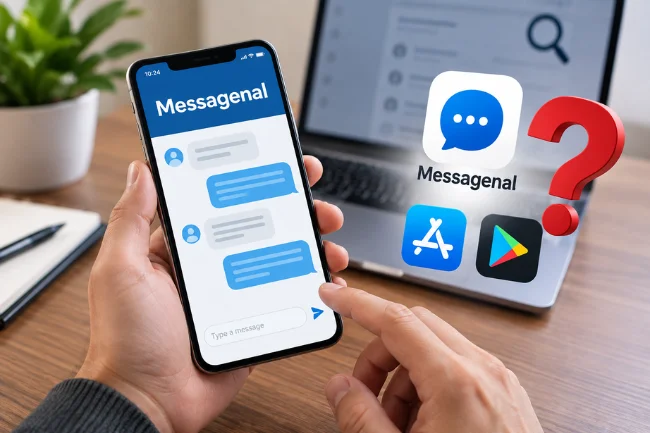
I found descriptions of a unified messaging tool, but I could not confirm a product owner, an official app-store listing, technical documentation, pricing, or a direct download from an identified developer. An unsuccessful search is not proof that an app cannot exist. It does mean readers should not repeat specific feature claims as established facts.
When a page promises synchronization and collaboration without product documentation, I want to see who makes the software, where the official distribution page lives, which platforms it supports, and how its privacy policy treats messages and files.
Do not confuse a similarly named service with proof. Messagenal, Messagenet, MessageMe, and other message-related names can appear close together in search results. Check the exact spelling, company, and domain before attributing one company’s features to another.
If an official application emerges later, this assessment should be updated with its developer identity, store links, version history, and an actual feature test. Until then, there is no sound basis for instructions such as “download Messagenal and connect your accounts.”
The useful communication idea behind the name
Why do these explainers appeal to readers? Digital conversations are often interrupted, skimmed on a phone, or read hours after they were sent. A message that depends on an unstated conversation in the sender’s head forces the recipient to ask for missing details. One extra question can add a day of delay when the people involved work in different time zones.
I see the value of the idea in its simplicity. A useful message should tell a particular person something they can understand and act on. It can still be friendly, detailed, or creative. Brevity helps only when it preserves the facts the reader needs.
The principles commonly attached to Messagenal are familiar communication practices rather than a proven proprietary system: define the purpose, consider the audience, provide context, choose a suitable tone, and name the next step. They work in email, team chat, customer support, and social messages because those formats all have readers with limited time.
A practical message check I use for this article
To make the broad advice more usable, I apply five questions to a draft. This is my editorial checklist, not an official Messagenal framework:
- Who is reading? A colleague on the project knows more background than a new customer. Give each the context they lack.
- What is the point? Put the decision, answer, or request near the start. A subject line such as “Approval needed for Tuesday’s draft” sets expectations faster than “Quick question.”
- What facts make action possible? Include the relevant link, version, date, constraint, or error message. Leave unrelated history out.
- What happens next? If you need a reply, specify the decision and a reasonable deadline. If the note is informational, say so.
- How will it sound? Read it as the recipient would. A terse sentence may be efficient between close teammates and abrupt in a complaint response.
This check is particularly useful before sending a message to someone who cannot immediately ask a follow-up question. It does not require special software. It requires a minute of attention before pressing send.
What better digital messages look like
Abstract advice becomes clearer when you compare actual wording. These are original sample messages, written to illustrate the difference; they are not transcripts of customer or workplace interactions.
| Situation | Vague message | More useful message |
|---|---|---|
| Team handoff | “Can you look at this today?” | “Could you review the pricing section in the linked draft by 3 p.m. Thursday? I need a yes or a list of changes before it goes to design.” |
| Customer support | “We are checking your issue.” | “I checked the delivery status for your order. It has not updated since Monday. I have asked the carrier for an update and will email you by Friday, even if there is no new scan.” |
| Scheduling | “Let’s talk next week.” | “I can discuss the revised outline on Tuesday or Wednesday between 2 and 4 p.m. Which 20-minute slot works for you?” |
| Marketing | “Our solution changes everything.” | “See all open support requests in one view, with an owner and due date beside each case.” |
The improved versions do not succeed because they are always shorter. They succeed because the reader can tell what happened, what matters, and what to do. A message can be very short and still cause confusion; it can be longer and save time later.
A legal notice, health instruction, or technical incident update may need detail. Put the takeaway first and organize the supporting facts beneath it. Clarity is the goal, not an arbitrary character count.
How to apply the idea at work
In a remote team, a good update can stand on its own. I suggest using four plain elements: current status, blocker, owner, and next expected update. For example: “The draft is ready for legal review. The missing item is the revised claim language. Aisha owns that change and expects to post it by Thursday noon. I will send the final version after approval.”
This format helps the next person continue the work without a meeting. It also makes uncertainty visible. If there is no reliable delivery date, say what you know and when you will check again. An invented deadline can look reassuring for a moment and damage trust when it passes.
For asynchronous collaboration, specify where the source of truth lives. “I updated the file” is less helpful than naming the document and the section. If there are two decisions, separate them into numbered questions. The reader can then answer each one without deciphering a long paragraph.
Use the right channel for the stakes. A routine status note fits in team chat. A decision with lasting consequences may belong in a shared document or email where people can find it later. Urgent incidents need the agreed escalation route, not a carefully polished chat message that nobody sees until tomorrow.
When clarity requires a conversation
Written messages cannot carry every nuance. A sensitive disagreement, a complex trade-off, or a distressed customer may need a call. The writing principle still helps: send a brief note explaining the issue and the purpose of the conversation, then document the agreed action afterward.
That final recap prevents the familiar “I thought you meant…” problem. Name the decision, who owns each action, and when the group will revisit it. A clear written record supports the conversation; it does not replace empathy or judgment.
Messagenal-style writing in marketing and customer support

Marketing copy has a similar challenge to workplace chat: the writer knows the offer, but the reader may be arriving cold. Lead with the specific value and its conditions. If a discount excludes certain products or expires on a date, make those limits easy to find. A compelling line that creates a mistaken impression is poor communication.
In customer support, answer the customer’s question before explaining your process. “Your return is eligible until 14 October” is more useful than three paragraphs about how the returns team operates. Then describe the next action, who will take it, and when the customer should expect an update.
I would also check for promises the organization cannot keep. Saying “Your issue is resolved” when a case has only been assigned creates a second problem. If the answer is incomplete, a precise status is more respectful: what was checked, what remains open, and when the team will respond again.
The same habits help with social media replies. Public messages should avoid exposing a customer’s order details or other private information. Give a useful public answer where possible, then move account-specific information to the business’s verified support channel. Clarity includes knowing what should not appear in public.
What is messagenal.com, and should shoppers trust it?
As of September 2026, messagenal.com identifies itself as an online store for household goods, not as a messaging app. Its shipping page describes a processing window of 3–7 working days and transit of about 14–30 working days, while also mentioning dispatch to a fulfillment center within 48 hours. Its return policy says customers have 14 days after receiving a product to request a return, subject to conditions. Those are the site’s published terms, not my verification of actual delivery or refunds.
The coexistence of a 48-hour dispatch statement and a separate 3–7-day processing window is a good reason to ask for a clear delivery estimate before ordering. Read the product page and checkout terms too; policies can change, and the terms relevant to your country or order may differ. Save a copy of the terms shown when you buy.
ScamAdviser currently displays a very low trust score for the domain and cites limited independent reviews, low traffic, and hidden registration details. Its page also notes positive signals, including a valid certificate and payment methods with possible buyer protections. An automated score is a warning to investigate, not a finding that a seller committed fraud. I have not placed an order, received a product, or tested its customer service, so I cannot give a first-hand shopping verdict.
A sensible check before you pay
First, confirm the exact domain and the seller’s contact information. Search the business name alongside “review” and “complaint,” and look beyond testimonials on its own pages. Read the return window, who pays return shipping, the expected delivery time, and the total amount at checkout. Ask the seller a specific question if any term is unclear, and keep the answer.
For payment, the US Federal Trade Commission’s online shopping guidance recommends credit cards where possible because they offer dispute protections. The FTC also cautions that a secure-looking HTTPS address does not prove a store is legitimate. Avoid sellers who insist on hard-to-reverse methods such as gift cards or wire transfers. Payment protections vary by country and provider, so check the rules for your own card or service.
If you already ordered and something goes wrong, save your receipt, product description, policies, and correspondence. Contact the seller first, then ask your payment provider about its dispute process if the issue remains unresolved. The point is to make a decision from evidence about the retailer itself, rather than from unrelated claims about digital communication.
What this idea can and cannot do
Clear messages can reduce avoidable follow-ups and make responsibilities easier to see. They cannot repair a broken process, supply missing facts, or make a dishonest claim accurate. If no one knows who owns a task, rewriting the update will expose the gap, but the team still has to assign an owner.
Nor does calling a writing habit “Messagenal” turn it into a certified method. Use the term if it helps explain the practice, but explain the practice itself. Readers deserve to know whether you are describing a verified product, a store, or general communication advice.
Frequently asked questions
What does Messagenal mean?
Some writers use it as an informal name for clear, purposeful digital messaging. I could not verify a single official definition or creator.
Is Messagenal a messaging app?
I could not verify an official app or developer from the publicly available evidence checked for this article. Treat specific feature claims as unconfirmed until a primary product source appears.
Is messagenal.com related to the communication concept?
The domain currently presents a household-goods store. I found no primary evidence that it created the communication concept or operates the alleged messaging app.
Is messagenal.com safe to shop from?
I cannot certify its reliability. Review its current policies, independent feedback, and payment protections; automated trust ratings are caution signals, not proof of fraud.
How can I use the Messagenal idea without an app?
Before sending, check the reader, main point, essential context, next action, and tone. Those habits work in the email or chat tool you already use.
The takeaway
Messagenal is best approached as an ambiguous name, with a useful writing idea attached to it and a separate retail website using the same word. The messaging-platform claims need stronger product evidence. If you came for better communication, try the five-question check on the next important message you send. If you came to shop, verify the seller and current terms before paying.

Noah Sterling is a technology research writer with 8+ years of experience covering emerging technologies, software trends, digital tools, and innovation. He creates practical, research-based articles to help readers understand the evolving technology landscape.