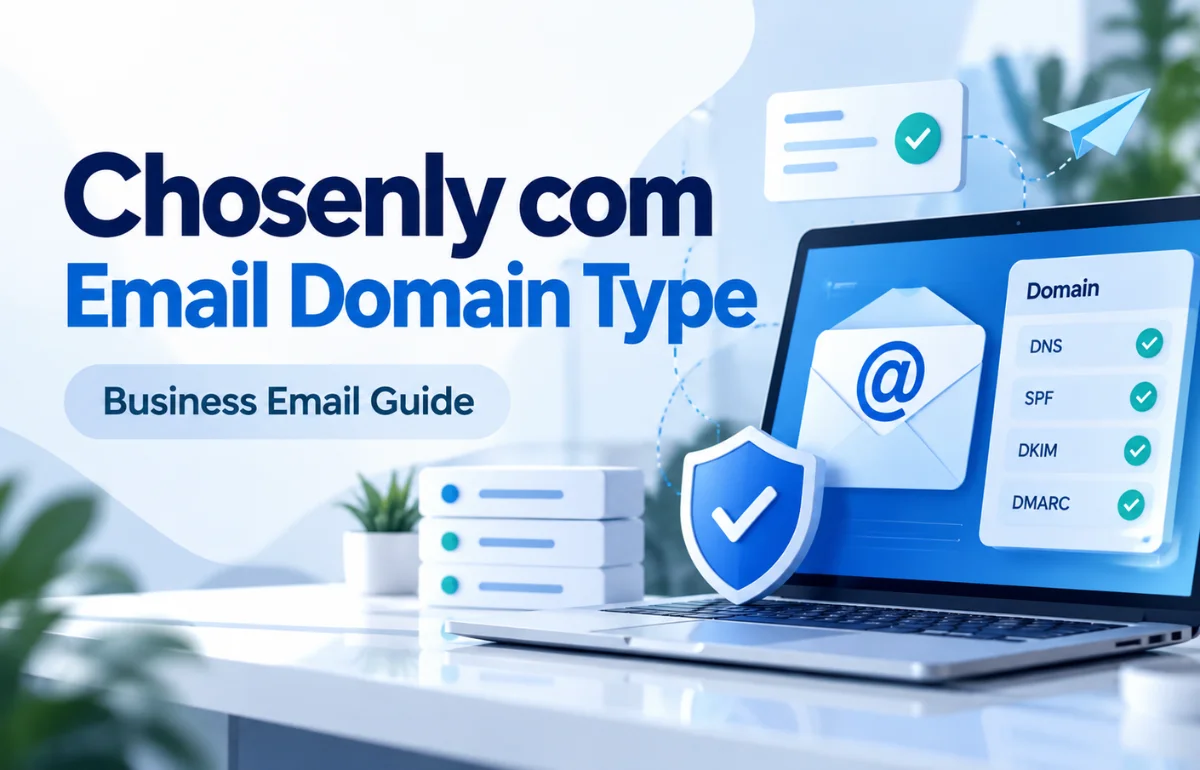
The chosenly.com email domain type is best classified as a custom business or corporate email domain associated with Chosenly LLC. In simple terms, addresses ending in @chosenly.com are tied to the company’s own domain rather than a public email service such as Gmail, Yahoo, or Outlook. Chosenly’s official legal page identifies the business as Chosenly LLC and publicly lists support@chosenly.com as a contact address, which is strong evidence that the domain is used for organizational email.
Based on the publicly available information I checked, chosenly.com should not be treated as a typical free-email domain or an obvious disposable-email domain. However, the email domain type should not be confused with the underlying email hosting provider. A business can own its domain while using Google Workspace, Microsoft 365, another mail platform, or a combination of email services behind the scenes.
Chosenly.com Email Domain Type at a Glance
For readers who only need the short answer, here is how I would classify the domain.
| Question | Chosenly.com |
|---|---|
| Domain type | Custom business/corporate domain |
| Associated organization | Chosenly LLC |
| Public company email | support@chosenly.com |
| Free consumer email domain? | No |
| Public email provider? | No evidence of this |
| Disposable or temporary email domain? | No clear evidence suggesting that |
| Used for company-related email? | Yes |
| Email hosting provider | Should be verified separately through current DNS/MX records |
| Does the domain alone prove every email is genuine? | No |
This distinction matters because people often search for an “email domain type” when they are really asking one of several different questions: Is this a company domain? Is it disposable? Who owns it? Which service hosts its email? Or can an email from that domain be trusted?
Those questions are related, but they do not have identical answers.
What Does “Email Domain Type” Actually Mean?
An email domain is the portion of an email address that appears after the @ symbol.
For example:
support@chosenly.com
The mailbox name is “support,” while chosenly.com is the domain.
When I classify an unfamiliar email domain, I normally look at four things: who controls the domain, who can obtain an address on it, how the domain is being used, and whether it represents a permanent organization or a temporary email service.
That produces several common email-domain categories.
| Email domain category | Typical example | Main purpose |
|---|---|---|
| Free/public email | gmail.com, outlook.com | Personal or general email accounts |
| Custom business email | companyname.com | Employees, support, sales and company communication |
| Educational email | university.edu | Students, faculty and staff |
| Government email | Government-controlled domain | Official public-sector communication |
| Disposable email | Temporary-mail domains | Short-lived inboxes and sign-ups |
| ISP email | Internet-provider domains | Email bundled with internet service |
Within that framework, chosenly.com fits most naturally into the custom business email category.
Why Chosenly.com Is a Business Email Domain

The clearest evidence comes from Chosenly itself.
The company’s Terms of Service identify the organization as Chosenly LLC, state that it operates chosenly.com, and provide support@chosenly.com as an official contact address. The same page describes Chosenly as a SaaS platform serving B2B companies.
That combination is significant.
A custom corporate email domain generally has three characteristics:
- The organization controls the website domain.
- The same domain is used for company-related email addresses.
- Email accounts are issued for organizational rather than general public use.
Chosenly.com matches that pattern.
The company’s LinkedIn presence also describes Chosenly.com as a privately held software-development business focused on helping B2B organizations improve their visibility in AI search systems.
A third-party business-contact database additionally associates company contacts with @chosenly.com addresses and reports possible employee-address formats. I would treat those specific format predictions as third-party estimates rather than official guarantees, but they reinforce the broader conclusion that @chosenly.com is used as an organizational email namespace.
Is Chosenly.com a Free Email Provider?
No evidence I found suggests that chosenly.com operates like Gmail, Yahoo Mail, Outlook.com, or another service where members of the public can freely register an email account.
That difference is central to the chosenly.com email domain type.
Someone can normally visit Gmail and create a new @gmail.com address. A custom corporate domain works differently. Accounts are generally created or authorized by the company controlling the domain.
So a person should not assume that an arbitrary user can register something like randomname@chosenly.com.
The domain appears to represent the organization rather than a general-purpose email platform.
Is Chosenly.com a Disposable Email Domain?
I found no convincing public evidence that chosenly.com functions as a disposable or temporary email provider.
Disposable-email services are designed to create short-lived inboxes. People commonly use them for temporary registrations, trials, testing, privacy, or avoiding marketing messages.
A corporate domain has a completely different purpose.
Chosenly publishes an @chosenly.com address on its legal documentation for customer contact. That is much more consistent with persistent business communication than with temporary-email infrastructure.
This is useful if you are classifying email leads. An address ending in @chosenly.com should not automatically be placed in the same category as an address coming from a known temporary-mail service.
That still does not prove that every individual mailbox exists. Email-address validity and domain classification are separate issues.
Business Domain vs. Email Hosting Provider
This is where many articles about email-domain types become inaccurate.
Chosenly.com is the domain. The company can own and use that domain while another technology provider handles the actual mail servers.
For example, a company could have:
employee@examplecompany.com
while its email infrastructure is powered by Google Workspace.
Another company might use the same type of branded address with Microsoft 365.
The visible domain would still be examplecompany.com in both situations.
Why MX Records Matter
MX stands for Mail Exchange.
MX records are DNS records that tell other mail systems where email for a domain should be delivered. Examining current MX records can often reveal which provider or mail infrastructure handles incoming email.
That technical result answers:
“Where is mail for this domain routed?”
It does not answer:
“What type of organization owns this email domain?”
That is why I would describe chosenly.com as a custom business domain based on public organizational evidence, while treating its underlying mail-hosting technology as a separate technical question that should be checked against live DNS information.
This approach also keeps the classification accurate if Chosenly later changes email providers.
How I Evaluate an Email Domain Like Chosenly.com
When I investigate an unfamiliar company email, I prefer a layered approach rather than relying on a single domain-checking website.
1. Match the email domain with the official website
If the business operates chosenly.com and communicates from @chosenly.com, that creates a logical connection between its web identity and email identity.
Chosenly’s own legal page provides exactly that connection.
2. Check whether the company publicly uses the email domain
A published support, legal, press, security, or sales address is much more useful than simply finding a domain registration.
In this case, support@chosenly.com appears in Chosenly’s official Terms of Service.
3. Look at MX records
MX records help determine whether the domain is configured to receive email and may identify its current mail provider.
Because DNS settings can change, I prefer real-time DNS results over an old screenshot or an article claiming that a company has permanently used one particular email provider.
4. Inspect SPF, DKIM and DMARC
These records and authentication systems help answer another question: how does the domain protect and authenticate outgoing mail?
SPF can specify systems permitted to send mail for a domain.
DKIM provides cryptographic authentication that receiving systems can check.
DMARC gives domain owners a policy framework for dealing with messages that fail authentication and provides alignment rules involving the visible sender domain.
These technologies are important for email security and deliverability, but their presence should not be treated as absolute proof that a particular message is safe.
5. Examine the actual email headers
If I need to determine whether a particular message claiming to come from chosenly.com is authentic, I would not rely only on the visible “From” field.
Email headers can reveal authentication results, mail-routing information, return paths and other technical evidence.
That is a much stronger approach than asking, “Does the address look professional?”
Does an @chosenly.com Address Mean an Email Is Safe?
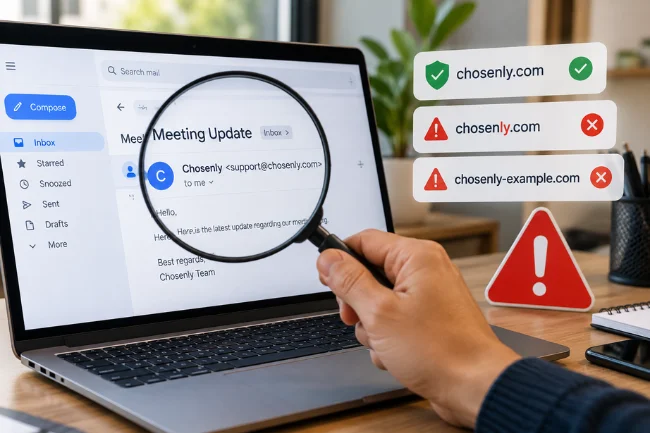
Not automatically.
This is one of the most useful distinctions to understand.
A domain can belong to a legitimate company while an individual message claiming to use that domain may still deserve scrutiny.
Attackers can use display-name impersonation, lookalike domains, compromised accounts, misleading reply-to addresses and, in some circumstances, spoofed sender information.
For example, these are visually different domains:
chosenly.com
chosenIy.com
chosenly-example.com
The second example can be particularly deceptive in fonts where a capital “I” resembles a lowercase “l.”
Before acting on a sensitive email, I would verify the exact domain character by character.
I would be especially cautious if a message unexpectedly requests passwords, verification codes, cryptocurrency, banking changes, invoices, gift cards, confidential files or urgent payment.
Corporate domain status is a useful trust signal. It is not a substitute for message-level verification.
Chosenly.com Email Addresses and Possible Naming Formats
Third-party business data suggests that addresses at chosenly.com may use short employee-based formats, including first-name or first-initial patterns.
However, I would not use those estimates to invent or assume a person’s email address.
Companies regularly create different types of mailboxes, such as:
support@domain.com
sales@domain.com
name@domain.com
initials@domain.com
billing@domain.com
They may also change naming conventions as teams grow.
The only chosenly.com address I can confirm directly from the company’s own public legal information in this research is support@chosenly.com.
That distinction between confirmed and predicted email addresses is worth maintaining, particularly when building contact databases.
Why Email Domain Type Matters for Lead Generation
Searches for chosenly.com email domain type may also come from marketers, sales teams and email-verification systems trying to classify a lead.
A company-domain email can provide useful information.
For example, an address at a corporate domain may indicate that a person is communicating through an organizational identity rather than a personal Gmail or Outlook account.
For B2B lead scoring, that can help distinguish business contacts from consumer registrations.
But domain type should be only one signal.
A strong verification process can separately examine:
- whether the domain exists;
- whether it has functioning mail infrastructure;
- whether the individual mailbox appears deliverable;
- whether the domain is disposable;
- whether the address is role-based;
- whether the business identity matches the contact;
- and whether the email has previously bounced.
Treating all of those as “domain type” produces bad data.
A Better Way to Classify Chosenly.com
I use a four-layer model because it prevents several common misunderstandings.
Layer 1: Ownership type
Chosenly.com is associated with an identifiable business, Chosenly LLC.
Classification: business-owned domain.
Layer 2: Account-access type
There is no indication that the general public can register @chosenly.com mailboxes in the way they can register Gmail accounts.
Classification: private organizational email namespace.
Layer 3: Persistence type
The company’s official publication of support@chosenly.com indicates ongoing business contact use rather than the normal behavior of a disposable inbox.
Classification: persistent corporate email use.
Layer 4: Infrastructure type
The actual email-delivery platform should be determined using current DNS/MX data rather than inferred from the domain name.
Classification: mail host must be checked independently.
This four-part framework gives a much more useful answer than labeling chosenly.com simply “custom.”
It tells a marketer, security analyst or everyday recipient what the classification does and does not establish.
Chosenly.com, Website Hosting and Email Hosting Are Different Things
Another common source of confusion is website infrastructure.
A website can be hosted by one company while its email runs through an entirely different provider.
Third-party domain data currently associates chosenly.com’s web infrastructure with Amazon-related services and Amazon Web Services DNS names.
That does not, by itself, prove that Amazon handles the company’s email.
Website hosting records, nameservers and MX records perform different jobs.
So if a domain-analysis website tells you chosenly.com uses a particular web host, do not automatically convert that result into an email-provider claim.
That small technical distinction prevents a surprisingly large number of inaccurate domain reports.
Should You Accept Chosenly.com Emails on a Website?
If you operate a B2B registration form that accepts corporate email addresses while rejecting free or disposable providers, chosenly.com would generally fit the business-domain category based on the evidence available.
I would not blacklist it merely because it is unfamiliar.
Instead, apply your normal verification controls.
Confirm the domain, check email deliverability where appropriate, use fraud or abuse signals independently, and avoid assuming that every address sharing a legitimate domain deserves automatic trust.
For cybersecurity-sensitive applications, authentication results and user behavior matter far more than the simple label “business email.”
What the Public Evidence Actually Proves
For accuracy, it helps to separate verified information from assumptions.
Public evidence supports the following points:
Chosenly LLC operates chosenly.com and publicly uses support@chosenly.com for company contact.
Chosenly presents itself publicly as a software business serving B2B organizations.
Third-party business-contact data also associates organizational email addresses with the @chosenly.com domain.
Together, those signals make a custom corporate/business domain the most defensible classification.
What I would not infer solely from those facts is that every address at the domain is valid, every email carrying that domain is safe, or one specific email provider will host chosenly.com indefinitely.
Those require different checks.
FAQs About Chosenly.com Email Domain Type
Is chosenly.com a business email domain?
Yes. Public information links chosenly.com to Chosenly LLC and the company publishes support@chosenly.com as an official contact address.
Is chosenly.com a disposable email domain?
There is no clear evidence that chosenly.com operates as a disposable or temporary email service; its public use is consistent with a corporate domain.
Is an email from @chosenly.com legitimate?
The domain is associated with an identifiable business, but the authenticity of a specific message should still be checked through its exact sender address and email authentication details.
Can anyone create a chosenly.com email address?
There is no evidence that chosenly.com is a public email provider offering registrations like Gmail or Outlook; accounts appear to be organization-controlled.
What company uses the chosenly.com email domain?
Chosenly LLC operates chosenly.com and describes its service as a B2B SaaS platform focused on visibility in ChatGPT and other LLM-based search experiences.
Final Takeaway
The most accurate answer to “What is the chosenly.com email domain type?” is: chosenly.com is a custom business or corporate email domain associated with Chosenly LLC. It is not presented as a free public mailbox provider, and the available evidence does not suggest that it is a disposable email service.
If you are checking the domain for lead verification, treat it as a corporate domain while verifying the individual mailbox separately. If you are checking a suspicious message, go one level deeper and inspect the sender address, authentication results and message headers rather than trusting the domain name alone.
That approach gives you a far more reliable answer than any single “domain type” label.

Noah Sterling is a technology research writer with 8+ years of experience covering emerging technologies, software trends, digital tools, and innovation. He creates practical, research-based articles to help readers understand the evolving technology landscape.