Brumeblog com is a general-interest publishing website that carries articles about business, technology, health, education, finance, lifestyle and travel. At brumeblog.com, readers can browse posts by category, follow author links and explore an archive of informational content. I would describe it as a multi-topic blog: a place to discover explanations and ideas across several subjects, with the usefulness of each article depending on its evidence and detail.
There is one distinction worth understanding immediately. The similarly named brume-blog.com also publishes content, but it is a different web address. I found different article collections on the two sites and could not establish shared ownership.
For this review, I examined public pages, category listings, author information and individual articles. My observations reflect the material available during research on September 15, 2026.
Brumeblog com and Brume-Blog.com Are Different Addresses
When I compared the two websites, the naming overlap was the first thing that needed clarification. Someone searching the name without punctuation could easily arrive at an explanation of the wrong domain.
The distinction affects more than spelling. A contact address, editorial statement or privacy policy found on one site should not automatically be attributed to the other.
| Detail | brumeblog.com | brume-blog.com |
|---|---|---|
| Navigation distinction | Education and finance appear in the main menu | Digital marketing appears in the main menu |
| Observed author labels | Shivi Hyde and an account-style username appear on recent posts | William Marchand appears on recent posts |
| Content examples | Senior care, property financing and business explainers | Travel savings, website explainers and online gaming |
| Relationship between domains | Shared ownership not established | Shared ownership not established |
These are observations from the unhyphenated website and the hyphenated website, not a claim that either impersonates the other.
My practical advice is simple: check the address before relying on a review. Save the exact article link if you plan to revisit it or cite it later. A similar name is not enough to establish a connection.
What Topics Does Brumeblog com Cover?

The site’s subject range is easier to understand through actual examples than through a long list of broad promises. Its archives mix introductory explanations, opinion-style discussions, practical instructions and descriptions of other websites.
Business and Professional Life
The business archive includes material about entrepreneurial uses of AI, workplace difficulties, employment checks, international business moves, remote working and online commerce. That makes the category broader than company news or startup advice alone.
I would approach these articles with a specific question in mind. If you want ideas for a small business, an overview may help you identify possibilities. If you need costs, implementation requirements or evidence of customer demand, look for those details before treating an idea as a workable plan.
Technology and Digital Tools
The technology archive includes topics such as Go developer hiring, virtual reality, automation, coding education, investing apps and wearable devices. Some listed material dates back several years, so a category label does not tell you how current an explanation is.
I also found a separate article comparing Google’s Gemini assistant with Google Search. Its use of a comparison table illustrates how the site sometimes organizes explanations around a practical choice.
For software-related reading, I look for a version, a date and links to the product’s own documentation. A clear explanation can still become incomplete when the product changes.
Health and Everyday Wellbeing
The health archive contains articles on subjects including telemedicine, mental wellbeing, nutrition and remote monitoring. This breadth means readers may encounter both general lifestyle discussion and content touching on clinical decisions.
My reading standard changes with the consequences of getting something wrong. I expect a stronger evidence trail for a treatment claim than for a general organizational tip. An approachable tone helps understanding, but it cannot establish a writer’s medical qualifications.
Education, Lifestyle and Other Interests
The author archive for Shivi Hyde includes a literary explanation alongside technology and business articles. This is a useful example of the site’s general-interest approach: the same browsing session can move between quite different kinds of learning.
For a student, I would use an introductory article to identify concepts and questions, then consult the original text or an appropriate academic source. For casual reading, the main test is whether the article answers the question clearly and gives enough context to avoid misunderstanding.
What I Found in Individual Articles
A category list tells me what a publisher attempts to cover. Reading individual pages tells me more about how that coverage works. Four examples illustrate the strengths and limitations I noticed.
A Technology Comparison with Useful Structure
The Gemini and Search article includes definitions, example situations, a feature table and short answers to follow-up questions. It also links to a Google source. Those features make its explanation easier to navigate and give readers somewhere to continue checking.
I would still distinguish an introductory comparison from a tested product review. Readers choosing a tool for a particular task would benefit from dated examples showing what happened when the writer tried that task. A table is helpful, but the evidence behind its judgments matters too.
A Business Overview That Leaves Follow-Up Work
The SoSoActive article introduces another publication through its business, finance and marketing themes. It discusses potential audiences and includes a link to the featured website, but it does not present a documented testing method or measured results.
My assessment is that this works better as an introduction than as an independent quality assessment. If I were deciding whether to rely on the featured publication, I would open its articles and examine them directly. Describing what a website aims to offer is different from demonstrating how well it delivers.
A Local Care Article with a Sourcing Question
An article about ageing at home in Wake County discusses practical considerations and links to a care provider. It also refers generally to research without identifying a specific study alongside that claim.
That gives readers a concrete follow-up question: what evidence supports the broader health statements? The provider link may help someone explore a service, but it does not independently establish every claim in the article. I would want named research or a qualified review before relying on those statements.
A Tutorial with a Date Mismatch
The pie-chart tutorial displays an April 2026 publication date while its title and parts of its text refer to 2025. It offers an example dataset and instructions, so there is practical material to work with. The mismatch nevertheless makes its review history unclear.
I would not reject the instructions solely because of that discrepancy. I would check whether the described interface and features still match the tool. This is a useful reminder that the date beside a headline and the currency of the underlying instructions are separate questions.
How I Assess Its Credibility
I cannot give every article on a broad website the same confidence rating. Different authors, subjects and publication dates create different evidence requirements.
Authorship Should Lead Somewhere Useful
The reviewed pages show both named contributors and an account-style byline. Shivi Hyde’s archive provides a record of published work, although the page I reviewed did not supply a detailed professional biography.
I treat a byline as a starting point for accountability. Next, I look for relevant experience, an identifiable editorial role or a clear explanation of how the article was researched. A familiar-looking name alone does not verify someone’s identity or expertise.
Evidence Should Match the Claim
My simplest credibility test is to select the most consequential sentence in an article and ask how I could verify it. A source should support that specific sentence, rather than merely discuss the same general subject.
For example, a product’s own page can establish its advertised features. It cannot independently establish that it outperforms every competitor. A first-person review can describe a test, but the conditions and results need to be clear enough to assess.
I also watch for the difference between an example and a finding. A hypothetical business scenario can explain an idea well. It should not be presented as proof that real customers achieved the same outcome.
Recent Activity Is Only One Signal
An active publication can contain older material that still needs attention. Conversely, an older explanation can remain useful when the underlying subject has not changed.
I check the page I intend to use, rather than borrowing confidence from the date of the newest homepage post. For changing subjects, a meaningful update should be reflected in the article’s details, examples and sources.
How Brumeblog Compares with Other Sources
I choose sources according to the question. The following table describes how I would use each type, rather than ranking every general-interest blog below every specialist publisher.
| Research need | Role for a broad blog | Useful next source |
|---|---|---|
| Understand an unfamiliar term | Read an accessible introduction | A textbook, glossary or original documentation |
| Learn a software task | Follow a clearly illustrated explanation | The vendor’s current help pages |
| Explore a business idea | Identify possibilities and questions | Customer research and real cost information |
| Investigate a health claim | Identify the claim and its sources | Clinical guidance or a qualified professional |
| Compare a paid service | Build an initial shortlist | Current terms and independently documented testing |
The benefit of a broad publication is discovery. It can introduce a subject you would not otherwise have explored. The limitation appears when a reader expects an overview to settle a detailed decision.
I find the most useful reading habit is to leave an article with either a clear answer or a better question. If it delivers neither, its length and number of headings do not add much value.
Is It Free to Read, and Can Readers Contribute?
The individual articles examined for this review were publicly accessible through the research tools without a subscription sign-in. That observation applies to those pages; I did not test every feature or registration flow.
Contribution opportunities require particular care because of the similar domains. The contact page at brume-blog.com explicitly invites advertising, sponsorship and guest-post inquiries. That statement belongs to the hyphenated website and does not establish the submission policy of brumeblog.com.
If you want to contribute, I would first confirm the exact publication and ask for its written requirements. Useful questions include whether a placement is paid, who edits the submission, how commercial relationships are disclosed and whether the contributor retains reuse rights.
I would also avoid treating acceptance of a guest article as an endorsement of its claims. Editorial review, commercial placement and independent recommendation are different things.
Privacy and Safety Require Separate Checks
Content quality and website security answer different questions. Reading several useful articles does not establish that every external link, form or download is safe. This review is not a technical security audit.
The hyphenated site’s privacy policy discusses cookies, possible advertising services and affiliate links. Those disclosures should not be transferred to the unhyphenated domain without checking its own applicable policies.
Before submitting personal information, I would check which website is collecting it and why. When an article sends me elsewhere, I would inspect the destination independently. A positive description on one page is not enough to justify a payment or a sensitive disclosure on another.
How to Get More Value from Your Visit
Start with one question you actually need answered. Browsing without a purpose is fine for discovery, but a specific question makes it easier to notice missing information.
I suggest keeping three short notes while reading: the answer offered, the evidence provided and anything still unresolved. This prevents a confident introduction from feeling more complete than it is.
Next, follow the strongest source link. Does it support the point you care about? If there is no source, decide whether the claim is ordinary background information or something that needs verification before you act.
Finally, record the article’s address and date if you use it in your own research. That gives you a way to revisit the exact material rather than relying on a remembered website name.
My Verdict on Brumeblog com
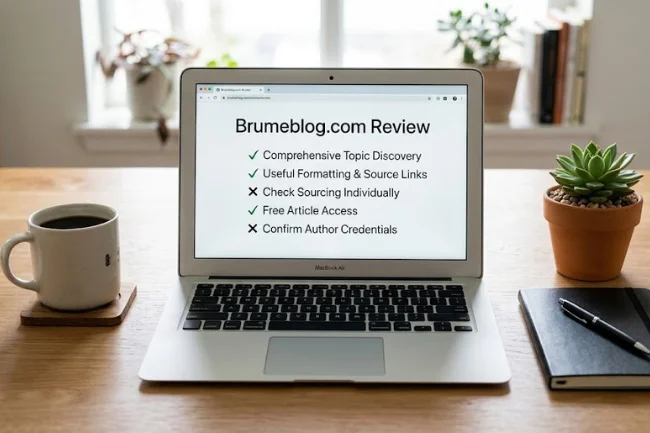
I would use Brumeblog com for topic discovery and introductory reading, while assessing consequential claims individually. The sample articles showed useful formatting and some source links, alongside questions about sourcing, review methods and freshness.
Start with one article relevant to your goal. Check its author, follow its supporting evidence and compare its answer with a suitable primary source. That will tell you more about its usefulness than a blanket recommendation ever could.
Frequently Asked Questions
What is Brumeblog com?
It is a multi-topic publishing website with informational articles across several subjects. This review focuses on brumeblog.com, the address without a hyphen.
Are brumeblog.com and brume-blog.com the same website?
They are different domains with different observed content collections. I could not verify shared ownership or an official relationship between them.
Is Brumeblog com free to read?
The articles examined for this review were accessible without a subscription sign-in. That does not establish the access conditions for every feature.
Who writes for Brumeblog com?
Reviewed pages included Shivi Hyde, Devin Haney and an account-style byline. Check the individual article for its author and supporting credentials.
Is Brumeblog com trustworthy?
I would judge individual articles by their evidence, authorship and currency. A functioning website or readable explanation does not establish universal accuracy.

Noah Sterling is a technology research writer with 8+ years of experience covering emerging technologies, software trends, digital tools, and innovation. He creates practical, research-based articles to help readers understand the evolving technology landscape.