Wachappe is an ambiguous online term associated with messaging and sometimes presented as a variation of WhatsApp.
In the public sources I checked on September 8, 2026, I could not verify a distinct messaging application with that exact name, an identifiable developer, and supporting product documentation. The most accurate explanation is therefore an unresolved name whose meaning depends on where you encounter it.
If you searched for it because someone mentioned an app, sent a link, or suggested a download, the useful question is which specific service they meant. A familiar-sounding name cannot answer that for you.
I investigated the term by comparing search results, looking for app-store evidence, and checking established messaging services directly. Here is what that research supports, what remains uncertain, and how I would decide what to do next.
What I Found When Researching Wachappe
My first task was to separate a word appearing online from a product someone could actually identify. Those are different kinds of evidence.
I searched the exact term alongside “meaning” and “app,” then used searches restricted to Google Play and Apple’s App Store. The results included articles offering different interpretations, along with unrelated or similarly named applications. I did not establish a consistent developer-to-product connection for the exact name.
This was a review of publicly searchable material, not an exhaustive inspection of every country’s app store. It also was not a hands-on software test: I did not identify a verified installation that I could responsibly treat as the product under discussion.
That limitation matters. An unsuccessful search cannot prove that no private project, unindexed website, or newly released application exists anywhere.
My Research Record
I would rather show the boundaries of the investigation than turn an incomplete search into a sweeping claim.
| Check performed | What I established | What it does not establish |
|---|---|---|
| Exact-name web searches | The term appears in messaging-related discussions and articles | A single agreed meaning or official owner |
| Google Play-restricted search | No exact-name product identity verified in returned results | Complete absence from every regional storefront |
| Apple App Store-restricted search | No exact-name product identity verified in returned results | Proof that an app has never existed |
| Official messaging websites | Established services publish identifiable product information | Any relationship between those services and Wachappe |
For readers, the practical result is straightforward: treat a specific website or application as something to investigate individually. Avoid assuming that every result containing the same word describes the same service.
Is Wachappe Another Name for WhatsApp?
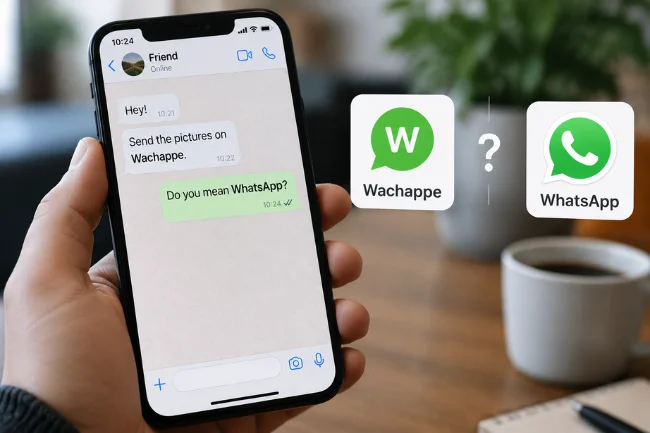
The resemblance makes a spelling or pronunciation variation a plausible explanation. However, I cannot establish that this interpretation applies to every use, or that it has a documented linguistic origin.
For example, imagine a friend says, “Send the pictures on Wachappe.” I would ask whether they mean WhatsApp before searching for another application. That is an illustrative situation, not evidence that everyone uses the word that way.
Context is more useful than guessing. A chat message, a software listing, and a blog headline may use the same letters for different purposes.
How I Would Resolve the Confusion
I would ask for the exact app-store link or the developer’s name. If the person means WhatsApp, I would use the official WhatsApp download page to reach its published installation options.
If they claim it is a separate product, I would ask for documentation identifying that product. A copied logo, familiar colour scheme, or similar name would not settle the question.
I also found no basis in this review for presenting Wachappe as an official rebrand of WhatsApp. Any future claim of a name change should be checked against an announcement from the company itself.
Why Detailed Descriptions Can Still Leave You Without an Answer
A page can explain messaging features fluently without establishing which application provides them. That was the central difficulty in this research: descriptive detail did not resolve product identity.
For instance, one article I reviewed presents texting, calling, groups, and file transfers as possibilities while acknowledging a lack of verification. That distinction should survive when information is repeated elsewhere.
My approach is to look for the original source behind each meaningful claim. If several articles all depend on one unsupported description, I would count that as one unresolved claim, not several independent confirmations.
The same standard applies to statements that the term is becoming popular. I have not measured its search volume or growth, so I would not describe it as a rapidly expanding trend.
Which App Features Can Actually Be Confirmed?
I cannot responsibly attribute a working feature set to Wachappe from the evidence reviewed. That includes encryption, voice calling, video meetings, artificial intelligence tools, business accounts, or cloud backups.
Instead, I would ask what evidence would make each claim useful to a potential user.
Messaging and Calling
For messaging, I want an identifiable app, current documentation, and a reproducible demonstration of sending and receiving messages. For calls, check supported devices and whether the feature works between the intended users.
A promotional screenshot can suggest an interface, but it does not show that a service is available or functioning. I would label any demonstration according to what was actually tested.
Privacy and Encryption
Security documentation should explain which conversations are protected and whether protection is automatic. A statement that an app is “secure” leaves too many practical questions unanswered.
Telegram provides a useful example of why wording matters: its ordinary Cloud Chats and its end-to-end encrypted Secret Chats use different arrangements. The specific chat type affects the privacy claim.
For an unfamiliar product, I would look for similarly specific explanations before entrusting it with private conversations.
Price, Availability, and Support
I also want to know whether the service costs money, where it operates, which operating systems it supports, and how users can contact support.
I would not infer that an unknown app is free because competing apps have free versions. Likewise, an article mentioning Android does not establish iPhone availability.
These questions may sound basic, but clear answers are often more valuable than an impressive list of unverified features.
How I Would Check a Wachappe Website or Download
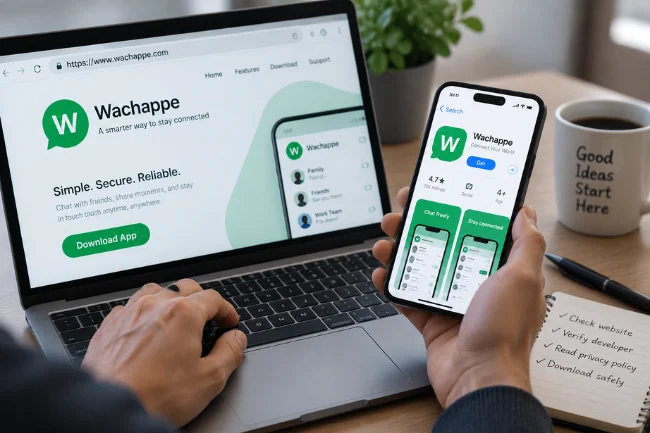
If you have an actual link, you can investigate more precisely than someone searching only a name. I would work through the following checks before installing anything.
Match the Website to the Developer
Compare the website’s operator with the developer named in the app listing and privacy policy. Different legal and trading names can be legitimate, but the relationship should be understandable.
If the page names unrelated businesses without explanation, I would pause. If the service has no identifiable operator, I would have nobody clear to hold responsible for its claims.
Follow a Consistent Download Route
My preferred route is an independently verified developer website linking to its store listing. Then check whether the listing points back to the same organisation.
A download button on an explanatory blog is not enough for me. I would also avoid treating the first search result as automatically official.
For Android users, Google Play Protect checks applications for potentially harmful behaviour and can warn about, disable, or remove harmful apps. It is a useful additional check, rather than a substitute for establishing who supplied the software.
Read the Policy for Actual Answers
Look for an explanation of what information is collected, why it is needed, who receives it, and how deletion requests work.
My question would be simple: can I understand what happens to my information after I create an account? If the policy only repeats broad promises about privacy, I would still need an answer.
Match Permissions to the Task
Before accepting a permission request, I consider what I am trying to do. A feature should have a clear reason for needing access, and the app should explain that reason.
For example, I would question a request for extensive device control when all I want is to read a message. I would not keep granting permissions simply to get past the setup screens.
Does an Unverified Name Mean It Is a Scam?
No. I would not label every use of Wachappe fraudulent merely because the name is unclear. The evidence supports uncertainty, not a blanket accusation.
An informal spelling, a harmless discussion page, and a deceptive download could all involve a similar term. Each would require a different assessment.
The behaviour deserves closer attention: unexpected requests for credentials, pressure to act immediately, and messages directing me to unfamiliar account pages.
The FTC advises contacting an organisation through a website or number you already know is genuine when a message looks suspicious. I would apply that principle to any supposed messaging-service update.
Suppose a message says I must install a new app immediately to keep my conversations. Before following it, I would check the existing service through its official channels. Urgency would make me verify the request more carefully.
Wachappe Compared With Documented Messaging Services
If your goal is simply to communicate, I would choose according to the people you need to reach and the privacy arrangements you understand.
The comparison below separates the unresolved name from services with published documentation. It is a decision aid, not a performance test or a security ranking.
| Option | Identity and documentation | Privacy distinction | When I would consider it |
|---|---|---|---|
| Wachappe | No distinct product verified in this review | Cannot assess without identifying the service | After obtaining and checking the exact product link |
| Official product and download pages | Personal messages and calls use end-to-end encryption | When my intended contacts already use it | |
| Signal | Official service with published privacy information | Messages and calls use end-to-end encryption | When I want that protection as a standard arrangement |
| Telegram | Official apps and detailed documentation | Ordinary Cloud Chats differ from end-to-end encrypted Secret Chats | When groups, channels, and cloud access fit my needs |
The product facts come from WhatsApp, Signal, and Telegram. The choice criteria are my assessment.
Start with the conversation itself. A family group, a public community, and a confidential exchange do not necessarily need the same features.
Check the current settings before moving sensitive discussions. Choosing a familiar brand does not remove the need to understand how the particular conversation is configured.
What If You Already Followed a Link?
First, establish what happened. Reading a page, downloading a file, installing software, and entering account details are different events. Describing the event accurately helps you choose the right response.
If you only received a suspicious message, use the service’s official channels to check its claim. There is no reason to continue interacting with the sender to prove that the message is genuine.
If you suspect a link or attachment downloaded harmful software, the FTC recommends updating security software and running a scan. Android users can also review Google Play Protect’s findings.
If you entered credentials or an account code, I would treat it as an account-security issue and use the affected service’s official recovery instructions. Record which account was involved and what you shared, without posting those details publicly.
That record can also help when contacting support. Keep the relevant URL, time, and app or developer name, while excluding passwords and verification codes from screenshots you share.
What Would Change My Assessment?
A verifiable product could change this article’s findings. I would look for an identifiable developer, consistent official links, current documentation, and an application whose behaviour can be examined.
My next task would be to separate developer claims from features independently tested. A new listing could establish availability while still leaving questions about reliability, privacy, or support unanswered.
This keeps the assessment open to better evidence. It also gives anyone promoting the service a clear way to resolve the uncertainty: provide information readers can inspect for themselves.
My Recommendation Before You Download
I would begin with one action: get the exact product link from whoever introduced you to Wachappe. Check its developer and documentation before deciding whether it meets your needs.
If you meant WhatsApp, use its official download route. If you meant another service, establish its identity first. That small check will help you make a more useful decision than another page of possible features.
Frequently Asked Questions
What is Wachappe?
It is an ambiguous term associated with messaging. My review did not verify a distinct application with that exact name and supporting documentation.
Is Wachappe the same as WhatsApp?
It may be intended as a spelling variation, but I could not verify it as an official WhatsApp name. Check the context and product link.
Is Wachappe safe to use?
I cannot assess safety from the name alone. The exact website, developer, download, and privacy practices need to be identified.
Where can I download Wachappe?
I did not verify an official download for a separate product under that name. If you mean WhatsApp, use its official download page.
Does Wachappe offer end-to-end encryption?
I found no verified technical documentation establishing that capability. A security claim needs evidence tied to an identifiable product.

Ava Bennett is a social media strategy writer with 7+ years of experience covering social platforms, content trends, audience engagement, and digital communication strategies. She creates practical insights to help readers understand the evolving social media landscape.