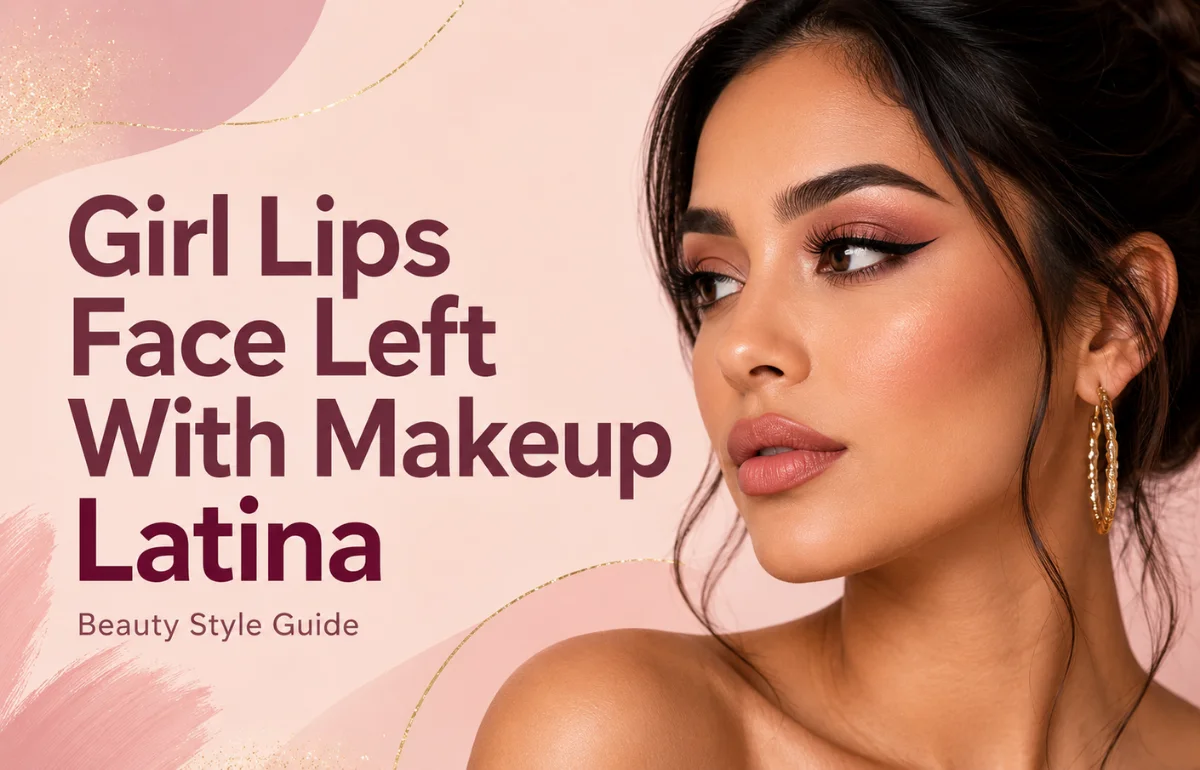
The phrase “girl lips face left with makeup latina” is best understood as a descriptive beauty and image-search query rather than the official name of one makeup technique. It usually describes an image of a woman presented with Latina-inspired makeup, noticeable or carefully defined lips, and her face turned or angled toward the left side of the frame.
When I break down this type of search phrase, I see several visual instructions combined into one query: the subject, the lips, the direction of the face, the makeup style, and a Latina beauty reference. That makes the phrase especially useful for people searching for beauty inspiration, photography references, makeup ideas, profile portraits, social media visuals, or prompts for creating beauty imagery.
The key point is that there is no single facial structure, lip shape, complexion, or makeup style that defines a Latina woman. Latin American communities are extraordinarily diverse. In this context, “Latina makeup” is better treated as a popular beauty aesthetic influenced by different cultural and social-media trends rather than as a description of ethnicity based on appearance.
What Does Girl Lips Face Left With Makeup Latina Actually Mean?
The easiest way to understand the query is to separate its individual parts.
| Search phrase element | Likely visual meaning |
|---|---|
| Girl | A female beauty or portrait subject |
| Lips | Strong attention to lip shape, color, liner, or gloss |
| Face left | Head or facial profile turned toward the left |
| Makeup | A polished cosmetic look |
| Latina | Latina-inspired beauty styling or visual context |
Together, these terms describe a very specific beauty-image composition.
Someone searching the phrase might want a close-up portrait where the model’s lips are highly visible, the face is positioned at an angle instead of looking directly into the camera, and the makeup uses details currently associated online with Latina-inspired glam.
This interpretation matters because many websites treat unusual long-tail keywords as though they were established beauty terminology. I would not recommend doing that here. A more useful approach is to answer the literal visual intent first and then explain the makeup, pose, photography, and cultural context behind it.
What Does Latina Makeup Usually Look Like?
Latina makeup is not a fixed rulebook. Online, however, the term has increasingly been associated with polished complexion makeup, defined brows, contour or bronzing, sharp eyeliner, expressive lashes, and strongly defined lips.
Recent coverage of the trend describes looks using matte or polished skin, structured eyebrows, defined eyeliner, facial sculpting, and darker lip liner paired with lighter lipstick or gloss.
I prefer to think of these as styling choices rather than “Latina features.” That distinction makes the beauty discussion both more accurate and more useful.
Defined Lips Are Usually the Focal Point
Lips are particularly important when interpreting the girl lips face left with makeup latina search.
A popular version of the look uses a brown, nude-brown, cocoa, rose-brown, or deeper neutral lip pencil around the natural lip line. A slightly lighter lipstick, gloss, or lip oil may then be applied toward the center.
This creates visual dimension without requiring an extremely bright lip color.
Dark liner with a softer center has also become closely associated with contemporary Latina makeup content and with beauty styles influenced by earlier Chicana looks. Current beauty coverage regularly highlights lined lips as one of the aesthetic’s most recognisable details.
Brows Add Structure
Well-shaped brows help balance stronger lips.
Rather than simply making the eyebrows darker, I find that shape is what creates the polished effect visually. A defined lower edge, controlled arch, and clean tail can frame the face without making the brows appear painted on.
For a softer version, individual brow strokes work well.
For full glam, the outline can be slightly more precise.
Eyes Can Range From Soft to Dramatic
The eye makeup does not have to compete with the lips.
Warm brown shadow, subtle neutral shading, elongated liner, mascara, or wispy lashes can provide definition while allowing the mouth to remain the main visual feature.
A sharper wing gives the portrait a stronger evening-glam character. Softer brown liner makes the same concept more wearable for everyday beauty.
Complexion Makeup Creates Dimension
Many viral interpretations of Latina makeup favor bronzed or sculpted skin rather than a completely flat base.
Contour can create depth beneath the cheekbones and along the jaw, while bronzer adds warmth. Some interpretations use a matte or semi-matte complexion with brighter under-eyes; others have moved toward softer, more luminous finishes.
The exact finish should suit the person’s skin rather than forcing every face into the same template.
Why Is the Face Turned Left?
The “face left” part of the keyword is more significant than it initially sounds.
It describes composition rather than makeup.
In photography, illustration, beauty advertising, and generated imagery, specifying left or right changes the direction of the portrait. Instead of a straight-on headshot, the person’s nose, lips, jawline, and cheek may form a more obvious profile or three-quarter view.
Left-Facing Profile
A full left-facing profile generally shows one side of the face prominently.
This position makes the outline of the forehead, nose, upper lip, lower lip, chin, and jaw especially visible.
For that reason, lip definition becomes extremely important. Uneven lip liner that might be difficult to notice in a front-facing photograph can become obvious from the side.
Three-Quarter Left Pose
For beauty content, I usually find a three-quarter angle more versatile.
The face turns left while enough of the opposite side remains visible to show both the makeup and the facial expression.
It can highlight:
- cheek contour
- lip shape
- eyelashes
- brow structure
- cheekbone highlight
- jaw definition
This is one reason similar poses appear frequently in cosmetic campaigns and social media beauty photography.
Left-Facing Profile vs Front-Facing Makeup Portrait
The best pose depends on what the image needs to communicate.
| Feature | Left-facing beauty portrait | Front-facing portrait |
|---|---|---|
| Lip profile | Highly visible | Shape and symmetry more visible |
| Nose profile | More prominent | Less prominent |
| Cheek contour | Stronger dimensional effect | Easier to compare both sides |
| Eyeliner | One eye may dominate | Both eyes clearly visible |
| Photography feel | Editorial and expressive | Direct and balanced |
| Best use | Beauty campaigns, lip visuals, artistic portraits | Tutorials, before-and-after images, product demonstrations |
Neither position is inherently better.
For a search specifically centered on lips, however, a left-facing or three-quarter portrait can make the mouth appear more sculptural and visually interesting.
How to Create the Makeup Look Naturally
If I were interpreting girl lips face left with makeup latina as a creative brief, I would start with balance rather than immediately applying heavy products.
The lips can be the hero of the composition. The rest of the makeup should support them.
Start With Skin That Still Looks Like Skin
Prepare the complexion according to skin type.
Hydrated skin generally helps makeup sit more smoothly, while people with oilier areas may prefer more controlled preparation around the forehead, nose, and chin.
Apply foundation only to the level of coverage needed.
A photograph can look more sophisticated when natural skin dimension remains visible instead of every part of the face having exactly the same texture.
Add Controlled Definition
Use contour or bronzer where it genuinely enhances the person’s bone structure.
For a left-facing pose, pay particular attention to the cheek facing the camera because overly dark contour can become very noticeable from this angle.
Blend the edges thoroughly.
The purpose is visual depth, not a visible stripe beneath the cheekbone.
Shape the Eyes Upward
Neutral brown, caramel, taupe, bronze, and softly smoky shades are easy to coordinate with a defined nude lip.
An outward-moving eyeliner shape can visually complement the direction of a three-quarter pose.
People wanting stronger glam can add fuller lashes.
For softer photographs, mascara and a small outer-corner lash may be enough.
Build the Lip Look Carefully
Lip makeup deserves extra attention because the keyword explicitly centers on lips.
Start with moisturised lips. Remove excessive balm before applying liner so the pencil does not slide.
Trace the natural lip shape first.
If overlining is desired, I would keep most of it around the center of the upper and lower lip rather than dramatically extending every edge. This tends to preserve a believable lip shape from profile angles.
Add lipstick or a creamy nude shade toward the middle.
Gloss can then be concentrated around the center rather than spread far beyond the lip line.
Choosing Lip Colors for Different Skin Tones
There is no universal “Latina nude.”
That assumption is one of the biggest weaknesses I see in generic articles on this topic.
Latina people can have very light, medium, olive, tan, brown, or deep complexions and a wide variety of undertones. A nude lipstick that works beautifully on one person can look pale, grey, orange, or overly pink on someone else.
A practical approach is to select the liner relative to the person’s natural lip and skin depth.
For lighter complexions, rose-brown, neutral beige-brown, and soft caramel can work well.
Medium and olive complexions may suit caramel, warm brown, cinnamon, mauve-brown, or terracotta tones.
Deeper complexions can look striking with cocoa, chestnut, espresso, rich berry-brown, or deep neutral liner combined with a complementary center shade.
These are creative starting points, not ethnicity-based rules.
Latina Beauty Is More Diverse Than a Viral Makeup Trend
This distinction deserves its own section.
Latina makeup has become a searchable social-media aesthetic, but Latina identity cannot be reduced to bronzed skin, dark hair, full lips, sharp eyeliner, or brown lip liner.
Recent discussion around the trend has raised exactly this issue: a handful of viral visual characteristics cannot adequately represent the beauty of an enormously diverse population.
Latin America includes people with countless combinations of ancestry, complexion, hair texture, eye shape, facial structure, and personal beauty traditions.
So when I use the expression “Latina-inspired makeup” in a visual context, I mean the popular makeup aesthetic being referenced online, not a claim about how Latina women naturally look.
That distinction is especially useful for photographers, designers, bloggers, and people creating visual prompts. It produces more accurate descriptions while avoiding stereotypes.
Why This Search Phrase Is Useful for Image Search
The unusual wording of girl lips face left with makeup latina makes much more sense when viewed as an image-discovery phrase.
Traditional article keywords often read like natural questions.
Image searches do not always work that way.
People frequently combine descriptive fragments such as subject + facial feature + direction + styling + identity or aesthetic. Search engines can then interpret these visual signals together.
I would classify this query as having several overlapping intents:
Beauty Inspiration
The searcher may want examples of defined lips, eyeliner, contouring, or Latina-inspired glam.
Pose Inspiration
“Face left” suggests the direction of the model is important.
Photography Reference
A designer or photographer might need a close-up beauty portrait with usable negative space, a specific head direction, or a strong lip profile.
Visual Creation
The terms can also resemble the way people describe an image they want to illustrate, generate, design, or reproduce.
That mixed intent explains why answering only “how to apply Latina makeup” would leave part of the query unresolved.
How to Make the Look Photograph Better
Makeup that looks good in person is not automatically optimized for a close-up beauty image.
A side or three-quarter angle changes what the camera sees.
I recommend checking the makeup from the actual shooting angle before taking final photographs.
Look closely at the lip liner around the corners of the mouth. Check whether cheek contour appears blended when viewed from the side. Examine the eyebrow tail, eyeliner wing, foundation near the jaw, and any makeup around the hairline.
Lighting also changes the effect.
Soft frontal or slightly side-positioned light can reveal the curves of the lips and cheek without creating extremely harsh shadows.
For glossy lips, watch reflections carefully. A controlled highlight can make the lips appear dimensional, while excessive glare may hide the actual color.
Common Mistakes to Avoid
One mistake is assuming the makeup needs to be extremely heavy to qualify as Latina-inspired glam.
It does not.
Another is choosing a nude lipstick that is dramatically lighter than the skin without using a compatible liner. This can make the center of the mouth appear disconnected from the rest of the makeup.
Harsh contour is another problem, particularly in side-facing portraits.
I would also avoid treating physical traits as requirements. Dark hair, full lips, tan skin, or a certain nose shape should never be used as a checklist for deciding whether someone “looks Latina.”
The makeup aesthetic can be described.
Ethnic identity cannot be reliably determined from makeup or facial appearance alone.
Creating a More Modern Version of the Look
A modern interpretation does not have to copy every viral detail.
For daytime wear, I would reduce the contour, soften the brow definition, use brown rather than intense black eyeliner, and choose a comfortable nude lip with moderate shine.
For evening makeup, the same foundation can be elevated with stronger lashes, a more precise wing, additional sculpting, and deeper lip liner.
The contrast between liner and lipstick can also be increased.
This flexibility is what makes the style visually interesting. The essential idea is not using the maximum amount of makeup; it is creating intentional definition.
FAQs
What is girl lips face left with makeup latina?
It is mainly a descriptive image-search phrase for a female beauty portrait featuring defined lips, a face angled toward the left, and Latina-inspired makeup styling.
What makeup is used for a Latina makeup look?
Popular versions often include defined brows, bronzed or sculpted skin, eyeliner, lashes, and a darker lip liner paired with nude lipstick or gloss.
What lipstick is best for Latina makeup?
Brown, caramel, rose-brown, cocoa, terracotta, nude, berry, and red tones can all work. The best shade depends on skin depth, undertone, and the desired level of contrast.
Can anyone wear Latina-inspired makeup?
Makeup techniques can be adapted to anyone’s features and complexion. The important distinction is to appreciate the aesthetic without suggesting that one makeup look represents every Latina woman.
Why are brown lip liner and nude lipstick popular in Latina makeup?
The darker outline adds definition and depth while the lighter center creates dimension, making the lips particularly noticeable in close-up and angled beauty portraits.
Bringing the Look Together
Girl lips face left with makeup latina is less a formal beauty term and more a highly specific visual search describing subject, makeup, facial direction, and lip emphasis in one phrase.
If you’re recreating the look, focus first on what the image needs to communicate. Use a flattering left-facing or three-quarter pose, define the lips carefully, balance them with structured brows and eye makeup, and adapt complexion products to the actual person rather than a stereotype.
Most importantly, use Latina makeup as an aesthetic reference rather than a definition of Latina appearance. That approach creates better beauty content, more useful photography, and a far more accurate representation of the diversity behind the term.

Olivia Parker is a home improvement research writer with 8+ years of experience covering home design, renovation ideas, maintenance tips, and practical living solutions. She creates easy-to-follow content to help readers make informed decisions about improving their homes.