Lenazwezia is an emerging, loosely defined term that is being used online for different forward-looking ideas. In the context of modern space exploration, Lenazwezia can be understood as a conceptual framework connecting human curiosity, scientific discovery, advanced technology, education, global cooperation, and responsible exploration beyond Earth.
It is not currently a clearly established scientific discipline, recognized space mission, or universally defined organization. While researching Lenazwezia, I found that some online sources associate the term with digital identity and creative expression, while others connect it specifically with space exploration.
That distinction matters. Rather than pretending the word has one official meaning, I find it more useful to understand what the idea represents, why it is being connected with space, and how its themes fit real developments in science and technology.
What Does Lenazwezia Mean?
There is no single universally accepted definition of Lenazwezia in the material currently available online. That makes it different from established scientific terms such as astrobiology, astrophysics, orbital mechanics, or planetary science.
The space-focused interpretation treats Lenazwezia as an umbrella concept: a way of thinking about exploration that combines imagination with practical scientific progress.
In simple terms, I would describe it as a future-focused mindset built around one question:
How can humanity explore beyond Earth intelligently, collaboratively, and responsibly?
That interpretation includes much more than rockets.
It can involve artificial intelligence, robotics, astronomy, engineering, space education, planetary research, international partnerships, sustainability, human health, and the long-term question of how people might live and work beyond Earth.
Why Is the Meaning of Lenazwezia Confusing?
The confusion comes from the fact that the word appears to be a coined or emerging term rather than one with a long documented history.
When I compared current uses of Lenazwezia, I found competing interpretations. Some websites describe it as a flexible idea related to branding, identity, or digital creativity. Another uses it as a framework for modern space exploration.
For readers, the safest approach is therefore to pay attention to context.
If a page discusses Lenazwezia alongside astronomy, spacecraft, robotics, lunar research, or interplanetary discovery, it is probably using the space-exploration interpretation.
If it appears in a discussion of online identity, naming, creativity, or branding, the intended meaning may be completely different.
Why Lenazwezia Fits the Modern Space Exploration Conversation
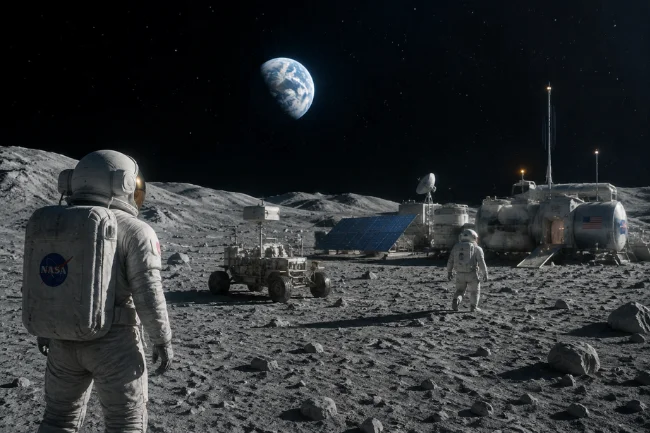
The attraction of the space-related interpretation becomes clearer when I look at how exploration itself is changing.
Space exploration is no longer simply a matter of launching a spacecraft, collecting data, and returning results to Earth. Modern exploration combines software, autonomous systems, robotics, human crews, commercial partners, scientific institutions, international cooperation, and increasingly sophisticated data analysis.
NASA, for example, describes its Artemis architecture as a program for scientific discovery, technology development, learning how to live and work on another world, and preparing for future human missions to Mars.
That broad combination of science, technology, human ambition, and long-term planning is where the Lenazwezia concept makes the most sense.
Instead of representing one spacecraft or one destination, it can serve as a lens through which those connected activities are viewed.
| Element of Lenazwezia | What It Represents in Space Exploration |
|---|---|
| Curiosity | Asking new questions about planets, life, and the universe |
| Technology | Using AI, robotics, spacecraft, sensors, and autonomous systems |
| Education | Preparing future scientists, engineers, researchers, and informed citizens |
| Cooperation | Sharing expertise across organizations, industries, and countries |
| Responsibility | Managing safety, resources, debris, and environmental impact |
| Long-term thinking | Preparing for sustained exploration beyond Earth |
The Five-Part Lenazwezia Framework
Because the term lacks a formal scientific definition, I find it helpful to organize its space-related meaning into five practical pillars.
This framework also makes Lenazwezia more useful than a vague label.
1. Curiosity Before Technology
Every major exploration effort begins with a question.
How did a planet form? Could another world have supported life? What resources exist on the Moon? How does the human body respond to extended periods away from Earth?
Technology provides tools for answering these questions, but curiosity determines which questions we pursue.
That is why I see curiosity as the first pillar of Lenazwezia. The concept works best when exploration is driven by genuine scientific inquiry rather than technology for technology’s sake.
2. Intelligent and Autonomous Exploration
One of the strongest connections between Lenazwezia and modern technology is artificial intelligence.
Spacecraft can operate at enormous distances where constant real-time control from Earth becomes impractical. Autonomous navigation, onboard decision-making, image analysis, pattern recognition, and intelligent planning can therefore become increasingly valuable.
NASA already uses artificial intelligence for mission support, research, data analysis, Moon and Mars exploration, and systems capable of supporting spacecraft more autonomously. Its documented AI use cases include autonomous exploration and navigation technologies.
This gives the futuristic side of Lenazwezia a practical foundation.
The future of exploration is likely to depend not only on stronger rockets, but also on machines capable of observing conditions, interpreting information, and making appropriate decisions with less direct intervention.
3. Human Learning and Space Education
Exploration depends on people long before anyone enters a spacecraft.
Students learning mathematics, physics, coding, biology, engineering, geography, and astronomy are part of the same knowledge ecosystem as scientists designing instruments or engineers testing spacecraft components.
For me, this educational dimension is essential to Lenazwezia.
A useful space-exploration philosophy should not make the subject feel available only to astronauts or professional astrophysicists. It should encourage ordinary learners to understand how exploration works.
Digital planetariums, telescope data, simulations, mission archives, virtual laboratories, educational videos, and publicly accessible scientific resources make that increasingly possible.
Space education also develops transferable skills: observation, analytical thinking, problem-solving, collaboration, experimentation, and the ability to question assumptions.
Lenazwezia and Global Cooperation
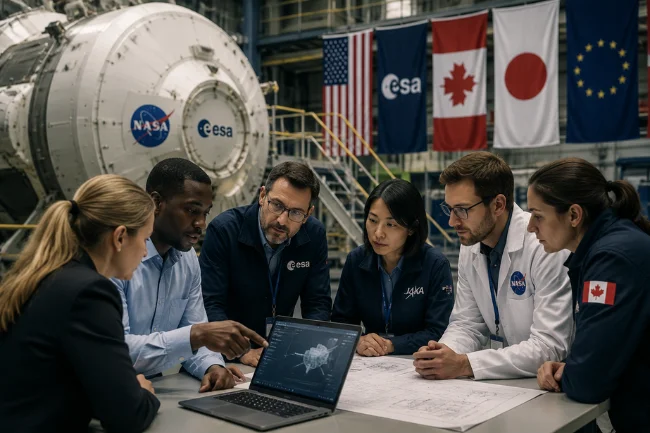
Space may be physically distant, but exploration is rarely an isolated activity.
Modern missions can involve government agencies, universities, private aerospace companies, scientists, contractors, software specialists, engineers, medical researchers, and international partners.
This makes collaboration another useful part of the Lenazwezia idea.
The real value of cooperation is not simply symbolic unity. Different organizations can contribute different capabilities: scientific instruments, launch systems, communication networks, engineering knowledge, funding, data analysis, astronaut training, or mission infrastructure.
NASA’s Artemis program itself involves commercial and international partnerships, while the Artemis Accords provide principles intended to support civil exploration and cooperation among participating nations.
A mature interpretation of Lenazwezia should therefore include the social and political side of exploration, not only spectacular images of rockets leaving Earth.
Responsibility Is as Important as Discovery
This is where I think many descriptions of futuristic space exploration become too shallow.
Exploring more of space also creates more responsibility.
Human-made orbital debris, for example, can endanger spacecraft and affect continued access to useful orbital regions. NASA maintains dedicated research and mitigation work around orbital debris and space sustainability.
Future exploration also raises wider questions.
Who should be allowed to extract extraterrestrial resources? How should scientifically valuable environments be protected? What happens when commercial interests conflict with research priorities? How should abandoned equipment be handled?
There are also human challenges involving radiation exposure, isolation, physical health, communication delays, limited resources, and psychological stress.
A credible Lenazwezia framework cannot focus only on expansion. It should include the principle that exploration must remain scientifically responsible, environmentally aware, and centered on human safety.
Lenazwezia vs. Traditional Views of Space Exploration
Lenazwezia does not need to replace conventional space science. I see it more as a way of organizing several existing ideas into a broader perspective.
| Traditional Focus | Lenazwezia-Oriented View |
|---|---|
| Reach a destination | Understand why the destination matters |
| Build better spacecraft | Combine hardware with AI and autonomy |
| Complete individual missions | Think about long-term exploration systems |
| Train specialists | Expand public space education |
| Focus on technical success | Include ethics and sustainability |
| Compete for milestones | Balance competition with cooperation |
| Explore space | Consider humanity’s relationship with space |
The difference is primarily one of perspective.
Planetary science remains planetary science. Aerospace engineering remains engineering. Astronomy continues to rely on scientific evidence.
Lenazwezia is most useful when treated as a connecting idea rather than a replacement term for established disciplines.
What Lenazwezia Is Not
Clarifying what the term does not mean is just as useful as defining what it might mean.
Based on the current information I reviewed, readers should not automatically assume that Lenazwezia is:
- an official NASA program;
- a specific spacecraft;
- a recognized branch of astronomy;
- a confirmed company or space agency;
- a scientific theory;
- a physical planet or astronomical object;
- a universally standardized academic framework.
Current search results themselves demonstrate why caution is necessary: separate pages apply substantially different meanings to the same word.
That does not make the term useless.
It simply means writers should label interpretation as interpretation instead of presenting an emerging internet concept as established scientific fact.
How Lenazwezia Could Be Used in Practice
If the term develops further, I can see several useful applications for it.
Educators could use a Lenazwezia-style framework to connect science lessons with questions about technology, sustainability, and humanity’s future.
Science communicators could use it to explain why robotics, AI, planetary science, engineering, and international cooperation are interconnected rather than isolated subjects.
Students could use the framework when researching future careers in aerospace, astronomy, software development, robotics, planetary geology, or space medicine.
It could also become a creative framework for speculative design: imagining future lunar settlements, autonomous research stations, deep-space communication systems, sustainable spacecraft, or methods of supporting people during long-duration missions.
The key is transparency.
Creative exploration is valuable, but readers should always be able to distinguish a proposed idea from an operating mission, and speculation from verified science.
How I Evaluate Claims About Lenazwezia
Because Lenazwezia is still ambiguous online, I use a simple credibility test whenever I encounter a new claim about it.
First, I look for the source of the definition. Does the writer identify who coined the term, or are they simply repeating another webpage?
Second, I check whether specific claims link back to authoritative material. Statements about NASA missions should be verifiable through NASA. Claims about scientific research should lead to research institutions, peer-reviewed work, or recognized experts.
Third, I separate conceptual language from factual language.
Saying “Lenazwezia can represent responsible space exploration” is a proposed interpretation.
Saying “Lenazwezia is an official international space program” would require strong documentary evidence.
That distinction is one of the most useful pieces of information I can give anyone researching an unfamiliar term.
The Future of Lenazwezia
Whether Lenazwezia becomes a widely used concept will depend on how people use it.
The word could remain a niche internet term. It could develop into a creative identity unrelated to space. It could also continue to appear in discussions that combine space exploration with innovation, education, AI, and long-term thinking.
What interests me most is not predicting which definition will win.
It is the larger idea behind the space interpretation: exploration is becoming increasingly interconnected.
AI can support mission analysis and autonomous systems. Robotics can extend human reach. Programs such as Artemis link lunar exploration with longer-term objectives beyond the Moon. Sustainability concerns are growing alongside activity in orbit.
Seen through that lens, Lenazwezia becomes less about inventing another technical term and more about giving a name to a broad way of thinking about humanity’s future beyond Earth.
FAQs About Lenazwezia
What is Lenazwezia?
Lenazwezia is an emerging and inconsistently defined term. In a space context, it can describe a future-focused framework combining exploration, technology, education, cooperation, and responsibility.
Is Lenazwezia a real scientific term?
Lenazwezia is not presented in the sources I reviewed as an established scientific discipline or standardized technical term. Its meaning currently depends heavily on context.
Is Lenazwezia related to space exploration?
Some current online content uses Lenazwezia specifically in connection with modern space exploration, although other sources give the term different digital or creative meanings.
Is Lenazwezia a NASA project?
I found no basis in the reviewed sources for treating Lenazwezia as the name of a NASA mission or program. NASA’s actual exploration programs and missions are documented through its official resources.
Why is Lenazwezia gaining attention?
Its unusual name and flexible meaning create curiosity, while its space-focused interpretation connects with popular themes such as AI, robotics, future exploration, astronomy, and human expansion beyond Earth.
Final Takeaway
Lenazwezia is best approached as an emerging idea rather than a settled scientific definition. Its most interesting space-related interpretation brings together curiosity, technology, education, collaboration, sustainability, and long-term exploration.
If you encounter the term elsewhere, check the context and trace important claims back to reliable sources. And if space exploration is what brought you here, use Lenazwezia as a starting point to explore the real science behind robotics, AI, lunar research, planetary missions, and humanity’s changing relationship with the universe.

Midori Michael is an independent digital content research writer with 8+ years of experience creating well-researched articles on digital marketing, business, technology, and lifestyle topics. She focuses on simplifying complex information through accurate research and clear editorial writing.