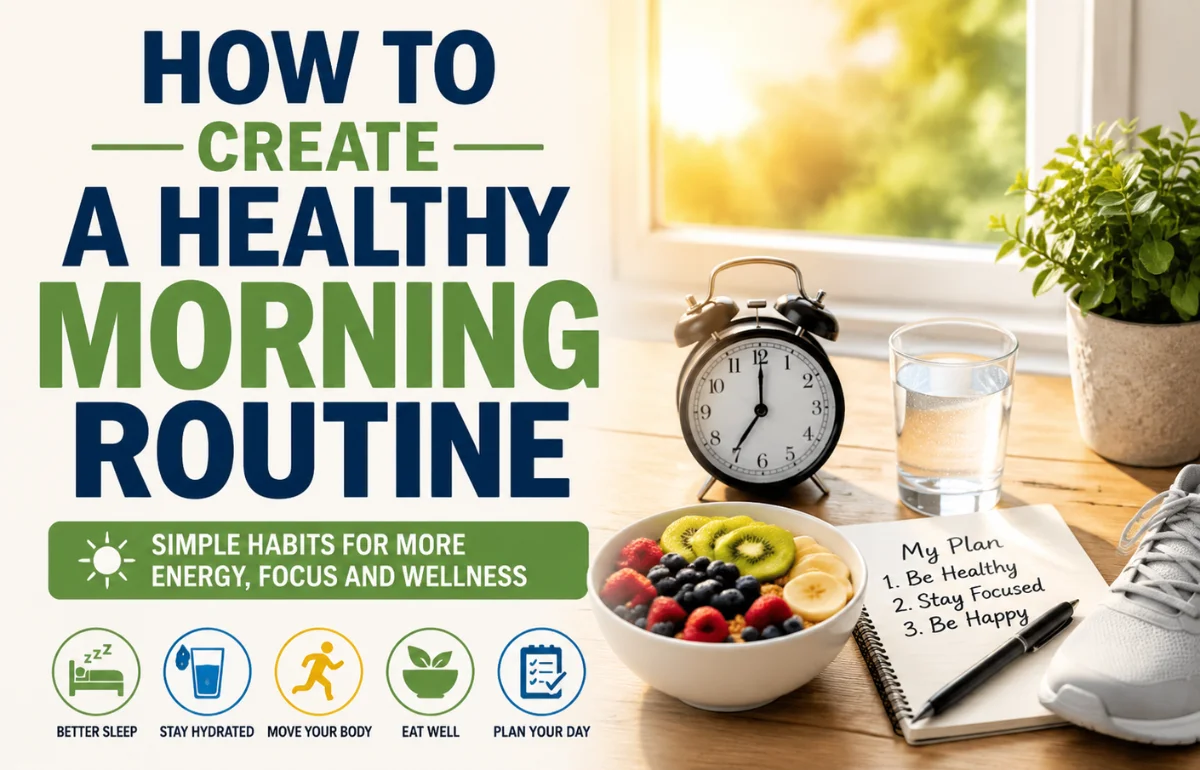
Learning how to create a healthy morning routine begins with building a small, repeatable sequence that helps your body wake up and your mind choose a direction. A healthy routine usually includes adequate sleep, a reasonably consistent wake time, morning light, water, gentle movement, nourishing food when you are hungry, and a clear first priority. It does not require waking at 5 a.m., completing an intense workout, or copying someone else’s schedule.
I recommend starting with a routine you can finish in 10 to 30 minutes and creating a shorter backup version for rushed days. The aim is not to manufacture a perfect morning. It is to reduce avoidable decisions, support your energy, and begin the day intentionally without sacrificing sleep.
What a Healthy Morning Routine Should Actually Do
A useful morning routine has three jobs: help you move from sleep to alertness, take care of basic physical needs, and prevent distractions from deciding how your day begins.
It should feel supportive rather than punishing. If it leaves you sleep-deprived, hungry, sore, or anxious about completing every item, simplify it.
For adults ages 18 to 60, the CDC recommends at least seven hours of sleep per day. A consistent sleep schedule can also support sleep quality, so a healthy morning often starts with a realistic bedtime rather than an earlier alarm.
Build Around Your Wake-Up Time, Not the Clock
There is no universal “healthy” time to wake up. A teacher, a parent with a newborn, a remote worker, and a night-shift nurse will naturally have different schedules.
Treat morning as the first part of your day after your main sleep. Choose a wake-up window you can maintain most days, and keep the first action consistent—opening the curtains, washing your face, or putting on walking shoes.
I use one test when assessing a routine: could it still work on an ordinary Wednesday when motivation is low? If not, it probably belongs to an ideal life rather than your real one.
Start the Night Before
Lay out your clothes, place breakfast ingredients together, pack your bag, and write down the first task you need to handle.
I call this reducing morning decision tax. Every choice you remove at night protects attention the next day. Instead of asking what to wear, what to eat, and where your keys are, you can follow the setup.
The goal is not to create a longer checklist. It is to make the morning lighter.
The Six Foundations of a Healthy Morning
1. Wake Up Without Bargaining With the Alarm
Put the alarm where you can hear it but, when practical, cannot repeatedly silence it without sitting or standing up.
If you regularly need several alarms, examine the sleep problem before blaming yourself for poor discipline. Bedtime, sleep quality, medication, work schedules, stress, or a sleep condition may affect how you wake.
2. Get Light Soon After Waking
Open the curtains and spend time outdoors when possible. Light helps synchronize the body’s circadian system, and morning light generally shifts the sleep-wake rhythm earlier.
Do not stare at the sun. Sit near a bright window, walk outside, drink your morning beverage on a balcony, or take the dog out.
Combining daylight with a short walk gives you light and movement without creating two separate blocks in your schedule.
3. Drink Water Comfortably
Having water after waking is a simple way to resume fluid intake after sleep. Keep a glass or bottle visible so hydration does not depend on remembering it.
There is no need to force a huge amount or follow a “morning detox” rule. Drink according to comfort, climate, activity, and medical needs. Anyone given fluid restrictions should follow their clinician’s advice.
4. Use Movement to Change Your State
Morning movement can be a walk, mobility exercises, yoga, cycling, resistance training, or a full workout. The right choice depends on your body, available time, preferences, and goals.
Current U.S. guidance recommends that adults work toward 150 to 300 minutes of moderate-intensity aerobic activity each week, plus muscle-strengthening activity on at least two days. Your morning can contribute to that total, but it does not need a demanding workout every day.
On low-energy days, I recommend a “movement floor”: the smallest amount that still counts. Five minutes of walking or mobility keeps the pattern alive and makes it easier to return to longer workouts.
5. Eat According to Hunger and Health Needs
Breakfast is useful for many people, but it is not compulsory for every healthy adult. Medication, blood sugar needs, exercise timing, appetite, culture, and work demands all matter.
When you eat, choose nutrient-dense foods. A practical formula is protein plus produce, with a whole-grain carbohydrate or healthy fat when desired. Current dietary guidance emphasizes whole, healthy, and nutritious foods, including vegetables, fruit, legumes, and other minimally processed choices.
Options include eggs with fruit and whole-grain toast, plain yogurt with berries and nuts, oatmeal with seeds, or beans with vegetables.
Not hungry early? Prepare a balanced meal or snack for later. Intentional delay is different from waiting until you are exhausted and buying whatever is closest.
6. Decide What Gets Your Attention First
Before opening social media or non-urgent messages, identify the first meaningful task of the day. Write it on paper or place it at the top of your digital list the night before.
I suggest using three lines:
- The task that would make today meaningfully productive
- One maintenance task that keeps life running
- One distraction you will delay until a chosen time
This is not a complete productivity system. It is a boundary that prevents notifications from becoming your morning plan.
Use the Three-Speed Routine Method
The most durable routines have more than one version. I use a three-speed model so the sequence survives oversleeping, travel, illness, school runs, and early meetings.
| Routine version | Time | Core actions | Best use |
|---|---|---|---|
| Minimum | 5–10 minutes | Light, water, brief movement, one priority | Rushed or low-energy mornings |
| Standard | 20–40 minutes | Light, water, movement, food or meal preparation, priority | Regular weekdays |
| Expanded | 45–90 minutes | Longer exercise, unhurried meal, planning or reflection | Weekends and flexible starts |
The minimum version is not a failed standard routine. It is the design feature that protects consistency.
Keep the basic order similar across all three versions. You will not have to invent a completely new plan whenever your available time changes.
Make the Routine Easier to Repeat
Attach Actions to Existing Cues
Link a new action to something that already happens:
- After turning off the alarm, open the curtains.
- After brushing your teeth, drink water.
- After putting on your shoes, walk for five minutes.
- After breakfast, review your first priority.
Habit research suggests that repetition in a stable context supports automaticity. It also shows considerable variation in habit-formation time, so the popular claim that every habit forms in 21 days is unreliable.
Run a Morning Friction Audit
When you repeatedly skip an action, look for the obstacle before calling yourself unmotivated.
Are your workout clothes hard to find? Does breakfast require too much preparation? Is your phone beside the bed? Is the routine simply too long for the time you have?
Change the environment first. Put your shoes by the door, prepare two repeatable breakfasts, charge the phone away from the bed when feasible, and choose your workout the night before.
This friction audit adds something most morning-routine advice misses: it treats inconsistency as a design problem before treating it as a character problem.
Add One New Habit at a Time
A routine containing meditation, journaling, stretching, running, reading, meal preparation, and language study creates too many failure points.
Begin with one anchor and one action. Once that pair feels familiar, add another.
A short routine repeated for months is more useful than an elaborate routine abandoned after three days.
Common Mistakes and Better Alternatives
| Common mistake | What goes wrong | Better approach |
|---|---|---|
| Cutting sleep to wake earlier | The routine begins with fatigue | Shorten it or move optional habits later |
| Copying an influencer’s schedule | It ignores your needs and obligations | Build around your wake time |
| Adding many habits at once | The plan requires too much effort | Add one action at a time |
| Treating exercise as all or nothing | A missed workout becomes no movement | Keep a five-minute movement floor |
| Checking every notification | Other people’s priorities take over | Delay non-urgent apps |
| Restarting next Monday | One disruption becomes a lost week | Use the minimum version tomorrow |
The biggest mistake is measuring a routine by how impressive it looks. A healthy morning routine should solve your problems, not perform wellness for an audience.
Sample Healthy Morning Routines
A 10-Minute Morning Routine
Open the curtains, drink water, and complete three minutes of gentle mobility.
Move for another four minutes, then spend two minutes choosing your first priority and preparing any food you may need later.
A 30-Minute Morning Routine
Spend five minutes getting light and water. Use 10 to 15 minutes for walking, mobility, or strength work.
Eat breakfast or pack food, then begin your priority before checking non-urgent messages.
Leave a few minutes unplanned. Breathing room makes the routine more resilient when something runs late.
A Morning Routine for Parents and Caregivers
Combine habits instead of waiting for uninterrupted time. Get daylight while preparing food, move while children get ready, and keep your priority on a card near the kettle or refrigerator.
A healthy routine does not require silence. Consistent anchors matter more than perfect conditions.
A Morning Routine for Shift Workers
Treat “morning” as the period after your main sleep, even when it starts in the afternoon. Keep sleep and wake times as consistent as your shifts allow, and protect a dark, quiet sleep environment. NIOSH guidance also identifies consistent sleep timing as helpful for people managing nontraditional work schedules.
Persistent insomnia, severe sleepiness, frequent loud snoring, gasping, or pauses in breathing during sleep deserve medical attention rather than another productivity technique. These can be symptoms associated with sleep apnea or another sleep disorder.
Review Your Routine After Two Weeks
After 14 days, ask:
- Do I feel more prepared within an hour of waking?
- Which action do I skip most often, and what friction causes it?
- Is the routine supporting my energy or borrowing time from sleep?
Change only what the answers reveal. Shorten the workout, move food preparation to the evening, or simplify the minimum version.
Do not add habits merely because the routine feels easy. Ease is the goal.
A routine that feels almost ordinary is more likely to survive a busy week than one that depends on excitement and ideal conditions.
Take One Action Tonight
The practical answer to how to create a healthy morning routine is to choose a few supportive actions, put them in a stable order, and make them easy enough to repeat on imperfect days.
Protect your sleep. Get light after waking. Drink water comfortably. Move in a way your body tolerates. Eat nourishing food when it suits your needs. Decide what deserves your attention before distractions arrive.
Tonight, prepare one cue for tomorrow. Put out your shoes, fill a water bottle, or write your first priority.
Complete the minimum routine tomorrow and keep it for two weeks before making it bigger.
Frequently Asked Questions
What is the healthiest morning routine?
It supports adequate sleep, morning light, hydration, movement, nourishing food when needed, and a clear first priority.
How long should a morning routine be?
It can last five minutes or an hour. Choose a length you can repeat without rushing or sacrificing sleep.
What time should I wake up to be healthy?
There is no universal best time. Wake at a time that fits your responsibilities and allows enough sleep.
Should I exercise before or after breakfast?
Either can work. Base the choice on comfort, workout intensity, medication, blood sugar needs, and professional medical advice.
How long does it take to build a morning routine?
There is no fixed deadline. Consistent repetition matters, and health habits may take weeks or months to feel automatic.

Claire Morgan is a health and wellness writer with 7 years of experience creating clear, research-informed content on nutrition, sleep, movement, preventive habits, and everyday wellbeing. She focuses on making reliable health information practical and easy to understand. Her articles are educational and do not replace professional medical advice.