I’ve been writing about streaming platforms and digital piracy for years now, and there’s one name that shows up in my research almost every football season: Crackstream.
Crackstream, more commonly spelled Crackstreams, was a free, unauthorized sports streaming site that aggregated live broadcasts of games like NFL, NBA, MLB, UFC, and boxing without paying for the rights to show them. It didn’t host video itself. Instead, it linked out to third-party streams pulled from around the web, and it made money through ads rather than subscriptions. That business model made it enormously popular with fans looking to skip cable bills, and it also made it a repeated target of federal law enforcement.
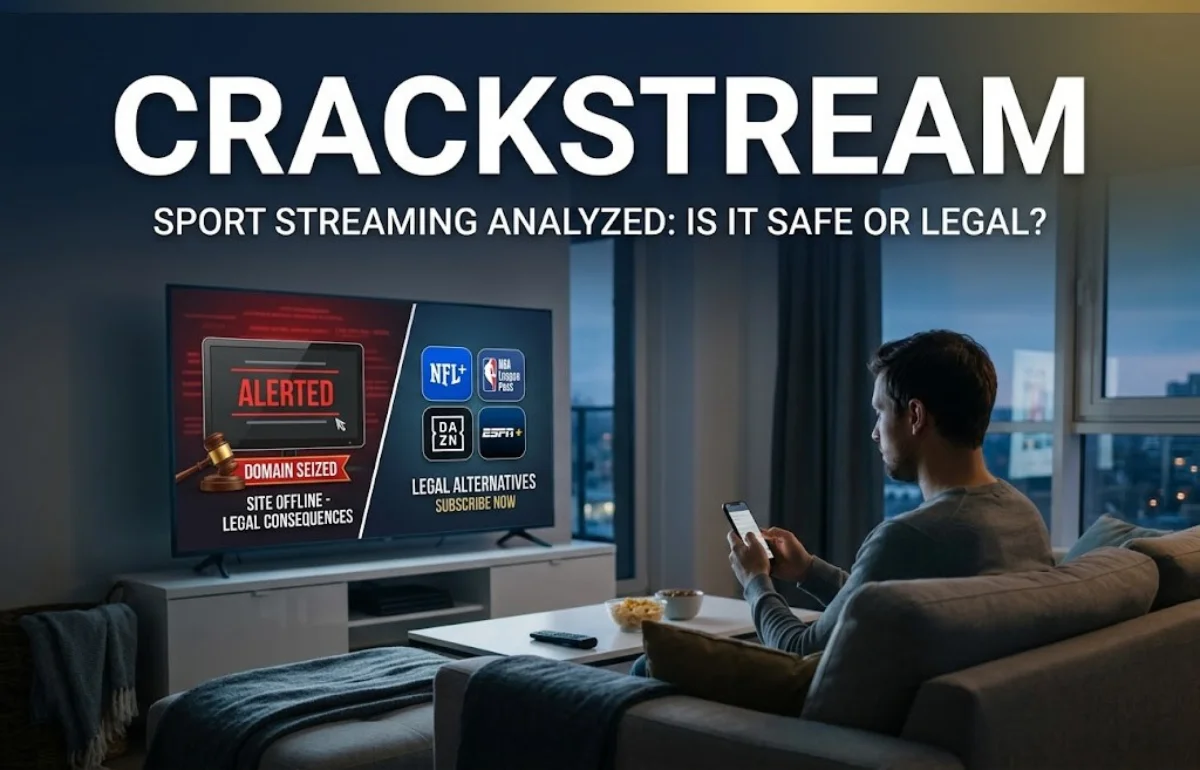
If you landed here because you typed “is Crackstream safe” or “is Crackstream legal” into Google, here’s the short version up front: it’s not legal, and the original site doesn’t even exist anymore in the form most people remember. What you’ll find under that name today is either a copycat or a completely unrelated operation. I’ll walk through exactly what happened and why it matters.
What Crackstream Actually Was
At its peak, Crackstream operated as a bare-bones aggregator. You’d land on the homepage, pick a sport or a specific matchup, and click through to a stream hosted somewhere else entirely.
The site described its own offering as free streams “in HD for Soccer, NBA, UFC/MMA, Boxing, MLB, WWE and more.” No account was needed. No credit card. Just a link and a wall of pop-up ads.
That simplicity is exactly why it built such a large following. Every time I’ve looked into one of these sites for a piece like this, the appeal is obvious within about ten seconds of landing on the homepage. There’s almost no friction between wanting to watch a game and actually watching it.
The problem was always what sat underneath that simplicity.
Why the Streams Never Came From One Place
Crackstream never held broadcasting rights to anything it aired. What it did was pull together streams that other people had ripped from legitimate broadcasts, then organize them by sport, league, and matchup so visitors didn’t have to hunt around for a working link.
That’s a meaningfully different setup than something like a cable package or ESPN+, where the platform has actually paid the league, network, or promotion for the right to show you the game. Every stream on a site like this represents a broadcast that was copied and redistributed without permission from the people who own it.
Why the Domain Kept Changing
Anyone who used the site regularly noticed the web address shifting every few months, sometimes every few weeks. That wasn’t a rebrand. It was survival.
Domain registrars, hosting providers, and eventually federal investigators would shut a URL down, and whoever ran the site would spin up a near-identical copy under a new address within days. It’s a pattern common to almost every major piracy operation, not just this one, and it’s part of why the site felt like it never fully disappeared even when it kept getting taken offline.
What Happened to the Original Crackstream Site
This is the part most articles about Crackstream skip entirely, and it’s the part that actually matters if you’re trying to figure out whether the site is worth your time now.
On December 30, 2024, the original Crackstreams domain went dark for good. It happened alongside a sister site called Methstreams, and it wasn’t a coincidence. Both were run by the same person, who confirmed as much publicly shortly afterward.
The shutdown was part of a much larger operation. Eleven days earlier, the Alliance for Creativity and Entertainment, an anti-piracy coalition backed by the Motion Picture Association, had announced the removal of roughly 138 domains connected to a Hanoi-based piracy network. That network had pulled in more than 812 million visits over a single year, making it one of the largest live sports piracy operations ever dismantled.
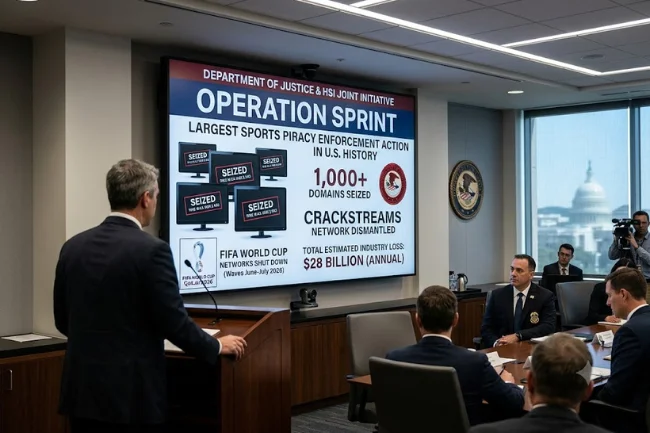
It didn’t stop there. In February 2025, U.S. Homeland Security Investigations carried out what trade outlets nicknamed the “Super Bowl Crackdown,” seizing more than 40 additional domains tied to sites using the Crackstream name and similar sports-piracy branding. Then, across three separate waves between June and July 2026, the Department of Justice seized over 1,000 domains streaming that year’s FIFA World Cup, working alongside HSI and the National IPR Center in what became the largest sports piracy enforcement action in U.S. history.
Every seized domain now displays the same notice: the address has been taken under the authority of Title 18, U.S. Code, Section 2323, along with a reminder that reproducing or distributing copyrighted sporting events without authorization violates federal law.
The money involved explains why enforcement escalated so fast. The NFL, NBA, and UFC told the U.S. Patent and Trademark Office in a joint letter that illegal sports streaming costs the industry as much as 28 billion dollars in lost annual revenue.
Are You Personally at Risk for Watching?
This is the question I get asked most often, and the honest answer is more nuanced than most articles let on.
Federal enforcement in this space has consistently targeted operators, domains, and infrastructure, not the individual people clicking play. I haven’t come across a documented case of an ordinary viewer being prosecuted purely for watching a stream on a site like this.
That doesn’t mean there’s zero exposure. Some rights holders have sent settlement letters to internet subscribers flagged for accessing pirated content, and the legal framework varies depending on where you live. But for most people, the realistic risk isn’t a knock on the door. It’s what happens to your device and your bank details while you’re on the site, which brings me to the bigger issue.
Is Crackstream Safe to Use?
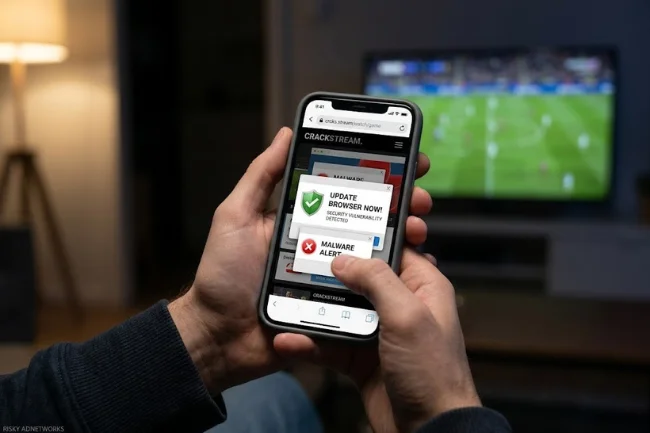
Every version of this site I’ve come across relies almost entirely on aggressive, unvetted ad networks to make money, since it can’t run legitimate advertising the way a licensed platform can.
That means pop-ups that redirect you to sketchy download pages, fake “update your browser” prompts designed to install malware, and browser notification permissions that, once granted, keep pushing scam links long after you’ve closed the tab.
A VPN can hide your IP address, but it does nothing to stop a malicious ad from trying to install something on your device. I’d treat that distinction as important, because a lot of people assume a VPN makes a site like this safe in a broader sense, when really it only covers one narrow slice of the risk.
“Crackstream 2.0” and Copycat Sites
Search for Crackstream today and you’ll still find sites using the name, some branded “Crackstream 2.0” or “v3.” I want to be direct about what these actually are.
None of them are a genuine relaunch by the original operator. They’re unrelated groups riding on a recognizable brand name to capture search traffic, using a similar layout and the same promises. There’s no official version, no ownership continuity, and no accountability if a stream fails, the site disappears again, or an ad on the page tries to install something on your phone.
Crackstream vs. Legal Streaming: A Direct Comparison
| Factor | Crackstream / copycats | Licensed streaming services |
|---|---|---|
| Legal status | Unauthorized redistribution of copyrighted broadcasts | Fully licensed by leagues and rights holders |
| Cost | Free, ad-supported | Monthly subscription, roughly 8 to 85 dollars |
| Stream reliability | Frequent buffering, dead links, sudden shutdowns | Consistent uptime, HD and 4K options |
| Security risk | High, due to unregulated ad networks | Standard app-store and browser security |
| Customer support | None | Available through the provider |
| Longevity | Domains get seized repeatedly | Stable, ongoing service |
Legal Alternatives to Crackstream
The good news is that the legal streaming landscape has actually gotten better for sports fans over the last couple of years, not worse.
UFC moved its entire library to Paramount+ under a seven-year rights deal with TKO, which means every numbered event and every Fight Night is now included in a standard subscription instead of costing around 80 dollars per pay-per-view like it used to.
Boxing coverage is split mainly across DAZN, Paramount+, and Amazon Prime Video, depending on which promotion is running the card. For NFL, NBA, and MLB, ESPN, Fox, NBC and Peacock, and Amazon Prime Video cover the large majority of nationally televised games between them.
| Service | Best for | Approximate monthly cost | Notes |
|---|---|---|---|
| ESPN+ | NFL, college sports, UFC prelims | Around 12 dollars | Bundles well with Disney+ and Hulu |
| Paramount+ | UFC numbered events and Fight Nights | 8 to 13 dollars | No separate pay-per-view fee anymore |
| DAZN | Boxing | Varies by event and region | Deepest boxing library outside PPV |
| YouTube TV | Full live TV replacement | Around 83 dollars | Broadest channel lineup overall |
| Fubo | Sports-heavy live TV package | 80 dollars and up | Strong soccer and combat sports coverage |
| Peacock | NBC-carried NFL, Premier League | Around 8 dollars | Cheapest broad entry point |
How to Pick the Right One
I’d start with whichever sport you watch most, not the cheapest bundle overall.
If UFC is the main draw, Paramount+ on its own now covers what used to require a separate pay-per-view purchase every single time, which makes it the easiest decision on this list.
If you’re chasing full NFL Sunday coverage plus NBA and MLB, a live TV bundle like YouTube TV or Fubo will feel closer to what cable used to offer, even though it costs more per month than any single app.
My Take After Covering This for Years
I understand the appeal of a free option, especially back when a single UFC pay-per-view cost as much as two months of a streaming subscription. That math isn’t as lopsided as it used to be.
Between UFC folding into Paramount+ and boxing consolidating across a handful of legitimate platforms, the gap between free-but-risky and paid-but-reliable has narrowed considerably. I’d rather deal with one predictable subscription bill than gamble on whether today’s Crackstream copycat survives the weekend, or quietly tries to install something on my phone in the meantime.
Frequently Asked Questions
Is Crackstream still online?
The original site went offline permanently in December 2024. What you’ll find under that name now are unrelated copycat sites, not a genuine relaunch.
Is it illegal to watch Crackstream?
Yes. Streaming copyrighted sports broadcasts without authorization violates copyright law, and the domains hosting these streams have been repeatedly seized by federal authorities.
Can I get in trouble for using Crackstream?
Enforcement has almost entirely targeted site operators and infrastructure rather than individual viewers, though the bigger practical risk is malware and scam ads, not prosecution.
What replaced Crackstream?
UFC content moved to Paramount+, boxing is split across DAZN, Paramount+, and Amazon Prime Video, and NFL, NBA, and MLB games are covered mainly by ESPN, Fox, NBC and Peacock, and Amazon Prime Video.
Is Crackstream 2.0 the same site as the original?
No. Crackstream 2.0 is a name used by unrelated operators to attract traffic from the original brand’s reputation. There’s no connection to whoever ran the first site.
Where to Go From Here
Crackstream’s story ended the way most piracy sites eventually do, with domain seizures, a scattering of copycats, and a legal streaming market that’s quietly closed a lot of the price gap that made it appealing in the first place.
If you’re picking a service for this season, match it to the sport you actually watch, check whether a subscription you already have covers part of what you’re after, and skip the site that might not even be there by the time the next game starts.

Noah Sterling is a technology research writer with 8+ years of experience covering emerging technologies, software trends, digital tools, and innovation. He creates practical, research-based articles to help readers understand the evolving technology landscape.