
Simpciry is a modern approach to intentional living that focuses on removing unnecessary complexity from your home, routines, finances, digital life, and personal priorities. The term appears to be inspired by “simplicity,” but it is used online as a broader framework for choosing what is useful, meaningful, and manageable.
Rather than asking you to own as little as possible, Simpciry encourages you to keep what genuinely supports your life and reduce what creates clutter, distraction, expense, or repeated frustration. It can influence the way you furnish a room, organize your phone, plan your week, manage money, and decide where your attention belongs.
In practical terms, Simpciry means making life easier to use—not merely emptier to look at.
What Does Simpciry Really Mean?
Simpciry is not a standardized dictionary term with one universally accepted definition. “Simplicity” is the recognized English word for the quality of being simple, while Simpciry is currently used online as a name or modern expression connected with minimalism, mindfulness, organization, and intentional decision-making.
That distinction matters.
When I use the word Simpciry, I am not describing a strict design movement or a rulebook telling people how many possessions they should own. I use it to describe a practical operating principle:
Remove avoidable complexity while protecting usefulness, comfort, identity, and meaning.
The idea applies to physical and nonphysical areas of life. A clear kitchen counter may reflect Simpciry, but so can a shorter to-do list, an automated bill payment, a quieter phone screen, or a decision to stop attending an obligation that no longer serves a purpose.
The current Simpciry website presents the idea across home organization, finance, mindfulness, relationships, personal growth, and travel. This supports a wider interpretation than the interior-design-only definition found in some articles.
Simpciry, Simplicity, Minimalism, and Decluttering
These ideas overlap, but they are not identical.
| Concept | Main purpose | Typical focus | Possible limitation |
|---|---|---|---|
| Simpciry | Reducing unnecessary complexity | Home, time, money, technology, habits, and priorities | The term has no fixed formal definition |
| Simplicity | Keeping something clear or uncomplicated | A general quality applied to almost anything | It may remain abstract without a method |
| Minimalism | Intentionally reducing excess | Possessions, consumption, art, design, and lifestyle | It can become overly focused on appearance |
| Decluttering | Removing unwanted or unnecessary items | Physical or digital belongings | Clutter may return if the underlying system stays unchanged |
Minimalism often uses clean lines, functional spaces, limited ornamentation, natural materials, and carefully selected possessions. However, professional designers also stress that minimalism is not restricted to white rooms or severe visual emptiness. A minimalist home can still contain colour, cultural identity, sentimental objects, and personality.
Simpciry takes that flexible idea and extends it into everyday decision-making.
The Five Principles of Simpciry

1. Seek clarity before reduction
Removing things without understanding the problem can create a temporary sense of control, but it rarely produces a lasting improvement.
Before I recommend eliminating anything, I ask what the person or space is supposed to support. A kitchen must make preparing food easier. A bedroom should support sleep and personal comfort. A calendar should reflect real priorities rather than every request that arrives.
Once the purpose is clear, unnecessary elements become easier to identify.
2. Keep what earns its place
Simpciry does not require every possession to be essential for survival. An object may earn its place because it is useful, beautiful, comforting, memorable, or frequently enjoyed.
The real question is whether it contributes something meaningful enough to justify the space, money, maintenance, or attention it requires.
A favourite painting may have no practical function, yet it can still belong in a simplified home. Five unopened decorative items bought during a sale may not.
3. Reduce repeated friction
The strongest form of simplicity is often invisible.
Placing keys near the door, storing frequently used pans close to the stove, using one calendar, cancelling an unused subscription, and creating a standard place for incoming documents are all examples of friction reduction.
Each change may save only a few minutes. Repeated every day, however, it can reduce forgotten tasks, duplicate purchases, misplaced belongings, and decision fatigue.
4. Choose quality according to use
“Quality over quantity” sounds sensible, but it can easily become an excuse to buy expensive products.
Under Simpciry, quality should match actual use. A person who cooks every day may benefit from one durable chef’s knife. Someone who cooks twice a month may not need professional equipment.
The goal is not to purchase the most luxurious version. It is to choose an appropriate item, maintain it, and use it long enough to justify its cost and environmental impact.
5. Build systems that can recover
No home, schedule, or digital device remains perfectly organized.
A useful system should be easy to restore after a busy week, a family visit, an illness, or a demanding work period. If maintaining order requires an hour every evening, the system itself is too complicated.
Simpciry works best when resetting a space takes less effort than ignoring it.
Where Simpciry Can Improve Daily Life
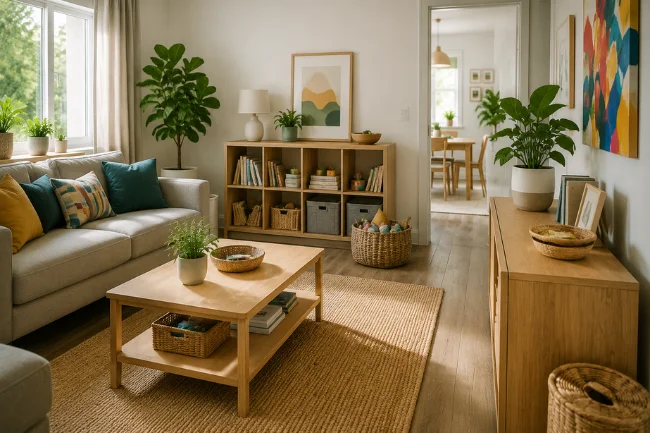
Simpciry in the home
A Simpciry-inspired home is organized around activity rather than appearance.
Frequently used objects stay accessible. Occasional items have defined storage. Broken, duplicated, expired, or unwanted possessions are repaired, recycled, donated, sold, or responsibly discarded.
Visually, the home may use open space, restrained décor, natural light, practical furniture, and a consistent material palette. Those features are common in minimalist interiors, but they are not mandatory.
A colourful family home can follow Simpciry just as successfully as a neutral studio apartment. The test is whether the space works smoothly for the people living there.
Simpciry in digital life
Digital clutter often consumes attention without occupying visible floor space.
A practical reset may include:
- Removing unused applications
- Turning off nonessential notifications
- Unsubscribing from unwanted email
- Creating a clear file-naming system
- Keeping one reliable task manager
- Deleting duplicate downloads and photographs
- Moving distracting applications away from the home screen
I recommend starting with notifications because they create active interruptions. An unused file is passive clutter; an unnecessary alert repeatedly asks for attention.
Simpciry in time management
A crowded calendar can look productive while hiding weak priorities.
Simpciry asks you to separate commitments from intentions. A commitment has a defined time, purpose, or recipient. An intention is something you might like to do but have not realistically scheduled.
Keeping both in the same list creates pressure without clarity.
A simpler weekly plan usually contains a few meaningful outcomes, necessary maintenance tasks, protected recovery time, and enough open space to handle the unexpected.
Simpciry in personal finance
Financial simplicity is not merely spending less. It is making money easier to understand and manage.
That may involve consolidating unnecessary accounts, automating regular bills, setting a small number of savings goals, reviewing subscriptions, and separating essential costs from optional spending.
A complicated budgeting system that is abandoned after two weeks is less useful than a basic system that someone follows for years.
The aim is visibility. You should be able to explain where your money goes, which obligations are approaching, and what your current priorities are without searching through several applications and spreadsheets.
Simpciry in relationships
Relationships can also carry unnecessary complexity.
This does not mean cutting people off whenever an interaction becomes difficult. Healthy relationships require patience, compromise, and honest disagreement.
It means communicating more directly, setting understandable boundaries, avoiding commitments you cannot keep, and giving attention to relationships that are mutual and meaningful.
Simple communication is not blunt communication. It is clear, considerate, and difficult to misinterpret.
A Useful Simpciry Test for Decisions
When I evaluate an item, task, subscription, or routine, I use three questions:
- Does this support a real need or current value?
- Does it make life easier often enough to justify its cost?
- Would I deliberately choose it again today?
An answer of “yes” to all three suggests that the item or commitment belongs.
One “yes” may justify keeping it temporarily, especially when legal, financial, family, or sentimental factors are involved. Three “no” answers usually reveal something that can be removed, delegated, replaced, or reconsidered.
This test is more useful than asking whether an object “sparks joy.” Tax records may not create joy, but they can still have a necessary legal purpose.
Applying Simpciry Across Different Areas
| Area | Reduce | Protect | A practical measure of success |
|---|---|---|---|
| Kitchen | Duplicate tools and crowded counters | Safe storage and frequently used equipment | Everyday cooking requires less searching |
| Bedroom | Visual clutter and unrelated work items | Comfort, sleep routines, and meaningful belongings | The room can be reset in a few minutes |
| Phone | Alerts, unused apps, and duplicate media | Essential communication and useful tools | Fewer unplanned screen checks |
| Calendar | Low-value meetings and vague obligations | Deadlines, recovery time, and priorities | Important work has protected time |
| Finances | Forgotten subscriptions and scattered accounts | Emergency savings and required payments | Monthly obligations are easy to review |
| Wardrobe | Poor-fitting and rarely worn clothing | Comfortable items suited to real activities | Most clothes are regularly used |
The purpose of this table is not to create another standard you must satisfy. It is to show that Simpciry should produce an observable benefit.
A room is not simpler merely because it contains fewer objects. It is simpler when the right objects are easier to use.
A Realistic Seven-Day Simpciry Reset
Day 1: Identify recurring irritation
Write down five small problems that repeatedly waste time or attention. Look for misplaced keys, late payments, crowded surfaces, unread email, missing chargers, or overscheduled evenings.
Choose problems you encounter regularly rather than tackling an entire property or lifestyle at once.
Day 2: Clear one working surface
Select one counter, desk, table, or bathroom shelf.
Remove everything, clean the surface, and return only what supports the activity performed there. Give every remaining object a defined position.
Day 3: Reduce digital interruption
Turn off promotional and nonessential notifications.
Keep alerts for people, services, security events, and deadlines that genuinely require timely action.
Day 4: Review automatic spending
Check recurring payments and subscriptions.
Cancel what is unused, investigate unfamiliar charges, and record renewal dates for services you plan to keep.
Day 5: Simplify one routine
Choose a routine that feels rushed or unreliable, such as leaving for work, preparing breakfast, handling mail, or getting ready for bed.
Arrange the needed items in the order you use them and remove unrelated decisions.
Day 6: Create a return point
Give commonly misplaced objects a permanent home.
A return point might be a tray for keys, a folder for documents awaiting action, a basket for library books, or a charging area for devices.
Day 7: Review rather than purge
Look at what changed during the week.
Keep the adjustments that reduced friction. Reverse anything that made the space less comfortable or the routine harder. Simpciry should adapt to real behaviour rather than force real behaviour to fit an attractive theory.
Common Simpciry Mistakes
Making simplicity performative
A home can appear calm in photographs while being impractical in daily life. Hiding every appliance may create more work if those appliances are used several times a day.
Design for ordinary Tuesdays, not only for photographs.
Buying storage before reducing clutter
New containers can organize excess without addressing it.
Review what you own first. After that, purchase storage only for possessions that have earned a place.
Replacing everything with a minimalist version
Discarding usable belongings to buy coordinated replacements increases cost and waste.
Use existing items until they no longer function, then replace them thoughtfully when necessary.
Removing personality
Minimalist rooms can feel sterile when they lack texture, personal objects, contrast, or signs of human life. Designers commonly warn against eliminating warmth and individuality while pursuing an uncluttered appearance.
Keep the books you read, the art you value, and the objects that connect you with people or places.
Trying to simplify everything at once
Large purges can create exhaustion, regret, and piles of unsorted possessions.
A smaller change that survives for six months has more value than a dramatic weekend transformation that collapses within two weeks.
Is Simpciry Sustainable?
Simpciry can support sustainability when it leads to lower consumption, longer product use, repair, reuse, and responsible disposal.
It becomes wasteful when people throw away functional possessions simply to achieve a new aesthetic. Donating can help, but donation centres cannot guarantee that every item will be reused.
A more responsible order is:
- Continue using what already works.
- Repair it when repair is reasonable.
- Repurpose or sell it.
- Donate useful items that others genuinely need.
- Recycle or dispose of the remainder correctly.
The most sustainable minimalist product is often the product you already own.
Who Is Simpciry For?
Simpciry can help people who feel overwhelmed by clutter, decisions, digital interruptions, recurring expenses, or commitments that no longer match their priorities.
It can be adapted for families, renters, students, remote workers, travellers, homeowners, and people living in small spaces. It does not require a particular income level, colour palette, furniture style, or number of possessions.
However, simplicity is not a cure for every difficulty. Organization cannot remove structural financial hardship, unsafe housing, excessive workloads, or a mental health condition. In those situations, Simpciry may reduce minor friction, but professional or practical support may still be necessary.
Frequently Asked Questions
What is Simpciry?
Simpciry is an emerging term for reducing unnecessary complexity and organizing life around usefulness, clarity, and personal values.
Is Simpciry a real dictionary word?
It is not currently a widely standardized dictionary term. Online sources use it as a modern variation of simplicity and as the name of an intentional-living platform.
Is Simpciry the same as minimalism?
No. Minimalism usually emphasizes reducing excess, while Simpciry can also simplify schedules, finances, communication, technology, and daily systems.
Does Simpciry require throwing away most possessions?
No. It encourages keeping possessions that are useful, meaningful, or regularly enjoyed while responsibly removing what creates unnecessary burden.
Can families practice Simpciry?
Yes. Families can use shared storage, simpler routines, clear responsibilities, and realistic limits without creating a sparse or impersonal home.
Make Simpciry Work in Real Life
Simpciry is most valuable when it creates practical relief. It should help you find what you need, understand your commitments, spend with greater awareness, and give more attention to what matters.
Start with one source of repeated friction today. Clear one surface, silence one unnecessary notification, cancel one unused service, or give one misplaced object a permanent home.
The objective is not a perfectly minimal life. It is a life that requires less effort to understand, maintain, and enjoy.

Emily Carter is a personal growth writer with 9 years of experience creating practical content about confidence, mindset, productivity, habits, goal setting, and self-improvement. She focuses on helping readers build positive routines, develop self-awareness, and make meaningful changes through simple, actionable strategies.