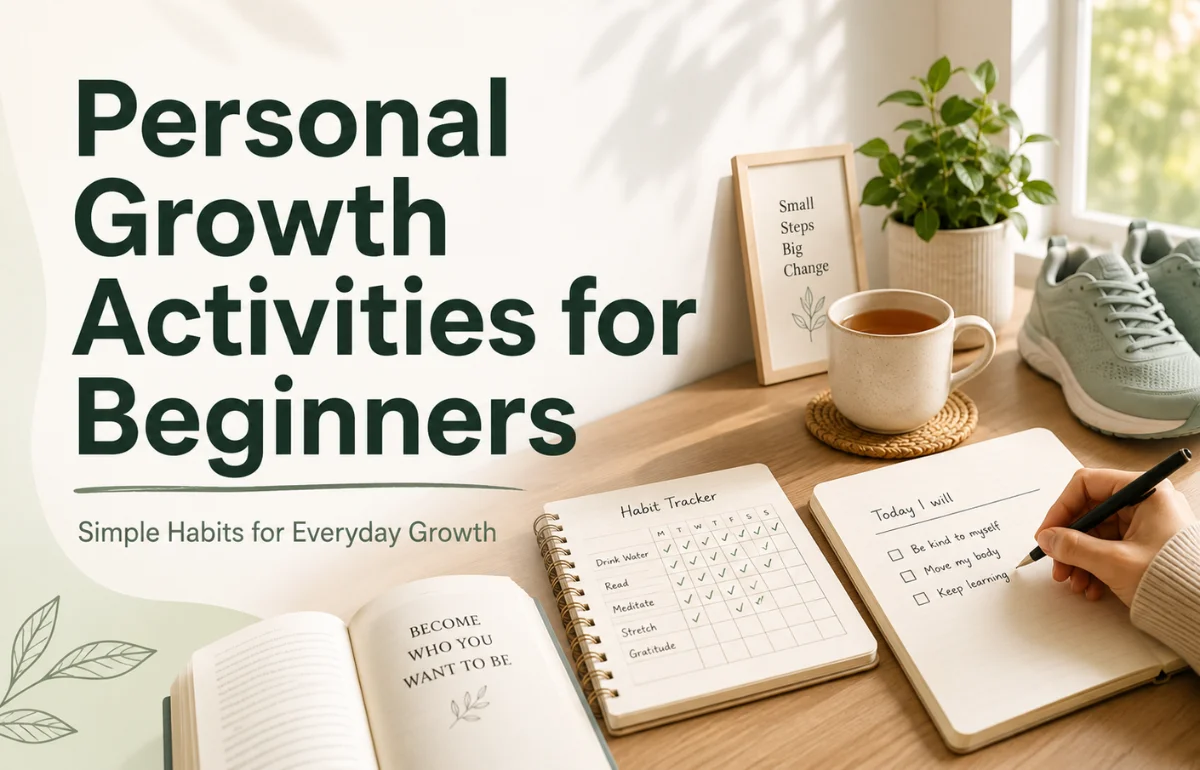
Personal growth activities for beginners are practical exercises that help a person understand themselves, improve useful skills, build healthier habits, and make intentional choices. They can include journaling, mindful breathing, reading, goal setting, physical movement, self-reflection, and meaningful conversations.
The best beginner activities are small, specific, and easy to repeat. You do not need a dramatic life plan, an expensive course, or hours of free time. A five-minute reflection or a ten-minute walk can be a genuine personal development practice when it helps you notice a pattern and choose a better response. I recommend treating personal growth as regular maintenance rather than a personality makeover. The aim is not to become a different person overnight. It is to become more aware and consistent over time.
What Personal Growth Really Means
Personal growth is the ongoing process of improving how you think, behave, communicate, learn, and care for yourself. It can support emotional intelligence, confidence, resilience, productivity, relationships, and a stronger sense of direction.
Growth does not always look impressive from the outside. Sometimes it is speaking more honestly. Sometimes it is going to bed on time, asking for feedback, reading ten pages, or pausing before reacting.
That is why I prefer activities over vague intentions. “I want to improve myself” sounds positive, but it gives the brain no clear action. “I will write three sentences about my day before bed” is measurable and repeatable.
Google’s current guidance favors useful, reliable, people-first content that adds real value. The same principle works for self-improvement: useful action beats impressive language. (Google for Developers)
How to Choose the Right Beginner Activity
A common mistake is selecting an activity because it looks productive online. The better question is: What part of my life needs attention now?
I use three filters: relevance, repeatability, and evidence. The activity should address a real need, fit an ordinary day, and produce a change you can notice.
Use this comparison table to find a sensible starting point.
| If you want to improve… | Beginner activity | Time needed | Simple sign of progress |
|---|---|---|---|
| Self-awareness | Daily reflection note | 5 minutes | You identify recurring thoughts or triggers |
| Focus | One distraction-free work block | 15 minutes | You finish one defined task |
| Confidence | Keep a “proof of progress” list | 3 minutes | You recall specific wins more easily |
| Emotional balance | Mindful breathing or body scan | 5–10 minutes | You pause before reacting |
| Physical energy | Brisk walk | 10–20 minutes | Your energy or sleep improves |
| Relationships | One intentional check-in | 5 minutes | Conversations become more meaningful |
| Direction | Weekly values review | 15 minutes | Decisions feel less scattered |
| Learning | Read and summarize one idea | 15 minutes | You can explain what you learned |
Start with one activity, not eight. A small practice gives you feedback. A huge self-improvement routine usually gives you guilt.
12 Personal Growth Activities for Beginners
1. Write a Three-Line Daily Reflection
At the end of the day, answer three questions:
- What went well?
- What felt difficult?
- What will I do differently tomorrow?
This format is short enough to maintain and structured enough to reveal patterns. Research suggests reflective writing can support self-reflection and emotional processing, though it is not a replacement for professional mental health care.
Write facts before interpretations. Instead of “I was terrible in the meeting,” write, “I rushed my answer and avoided asking a question.” Facts create room for improvement; harsh labels create shame.
2. Create a Personal Values List
Values are qualities you want your choices to represent, such as honesty, curiosity, stability, health, courage, creativity, family, or service.
Choose ten values, reduce the list to five, then rank your top three. For each one, write one behavior that would express it this week.
If health is a value, the behavior might be preparing lunch at home twice. If courage is a value, it might be making a phone call you have delayed.
This exercise turns abstract identity into visible action.
3. Use the Notice–Choose–Repeat Loop
This is a simple framework I use to make personal growth less vague:
- Notice: Identify what is happening without exaggerating it.
- Choose: Pick the smallest useful response.
- Repeat: Practice that response in a similar situation.
For example, you notice that you open social media whenever work becomes uncomfortable. You choose to wait two minutes and complete one small task first. You repeat the same response each time the urge appears.
The goal is not perfect control. The goal is shortening the distance between awareness and a better choice.
4. Take a Walk Without Headphones
A quiet walk combines movement, observation, and mental space. During the first half, notice your surroundings. During the second half, think about one question: “What needs my attention this week?”
Physical activity can support mood, thinking, sleep, and anxiety reduction. The CDC also emphasizes that some activity is better than none, which makes walking a practical entry point for beginners.
Do not turn every walk into a performance metric. Some walks are valuable because they help your mind settle.
5. Practice Five Minutes of Mindfulness
Sit comfortably and focus on your breathing, physical sensations, or surrounding sounds. When your attention wanders, bring it back without scolding yourself.
Mindfulness is not the absence of thought. It is the practice of noticing thoughts without automatically following them. Mayo Clinic describes it as present-moment awareness without judgment and notes that beginners can practice it while sitting, walking, standing, or doing everyday tasks. (Mayo Clinic)
Try five minutes, four days a week. Consistency matters more than a perfect setting.
6. Build a Proof-of-Progress File
Confidence grows more reliably from evidence than from slogans. Create a note on your phone called “Proof of Progress.”
Add specific examples:
- I asked a clear question in today’s meeting.
- I completed the task I had been avoiding.
- I stayed calm during a difficult conversation.
- I practiced for fifteen minutes even though I felt tired.
Review the list when self-doubt becomes louder than the facts. This activity helps correct the common habit of remembering failures in detail while treating progress as accidental.
7. Read Less and Apply More
Choose one useful book, article, course, or podcast episode. After each session, write:
- The main idea
- Why it matters to me
- One action I will test
Consuming self-improvement content can feel productive even when nothing changes. I suggest a one-to-one rule: follow each learning session with a similar amount of action, reflection, or discussion.
8. Try One Weekly Discomfort Rep
A discomfort rep is a small, safe action that stretches your normal behavior without overwhelming you.
Examples include introducing yourself, asking for feedback, sharing an idea, attending a beginner class, setting a boundary, or admitting that you do not understand something.
Choose discomfort that serves a value. Random suffering is not growth. Speaking up because you value honesty is growth. Exhausting yourself just to feel disciplined is usually poor self-management.
9. Improve One Part of Your Environment
Behavior is shaped by what is easy, visible, and available. Instead of depending only on motivation, change one environmental cue.
Place a book on your pillow if you want to read before bed. Keep fruit visible. Charge your phone outside the bedroom. Put walking shoes near the door. Remove one distracting app from the home screen.
I call this a growth friction audit: make helpful behavior easier and unhelpful behavior slightly harder.
10. Schedule a Real Conversation
Personal development is not only private work. Growth also happens through connection, listening, honesty, and feedback.
Once a week, contact someone and ask a question that goes beyond “How are you?” Try, “What has been taking most of your energy lately?” or “What are you looking forward to?”
Social connection is closely linked with health and well-being, and U.S. Surgeon General guidance describes connection as a fundamental human need. (HHS.gov) Listen without immediately turning the conversation back to yourself.
11. Run a Weekly Personal Review
Set aside fifteen minutes at the end of the week. Review your calendar, notes, habits, energy, and unfinished tasks.
Ask:
- What gave me energy?
- What drained me?
- What did I avoid?
- What am I proud of?
- What should I stop, start, or continue?
This turns scattered experiences into information you can use next week.
12. Protect Your Sleep Window
Sleep may not sound like a personal growth activity, but poor sleep weakens attention, memory, mood, and self-control—the same abilities many people are trying to improve.
Choose a realistic sleep window and protect the thirty minutes before it. Reduce stimulating work and prepare what you need for the morning. The CDC notes that adequate sleep supports mood, attention, memory, and stress reduction. (CDC)
Growth is harder when exhaustion is treated as ambition.
A Simple 30-Day Personal Growth Plan
Do not attempt all twelve activities at once. Use a four-week rhythm.
| Week | Main focus | Activity | Minimum version |
|---|---|---|---|
| 1 | Awareness | Three-line reflection | Write one honest sentence |
| 2 | Energy | Walk and protect sleep | Walk for five minutes |
| 3 | Courage | One discomfort rep | Take one mildly uncomfortable action |
| 4 | Direction | Values review and weekly review | Choose one priority for next week |
Track completion with a check mark, not a personality score. At the end of each week, ask whether the activity made a useful behavior more likely. Keep what works and remove what creates effort without benefit.
Common Beginner Mistakes
Trying to Fix Everything at Once
A complicated routine increases the number of ways to fail. Pick one focus for two weeks before adding another.
Confusing Intensity With Progress
A two-hour burst followed by ten inactive days is less useful than ten minutes repeated regularly.
Measuring Feelings Instead of Behavior
You may not feel confident while practicing confidence. Measure whether you spoke, applied, exercised, wrote, or followed through.
Using Self-Criticism as Motivation
Honest reflection should be specific and fair. Replace “I am lazy” with “I avoided this task three times because the first action was unclear.” The second sentence gives you something to change.
Copying Someone Else’s Routine
A routine designed for a full-time creator, athlete, executive, or student may not fit your responsibilities. Build around your actual energy, schedule, health, and priorities.
How to Know You Are Making Progress
Progress is not only reaching a major goal. Look for smaller indicators:
- You recover from mistakes faster.
- You recognize triggers earlier.
- You make fewer promises and keep more of them.
- You communicate needs more clearly.
- You spend more time on chosen priorities.
- You can change a plan without abandoning the goal.
- You treat yourself with honesty instead of cruelty.
These signs show that awareness and behavior are starting to work together.
Frequently Asked Questions
What are the best personal growth activities for beginners?
Start with journaling, walking, mindfulness, reading with application, weekly reflection, and one small goal. Choose one activity you can repeat for at least two weeks.
How can I start personal growth at home?
Use a notebook or phone note for daily reflection, remove one distraction, read for ten minutes, and schedule a short weekly review.
How much time should I spend on personal development daily?
Ten to twenty minutes is enough for a beginner. A smaller practice done consistently is usually more useful than a long routine you cannot maintain.
Can personal growth improve confidence?
Yes, especially when activities create evidence of competence, such as practicing a skill, keeping commitments, speaking up, or tracking progress.
What is the difference between personal growth and self-care?
Self-care supports your current well-being, while personal growth develops awareness, skills, and behavior over time. Many activities, such as sleep, exercise, and boundaries, can serve both.
Your Next Move
Choose one of these personal growth activities for beginners and make the first version almost too easy to avoid. Write one sentence, walk for five minutes, send one thoughtful message, or remove one distraction.
Then repeat it long enough to learn something about yourself. Real growth often begins quietly: one honest observation, one useful choice, and one more attempt.

Emily Carter is a personal growth writer with 9 years of experience creating practical content about confidence, mindset, productivity, habits, goal setting, and self-improvement. She focuses on helping readers build positive routines, develop self-awareness, and make meaningful changes through simple, actionable strategies.