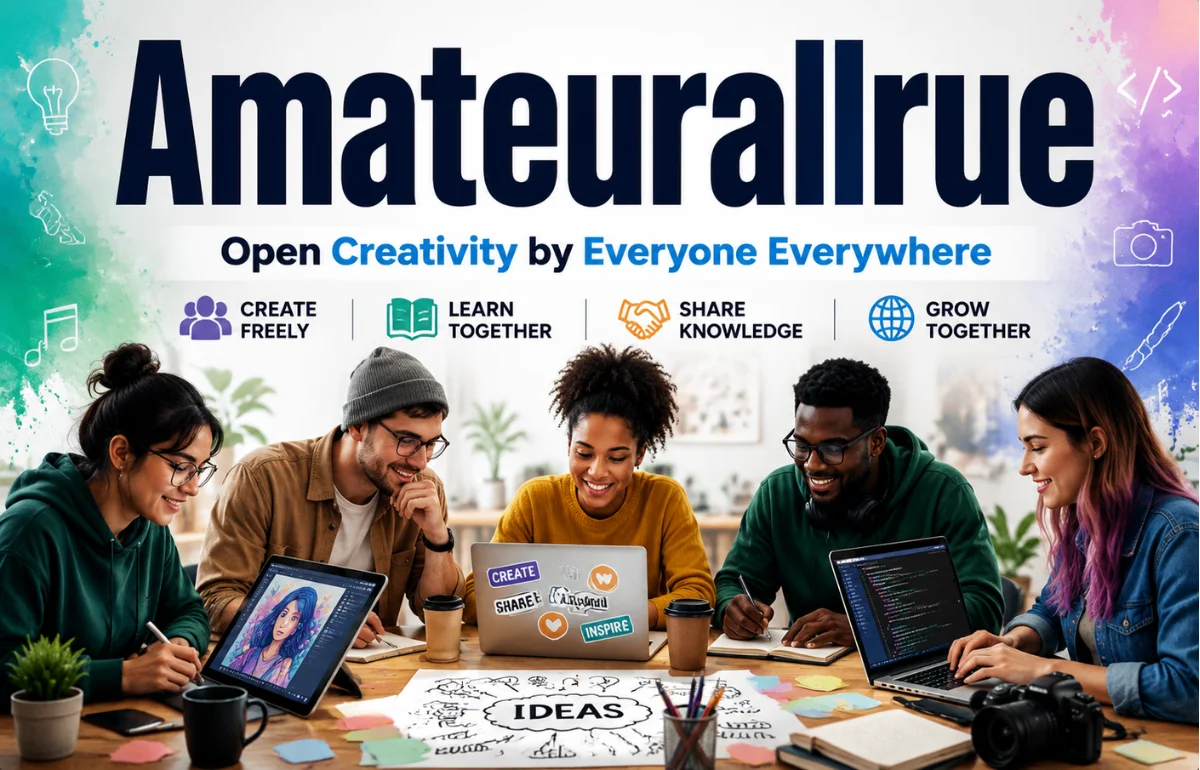
Amateurallrue is an emerging internet term commonly used to describe open, community-led creativity in which people make, share, and improve work without needing formal credentials or approval from traditional gatekeepers. In plain language, it refers to creators learning in public, collaborating online, and turning personal interests into useful art, media, software, or knowledge.
The term does not yet have one authoritative definition, documented founder, or widely accepted history. Some websites describe Amateurallrue as a decentralized creative movement, while the similarly named domain has been presented as a technology-news and digital-guides website. I therefore treat it as a developing label rather than a formally established organization.
What Does Amateurallrue Mean?
The clearest working definition is this:
Amateurallrue is a culture of accessible creation where enthusiasts, self-taught contributors, and independent makers participate because they are curious, motivated, or passionate—not because an institution has formally approved them.
The “amateur” part is easier to verify. The English word comes through French from the Latin amator, meaning a lover or admirer. Historically, an amateur was someone who pursued an activity for interest or love rather than as a paid profession.
The word later developed a second, less flattering meaning associated with inexperience.
The second half of Amateurallrue is less certain. One published interpretation claims that “all-rue” means “all roads,” but I could not find a reliable linguistic source or original coinage supporting that explanation.
The safer reading is that the complete word suggests openness: many people, many paths, and many forms of participation.
A Useful Way to Understand the Term
Rather than treating Amateurallrue as a rigid movement with membership rules, I see it as a label for several behaviors that already exist online:
- Creating before receiving professional validation
- Learning by publishing, testing, and revising
- Sharing resources with peers
- Collaborating across locations and skill levels
- Building an audience outside traditional institutions
- Moving between hobby, freelance, and professional work
This definition fits digital art, independent publishing, fan-created media, open-source software, collaborative learning, and parts of the creator economy.
Is Amateurallrue a Movement, Platform, or Website?
This is where many existing articles become unclear. Amateurallrue is used online in more than one way, and readers should not assume that every mention refers to the same thing.
Peace Quarters describes it as a movement of decentralized creativity, learning by doing, and community-based innovation. A third-party website analysis, however, identified amateurallrue.com as a recently registered site focused on technology news, app reviews, and digital guides.
| Use of the term | What it appears to mean | What readers should verify |
|---|---|---|
| Creative concept | Open participation by amateur and self-taught creators | Whether the writer provides evidence for the definition |
| Cultural movement | A broad shift away from creative gatekeeping | Whether real communities identify themselves with the term |
| Website or brand | A specific online publication using the name | Ownership, editorial policies, contact details, and domain history |
| SEO topic | A low-competition phrase discussed by different blogs | Whether articles repeat claims without offering original evidence |
Check the context. One writer may be discussing a philosophy, while another may be referring to a website or brand.
The spelling alone does not prove that the two uses are officially connected.
The Four Principles Behind Amateurallrue
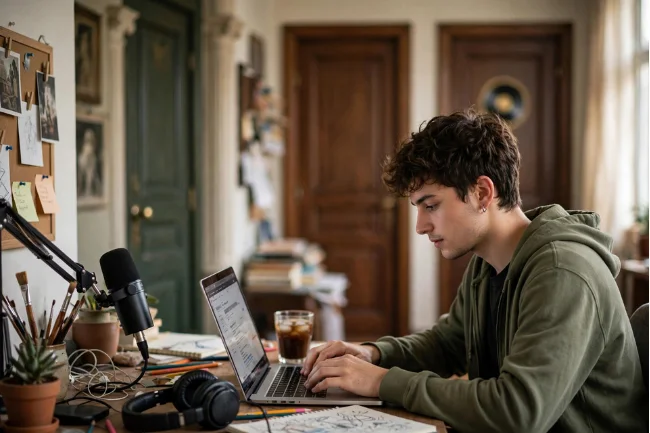
Although the label is new and loosely defined, the behavior it describes is familiar. I would organize it around four main principles.
1. Access Before Permission
Traditional creative systems often require an editor, gallery, record label, employer, school, or publisher to approve someone’s work. Online platforms allow creators to publish first and earn attention later.
Expertise still matters, but the order changes. A learner can improve publicly and gradually build trust through a visible body of work.
This makes participation more accessible to people who may not have the money, location, qualifications, or personal connections required by traditional institutions.
2. Practice in Public
Many self-taught creators do not wait until their work looks perfect. They share sketches, prototypes, early drafts, recordings, code, experiments, and behind-the-scenes decisions.
Public practice creates a useful feedback loop. The creator receives questions and criticism, applies what is helpful, and produces a stronger version.
This explains why online creative communities can sometimes accelerate learning. Members do not only see finished products; they also see how those products were developed.
3. Community Knowledge
Amateurallrue-style creation depends on shared knowledge. Tutorials, templates, source files, critique groups, forums, documentation, and peer mentorship reduce the cost of getting started.
The best communities explain decisions, welcome basic questions, and document recurring problems for the next person.
Knowledge becomes more useful when it is searchable, understandable, and available to members with different levels of experience.
4. Flexible Professional Identity
The boundary between an amateur and a professional is no longer fixed.
A hobbyist may sell a template. A full-time designer may contribute to an unpaid open-source project. A student may publish research notes that become widely useful. An independent musician may release free tracks while earning income from performances or memberships.
Payment, skill, credentials, and public recognition do not always arrive together.
Amateurallrue is most useful when it describes this flexible path without romanticizing unpaid labor or dismissing professional standards.
How Amateurallrue Differs From Related Ideas
The term overlaps with the creator economy, DIY culture, user-generated content, online communities, and open-source collaboration. However, these ideas are not identical.
| Concept | Main focus | Typical motivation | Key difference |
|---|---|---|---|
| Amateurallrue | Open, passion-led participation | Learning, expression, contribution, and recognition | A broad umbrella connecting creativity and community |
| Creator economy | Earning income from an audience | Revenue, independence, and business growth | Monetization is central |
| DIY culture | Making or repairing things independently | Self-reliance and experimentation | Often emphasizes hands-on production |
| User-generated content | Material produced by platform users | Participation, entertainment, and visibility | Usually defined from the platform’s perspective |
| Open source | Publicly accessible collaborative development | Shared improvement and reuse | Governed by licenses and contribution rules |
A creator can participate in several systems at once—learning in a peer group, publishing on social media, selling products, and releasing assets under an open license.
The concepts overlap, but the motivations and rules may be different.
Where the Idea Appears in Real Life
Independent Art and Design
Digital artists routinely share work-in-progress posts, brush settings, process videos, reference packs, and constructive critiques.
Portfolios are no longer limited to graduates of recognized art schools. A self-taught illustrator can build an audience, work with clients, sell digital assets, and receive feedback from artists living in different countries.
Strong communities welcome beginners while still discussing craft, accessibility, attribution, and professional ethics.
Writing and Independent Publishing
Newsletters, blogs, fanfiction archives, online magazines, and serialized-fiction platforms allow writers to reach readers without first securing a traditional publishing agreement.
Writers still need to separate reporting from opinion, credit sources, correct errors, and avoid presenting invented history as fact.
That responsibility becomes especially relevant when explaining an unfamiliar keyword such as Amateurallrue. A confident definition should not be treated as evidence simply because several websites repeat it.
Coding and Open Collaboration
Software communities provide one of the clearest examples of learning through contribution.
A beginner may start by correcting documentation, reporting a bug, translating instructions, answering a question, or improving a small feature. These contributions may appear minor, but they help the entire project.
Visible revision histories aid evaluation, while codes of conduct, review processes, licensing, and clear ownership support healthy collaboration.
Music, Video, and Performance
Affordable recording tools and digital distribution platforms have reduced the gap between making creative work and releasing it.
Independent musicians, filmmakers, performers, podcasters, and video essayists can test ideas with real audiences without first receiving support from a major studio or record label.
Reach does not guarantee sustainability. Creators still face licensing problems, platform dependence, content theft, unstable income, and pressure to publish frequently.
My Credibility Test for Amateurallrue Communities

Because the term lacks a formal standard, I use a four-part test to decide whether a platform or group genuinely reflects the values associated with it.
Identity
Who runs the community? Is there a clear About page, editorial policy, contact method, or leadership structure?
Anonymous participation can be legitimate. However, a platform requesting personal details, payments, or uploaded files should provide stronger transparency.
Participation
Can beginners meaningfully contribute, or are they merely an audience?
Real participation may include submitting work, receiving feedback, suggesting ideas, improving shared resources, answering questions, or assisting with moderation.
A community is not open simply because anyone can follow its social media account.
Ownership
Do contributors retain rights to their work? Are licensing, reuse, AI training, attribution, and commercial use explained in understandable language?
A community that celebrates openness while quietly taking broad ownership rights is not genuinely creator-friendly.
Before submitting original work, creators should read the platform’s terms rather than assuming they will maintain complete control.
Continuity
Does the group preserve useful knowledge, maintain projects, resolve disputes, and support long-term participation?
A viral hashtag can generate attention for a few days. A durable community requires documentation, moderation, dependable leadership, and responsible governance.
This identity-participation-ownership-continuity model is more useful than judging a creative community by follower count alone.
Benefits of an Amateurallrue Approach
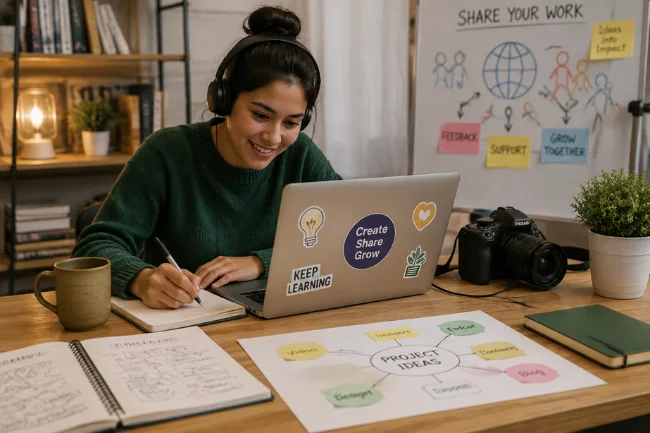
The approach lowers entry friction, allowing people to test an interest before paying for costly equipment, software, or training.
It also broadens perspective by bringing in regional knowledge, niche interests, unconventional methods, and creators from different economic backgrounds.
Small groups can test new formats quickly without navigating a long institutional approval process. Beginners also learn from visible mistakes and revisions rather than seeing only polished results.
Another benefit is portability. Skills developed through community projects may lead to employment, freelance work, teaching opportunities, business ideas, or independent creative projects.
The work may begin as a personal interest but develop into something professionally valuable.
Risks and Limitations
Open participation does not automatically create a fair or trustworthy environment. Online communities can reproduce many of the problems found in traditional institutions.
Algorithms may reward frequent posting instead of thoughtful work. Popular members may dominate attention. Uncredited copying may be defended as remixing. Volunteer moderators can burn out, while unpaid contributors may create value that a platform later monetizes.
There is also a credibility risk. Multiple websites can repeat an unsupported definition until repetition begins to look like evidence.
While researching Amateurallrue, I found broad claims about its origin and history more easily than I found primary proof.
Readers should therefore ask three questions whenever they encounter a confident explanation:
- Does the article identify and cite the first known use?
- Do the named communities use the term themselves?
- Are the examples directly connected to Amateurallrue, or are they simply general examples of online creativity?
These questions help separate genuine research from recycled content.
How to Participate Responsibly
Begin with a community that matches the type of work you want to create. Read its rules, observe how members provide feedback, and check what happens to uploaded content.
Contribute something small and useful. A thoughtful critique, corrected resource, documented solution, or clearly labeled creative experiment can build more trust than aggressive self-promotion.
Protect your work by keeping original files, recording publication dates, reading platform terms, and choosing an appropriate license.
When collaborating, agree on credit, ownership, deadlines, revenue, responsibilities, and future reuse before the project becomes valuable.
Openness should not be confused with carelessness. Accessible communities still require quality control, factual accuracy, privacy safeguards, and respectful moderation.
The Future of Amateurallrue

The pattern may continue even if the word itself fades. Creative tools are becoming more accessible, remote collaboration is normal, and people increasingly build public portfolios outside formal institutions.
The more interesting question is not whether amateurs can produce professional-quality work. Many already do.
The real question is whether online systems will reward contributors fairly, preserve community knowledge, and make ownership understandable.
For Amateurallrue to become more than a vague label, it needs documented origins, recognizable communities, transparent governance, and examples that can be independently verified.
Until then, the term is best used as a descriptive framework for open, passion-led digital creation.
Final Takeaway
Amateurallrue describes a useful idea: people should be able to create, learn, collaborate, and contribute without waiting for institutional permission.
Its meaning, however, is still developing. Claims about an official movement, established history, or universally accepted definition deserve careful verification.
Use the concept as an invitation to participate, not as an excuse to ignore expertise. Find a transparent community, contribute useful work, protect your rights, and leave the shared space more helpful than you found it.
Frequently Asked Questions
What is Amateurallrue in simple words?
Amateurallrue is a developing term for open, community-led creativity where people learn, make, and share work without requiring formal professional approval.
Is Amateurallrue a real movement?
It is described online as a creative movement, but there is currently no widely verified founder, governing body, or universally accepted definition.
Is Amateurallrue a website?
A website uses the Amateurallrue name, but the term is also used as a broader concept. Verify the context before sharing personal information or making payments.
Where did the word Amateurallrue come from?
The “amateur” element has a documented connection to doing something for love, but the origin and meaning of the complete coined term remain unclear.
How can I join an Amateurallrue community?
Look for transparent creator groups with clear rules, active peer feedback, fair ownership terms, and meaningful opportunities for beginners to contribute.

Midori Michael is an independent digital content research writer with 8+ years of experience creating well-researched articles on digital marketing, business, technology, and lifestyle topics. She focuses on simplifying complex information through accurate research and clear editorial writing.