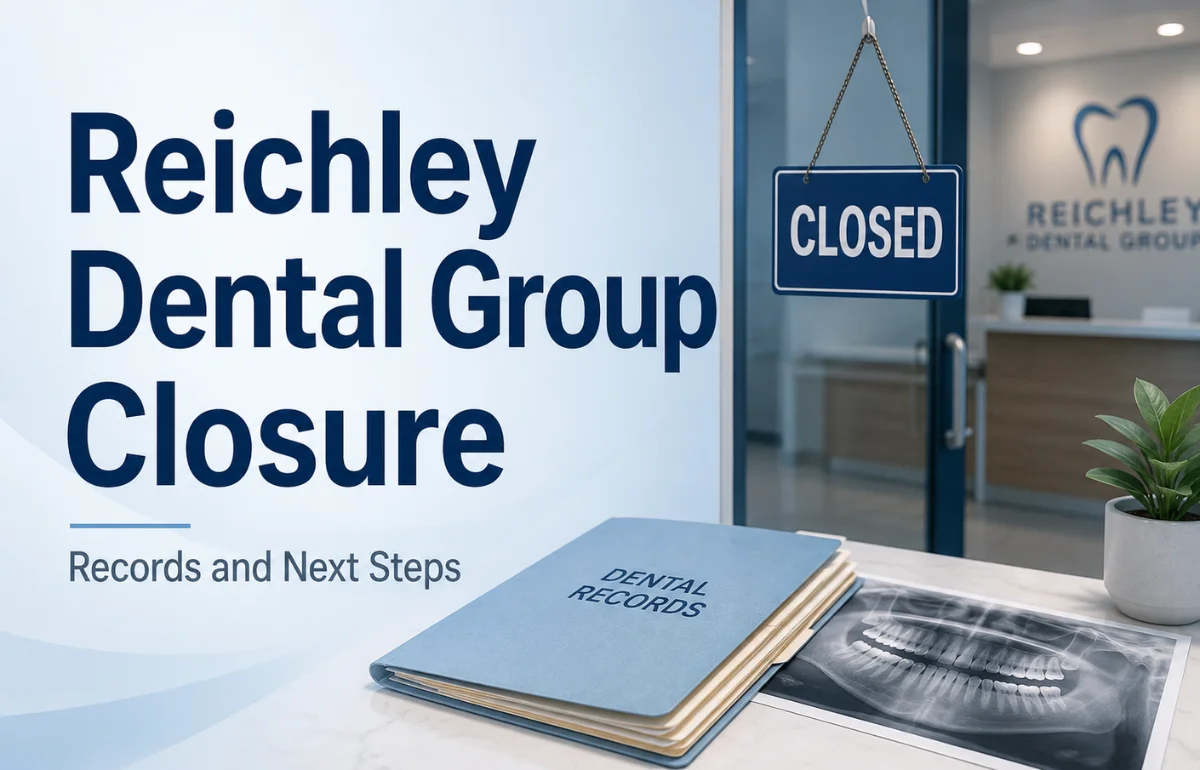
Reichley Dental Group was a family-owned general and cosmetic dental practice in Beavercreek, Ohio, that served local families for roughly five decades. The Reichley Dental Group Closure refers to the practice’s permanent shutdown announced in March 2026 after owner Dr. Rochelle Reichley disclosed a serious cancer diagnosis and shifted her focus to treatment. For former patients, the practical issue is no longer scheduling routine care there; it is securing dental records, X-rays, treatment plans, billing information, and continuity of care with a new dentist. Local reporting said patients initially had a 60-day period to request records, while the Better Business Bureau now identifies the practice as out of business.
I reviewed closure coverage, business listings, and patient-record guidance to separate confirmed facts from assumptions. Former patients should act promptly, document requests, and avoid delaying urgent or unfinished treatment.
What Happened to Reichley Dental Group?
Reichley Dental Group operated at 1450 Hanes Road in Beavercreek and provided general and cosmetic dentistry. Public profiles trace the business to the mid-1970s, with Dr. Joseph “Joe” Reichley founding the practice and Dr. Rochelle Reichley joining in 2000 before continuing it after her father’s retirement.
The permanent closure was reported on March 11, 2026. According to the practice’s public message as summarized by local news, Dr. Reichley had been diagnosed with Stage 4 lung cancer that had spread to her brain, and her attention needed to move fully toward her health and treatment.
The announcement also thanked patients for the trust they had placed in the family and staff over the years.
This was a permanent practice closure connected to the dentist’s health. Becker’s Dental Review reported that patients would be able to transfer records for the following 60 days.
Reichley Dental Group Closure: Confirmed Facts and Open Questions
The table below separates what can be verified from what remains unclear in publicly indexed information as of August 2026.
| Topic | What is publicly confirmed | What is still unclear |
|---|---|---|
| Closure status | The practice announced a permanent closure, and the BBB now marks it as out of business. | No reopening or acquisition has been publicly confirmed. |
| Reason | Public reporting linked the closure to Dr. Rochelle Reichley’s cancer diagnosis and treatment needs. | Private medical details beyond the announcement should not be assumed. |
| Record-transfer period | Coverage published in March 2026 said records could be transferred for 60 days. | I found no publicly indexed update naming a permanent records custodian after that initial period. |
| Contact numbers | WHIO reported 937-475-9541 for record copies; the BBB lists the historical office number as 937-426-5560. | Public sources do not confirm whether either number is still actively monitored. |
| Successor dentist | No named successor practice appears in the closure reports I reviewed. | Former patients may need to select a new dentist independently. |
That final column matters. Searchers often want to know, “Who took over the patients?” or “Where did the records go?”
The available reports explain why the office closed, but they do not publicly identify a successor dental practice or long-term record custodian.
What Former Patients Should Do About Dental Records
I would treat record retrieval as the first priority, especially for anyone with recent X-rays, periodontal treatment, implants, crowns, root canals, dentures, orthodontic work, or an unfinished treatment plan.
HIPAA generally gives patients the right to access a broad range of health information maintained by a covered provider. This can include clinical notes, X-rays, billing and payment records, insurance information, treatment consents, and other records used to make decisions about care.
Patients may also direct a covered entity to send copies to another person or provider.
Request the Complete Clinical File, Not Just “My Records”
A vague request may produce only a summary. I recommend asking specifically for:
- The full clinical chart and progress notes
- All dental X-rays, including bitewings, periapicals, panoramic images, and CBCT scans
- Periodontal charting and gum measurements
- Current and proposed treatment plans
- Records of crowns, bridges, implants, dentures, or orthodontic appliances
- Laboratory, referral, medication, and allergy information
- Itemized billing, insurance submissions, and account balances
The ADA explains that patients generally have the right to inspect and obtain copies of dental records even though the dentist remains the legal guardian of the original chart.
ADA ethics guidance also says dentists should furnish records or useful copies for a patient’s future treatment, subject to applicable law.
Use a Written, Dated Request
Even when a phone number is available, I would follow the call with a written request. Include the patient’s full name, date of birth, former address if it has changed, approximate dates of treatment, and where the records should be sent.
Ask for electronic copies in a commonly usable format whenever possible. HHS guidance says a covered entity generally must provide the requested form and format when it is readily producible.
Under the HIPAA access rule, a covered entity normally must act on a request within 30 calendar days. It may take one additional 30-day extension only after providing written notice explaining the delay.
Keep copies of emails, delivery confirmations, voicemail dates, and release forms in case the request stalls.
What If the Announced 60-Day Window Has Passed?
The 60-day period reported in March 2026 has passed. That does not automatically prove that the records were destroyed or that access rights disappeared.
Federal guidance says the right of access applies for as long as protected health information is maintained by a covered entity or its business associate. This applies whether the information is stored onsite, remotely, on paper, electronically, or in an archive.
Try both publicly reported numbers, ask for the “records custodian,” and send a dated request to the last known office address. A new dentist can also request the file for treatment purposes.
If repeated, documented requests receive no response, patients can contact the Ohio State Dental Board for guidance. A patient may also file a health-information privacy complaint with the U.S. Department of Health and Human Services Office for Civil Rights when a HIPAA-covered entity may have failed to provide access.
HHS says complaints generally must be filed within 180 days of when the person knew of the possible violation, although an extension may be allowed for good cause.
How to Choose a New Dentist After the Closure
The best replacement is not necessarily the closest office. I would compare clinical fit, insurance participation, appointment availability, and willingness to evaluate work started by another provider.
| Patient situation | What to ask a new office | Suggested priority |
|---|---|---|
| Routine cleanings only | Are you accepting new patients, and do you accept my dental plan? | Schedule within the normal recall period. |
| Unfinished crown, bridge, implant, or root canal | Can the dentist review existing records and continue another office’s treatment? | Contact offices immediately. |
| Periodontal disease or frequent maintenance | Do you provide periodontal maintenance, and how soon can I be seen? | Avoid missing the recommended interval. |
| Dentures, retainers, night guards, or appliances | Can you repair, adjust, or replace an appliance made elsewhere? | Book before fit or function worsens. |
| Pain, swelling, trauma, or infection symptoms | Do you offer same-day emergency dental care? | Seek prompt evaluation. |
The ADA’s Find-a-Dentist service allows patients to search by location and filter by factors such as specialty, language, insurance, and travel distance.
Insurance directories can also help, but I would still call the office because online network listings may not always reflect current participation.
Tell the New Dentist About Unfinished Treatment
Do not assume a new dentist can simply finish where the former office stopped. The incoming dentist must independently examine the patient, confirm the diagnosis, evaluate the existing work, and decide whether the original treatment plan remains appropriate.
Bring temporary crowns, appliance cases, implant cards, prescription information, and treatment estimates. For laboratory-made work, ask whether the new dentist needs the lab name, restoration shade, or implant system.
A treatment estimate from Reichley Dental Group can still provide useful context, but it does not require the new provider to follow the same recommendation, materials, timeline, or fee.
Review Insurance and Financial Details Separately
A practice closure can leave confusion around deposits, prepaid treatment, pending claims, denied claims, financing plans, and unused insurance authorizations.
Clinical and financial records may be maintained separately, so request both.
Ask the insurer whether a preauthorization can be transferred, whether a claim was submitted, and whether work begun elsewhere remains covered. A new dentist may use different codes or fees after a new examination.
Patients should also request an itemized account statement showing payments, adjustments, insurance activity, deposits, and any claimed balance. This can help resolve disagreements without relying on memory or an old treatment estimate.
Why Transferring X-Rays and Treatment Notes Matters
Existing records show what was diagnosed, completed, and still needs attention. They may reduce unnecessary repetition, although updated images can still be necessary.
The ADA’s 2026 radiography recommendations emphasize reviewing medical and dental history, prior images, and current examination findings before ordering new X-rays. The aim is to use imaging when clinically necessary rather than following a one-size-fits-all schedule.
This is one reason I would ask for actual image files, not screenshots or a written note saying “X-rays taken.” Diagnostic-quality files are more useful for comparison and treatment planning.
Records can also show the type of restoration placed, the tooth treated, the date of treatment, the implant system used, previous gum measurements, and the reason a procedure was recommended.
Without those details, the new dentist may need to spend more time reconstructing the patient’s history.
Do Not Wait on a Dental Emergency
Records can be sorted out later if the immediate problem is severe pain, facial swelling, uncontrolled bleeding, trauma, fever with oral symptoms, or a rapidly worsening infection.
The ADA advises seeking a dentist or emergency department as soon as possible for a dental emergency, particularly when bleeding will not stop or pain is significant.
When calling, say you are a former Reichley Dental Group patient and describe symptoms clearly. Mention swelling, fever, trauma, difficulty swallowing, or recent treatment at the start of the call.
Do not postpone urgent care because records have not arrived. A dentist can evaluate the current problem first and review historical information later.
What Most Reports About the Closure Do Not Explain
News coverage understandably focused on Dr. Reichley’s diagnosis and the emotional end of a long-running family practice. What patients need next is a continuity plan.
From the public information I reviewed, there is no clearly indexed announcement naming a successor dentist, permanent record-storage company, or long-term process for requests submitted after the initial 60 days.
That absence does not mean no arrangement exists. It means patients should not rely on assumptions or wait for a referral notice that may never arrive.
A dental office’s status is also different from an individual license status. The BBB marks the business as out of business while separately displaying licensing information connected with Dr. Reichley, so an active license date should not be read as proof that the office is accepting appointments.
Frequently Asked Questions
Is Reichley Dental Group permanently closed?
Yes. The practice announced a permanent closure in March 2026, and the BBB currently identifies the business as out of business.
Why did Reichley Dental Group close?
Public reports say the office closed after Dr. Rochelle Reichley disclosed a serious cancer diagnosis and needed to focus on treatment.
How can I get my records from Reichley Dental Group?
Try the record-request number reported by WHIO, 937-475-9541, and the historical office number, 937-426-5560. Also send a dated written request and ask for the records custodian.
Did another dentist take over Reichley Dental Group patients?
I found no publicly indexed announcement naming a successor dentist or practice, so patients may need to choose a new provider independently.
What should I do if I have dental pain after the closure?
Contact a dentist offering urgent appointments. For severe pain, uncontrolled bleeding, significant swelling, or trauma, seek prompt emergency evaluation.
The Next Move for Former Patients
The Reichley Dental Group Closure ended a long chapter in Beavercreek dental care, but patients can protect their continuity of treatment by acting now.
Request the complete clinical and financial file, preserve proof of the request, choose a new dentist based on current needs, and do not postpone urgent care while waiting for paperwork.
My practical recommendation is to make the records request and contact a replacement dentist on the same day. Those two actions give the new office the best chance to review past care without allowing routine maintenance, unfinished treatment, or a developing problem to fall through the gap.

Daniel Reed is a dental health writer with 6 years of experience creating clear, research-informed content about oral hygiene, gum care, preventive habits, and everyday dental wellness. He focuses on making reliable information easy to understand while encouraging readers to seek professional dental care for diagnosis and treatment.