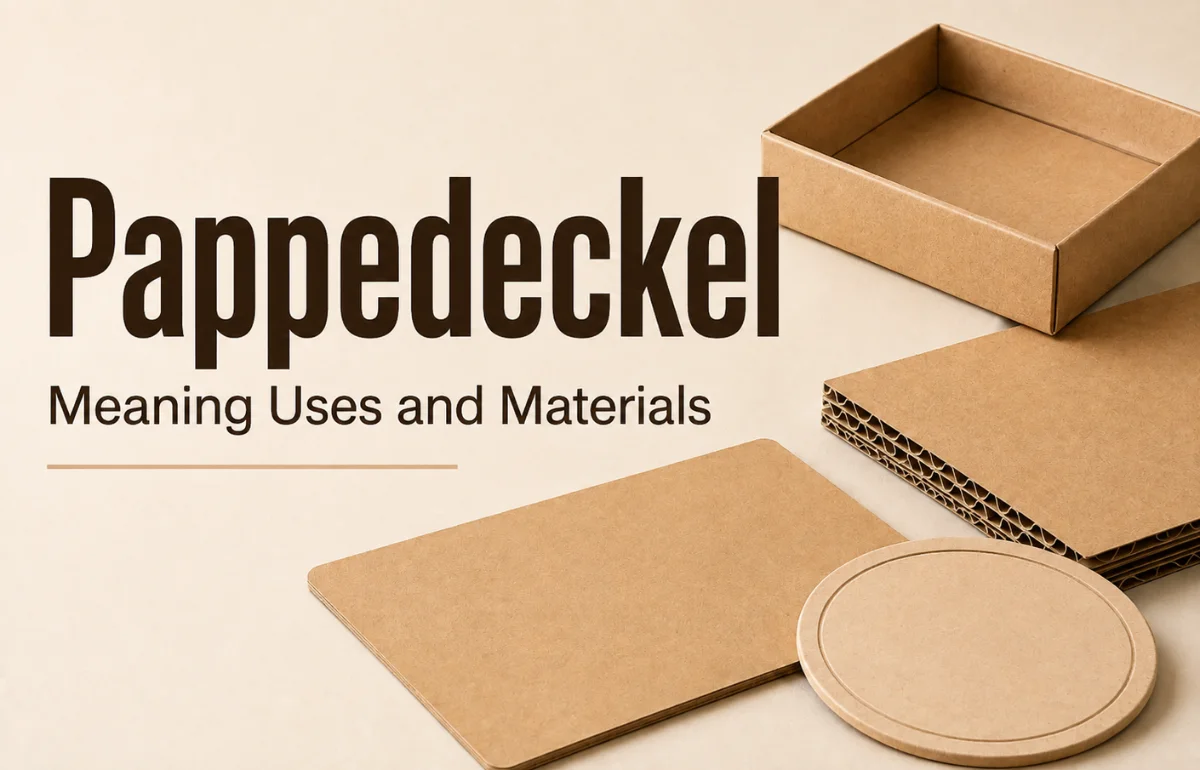
Pappedeckel is a regional German word for cardboard, paperboard, or a piece made from stiff paper material. It is closely related to the standard German forms Pappendeckel and Pappdeckel. Depending on the speaker and context, it may describe a flat piece of cardboard, a cardboard box, or a lid made from paperboard. It is not, however, the established name of a traditional German decorative-lid craft.
When I checked German dictionary entries and regional language sources, I found that the meaning changes slightly by region. In Alemannic-speaking areas, including parts of southwestern Germany, Pappedeckel can be used much like Karton. In packaging, the same word may be understood literally as a cardboard lid. That regional flexibility explains why English-language websites often give conflicting definitions.
What Does Pappedeckel Mean?
The easiest English translation is “cardboard” or “paperboard,” although no single English word fits every situation.
German speakers may use Pappedeckel for the material itself, a cut piece of board, a carton, or an object made from cardboard. Duden defines the related standard word Pappendeckel as a usually rectangular piece of Pappe. Pappe, in turn, is a fairly stiff material made from multiple layers of paper. Langenscheidt translates Pappendeckel as cardboard, millboard, paperboard, or pasteboard.
The spelling Pappedeckel is especially associated with regional speech. An Alemannic glossary translates Pappedeckel as Karton and records related dialect forms such as Pabbedeggel and the Bavarian Babbadeckel or Babbadeggl.
That means the most accurate translation depends on the sentence:
- “Gib mir einen Pappedeckel” could mean “Give me a piece of cardboard.”
- “Der Pappedeckel ist kaputt” could refer to a damaged carton or cardboard lid.
- “Schreib es auf den Pappedeckel” suggests writing on a piece of board.
- In some regional, informal settings, the word may refer to a driver’s license, much as Pappe can in colloquial German.
The surrounding situation matters more than a literal word-for-word translation.
Pappedeckel, Pappendeckel, and Pappdeckel Compared
These words look almost identical because they share the root Pappe, but they are not always used in precisely the same way.
| Term | Most likely meaning | Where or how it is used |
|---|---|---|
| Pappedeckel | Cardboard, a piece of cardboard, a carton, or a cardboard lid | Regional and dialect speech, especially in Alemannic areas |
| Pappendeckel | A piece of cardboard or stiff paper | Recognized standard German form |
| Pappdeckel | Cardboard or a cardboard piece | Shorter related standard form |
| Deckel aus Pappe | A lid made from cardboard or paperboard | Clear literal packaging description |
| Bierdeckel | A beverage coaster, particularly for beer glasses | Pubs, restaurants, printing, collecting, and advertising |
I would not automatically translate Pappedeckel as Bierdeckel. A Bierdeckel is a specific object placed beneath a glass, while Pappedeckel is a broader regional term that may simply name the material.
German beer coasters are generally made from absorbent board, but the object itself is normally called a Bierdeckel, Bierteller, or Bierfilz. Historical accounts trace modern cardboard beer coasters to developments in the late nineteenth century.
Why the Internet Gives Conflicting Definitions
The confusion surrounding Pappedeckel comes from three main sources: dialect, literal translation, and repeated online content.
Dialect words do not always have one spelling
Regional words are often written according to their pronunciation. One speaker may write Pappedeckel, while another uses Pabbedeggel, Babbadeckel, or Babbadeggl.
Search engines can treat these spellings as separate subjects even though they express closely related regional meanings.
The literal translation is too narrow
The word can be divided into Pappe and Deckel. Pappe means cardboard or stiff paper material, while Deckel means lid or cover.
That makes “cardboard lid” a logical translation. It may also be completely correct when the sentence concerns a cup, container, box, or package. It becomes misleading, however, when presented as the only possible meaning.
A person asking for a Pappedeckel in a workshop may simply want a piece of cardboard rather than a specially manufactured lid.
Unsupported definitions get repeated
Some English-language articles describe Pappedeckel as a traditional German art involving decorated paper lids. I could not find that definition in the German dictionary and regional sources I reviewed.
Those references consistently point toward cardboard, paperboard, a piece of stiff board, or a carton. A cardboard lid can certainly be painted, wrapped, printed, or used in a craft project, but that does not make Pappedeckel the recognized name of a German folk-art tradition.
The safest approach is to examine the context. A café, cup, food tray, jar, or takeaway container suggests a lid. A school, workshop, shipping box, cutting tool, model, or sign suggests cardboard material.
What Is a Pappedeckel Made From?
In everyday conversation, people often group several paper-based materials under the general word cardboard. Packaging professionals separate them more carefully because their structure affects strength, print quality, flexibility, moisture resistance, and end use.
Paperboard is a strong, lightweight material produced from wood pulp, recycled paper pulp, or a combination of fibers. It is frequently converted into folding cartons, sleeves, backing cards, tubes, trays, and lightweight lids. Corrugated board has a different structure, with fluted paper positioned between flat liner sheets to provide cushioning and greater shipping strength.
| Material | Structure | Best suited to | Main limitation |
|---|---|---|---|
| Folding paperboard | Smooth, solid sheet | Retail cartons, sleeves, light lids, and printed packaging | Can bend under heavy loads |
| Greyboard or chipboard | Dense, rigid board | Box lids, book covers, displays, and craft bases | Often needs wrapping for a refined appearance |
| Corrugated board | Fluted core between liner sheets | Shipping boxes, protective inserts, and large covers | Exposed edges may look unfinished |
| Pulp board | Thick, absorbent fiber material | Drink coasters and protective pads | Performs poorly where water resistance is required |
| Laminated or coated board | Board with a barrier or decorative surface | Branded lids, food service, and moisture-prone uses | Added layers may complicate recycling |
Thickness alone does not determine whether a board will perform well. Grain direction, fiber density, scoring, humidity, surface coating, and the position of folds can be equally significant.
A thin but dense paperboard may produce a cleaner folding lid than a much thicker piece of corrugated material.
Common Uses of Pappedeckel
Packaging and storage
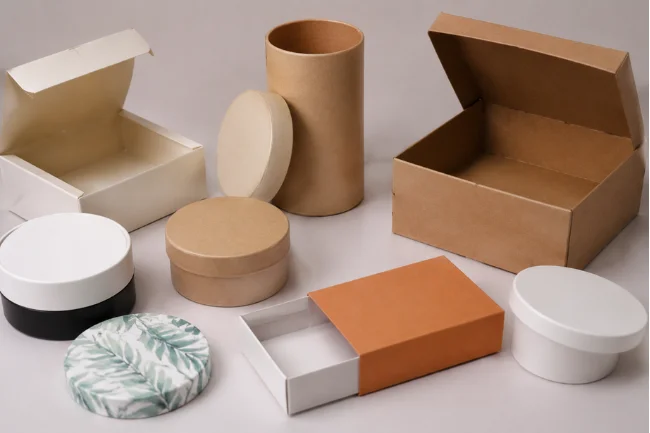
A Pappedeckel may refer to a lid for a small box, tube, tray, jar-style package, or takeaway container.
Paperboard lids are useful where low weight, printability, branding, and a paper-based appearance are priorities. They can be plain, printed, embossed, coated, wrapped, or cut into custom shapes.
The material still has to match the product. Dry goods, cosmetics, gifts, and stationery place different demands on a lid than hot drinks, oily food, frozen products, or damp items.
If you’re also working on decluttering your home storage, our guide on Simpciry and simpler living principles covers how to rethink what materials you keep around the house.
Crafts, models, and school projects
Cardboard pieces are useful for model buildings, masks, signs, picture mounts, game pieces, dividers, ornaments, stencils, and reusable templates.
In this setting, Pappedeckel describes the material rather than a particular craft technique.
I recommend choosing the board only after deciding what the finished project must do. Does it need to fold neatly, stay perfectly flat, absorb paint, carry weight, survive repeated handling, or resist moisture?
Answering that question first prevents many problems that people later blame on glue, cutting, or poor construction.
Coasters and hospitality products
A thick, absorbent cardboard disc or square is normally called a Bierdeckel when it is designed to sit beneath a beverage.
Beer coasters can also carry logos, event information, promotional messages, puzzles, menus, or handwritten order totals. Their board must absorb condensation without curling immediately or allowing printed ink to transfer onto the table.
Traditional round coasters in German-speaking markets are commonly produced in recognizable standard dimensions, although square and custom-cut versions are also widely used.
Printing, displays, and backing cards
Solid board provides a stable surface for countertop signs, photo mounts, retail displays, sample cards, product backing cards, and presentation materials.
Print quality depends largely on surface smoothness and coating. Structural performance depends on stiffness, thickness, grain direction, and the way the board is supported.
A premium cosmetics card, for example, may need a smooth printable surface. A temporary display stand may need greater rigidity even if its surface is less refined.
How to Choose the Right Cardboard Lid or Board
Match the board to the load
A decorative lid for a lightweight gift box does not require the same material as a cover that will be stacked, shipped, opened repeatedly, or exposed to pressure.
Folding paperboard may be sufficient for lightweight packaging. A premium rigid box usually benefits from dense greyboard wrapped in decorative or printed paper. Corrugated board is generally better for protection during transport.
The right choice is not necessarily the thickest board. It is the material that provides enough stiffness without making the lid bulky, difficult to fold, or expensive to produce.
Check the fit before decorating
A fitted lid needs a small allowance around the base.
If the lid is made to exactly the same dimensions as the container, the thickness of the paper, folds, adhesive, and decorative covering can make it too tight. If the allowance is excessive, the lid will slide, rattle, or look poorly made.
I would test a plain, undecorated sample before applying paint, printed paper, foil, fabric, or coating. A basic sample quickly reveals whether the corners bind, the walls bow outward, or the lid lifts unevenly.
Consider moisture and food contact
Ordinary cardboard absorbs water and grease. Coatings can improve resistance, but a coated surface is not automatically food-safe, heat-safe, or suitable for direct contact with beverages.
Materials intended to touch food must be suitable for their actual conditions of use. European food-contact rules require packaging materials, including paper and board, to avoid transferring substances at levels that could endanger health or unacceptably affect a food’s composition, taste, or smell.
For food packaging, use paperboard, inks, barriers, and adhesives supplied for the intended temperature, food type, and contact duration. Printed craft board should not be assumed food-safe simply because its surface looks clean.
Think beyond the recycling symbol
Paper, cardboard, and cartons can remain within recycling systems, but the fibers experience losses and changes as they move through repeated processing. Food residue and some coatings can also reduce the quality of recovered paper.
Wax, plastic film, heavy lamination, glitter, grease, and mixed-material attachments may affect whether a local program accepts a Pappedeckel.
My practical rule is simple: keep the item clean and dry, separate removable non-paper components, and follow the instructions of the local recycling collector rather than relying only on a recycling symbol.
Can You Make a Pappedeckel at Home?
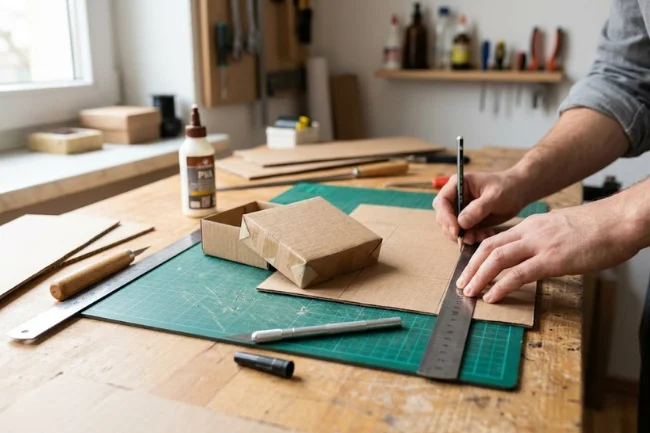
Yes. When Pappedeckel means a simple cardboard lid, it can be made with board, a ruler, a pencil, a sharp knife, a cutting mat, and a suitable adhesive.
Begin by measuring the outside length and width of the container. Add a small fitting allowance, then draw the top panel and side walls as a single net.
Score the fold lines without cutting completely through the board. Fold the walls, join the corners, and test the fit before adding decorative paper or paint.
For a round lid, cut a top disc and create the side wall from a separate strip. The strip should match the circumference of the disc, with a small overlap for joining.
Dense solid board usually produces a cleaner curved edge than corrugated board when making a small round lid. Corrugated material is more suitable when strength matters more than appearance.
Use a craft knife away from the body, replace dull blades, and protect the work surface. Children should work with age-appropriate scissors and adult supervision.
How to Use the Word Correctly
Use Pappedeckel when quoting regional speech, discussing Alemannic vocabulary, or matching the exact term used by a person, business, product, or search query.
Use Pappendeckel or Pappdeckel when you want a recognized German term for a piece of cardboard. Use Karton or Pappe when you mean the material generally.
Use Deckel aus Pappe when clarity matters and you specifically mean a paperboard or cardboard lid.
For English content, one of the following translations will usually sound more natural:
- Cardboard
- Paperboard
- Piece of cardboard
- Cardboard box
- Cardboard cover
- Cardboard lid
The surrounding context should determine which translation appears in a product description, glossary, article title, packaging specification, or translation.
Frequently Asked Questions
What is Pappedeckel in English?
Pappedeckel usually means cardboard, paperboard, a piece of cardboard, or a carton. In a packaging context, it can also mean a cardboard lid.
Is Pappedeckel a German craft?
No recognized dictionary source defines it as a traditional craft. It is mainly a regional word connected with cardboard, although cardboard lids can be decorated as craft projects.
Is Pappedeckel the same as Bierdeckel?
Not exactly. Bierdeckel means a beverage coaster, while Pappedeckel is a broader regional term for cardboard or an object made from it.
What is the correct spelling: Pappedeckel or Pappendeckel?
Pappendeckel and Pappdeckel are recognized standard forms. Pappedeckel is a regional or dialect spelling documented in Alemannic usage.
Can a Pappedeckel be recycled?
A clean, dry cardboard item is often recyclable, but food residue, wax, plastic layers, and heavy coatings may affect whether a local recycling program accepts it.
For more on words that are frequently mistranslated online, see our guides to Wollmatten and Babybelletje.
A Clearer Way to Understand Pappedeckel
Pappedeckel is best understood as a flexible regional word rather than the name of one specialized product or craft. It can point to cardboard, a piece of paperboard, a carton, or—when the sentence clearly concerns packaging—a cardboard lid.
Before buying, translating, or making one, identify the intended object and the conditions it must handle. Then select the correct term and material based on fit, strength, moisture exposure, printing, food contact, and local recycling requirements.
That small amount of context will help you avoid mistranslations, unsuitable materials, and the misleading definitions that currently surround this unusual German keyword.

Olivia Parker is a home improvement research writer with 8+ years of experience covering home design, renovation ideas, maintenance tips, and practical living solutions. She creates easy-to-follow content to help readers make informed decisions about improving their homes.