MyPipette is a name used for a precision-focused laboratory pipette intended to transfer measured amounts of liquid during research, testing, and quality-control work. A June 2026 product overview describes it as an ergonomic instrument with smooth piston movement, adjustable volume, and an easy-to-read numerical indication. In everyday terms, the aim is simple: help a laboratory worker transfer the intended volume repeatedly without unnecessary hand strain.
However, the published overview does not identify a specific manufacturer, catalogue number, verified operating range, or measured accuracy figures. Those details matter because the performance of any micropipette depends on its exact model, selected tips, calibration, liquid, and technique.
I would approach MyPipette as a potentially useful laboratory tool, not as a proven upgrade on the strength of marketing claims alone. Here is what the available information tells us, how precision pipetting actually works, and what I would verify before placing an order.
What Is MyPipette Designed to Do?
At its most basic, a laboratory pipette moves a specified volume from one container to another. The quantities can be tiny: a few microliters of reagent in a PCR tube, a measured aliquot of sample in a diagnostic assay, or a larger portion of liquid for chemical analysis.
Consistency matters because changing the liquid volume can also change a reaction’s concentration or final result.
The Microbioz India overview presents MyPipette as a solution for laboratories that need accurate liquid handling and comfortable, repetitive operation.
It mentions molecular biology, pharmaceutical development, clinical diagnostics, food testing, and quality control. These are plausible application areas for precision pipettes, but they are not evidence that every MyPipette model suits every job.
A Naming Distinction Worth Checking
Search results also include AHN’s separately branded myPette Pro manual pipettes, while Thermo Fisher Scientific offers My Pipette Creator, an application for programming compatible E1-ClipTip electronic pipettes.
Similar names do not establish that these are the same product. Before ordering anything advertised as MyPipette, I would match the maker’s name, catalogue code, and product photograph to the supplier’s quotation.
Features That Matter Beyond the Marketing Description
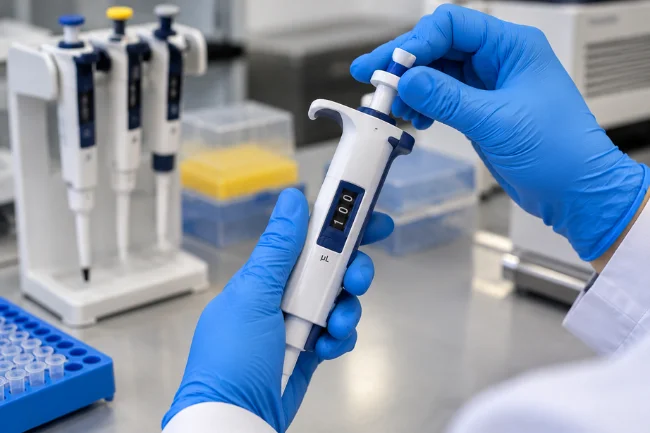
Adjustable Volume and a Readable Display
A variable-volume pipette lets the operator select the amount to aspirate and dispense within its rated range.
MyPipette’s published description mentions digital volume indication, although it does not clarify whether this means a mechanical numerical display or electronic controls. I would not assume the instrument is electronic without a model-specific specification.
A readable display helps prevent setting mistakes. A volume lock, if fitted, can also prevent accidental changes while moving between tubes.
Both features should be checked on the actual product rather than inferred from the description.
A Smooth Piston and Comfortable Grip
Piston movement affects how steadily the operator draws up and releases liquid.
A stiff plunger, awkward finger rest, or forceful tip-ejection button can become tiring during a long sample-preparation session. The MyPipette article emphasizes ergonomic construction but provides no measured operating force, weight, or user study.
When I assess ergonomic claims, I look for details that can be demonstrated: the force required to reach the first stop, the ease of tip removal, the balance in different hand sizes, and whether the volume display remains visible in a natural grip.
A short trial is more persuasive than an adjective such as “comfortable.”
Tip Fit and Durable Construction
Even a well-made pipette cannot deliver consistently if its disposable tip seals poorly.
A loose tip can leak or admit air; an excessively tight one can require unnecessary ejection force. Compatibility must be tested with the particular tips a laboratory already stocks.
The competitor article also describes reliability and longevity without identifying cleaning limits, replacement seals, chemical resistance, or service options.
I would ask for those details before treating durability as an established advantage.
MyPipette Specifications: What Can Actually Be Verified?
The main information gap is technical documentation. No credible purchasing decision should rest on an unspecified claim of “high accuracy.”
This table separates what has been stated publicly from the evidence a buyer still needs.
| Specification | Currently described for MyPipette | What to verify before use |
|---|---|---|
| Volume setting | Adjustable, with numerical indication | Minimum, maximum, and increments in µL |
| Liquid handling | Precision-focused pipetting | Air- or positive-displacement mechanism |
| Channels | Not established | Single-, 8-, or 12-channel configuration |
| Accuracy and precision | Claimed without figures | Error limits at multiple test volumes |
| Pipette tips | Compatibility not specified | Approved tip types and fit testing |
| Cleaning and service | Not established | Autoclaving instructions, spares, warranty |
| Calibration | No certificate shown | Test method, certificate, and service support |
One useful distinction is between an entire product family and one instrument.
A range listed for one model cannot be transferred to a different model simply because the names resemble each other.
For procurement, the catalogue number is the anchor that connects the quotation, manual, calibration certificate, and consumables.
Accuracy vs. Precision: The Difference a Lab Cannot Ignore
Accuracy means how close the average delivered volume is to the intended setting. Precision describes how tightly repeated deliveries agree with one another.
A pipette can be repeatable but consistently deliver too little liquid, or deliver the correct average while varying noticeably between samples.
Consider a hypothetical pipette set to 100 µL.
If five deliveries are 95, 95, 96, 95, and 94 µL, they are relatively consistent but biased low.
If deliveries vary between 95 and 105 µL yet average 100 µL, the mean is on target, but individual results are variable. These are teaching examples, not test results for MyPipette.
For real evaluation, I would request systematic error and random error values at more than one volume, along with the test conditions and pipette-tip combination.
Values near the lower end of a pipette’s range deserve special attention because small absolute differences can become large percentage errors. A single headline accuracy percentage rarely tells the whole story.
Where Could MyPipette Be Used in a Laboratory?
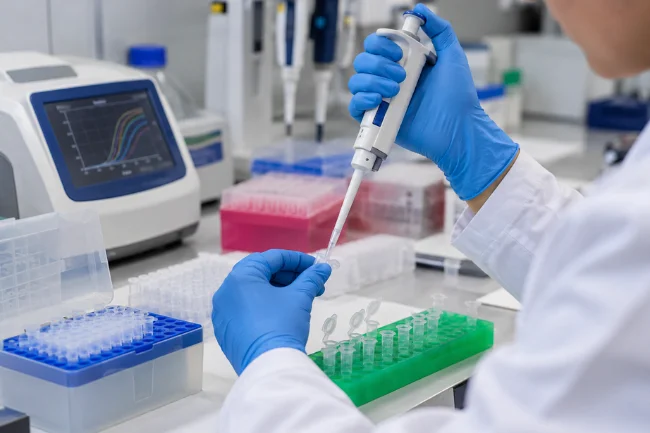
Molecular Biology and PCR Preparation
DNA and RNA workflows often involve small volumes of primers, enzymes, buffers, and templates.
Incorrect additions can change reaction composition, while contamination can compromise results.
For these tasks, tip fit, repeatable technique, and separation of clean and potentially contaminated work areas are as important as the pipette’s advertised accuracy.
Clinical and Pharmaceutical Laboratories
Diagnostic tests and drug-development assays rely on traceable procedures, trained operators, and suitable equipment.
MyPipette may be considered for sample preparation or reagent transfer, but the actual model must be qualified for the method.
A general product claim does not itself demonstrate compliance with a regulated laboratory’s quality system.
Food, Environmental, and Quality-Control Testing
A laboratory measuring contaminants, preparing dilutions, or distributing standards needs reliable volumes across many samples.
I would select a pipette range around the volumes used most frequently, then check whether the liquids are watery, viscous, foaming, or volatile.
Difficult liquids can require a different pipetting technique or a different type of instrument.
Teaching and Routine Research
For students and shared research benches, readable settings and robust controls can be especially helpful.
Clear labeling and a maintenance log also reduce the chance that a damaged or out-of-calibration pipette circulates among users.
Ease of use helps, but proper training remains essential.
How to Get More Reliable Results When Pipetting
Good equipment cannot compensate for inconsistent handling.
Thermo Fisher Scientific’s guidance on pipetting accuracy recommends pre-wetting tips, controlling temperature differences, using the appropriate immersion depth, and moving the plunger smoothly.
For a routine aqueous sample, I would follow the instrument manual and the laboratory’s procedure:
- Check that the pipette is within its calibration period and that the selected volume falls inside its rated range.
- Attach a clean, correctly fitting tip without excessive force. Pre-wet it when the method calls for this.
- Aspirate smoothly with the pipette upright, keeping the tip at an appropriate depth below the liquid surface.
- Pause consistently before withdrawing the tip; avoid droplets hanging from the outside.
- Dispense against the receiving vessel wall using the specified technique, then eject the tip into the correct waste container.
For viscous or foaming liquids, reverse pipetting may improve repeatability, but it also changes how liquid is retained and delivered.
The method should therefore be validated for the specific reagent rather than adopted automatically.
Likewise, filter tips can help protect the pipette from aerosols, but they do not replace clean technique.
Calibration, ISO Standards, and Routine Maintenance
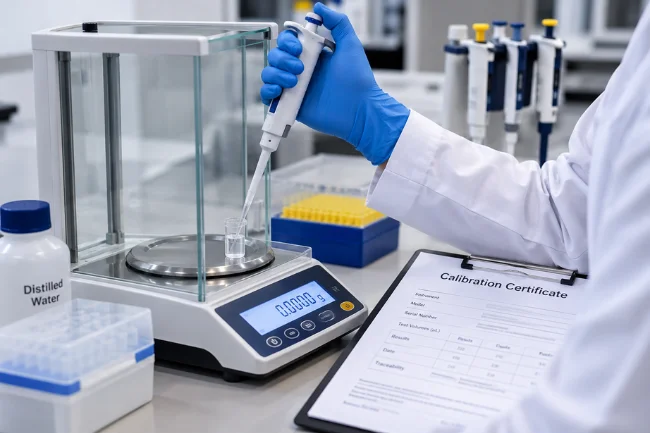
A calibration certificate is more informative than a promise of precision.
It should identify the instrument, relevant measurement conditions, test volumes, results, date, and traceability information.
The laboratory must still decide whether those results meet its own acceptance limits and intended applications.
ISO 8655-2:2022 covers metrological requirements and maximum permissible errors for piston-operated pipettes.
ISO 8655-6:2022 describes a gravimetric reference procedure for determining delivered volume.
Referencing these standards does not establish that an unnamed MyPipette model has been independently tested or certified to them.
I would set calibration intervals according to usage, risk, manufacturer guidance, and the laboratory quality system rather than claiming that every pipette needs one fixed schedule.
Heavy daily use, repairs, impacts, or failed performance checks can justify earlier verification.
Between formal checks, inspect the tip cone, seals, and piston operation.
Clean only with methods approved for the model, and confirm whether complete autoclaving, partial sterilization, or UV exposure is permitted.
An unverified cleaning claim can damage equipment just as easily as poor handling.
MyPipette vs. Other Pipetting Options
The right comparison depends on workflow rather than brand recognition.
Because the published MyPipette description lacks model-specific data, I would initially compare the described concept with established pipetting categories, not invent a numerical contest between brands.
| Option | Usually most useful for | Main consideration |
|---|---|---|
| MyPipette, as described | General precision liquid transfers | Model and performance data need confirmation |
| Manual air-displacement pipette | Routine aqueous reagents | Technique and tip fit affect delivery |
| Positive-displacement pipette | Challenging viscous or volatile liquids | Different consumables and operating costs |
| Electronic pipette | Repeated transfers and programmable tasks | Higher upfront cost, charging, service needs |
| Multichannel pipette | Microplates and parallel sample sets | Uniform performance across every channel |
I would not automatically choose an electronic instrument for every laboratory.
A well-maintained manual pipette can be practical for varied bench work, while electronic or multichannel designs become attractive when repetition and throughput justify the expense.
The deciding factor is fit for the actual protocol.
Common Problems and What They May Mean
If a pipette suddenly seems inconsistent, I would investigate the simplest causes before assuming it needs replacement.
Droplets on the tip exterior, rapid aspiration, a poorly fitted tip, or large temperature differences can alter delivered volume.
A damaged seal, blocked tip cone, or maladjusted mechanism may also be responsible.
For suspected contamination, the response should be different: remove the instrument from the clean workflow, follow the laboratory’s decontamination procedure, and replace affected consumables.
The CDC’s laboratory guidance explains how pipette-related aerosols and cross-contamination can affect diagnostic testing.
My practical rule is to separate a technique problem from an equipment problem.
Repeat a controlled check with approved tips and a trained operator.
If results remain outside the method’s acceptance limits, label the pipette out of service until it has been inspected and verified.
Is MyPipette Worth Buying? A Practical Decision Checklist
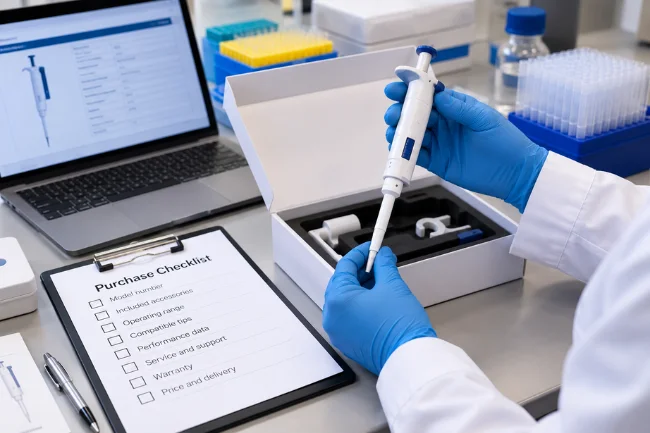
I would make the buying decision only after receiving the exact model number, manufacturer documentation, and a quotation that identifies included accessories.
Price on its own is a weak measure of value: consumable costs, calibration access, replacement parts, and downtime can easily outweigh a small initial saving.
Before approving a purchase, I would ask five questions: Does the operating range cover the work comfortably? Are the required tips readily available? Can the supplier provide performance data at the volumes I actually use? Who handles servicing locally? And can an operator test the grip and plunger before purchase?
For an Indian laboratory, I would also confirm taxes, delivery time, warranty handling, and access to calibration support in the relevant city.
These details should come from a current authorized quotation; I could not verify one universal MyPipette price from the product overview.
Frequently Asked Questions
What is MyPipette used for?
MyPipette is presented as a laboratory pipette for measured liquid transfers in research, testing, diagnostics, and quality-control workflows.
Is MyPipette a manual or electronic pipette?
The published overview mentions piston movement and numerical volume indication, but it does not establish the exact mechanism. Check the specific model’s manual.
How accurate is MyPipette?
No verified model-specific error figures were supplied in the reviewed overview. Request a performance specification and calibration results for your intended volumes.
Can MyPipette use universal pipette tips?
Tip compatibility has not been established for the product described. Confirm approved tips and test their seal before adopting them in routine work.
How often should MyPipette be calibrated?
The interval should reflect workload, risk, the manufacturer’s instructions, and the laboratory’s quality procedures—not a universal calendar rule.
Final Thoughts
MyPipette’s appeal is understandable: researchers want accurate transfers, comfortable handling, and fewer interruptions at the bench.
Yet those benefits must be demonstrated by the exact instrument being purchased.
I would start with the manufacturer’s datasheet, inspect tip compatibility, and request calibration evidence before choosing MyPipette for a critical workflow.
A little verification now is more useful than a persuasive product description later.
Disclaimer
This article is for informational and educational purposes only. Product features, specifications, accuracy, and compatibility may vary by MyPipette model and manufacturer. We have not independently tested or verified the product’s performance. Readers should consult official manufacturer documentation, calibration certificates, and authorized suppliers before making purchasing or laboratory-use decisions.

Noah Sterling is a technology research writer with 8+ years of experience covering emerging technologies, software trends, digital tools, and innovation. He creates practical, research-based articles to help readers understand the evolving technology landscape.