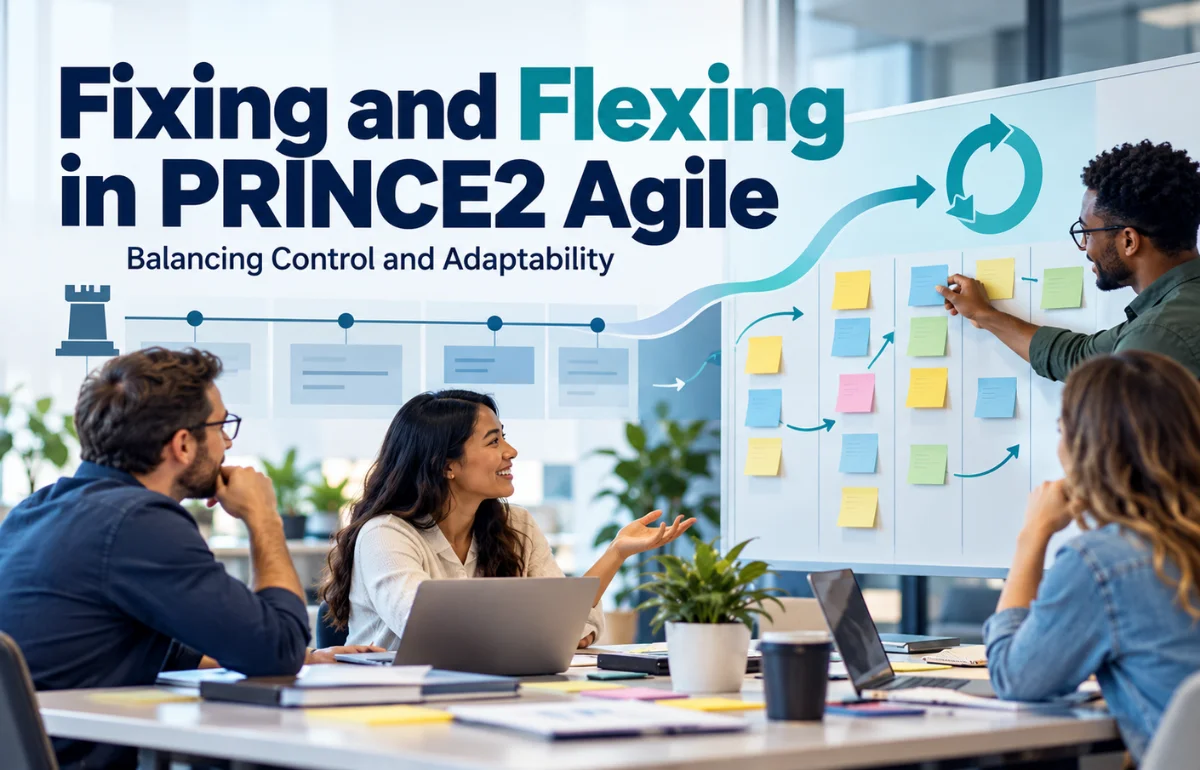
Can a project keep its deadline when the team discovers a better way to meet customer needs? This is where Fixing and Flexing become useful. PRINCE2 Agile Foundation and Practitioner (Version 2) helps professionals understand how to combine clear project commitments with the freedom to adjust delivery.
Fixing and Flexing work together. Teams agree which boundaries to protect, then decide what can change within them. This helps them respond to feedback without losing control of the project. But what should remain firm, and where can teams make choices? Let us explore the factors and benefits of Fixing and Flexing.
Fixing in PRINCE2 Agile: Creating Reliable Boundaries
Below are the meaning, factors and benefits of Fixing commitments during a project:
What Does Fixing Mean?
Fixing means agreeing which commitments the team will aim to protect. These provide a clear basis for planning and decisions. A fixed commitment is not a promise to ignore problems. If circumstances change, the team raises the issue and considers its effect before altering the agreement.
For example, a retailer may need a new ordering service before its busiest season. That date affects how the team plans the work and decides which features matter most.
Factors Teams Should Consider Fixing
- Time: Is there a launch date that matters to customers or the organisation? Agreeing it early helps the team plan a realistic amount of work.
- Cost and Capacity: How much funding and team time are available? These limits help prevent the team from accepting more work than it can complete.
- Essential Quality: What must the result do safely and reliably? An ordering service, for instance, must process orders correctly even if optional features move to a later release.
- Project Purpose: What improvement should the work achieve? A clear purpose helps the team protect the outcome while making decisions about individual features.
These factors will differ between projects. Teams should discuss them with the people making decisions, rather than assume that every target must be fixed in the same way. PRINCE2 Agile Foundation and Practitioner (Version 2) supports the skills needed to apply project control alongside agile delivery.
Benefits of Fixing
- Clearer Priorities: When the boundaries are known, the team can focus on work that fits within them and supports the project goal.
- More Realistic Plans: Agreed time, cost and capacity limits encourage honest estimates. They also make agile project planning easier to review.
- Faster Decisions: If a new request affects a firm commitment, the team knows it needs a decision instead of quietly adding the work.
- Greater Confidence: Stakeholders can see what the team is working to protect. They are less likely to be surprised by changes late in the project.
Fixing is most helpful when everyone understands the reason behind each commitment. A deadline becomes more useful when the team knows why that date matters.
Flexing in PRINCE2 Agile: Responding to What Teams Learn

Below are the meaning, factors and benefits of adjusting work within agreed project boundaries:
What Does Flexing Mean?
Flexing means changing suitable parts of the planned work as the team learns more. Users may react to an early version, a feature may take longer than expected, or a new need may become important.
Flexing gives the team a way to respond. It does not mean accepting every request. Each change should still support the project purpose and respect the commitments already agreed.
Factors Teams Can Consider When Flexing
- Feature Priorities: Which functions must be ready first, and which can wait? This is the basis of scope prioritisation.
- Delivery Order: Would completing one part sooner help users or reveal useful feedback? Teams can change the sequence of suitable work.
- Design Details: Is an early solution confusing or difficult to use? Feedback can guide improvements without changing the overall goal.
- Optional Work: If an essential feature takes longer than planned, can a lower priority feature move to a later release?
Imagine the retailer discovers that customers struggle to complete the checkout form. The team could improve that form before adding personalised suggestions. The change protects the purpose of helping customers order successfully. Professionals taking PRINCE2 Agile Foundation and Practitioner (Version 2) can learn how to make such choices within a structured project.
Benefits of Flexing
- Better Use of Feedback: Teams can learn from users and improve the result while there is still time to act.
- Greater Focus on Value: Lower priority work does not have to crowd out the features people need most.
- Less Pressure on Quality: Moving optional work can give the team time to test essential features properly.
- Improved Response to Change: Iterative delivery allows teams to review what they have built and choose the most useful work for the next cycle.
Flexing works best when decisions are visible. Teams should explain what changed, why it changed and what effect it has on the planned release. This helps stakeholders stay involved without making every small adjustment a surprise.
Conclusion
Fixing gives project teams dependable boundaries. Flexing helps them make better choices as they learn. Together, they allow a team to protect essential commitments while adjusting the work needed to deliver value. The practical step is to agree on what must stay firm, then review flexible priorities throughout delivery.
Clear conversations make both approaches work. Professionals can strengthen these skills through PRINCE2 Agile Foundation and Practitioner (Version 2) training from The Knowledge Academy, a global training provider.

Ethan Caldwell is a business research writer with 9+ years of experience covering entrepreneurship, market trends, business strategies, and industry insights. He focuses on creating clear, data-informed articles that help readers understand modern business concepts.