ImportPellet is a term used in online searches and trade discussions about importing pellets, particularly compressed wood pellets used as fuel for heating and energy production. In simple terms, it describes buying wood pellets from producers in another country and bringing them into a local market for resale or use. It is not, by itself, an internationally recognized pellet grade, customs program, or universal trading platform. A business may use a similar name, so its identity must be checked separately. For buyers, the real subject behind ImportPellet is practical: finding suitable fuel, confirming its quality, arranging safe transport, and calculating what each delivered tonne will actually cost.
Wood pellet imports can be attractive, but the cheapest quotation rarely tells the whole story. I look at quality at the point of use, not just quality at the factory gate. That distinction explains many of the decisions covered below.
What Are Wood Pellets, and Why Are They Imported?
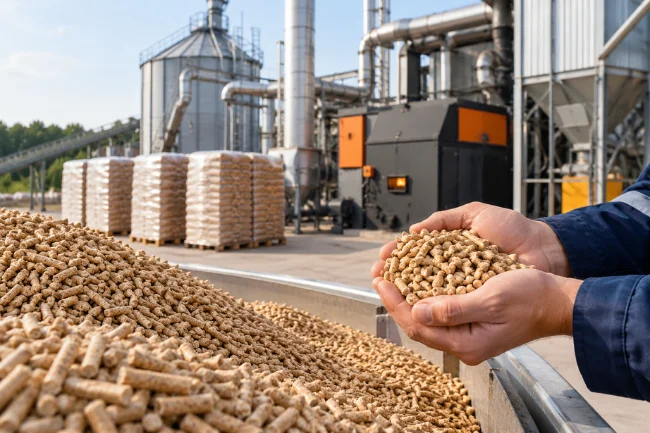
Wood pellets are small cylinders made by drying, grinding, and compressing woody material. Sawmill residues such as sawdust and shavings are common inputs, although manufacturers may also use other permitted wood feedstocks. A pellet’s compact shape makes it easier to handle in automated stoves, boilers, and some industrial energy systems.
Countries import pellets when overseas manufacturers can supply the required volume, quality, or delivery schedule more competitively than local producers. Large electricity generators may buy shiploads of biomass fuel; smaller distributors may import bags for household heating customers.
The trade is substantial rather than hypothetical. The U.S. Energy Information Administration reported 0.81 million U.S. tons of densified biomass fuel exports in December 2025 alone. That figure describes one month’s reported U.S. export sales, not global trade or a guaranteed indicator of today’s price.
What matters to a buyer is whether importing solves a supply problem. An inexpensive overseas offer may stop making sense once ocean freight, customs charges, warehouse costs, and product losses are included.
What Does ImportPellet Cover in Practice?
I find it useful to separate three activities that are often blurred together.
Buying Pellets for Direct Use
A heating company, factory, greenhouse, or power plant purchases fuel to operate its own equipment. Its priorities are dependable combustion, consistent deliveries, and fewer shutdowns. The buyer should start with the boiler or burner manufacturer’s approved fuel specifications.
Importing for Wholesale or Retail
A distributor brings in pellets for dealers, installers, or household customers. Packaging, truthful labeling, pallet strength, and seasonal demand matter alongside fuel performance. A shipment of excellent pellets in poorly protected bags can still be a commercial failure.
Acting as a Sourcing Intermediary
A broker connects manufacturers with importers but may not own the pellets. That arrangement can work, provided the contract clearly identifies the actual seller, the responsible exporter, the payment recipient, and the party handling quality claims. ImportPellet is not proof of anyone’s credentials.
Understanding Pellet Quality Before You Order
No single pellet fits every heating system. A residential stove may be sensitive to dust and ash, while a properly designed industrial boiler may accept different fuel characteristics. I would never treat the phrase “premium quality” as a substitute for numbers.
The international standard ISO 17225-2:2021 defines specifications and quality classes for graded wood pellets. The ENplus certification scheme builds on technical requirements and adds controls involving production and the supply chain.
ENplus A1, A2, and B Compared
| Fuel characteristic | ENplus A1 | ENplus A2 | ENplus B |
|---|---|---|---|
| Maximum ash, dry basis | 0.70% | 1.20% | 2.00% |
| Maximum moisture, as received | 10% | 10% | 10% |
| Minimum mechanical durability | 98.0% | 97.5% | 97.5% |
| Minimum net calorific value | 4.6 kWh/kg | 4.6 kWh/kg | 4.6 kWh/kg |
| Typical buying consideration | Small heating appliances requiring low ash | Compatible boilers tolerant of more ash | Equipment specifically suited to the grade |
These figures come from the ENplus ST 1001:2022 specification. They are thresholds, not promises that every shipment performs identically. A stove requiring A1 pellets should not be fed A2 or B simply because those products cost less.
Five Properties I Would Ask a Laboratory to Check
Moisture affects usable heat and can weaken pellets during storage. Ash determines how much residue an appliance must handle. Mechanical durability indicates how well pellets withstand movement and handling. Fines are the small fragments and dust that can interfere with feeding and create housekeeping problems. Net calorific value indicates the energy available from the fuel under specified test conditions.
Pellet diameter also matters. A standard-grade product is of little use if it cannot run through the intended feed mechanism. Put the acceptable diameter, test methods, and tolerance limits directly into the purchase contract.
Check the Certification, Not Just the Logo
A logo printed on a bag is not independent proof. The official ENplus website lets buyers check certification IDs, company status, and reported fraudulent use. I would match the supplier’s legal name and approved activities against the register before paying a deposit.
I would also request a recent test report tied to the relevant production batch. Certification and batch testing answer related but different questions: one concerns a certified operation, while the other helps assess particular goods.
How to Source Imported Pellets Without Guesswork
Start With Your Equipment and Annual Demand
Before contacting exporters, define monthly tonnage, pellet diameter, permitted ash and moisture, preferred packaging, delivery location, and storage capacity. A business using five tonnes a month does not need the same shipping arrangement as a power station.
I would also calculate a buffer for winter peaks and possible shipping delays. Buying too much too early creates inventory costs; buying too little puts heating continuity at risk.
Verify the Actual Manufacturer
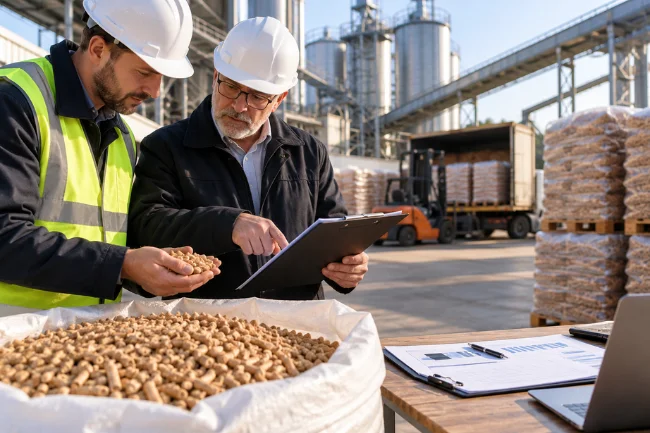
Ask whether the supplier makes pellets, represents a factory, or resells cargo from other traders. Check company registration, the factory address, production capacity, independent references, and whether banking details match the contracting entity.
A video call and photographs can help, but neither substitutes for documentary checks or an independent inspection. A surprisingly low price paired with pressure for an immediate advance payment deserves particular caution.
Agree on Samples and Acceptance Testing
A sample sent by courier may differ from the material eventually loaded. I prefer a contract that covers both pre-shipment and arrival testing, with a clear sampling method, independent laboratory, acceptable tolerances, and a remedy for failed results.
Specify whether a rejected shipment can be replaced, discounted, reprocessed, or returned. Without an agreed remedy, proving a quality problem may not solve the commercial problem.
The Real Cost of an ImportPellet Shipment
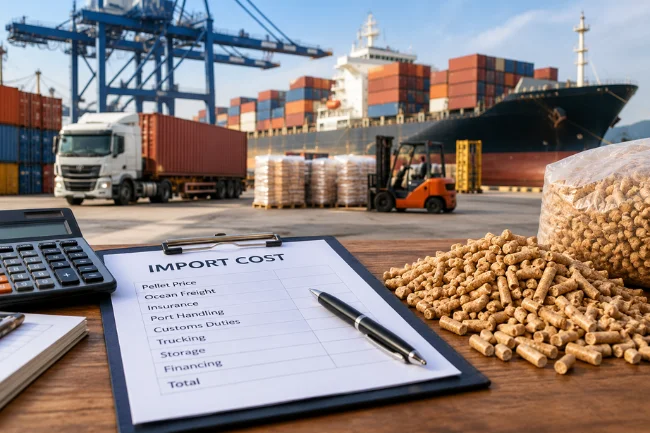
The factory quotation is only the starting point. Shipping, insurance, port handling, customs brokerage, duties, local trucking, storage, financing, and damaged material all influence the landed price.
An Illustrative Landed-Cost Calculation
| Cost item | Example cost per metric tonne |
|---|---|
| Pellet purchase price | $175 |
| Ocean freight and insurance | $48 |
| Port, documentation, and handling | $19 |
| Inland delivery and storage | $23 |
| Financing and contingency | $10 |
| Total before destination taxes and duties | $275 |
These are hypothetical numbers to demonstrate the calculation, not current market quotations. Destination taxes and duties must be added where applicable. If 3% of the shipment becomes unusable through damage or excessive fines, the $275 cost effectively rises to about $283.51 per usable tonne, even before disposal expenses.
That small adjustment is easy to miss. I use usable tonnes rather than invoice tonnes because buyers ultimately pay for fuel they can burn or sell.
Compare Cost per Unit of Useful Heat
Price per tonne can also hide a difference in energy value. For example, at 4.6 kWh/kg, one metric tonne contains approximately 4,600 kWh of net fuel energy. At a hypothetical $275 per tonne, that equals about 6.0 cents per kWh of fuel energy before boiler efficiency is considered.
If the equipment operates at 85% efficiency, the approximate fuel cost becomes 7.0 cents per kWh of delivered heat. The figures are illustrative; real efficiency and operating costs vary. This comparison is more useful than declaring one cargo cheaper based on its invoice alone.
Choosing Shipping Terms and Protecting the Cargo
Wood pellets move in bags, containers, or bulk vessels, depending on scale and infrastructure. Bagged imports may fit established retail distribution. Bulk shipments can reduce packaging demands but require suitable silos, conveyors, and discharge facilities.
Under Incoterms 2020, trade terms allocate delivery responsibilities, costs, and risks. FOB is designed for appropriate sea or inland-waterway shipments, while FCA is often more suitable when containerized goods are handed to a carrier at a terminal. CIF includes seller-arranged freight and a defined minimum level of insurance, but it does not mean the seller bears every risk until the destination port.
I would put the named port or delivery point, the Incoterms 2020 rule, insurance requirements, and the inspection process in writing. Vague promises such as “shipping included” are not precise enough for an international contract.
Moisture and Dust Are Not the Only Hazards
Wood pellets can generate carbon monoxide and reduce oxygen concentrations in enclosed storage or cargo spaces. Bulk material may also self-heat. These are genuine safety concerns, not simply quality defects.
Ships, warehouses, and storage facilities need procedures suited to the cargo and applicable regulations. Untrained people should never enter a pellet hold, silo, or confined storage area without a proper risk assessment, atmospheric testing, and authorized safety controls.
Keeping pellets dry is equally essential. Rain or condensation can cause swelling, breakage, and extra fines. I would require photos and inspection records at loading, sealing, and unloading so damage can be traced rather than argued over months later.
Customs Documents and Import Regulations
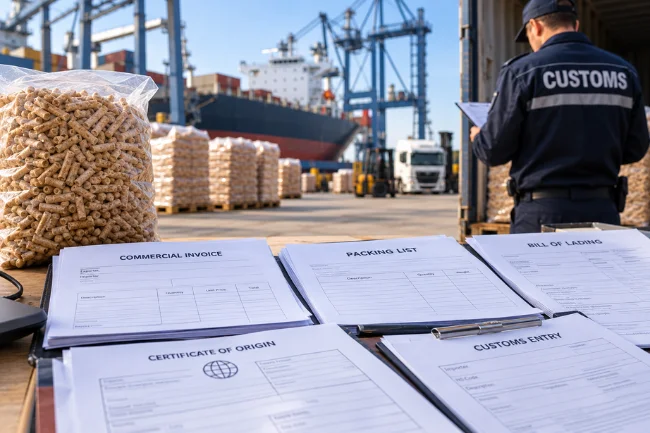
Import rules depend on the country of destination, the shipment, and how the product is classified. Wood pellets are generally identified under the international Harmonized System subheading 4401.31, but the complete tariff code and actual charges may be more specific in each jurisdiction.
Common paperwork includes a commercial invoice, packing list, transport document or bill of lading, certificate of origin where required, and customs entry. Additional inspection, phytosanitary, sustainability, or product records may apply depending on the market and circumstances.
I would ask a licensed customs broker to confirm the destination’s current classification, duties, taxes, and import controls before signing a purchase contract. Guessing based on another country’s tariff schedule is an expensive shortcut.
For European Union markets, wood-related products within the scope of the EU Deforestation Regulation require special attention. As of October 2026, the European Commission lists application dates of December 30, 2026, for large and medium operators and June 30, 2027, for most micro and small operators, with an earlier date for certain smaller businesses covered by existing timber rules. Buyers should check the precise product scope and their legal role.
Are Imported Wood Pellets Really Sustainable?
Wood pellets are often described as renewable because trees and other biomass can regrow. That does not automatically make every shipment low-carbon or environmentally responsible.
The result depends on feedstock origin, forest management, land-use changes, drying energy, manufacturing efficiency, shipping distance, and what fuel the pellets replace. Using genuine wood-processing residues may offer a different environmental profile from harvesting additional trees primarily for fuel.
I would ask exporters for traceable feedstock records and evidence supporting any sustainability claim. A certification covering fuel quality is not automatically proof of responsible forestry or a particular greenhouse-gas saving.
There is also a local angle that often gets overlooked: an imported pellet might meet every laboratory threshold yet travel farther than a suitable local alternative. The sensible comparison is not “imported versus local” in isolation, but documented emissions, consistent performance, total cost, and dependable availability.
Three Overlooked Risks That Can Change the Deal
Quality Can Deteriorate After Factory Testing
A passing factory report captures a moment in time. Multiple transfers, poor bags, and humid storage can increase fines or moisture before arrival. For serious purchases, I favor testing at both loading and delivery, with the same agreed methods.
Cash Can Be Tied Up Longer Than Expected
Deposits, production lead times, sailing schedules, customs delays, and a retailer’s payment terms may keep cash unavailable for weeks or months. A profitable order on paper can still strain a small business.
I would map the cash timeline from deposit to customer payment and include a reserve for delayed containers. This exposes financing needs before they become an emergency.
Supplier Dependence Is a Hidden Cost
A single exporter might offer attractive pricing but leave a buyer exposed to factory outages or port disruptions. I would qualify a second supplier and test its product before the busy season, rather than searching for alternatives after stocks run low.
A Practical Buying Checklist for 2026
Before approving any ImportPellet order, I would want answers to seven questions:
- Does the proposed pellet grade meet the end user’s equipment requirements?
- Is the legal supplier verified, including any claimed certification?
- Do the contract and laboratory methods define acceptance at arrival?
- Have I calculated the full landed cost and unusable-material allowance?
- Are the shipping terms, insurance, delivery point, and safety procedures clear?
- Have customs requirements and environmental obligations been checked locally?
- Can the business withstand a delayed or partially rejected shipment?
These questions do not guarantee a trouble-free transaction. They do turn vague promises into points that can be checked, priced, and enforced.
Frequently Asked Questions About ImportPellet
What does ImportPellet mean?
ImportPellet generally refers to cross-border sourcing of pellet products, especially wood pellets used for heating and biomass energy. It is not a universal certification.
Is ImportPellet a company or an online platform?
The word alone does not identify one verified company or platform. Check the exact legal business name and official records before engaging a seller.
Which wood pellet grade is best for home heating?
ENplus A1 is commonly selected for compatible domestic pellet stoves and small boilers, but the appliance manufacturer’s instructions should decide.
How much does it cost to import wood pellets?
Costs depend on pellet grade, quantity, freight, handling, destination taxes, and storage. Compare fully landed, usable-tonne costs rather than factory prices.
Can imported wood pellets be environmentally friendly?
They can have environmental advantages in some supply chains, but sustainability depends on verifiable sourcing, production emissions, transport, and end use.
Final Thoughts
ImportPellet makes the most sense as a way to understand the wood pellet import trade, not as a shortcut around supplier checks or technical requirements. A good shipment must be suitable for its equipment, economically competitive after delivery, safely handled, and supported by credible documentation.
If I were evaluating an offer today, I would request the fuel specification, independent test evidence, verified seller information, and a complete landed-cost quotation before discussing a deposit. Those four documents are a stronger starting point than any promise of a bargain.

Ethan Caldwell is a business research writer with 9+ years of experience covering entrepreneurship, market trends, business strategies, and industry insights. He focuses on creating clear, data-informed articles that help readers understand modern business concepts.