
Why Financial Artwork Is the Secret Weapon of High-Performing Home Offices
The art hanging on your walls is not decoration — it is a cognitive tool. Research in environmental psychology consistently shows that a visually intentional workspace reduces mental fatigue, sharpens attention, and reinforces professional identity. Financial artwork takes this one step further: every time your eyes drift from the screen, they land on imagery that signals ambition, discipline, and high-stakes thinking — exactly the mindset remote workers and digital marketers need to sustain through long, distraction-heavy days.
Unlike generic motivational posters, finance-themed wall art carries specific meaning. A candlestick chart print, a bull market painting, or a Wall Street skyline does not just look good — it anchors your professional context. Your brain registers the environment as a workspace rather than a living room, and that distinction matters enormously for focus. The seven ideas below walk you through every decision, from choosing the right subject to hanging the final piece at the perfect height.
Choose Financial Artwork That Reflects Your Professional Goals
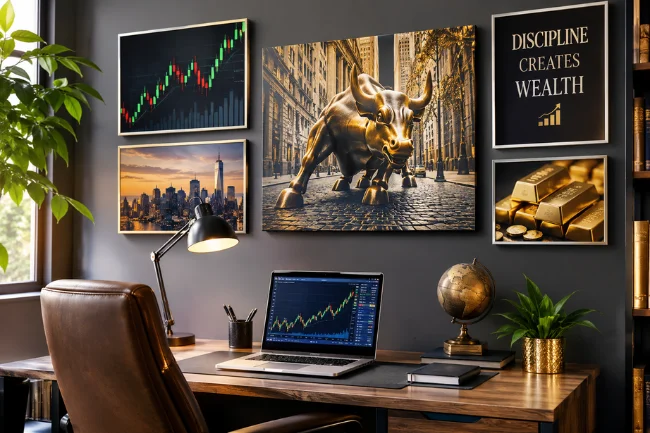
The most effective office wall art is personally meaningful — imagery you will look at a hundred times a week without tuning out. For remote workers in finance, trading, or digital marketing, the subject pool is rich.
- Stock market and trading charts: candlestick patterns, ticker tape prints, and data visualization art translate the language of your work into visual form.
- Iconic financial districts: Wall Street, the City of London, or La Défense rendered as a skyline print or architectural study communicate global ambition.
- Bull market paintings: the charging bull is one of the most recognized symbols of upward momentum in financial culture — a bold oil or acrylic interpretation commands any wall.
- Currency and wealth symbolism: gold ingot compositions, currency symbol abstracts, and coin motifs add a layer of wealth psychology to the space.
- Motivational finance quotes: typographic prints featuring maxims from legendary investors work well as secondary pieces in a gallery wall arrangement.
When browsing finance-themed office paintings, filter by subject first — pick imagery that connects directly to your sector, whether that is forex trading, investment banking, or entrepreneurship. Art you find genuinely compelling will hold its motivational charge far longer than something chosen purely for aesthetics.
Pick the Right Size of Financial Artwork for Your Office Wall
Size is the single most common mistake people make when buying wall art for a home office. A piece that is too small disappears; one that is too large overwhelms a compact room.
- The standard rule: your artwork should cover 60 to 75 percent of the available wall width above your desk or behind your chair. In practice, this translates as follows:
- Small or narrow offices: one bold statement piece in the 50×70 cm (20×28 in) range is more effective than several tiny prints scattered without structure.
- Medium walls (1.2–1.8 m wide): a single canvas at 80×120 cm strikes the right balance between presence and proportion.
- Large walls or open-plan areas: oversized financial artwork at 100×150 cm or larger creates the executive, high-stakes atmosphere associated with trading floors and corner offices.
Before ordering, tape a sheet of paper or use painter’s tape on the wall to mock up the dimensions. Measure the wall width, subtract 20–30 cm on each side, and use that figure as your maximum print width. This simple step prevents the overwhelmingly common mistake of going too small.
Select Frames That Make Your Financial Artwork Look Professional
The frame is the handshake between the artwork and the room. In a professional home office context, three options consistently work well with financial wall art:
- Black metal frames: the default choice for a modern, Wall Street-inspired aesthetic. Clean lines, zero visual noise, and they coordinate naturally with dark monitor bezels and black desk accessories.
- Natural wood frames: a warmer alternative suited to entrepreneurial or creative home offices. Light oak or walnut tones soften the intensity of high-contrast financial prints without undermining their authority.
- Frameless canvas prints: gallery-wrapped canvases with painted edges are sleek, contemporary, and ideal for minimalist setups where every element competes for attention.
The practical rule: match the frame finish to the dominant metal tone in your desk setup — monitor stand, lamp base, cable management clips. A cohesive material palette makes the entire workspace feel designed rather than assembled.
Choose Colors in Financial Artwork That Boost Focus and Motivation

Color psychology is directly relevant to productivity, and financial artwork offers a naturally disciplined palette to work with.
- Deep navy and charcoal: these tones convey authority and depth. As background colors in a stock market art print or trading floor scene, they create a sense of concentration and gravitas.
- Gold and amber accents: symbolically linked to wealth and achievement, gold details add visual energy and warmth without becoming distracting. Best used as accent tones rather than dominant fields.
- Black and white financial artwork: monochrome prints — a charcoal sketch of a trading floor, a high-contrast architectural photograph of a financial district — are timeless and reduce visual noise to a minimum, which is ideal for deep work sessions.
- Red and green (trading colors): energizing and immediately legible as finance-coded, but use them strategically. A candlestick chart print with red and green candles works brilliantly as a single accent piece, not as the dominant tone across an entire wall.
When selecting your investment-themed artwork, hold the palette against your existing office colors. A neutral office (white, grey, beige walls) accepts almost any financial print palette, while a darker room benefits from gold or amber accents to prevent the space from feeling heavy.
Where and How to Hang Financial Artwork in Your Home Office for Maximum Impact
Placement determines whether your wall art works as a productivity tool or simply occupies space. There are three proven strategies for home offices.
The Focal Wall Strategy
Identify the wall directly in your line of sight when seated at your desk, or the wall visible behind you during video calls. This is your focal wall — the single most valuable real estate in the room. Hang your primary financial artwork piece here, centered at eye level when seated, which places the center of the canvas approximately 145 cm (57 inches) from the floor for most standard desk setups.
The Gallery Wall Arrangement
For larger walls or a curated, trading-desk atmosphere, combine three to five financial prints in coordinated frames. Mix one larger anchor piece (60×80 cm) with two to four smaller supporting prints — motivational finance quotes, currency symbols, or abstract market data visualizations. Lay the arrangement on the floor first, photograph it, then transfer it to the wall.
Lighting Your Financial Artwork
A picture light mounted above the canvas or a directional LED track light angled at the artwork makes it pop both in person and on camera — a meaningful advantage for professionals who appear on video calls daily. Avoid hanging artwork directly opposite a window, where glare will wash out the image and create reflections. A side-wall placement eliminates this problem entirely while still keeping the piece within your peripheral field of vision.
7 Specific Financial Artwork Ideas to Transform Your Home Office
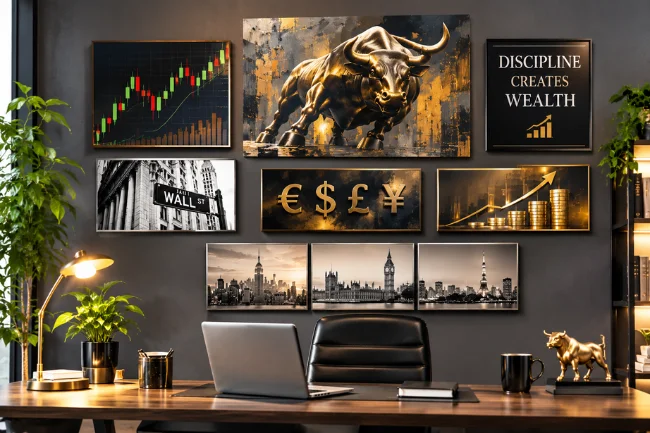
To bring everything together, here are seven concrete ideas you can act on immediately:
- 1. Oversized bull market painting — a large-format acrylic or oil rendering of the charging bull as your focal wall centerpiece.
- 2. Candlestick chart canvas print — a stylized, high-contrast print of a bullish chart pattern in navy and gold.
- 3. Wall Street skyline in black and white — a monochrome photographic or illustrated print for a timeless, distraction-free backdrop.
- 4. Abstract forex art — currency pair symbols rendered as a geometric, minimalist composition in charcoal and amber.
- 5. Motivational investment quote print — a typographic piece in a black metal frame as a secondary gallery wall element.
- 6. Gold and black wealth symbolism canvas — abstract shapes referencing coins, graphs, or upward trajectories in a premium color palette.
- 7. Financial district triptych — three coordinated prints of iconic financial skylines (New York, London, Tokyo) in matching frames for a global, executive feel.
Conclusion
A well-chosen piece of financial artwork does more than fill a blank wall — it actively shapes the cognitive environment in which you work. By matching the subject to your professional goals, sizing the piece correctly, selecting a frame that coheres with your desk setup, and hanging it at the right height on the right wall, you turn a passive surface into a daily source of focus and motivation. Start with one statement piece, get the placement right, and build from there.

Olivia Parker is a home improvement research writer with 8+ years of experience covering home design, renovation ideas, maintenance tips, and practical living solutions. She creates easy-to-follow content to help readers make informed decisions about improving their homes.