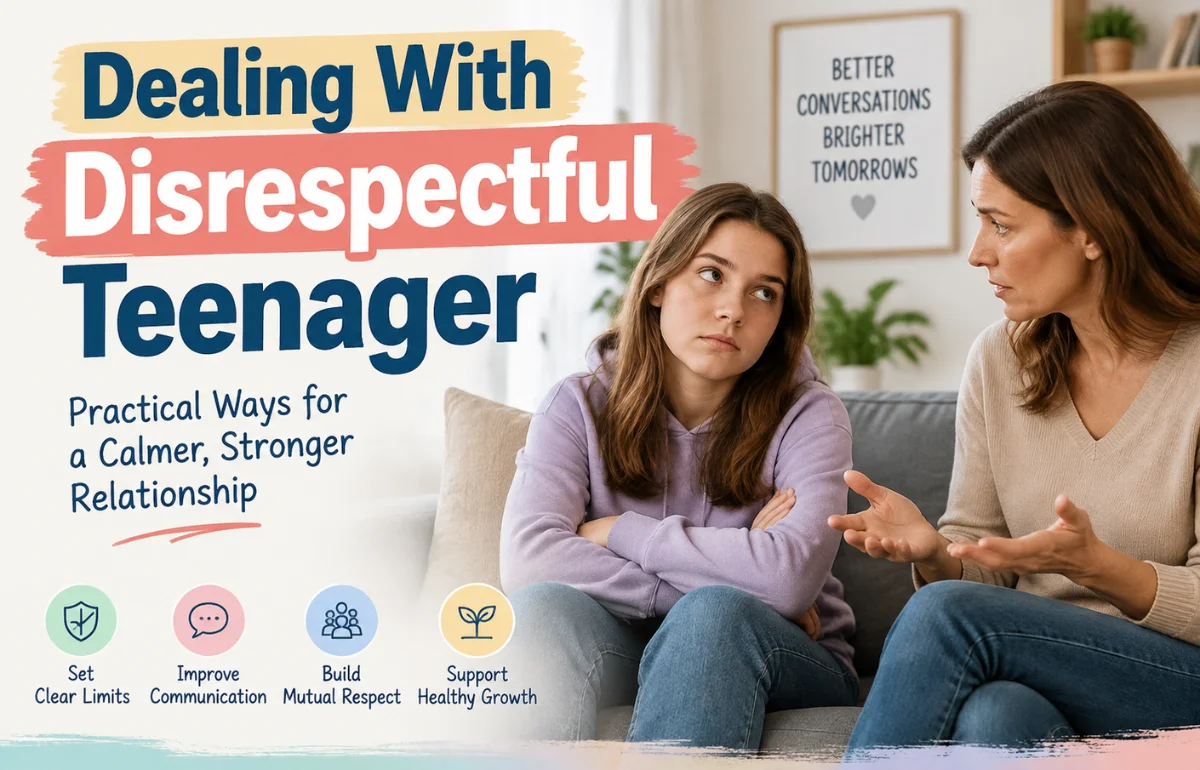
Dealing with disrespectful teenager behavior means responding to hurtful words, broken agreements, or hostile actions with clear limits while helping your teen communicate more responsibly. It involves listening to the underlying concern, addressing the specific behavior, and following through fairly. Disagreement, privacy, and growing independence are not automatically signs of disrespect.
A teenager can question your decision without insulting you. You can understand their anger without accepting threats or humiliation. The aim is to teach respectful disagreement while keeping the relationship safe enough for honest conversation.
I would start by asking what actually happened. “My teenager is disrespectful” could mean an eye roll, repeated name-calling, or physical intimidation. Those situations need different responses, and treating them alike can turn a manageable disagreement into a daily power struggle.
What Counts as Disrespect, and What Does Not?
Before choosing a consequence, describe the behavior without judging your teenager’s character. “You called me an idiot” is specific. “You have a terrible attitude” leaves both of you arguing about a label.
The Raising Children Network explains that adolescents are developing independent ideas and learning to manage disagreement. It suggests focusing on behavior rather than personality and not reacting to every shrug or bored expression.
I would use the following distinctions when deciding what needs attention:
| Situation | What it may mean | A proportionate response |
|---|---|---|
| “I disagree with that rule.” | An attempt to have a say | Hear the argument and explain your reasoning. |
| Requesting time alone | A need for privacy or space | Agree on when to reconnect. |
| An eye roll while completing a task | Frustration expressed poorly | Consider addressing it briefly later. |
| Repeated personal insults | A communication boundary being crossed | Stop the exchange and arrange a calmer restart. |
| Missing an agreed responsibility | An accountability problem | Check what happened and agree on follow-through. |
| Threats, hitting, or blocking an exit | A safety concern | Prioritize safety and seek appropriate support. |
Households differ in their expectations around language and manners. Make those expectations explicit, but leave room for a teenager to say no, express discomfort, and challenge an idea respectfully.
Why Teenagers Become Rude or Argumentative

Understanding the cause helps you choose a response. It does not remove your teen’s responsibility for what they do.
Independence Changes the Parent-Teen Relationship
Rules that worked at eight may need revisiting at fifteen. Your teenager may want more control over friendships, clothing, schedules, and how they spend free time.
The CDC describes adolescence as a shift from directing much of a child’s life toward supporting independent thinking and decision-making. Your role remains significant, but the balance changes.
I would separate negotiable choices from genuine safety requirements. A different haircut and an unsafe ride home do not belong in the same argument about obedience.
Stress May Be Hiding Behind the Response
Rudeness can sometimes accompany stress, sadness, or anxiety, according to the Raising Children Network. A sharp answer does not reveal the cause on its own.
Rather than announcing, “You’re always rude after school,” try asking later, “What is the hardest part of getting home right now?” The answer may concern schoolwork, friendship trouble, or simply wanting a short break before questions begin.
Do not assume you have solved the problem because one explanation sounds plausible. Ask, listen, and notice whether changing the situation actually helps.
The Argument May Have Become Predictable
Look at the whole exchange: you remind, your teen snaps, you lecture, they shout, and the original task disappears beneath the conflict.
I would write down the sequence once, including my suggested adult response, rather than recording only the teenager’s worst sentence. This is a practical reflection exercise, not a diagnosis or a way to assign equal blame.
The question is simple: which part can the parent change without abandoning the expectation? One clear reminder and a planned check-in may be more workable than repeated comments from the doorway.
How to Respond in the Moment
When a conversation starts becoming hostile, you do not have to settle the entire issue immediately. Your first task is to prevent further harm and keep the discussion recoverable.
Pause Before Answering the Insult
The CDC recommends pausing before reacting and returning to difficult conversations when you can respond calmly. A pause might mean taking a breath, getting water, or briefly moving to another space when it is safe.
I would avoid replying with a verdict about your teen’s future: “Nobody will ever put up with you.” Address what is happening now.
Try: “I will discuss the rule. I won’t continue while we’re calling each other names.” Keep your voice conversational rather than delivering the sentence as a threat.
Set a Return Time
“We’ll talk later” can become an unresolved argument that follows everyone through the evening. Offer a specific return point instead.
For example: “Let’s pause and try again after dinner.” If either person is still too upset, agree on another realistic time and follow through.
A pause should make discussion possible, not become days of silence used as punishment. Continue necessary communication about transport, meals, school, and safety.
Address the Message and the Delivery Separately
Imagine your teenager says, “You’re so controlling. You never let me see anyone.”
There are two issues: the personal accusation and the request for more freedom. I would address both: “Tell me what feels too restrictive without calling me names. We can discuss Saturday’s plan.”
Otherwise, the discussion can get stuck on tone while a legitimate concern goes unheard. Listening does not require agreeing to the request.
What to Say When Your Teen Talks Back
These sample responses are starting points, not scripts to recite mechanically. Adjust them to your teenager’s age and the situation.
| What your teenager says or does | A response that can escalate things | A clearer response |
|---|---|---|
| “You don’t understand anything.” | “I understand more than you ever will.” | “Tell me what I’m missing without insulting me.” |
| “Leave me alone.” | “You don’t get privacy in my house.” | “You can have some space. Let’s check in after dinner.” |
| Refuses an agreed chore | “You’re lazy and ungrateful.” | “The bins are still your job. What is your plan to finish?” |
| Swears directly at you | Swearing back | “I’m willing to listen, but not to be sworn at.” |
| “Everyone else’s parents allow it.” | “Then go live with them.” | “Explain the plan, who will be there, and how you’ll get home.” |
Avoid turning these responses into a contest over the last word. You have communicated the boundary; repeating it ten times is unlikely to make it clearer.
If your teenager corrects a fact, acknowledge it. “You’re right, you did text” can coexist with a separate discussion about missing the agreed return time.
Set Rules Your Teen Can Actually Understand
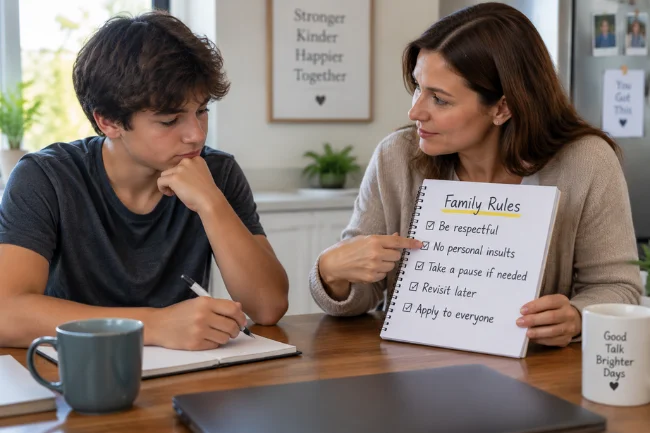
“Be respectful” is a principle, but it is not a complete household agreement. Define what it looks like in daily life.
The CDC recommends involving teenagers in setting expectations, being consistent, and updating expectations as they gain experience. Participation gives them a voice; it does not require parents to approve unsafe choices.
For example, a family agreement might say: no personal insults, either person may request a pause, and unfinished disagreements are revisited at an agreed time.
Make the rule apply to adults too. If sarcasm and public embarrassment are unacceptable for your teenager, they should not become your tools for enforcing the rule.
I would also ask, “What could I do that would make this conversation easier?” You might hear an uncomfortable but useful answer, such as not raising a problem in front of friends.
For families with younger children, clear limits also matter during toddler tantrums, although expectations and responses should suit the child’s age.
Choose Consequences That Teach Responsibility
A consequence should make the connection between an action and its outcome understandable. It should also be realistic enough that you can follow through without constant confrontation.
The American Academy of Pediatrics recommends clear limits and consistent consequences, while advising against physical punishment and shaming. Basic needs should never become bargaining tools.
Connect the Response to What Happened
If your teen damages something, discuss a reasonable contribution to repair or replacement. If they repeatedly misuse a shared device, a specific restriction on that use may fit better than removing every activity they enjoy.
Do not automatically confiscate a phone because the argument happened near one. First ask whether phone use was actually part of the problem.
For example, sending abusive messages and speaking irritably about homework are different behaviors. The same punishment does not become appropriate simply because it is convenient.
Explain When the Restriction Ends
“Until I trust you again” gives a teenager no clear way forward. I would specify what needs to happen and when you will review the arrangement.
An illustrative agreement might be: “For the next two outings, we will confirm the pickup time beforehand. After that, we’ll review how it went.” This keeps the response tied to the missed arrangement rather than to the teenager’s personality.
Preserve access needed for education, healthcare, emergency contact, and supportive relationships. A reasonable boundary should not leave a young person without a safe way to ask for help.
Rebuild Cooperation Outside Arguments
If every conversation concerns grades, mess, or behavior, there is little room left for connection. Make time together that is not a disguised review of what your teen did wrong.
The CDC encourages regular shared activities and empathetic listening. That might mean preparing food, taking a walk, or watching something your teenager chooses.
I would offer an invitation without demanding enthusiasm: “I’m making lunch if you’d like to join me.” A short conversation still counts.
Notice respectful disagreement when it happens. “You explained why you wanted a later time without insulting anyone” identifies a useful skill. The CDC recommends describing the specific behavior you appreciate, rather than relying only on broad praise.
Avoid adding, “Why can’t you always be like this?” That turns recognition into another criticism.
When Your Teen Is Disrespectful Mainly to One Parent
Do not assume this proves they love one parent less or feel safest with the other. You need more context before deciding what the pattern means.
I would compare the situations. Who handles homework reminders? Who sets transport limits? Who is present at the most stressful time of day? Are household expectations different?
For example, a teenager may argue mainly with the parent who manages morning departures. The useful starting point is the morning routine, not a conclusion about the relationship as a whole.
If another caregiver is involved, agree privately on basic boundaries. Avoid making one parent the permanent disciplinarian while the other dismisses every concern. Equally, do not form a united front around a rule that needs reconsidering.
Ask your teen for their perspective separately from the argument. They may identify a specific interaction that both adults have overlooked.
A Practical Reset for a Repeating Argument
Here is a planning exercise I would use to make advice about dealing with disrespectful teenager behavior more concrete. It is an organizational tool, not a treatment program or a promise of results.
Choose one recurring disagreement. Write down the expectation, the exact behavior crossing the line, what each person can do differently, and when you will review it.
For a homework dispute, the expectation might be checking the school’s assignment list after a break. The boundary might be no personal insults. The parent’s change could be giving one reminder instead of questioning the teen every ten minutes.
The teenager’s contribution could be choosing a check-in time and explaining any obstacle before the work becomes overdue. Ask whether the task is understood before assuming the problem is refusal.
Review what happened after several attempts. Did you spend less time arguing? Did either person request a pause before shouting? Was the task completed, or did a practical barrier remain?
Do not use the notes as evidence to prosecute your teen at the next disagreement. Their purpose is to improve the arrangement. If something did not work, name it plainly and adjust the plan.
Know When You Need Outside Support
Persistent hostility deserves attention when it disrupts family life, school, friendships, or your teenager’s ability to function. A pediatrician, family doctor, or qualified adolescent mental health professional can help assess the wider picture.
NIMH recommends seeking professional help when concerning symptoms persist and interfere with daily life. Warning signs include withdrawal from usual activities, major sleep changes, substance use, self-harm, and suicidal thoughts.
Do not diagnose a teenager from rudeness alone. Tell the clinician what changed, how long it has lasted, and what you observe across settings.
If there are threats, physical violence, or immediate danger, prioritize safety over continuing the discussion. Move away when possible and seek emergency help if needed. In the United States, call or text 988 for suicide or emotional-crisis support; call 911 for immediate life-threatening danger.
Start With One Clear Change
I would begin with one behavior you can describe, one reasonable boundary, and one change to your own response. Discuss the plan when everyone is calm, then follow through without adding new punishments mid-argument.
The next useful move may be a quieter conversation, a more realistic agreement, or professional support. Choose the response that fits what is happening in your family, and review whether it is helping.
Frequently Asked Questions
How do you discipline a disrespectful teenager?
Name the specific behavior, set a clear limit, and use a proportionate consequence when needed. Explain how they can repair the situation and regain any restricted privilege.
Should I ignore my teenager’s rude behavior?
You may choose not to react to every sigh or eye roll. Address repeated insults, bullying, threats, and unsafe behavior rather than treating them as harmless attitude.
Should I take my teenager’s phone away for disrespect?
Only consider a restriction if it reasonably relates to the behavior. Make its scope and duration clear, while preserving necessary access to schoolwork, safety, and support.
Why is my teenager respectful to others but rude to me?
Expectations, timing, and relationship patterns may differ across settings. Ask what happens before the conflict rather than assuming it proves anything about their love for you.
When should I seek help for my teenager’s behavior?
Seek support for persistent hostility that disrupts daily life or accompanies major mood or behavior changes. Threats, self-harm, or physical violence need prompt attention.

Elena Whitmore is a parenting writer with 7 years of experience covering child development, family wellbeing, and everyday parenting. She translates research into practical guidance to help parents strengthen family relationships and support their children’s emotional and physical development.