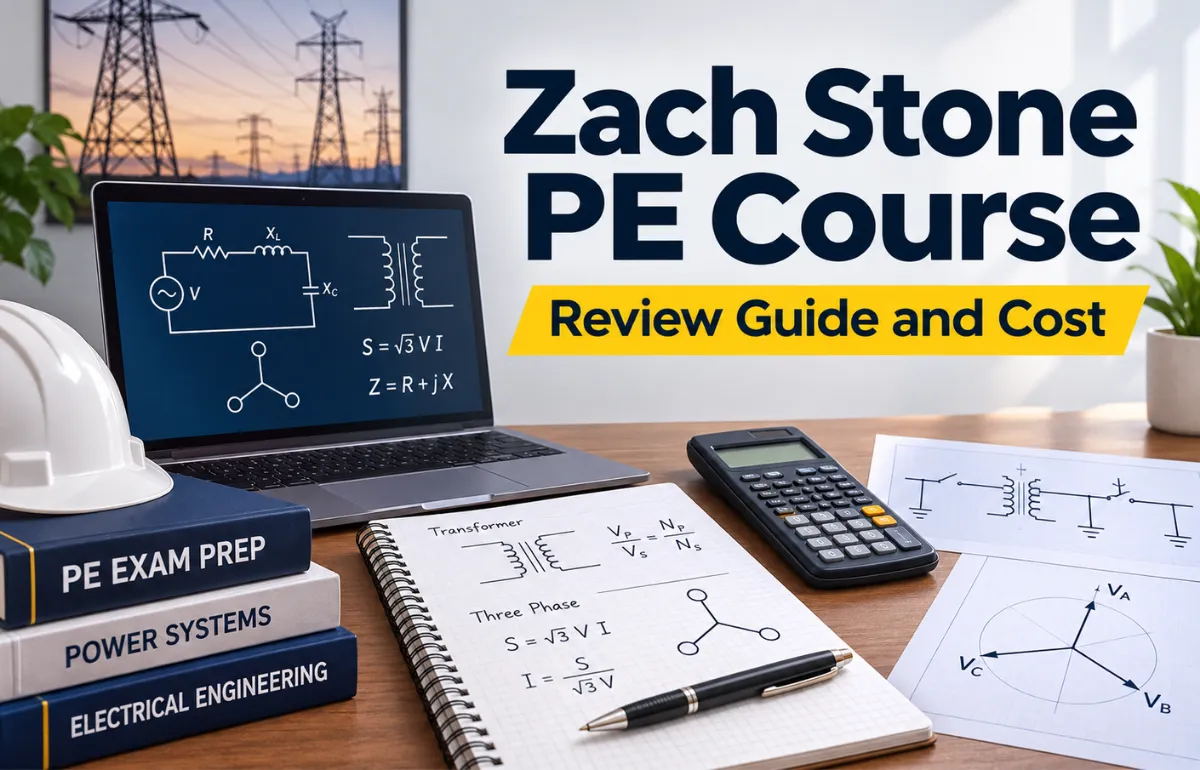
The Zach Stone PE Course is an online exam preparation program designed to help electrical engineers pass the NCEES Principles and Practice of Engineering (PE) Electrical and Computer: Power exam. Created by Zach Stone, P.E., the founder of Electrical PE Review, the program combines live instructor-led classes, recorded video lessons, practice exams, technical study materials, and online community support.
The course focuses on electrical power engineering concepts, including circuit analysis, transformers, electrical machines, power distribution, protective devices, and electrical codes.
What interests me most about this program is its emphasis on understanding engineering principles rather than simply memorizing formulas.
In this review, I examine its learning materials, pricing, advantages, limitations, student feedback, and preparation strategies to help you decide whether it deserves your time and money.
What Is the Zach Stone PE Course?
The Zach Stone PE Course is a specialized educational program for engineers preparing for the Electrical Power PE examination in the United States.
Unlike general engineering courses that cover multiple disciplines, this program concentrates on electrical power engineering and the examination requirements established by the National Council of Examiners for Engineering and Surveying (NCEES).
Students can learn through recorded lectures, interactive webinars, technical exercises, chapter assessments, and practice examinations.
I particularly appreciate the combination of structured instruction and independent learning. Working professionals can organize their preparation around employment responsibilities without relying entirely on fixed classroom schedules.
The program is available through ElectricalPEReview.com, where prospective students can also explore selected learning materials before purchasing an enrollment plan.
Who Is Zach Stone, P.E.?
Zach Stone is an electrical engineer, professional engineering exam instructor, and founder of Electrical PE Review. According to his professional biography, he is a licensed engineer in Florida with a bachelor’s degree in electrical engineering.
His engineering background includes industrial automation, electrical distribution, power generation, motor control systems, and electrical equipment maintenance.
He also has experience working with practical engineering systems in industrial and healthcare environments.
What stands out to me about his professional background is the connection between technical instruction and real engineering applications.
Understanding why a transformer behaves in a particular way, for example, can be considerably more valuable than remembering an isolated equation without knowing when to apply it.
His educational platform aims to develop that broader understanding while helping engineers prepare for examination conditions.
How Does the Electrical Power PE Exam Work?
Before evaluating any preparation course, I recommend understanding what the actual examination requires.
The NCEES Electrical Power PE exam is a computer-based examination offered throughout the year at approved testing centers.
Candidates answer 80 questions during eight hours of examination time, within a nine-hour appointment that includes administrative activities and a scheduled break.
The examination includes conventional multiple-choice questions and alternative item types that assess different forms of technical understanding.
Candidates receive authorized electronic reference materials during the examination. Personal textbooks and handwritten study notes cannot be brought into the examination room.
According to the July 2026 data published by NCEES, the Electrical Power PE exam had a 62% first-time pass rate and a 42% repeat-examinee pass rate.
These figures demonstrate why a structured preparation strategy matters, particularly for engineers returning to academic study after several years.
Key Features of the Zach Stone PE Course
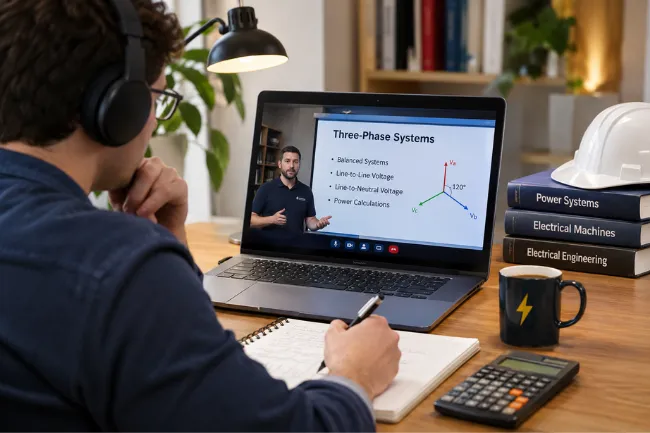
The program offers several learning resources that address different stages of examination preparation.
1. Live Instructor-Led Classes
Live webinars allow students to participate in scheduled lessons, follow technical explanations, and ask questions during instruction.
Rather than concentrating exclusively on theoretical presentations, the classes incorporate calculations, engineering examples, and problem-solving demonstrations.
The provider also offers recorded sessions for students who cannot attend live instruction.
I would recommend this format to anyone who struggles to maintain a consistent independent study routine. Having scheduled classes creates accountability and makes it easier to establish measurable weekly goals.
2. Self-Paced Video Lessons
The on-demand learning platform contains more than 200 instructional videos and over 400 practice problems, according to the official course description.
Lessons are divided into manageable topics, allowing students to concentrate on specific areas where additional preparation is needed.
An engineer who understands power distribution but struggles with electrical machines, for instance, can dedicate additional study sessions to motors and generators.
This flexibility is particularly useful for professionals balancing demanding work schedules and family commitments.
3. Electrical PE Practice Exams
Practice examinations are among the most valuable components of the program.
The available resources include:
- An 80-question technical practice examination.
- An 80-question alternative item type practice examination.
- A collection of 100 qualitative engineering questions.
- A randomized practice examination generator.
- Topic-specific exercises and chapter assessments.
These materials help students develop calculation accuracy, technical reasoning, and examination familiarity.
I suggest treating each incorrect answer as a learning opportunity rather than viewing practice scores as the sole measure of progress.
4. Power Fundamentals and Circuit Analysis Bootcamps
The program includes supplementary instruction intended to strengthen foundational electrical engineering knowledge.
These bootcamps can help candidates revisit essential principles before attempting more advanced examination problems.
This is especially useful for engineers whose professional responsibilities involve project management, supervision, or specialized technical work rather than daily engineering calculations.
A weak understanding of basic circuit relationships can create difficulties across several advanced examination topics.
5. Online Student Community
Paid enrollment includes access to an online learning community where students can discuss difficult concepts, exchange preparation strategies, and request assistance.
Having access to technical discussions can reduce the time spent struggling with unfamiliar problems independently.
I recommend attempting a problem thoroughly before requesting assistance. Understanding precisely where your reasoning failed makes the resulting explanation more valuable.
What Topics Does the Zach Stone PE Course Cover?
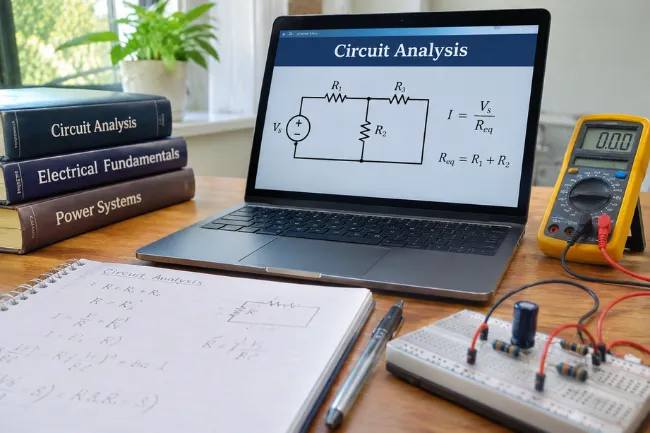
The curriculum is designed around the electrical power engineering examination specifications.
Circuit Analysis and Electrical Fundamentals
Students revisit electrical circuit relationships, alternating current systems, impedance, electrical power calculations, and three-phase circuits.
These concepts establish the foundation for more advanced power engineering problems.
Transformers and Electrical Machines
This area includes transformer operation, equivalent circuits, efficiency, motors, generators, and related calculations.
I consider these subjects particularly valuable because they require both mathematical accuracy and an understanding of physical electrical behavior.
Power Transmission and Distribution
Students explore electrical distribution networks, transmission systems, voltage relationships, power flow concepts, and electrical system performance.
These subjects are directly relevant to professionals working in utility services, industrial facilities, and electrical infrastructure development.
Protection and Fault Analysis
Protection-related instruction addresses fault current calculations, protective relays, circuit breakers, and electrical system coordination.
Understanding how protective devices respond to abnormal operating conditions can help students approach unfamiliar conceptual questions more confidently.
Electrical Codes and Standards
Preparation also involves navigating relevant electrical codes, including the National Electrical Code (NEC), and other standards specified by NCEES.
I recommend checking the official examination specifications for the applicable code editions before purchasing supplementary reference materials.
Using outdated standards can introduce unnecessary confusion during preparation.
Zach Stone PE Course Pricing in 2026
Electrical PE Review offers several enrollment options depending on the student’s budget, preferred learning format, and examination timeline.
The following prices reflect the publicly listed enrollment plans as of November 2026.
| Course feature | Free Trial | Monthly Subscription | Unlimited Package |
|---|---|---|---|
| Price | $0 | $299/month | $1,196 |
| Access duration | No stated time limit | Monthly renewal | Six months |
| Video lessons | Limited | Full access | Full access |
| Live classes | Not included | Included during live semesters | Included during live semesters |
| Class recordings | Selected samples | Current semester | Current and previous semester |
| Practice materials | Selected exercises | Full collection | Full collection |
| Retake guarantee | No | Conditional eligibility | Conditional six-month extension |
| Best suited for | Exploring the course | Shorter preparation periods | Comprehensive preparation |
Is the Monthly or Six-Month Package Better?
I would consider the monthly subscription for candidates who already possess strong technical foundations and expect to complete their preparation within two or three months.
The six-month package becomes more attractive for candidates who need additional flexibility or a longer preparation period.
Another significant difference involves access to recorded classes. Monthly subscribers may lose access to earlier semester recordings when the academic schedule resets, while the six-month package offers broader access to previous sessions.
Also, unlimited access refers to the available resources during the enrollment period, not permanent lifetime access.
I recommend reviewing the official pricing and enrollment conditions before making a payment.
Zach Stone PE Course vs. Traditional Self-Study
Purchasing an instructor-led course is not the only way to prepare for the Electrical Power PE exam.
Many engineers successfully prepare using textbooks, independent practice examinations, and official NCEES resources.
The following comparison illustrates where a structured preparation program may offer additional value.
| Comparison factor | Zach Stone’s Course | Traditional Self-Study |
|---|---|---|
| Learning structure | Organized curriculum | Individually developed |
| Instructor assistance | Available | Usually unavailable |
| Study flexibility | High | Very high |
| Preparation cost | Higher | Generally lower |
| Technical explanations | Videos and worked examples | Depends on selected books |
| Accountability | Scheduled learning opportunities | Self-managed |
| Best suited for | Candidates needing direction | Confident independent learners |
In my assessment, the biggest difference is not necessarily the availability of information. Electrical engineering principles can be studied using numerous resources.
The difference is how efficiently that information is organized, explained, and applied to examination preparation.
Advantages and Disadvantages of the Zach Stone PE Course
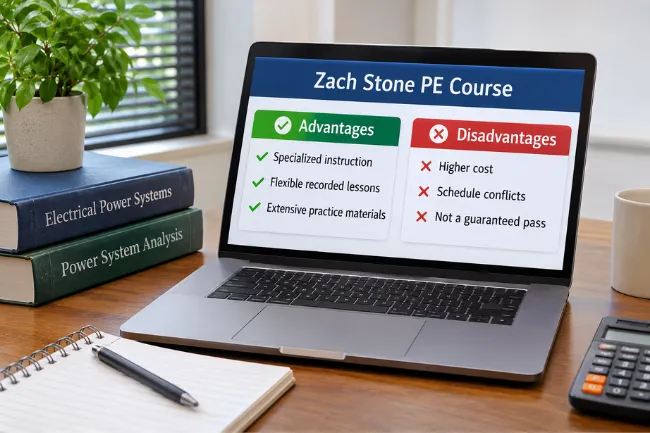
Every educational program has strengths and limitations. I would consider both before committing to a paid subscription.
Advantages
- Specialized instruction for the Electrical Power PE examination.
- Flexible recorded lessons for working professionals.
- Extensive technical and conceptual practice materials.
- Opportunities to receive assistance with challenging subjects.
- Structured preparation aligned with examination requirements.
- Free introductory resources before purchasing.
- Complimentary additional access for eligible unsuccessful candidates.
Disadvantages
- The full enrollment package requires a significant financial commitment.
- Live instruction may conflict with professional or personal schedules.
- Monthly subscribers face restrictions during semester transitions.
- The amount of available material may overwhelm candidates with limited study time.
- Completing the course does not guarantee examination success.
- Some students may benefit from additional code-focused practice resources.
The program’s value ultimately depends on how consistently students engage with its resources rather than simply how many materials they receive.
My Recommended Study Plan for Using the Course
I would organize preparation into approximately 16 weeks, although candidates with substantial knowledge gaps may need longer.
Weeks 1–4: Rebuild Technical Foundations
Begin with circuit analysis, electrical mathematics, three-phase systems, and fundamental power relationships.
Attempt the introductory exercises independently before reviewing their solutions.
Establish familiarity with the electronic NCEES reference handbook from the beginning instead of waiting until examination week.
Weeks 5–8: Develop Subject-Specific Knowledge
Move into transformers, electrical machines, transmission, distribution, and protection systems.
Alternate between recorded instruction and independent problem-solving sessions.
I recommend revisiting earlier subjects regularly so that newly acquired knowledge does not replace previously learned concepts.
Weeks 9–12: Strengthen Codes and Conceptual Reasoning
Dedicate additional attention to electrical codes, qualitative questions, and unfamiliar engineering scenarios.
Start mixing questions from different subjects rather than completing only topic-specific exercises.
Mixed practice helps reveal whether you recognize the appropriate engineering principle without being told which chapter the question belongs to.
Weeks 13–16: Simulate Examination Conditions
Complete timed practice examinations using permitted reference materials and an approved calculator.
Review errors, identify recurring weaknesses, and improve your time management.
The goal during this stage should be independent problem-solving rather than completing additional hours of passive video instruction.
Three Overlooked Strategies for Getting More Value From the Course
While reviewing the program’s structure, I identified three practical preparation strategies that could help candidates make better use of their enrollment.
Measure Independent Recall Instead of Video Completion
Watching a technical explanation creates familiarity, but familiarity does not necessarily indicate mastery.
After completing a lesson, close the solution and attempt a similar problem without assistance.
If you cannot explain why a particular equation applies, revisit the underlying principle.
This approach helps distinguish genuine understanding from temporary recognition.
Maintain a Technical Error Journal
I recommend recording mistakes according to their causes rather than simply listing incorrect answers.
Separate errors into conceptual misunderstandings, calculation mistakes, incorrect reference lookups, unit conversion problems, and misinterpreted questions.
For example, repeatedly confusing line-to-line and phase voltage suggests a specific technical weakness that requires targeted revision.
This method makes subsequent study sessions more productive.
Practice Reference Handbook Navigation
Finding the correct equation quickly can be almost as valuable as remembering it.
During practice, record the search terms that help you locate relevant formulas and reference sections efficiently.
Instead of memorizing page numbers that may change between handbook editions, develop familiarity with technical terminology and document organization.
This skill can reduce unnecessary searching under examination pressure.
What Do Student Reviews Say About the Course?
Public discussions on Reddit and the Electrical PE Review community contain numerous accounts from engineers who report passing the examination after using Zach Stone’s materials.
Common positive themes include clear explanations, organized learning resources, comprehensive practice problems, and flexible access to recorded instruction.
In one October 2026 Reddit account, an engineer reported passing on the first attempt after approximately three months of preparation, despite graduating 12 years earlier.
Other discussions include candidates who appreciated the instruction but remained unsuccessful on their first attempt or needed additional practice with electrical codes.
I view these experiences as useful insights rather than proof of a guaranteed outcome.
Individual preparation habits, professional experience, technical foundations, and examination performance all influence results.
What Is the Zach Stone PE Course Pass Rate?
I could not establish a current, independently audited course-specific pass rate from the publicly available information.
Although the provider publishes numerous student success stories, these should not be confused with verified statistical outcomes for every enrolled candidate.
The national pass rates published by NCEES represent examination populations across different preparation methods, not students from one particular course.
Electrical PE Review also offers a retake guarantee that provides additional course access to eligible candidates who do not pass.
However, eligibility requirements and examination deadlines apply. This policy does not guarantee a passing result or reimbursement of examination fees.
Who Should Enroll in This Course?
The program may be particularly suitable for electrical engineers who have been away from university for several years, professionals with limited independent study experience, and candidates preparing for another examination attempt.
It can also benefit engineers who work within a narrow technical specialty and need to rebuild their knowledge across the wider electrical power engineering curriculum.
On the other hand, candidates with strong technical knowledge, effective independent learning habits, and limited budgets may find that official practice examinations and carefully selected textbooks are sufficient.
I would start with the free materials to determine whether the instructional style matches your learning preferences.
Is the Zach Stone PE Course Worth It in 2026?
Based on my review of the curriculum, pricing, examination resources, and publicly available student feedback, I consider the program a worthwhile option for engineers who need structured Electrical Power PE preparation.
Its combination of technical instruction, conceptual exercises, recorded classes, and examination practice offers considerable educational value.
However, purchasing the program is not a substitute for disciplined preparation.
I would assess its value according to the technical weaknesses it helps resolve, the study time it saves, and the confidence it develops through independent problem-solving.
Conclusion
The Zach Stone PE Course provides a comprehensive preparation environment for electrical engineers pursuing professional licensure. Its organized curriculum, flexible learning options, technical explanations, and extensive practice materials make it a compelling alternative to unstructured self-study.
I recommend beginning with the free trial, reviewing the current NCEES examination specifications, and creating a realistic preparation schedule before choosing a paid enrollment plan.
Your ultimate objective should be developing the engineering knowledge and problem-solving ability necessary to approach the examination with confidence.
Frequently Asked Questions
1. How much does the Zach Stone PE Course cost?
The course costs $299 per month or $1,196 for six months. A limited free trial is also available.
2. Is the Zach Stone PE Course worth it?
It can be worthwhile for electrical engineers seeking structured instruction, comprehensive practice materials, and professional examination preparation support.
3. How long does it take to complete Zach Stone’s PE course?
Candidates can generally plan for three to six months of preparation, depending on their technical knowledge and available study time.
4. Does Zach Stone offer a free PE review course?
Electrical PE Review provides a free trial containing selected video lessons, sample learning modules, and more than 50 practice problems.
5. Can I pass the Electrical Power PE exam using Zach Stone’s course alone?
The program offers comprehensive preparation materials, but additional practice may be beneficial depending on your individual technical weaknesses and examination readiness.

Noah Sterling is a technology research writer with 8+ years of experience covering emerging technologies, software trends, digital tools, and innovation. He creates practical, research-based articles to help readers understand the evolving technology landscape.