

Eltive is a UK-based English-language immersion and homestay provider operating from East Sussex, England. Its name stands for English Language Total Immersion Vacation in England. Rather than teaching English only in a conventional classroom, Eltive arranges residential experiences where learners stay with English-speaking host families, attend individual or small-group lessons, and practise communication during everyday activities.
Its offerings include English family experiences for children and adults, short school placements, and educational guardianship for international pupils.
The idea is straightforward: learning continues beyond lesson time, whether someone is sharing dinner, visiting a local attraction, or talking with their host. For prospective students and parents, the practical questions are how these arrangements work, who benefits, and what should be confirmed before paying.
What Does Eltive Mean, and Where Is It Based?
The name describes the service rather than a teaching method invented by the company.
Eltive began with short residential English courses taught in the teacher’s home and later expanded into school experiences, preparation programmes, and guardianship services. Its published contact address is in Sedlescombe, near Battle and Hastings in East Sussex.
How Eltive’s English Immersion Approach Works
An English immersion course tries to increase meaningful contact with the language. Eltive combines scheduled teaching with ordinary life in an English-speaking household.
A host may also be the teacher, while other guests can come from different countries so that English becomes their shared language.
According to Eltive’s programme descriptions, small groups usually contain two to four learners, with individual tuition available on some courses.
Lessons may cover grammar and vocabulary, but conversation continues when students cook, travel, play sports, or discuss what happened during the day.
Eltive Courses and Experiences Compared
Eltive advertises several routes rather than one standard package. Here is a concise comparison based on the programme information published on its official website.
| Programme | Published duration | Formal study | Best suited to |
|---|---|---|---|
| English Family Experience for Children | 1–8 weeks | 15 hours weekly in a teacher’s home | Young learners needing speaking practice and supported activities |
| English Family Experience for Adults | 1–8 weeks | 10–20 hours weekly | Adults, couples, or families seeking tuition with cultural activities |
| English School Experience | 1–16 weeks | Five full school days each week | Students prepared to join ordinary lessons in an English school |
English Family Experience for Children
On the children’s course, learners live in a host teacher’s home and study in a small group.
Eltive says it aims to match guests by age, language ability, and interests while placing different nationalities together. It also lists afternoon activities and the possibility of a day at a local school.
This arrangement may appeal to parents who want something more personal than a large summer camp.
Still, a parent should request the actual supervision schedule, bedroom arrangements, host details, emergency procedures, and a clear explanation of which outings are included. A small group is not automatically the right group for every child.
English Family Experience for Adults
Adult programmes combine lessons in the host teacher’s home with opportunities for social and cultural activities.
Eltive advertises 10 to 20 tuition hours per week, options for one-to-one study, and room for independent exploration. It also describes experiences for couples and families travelling together.
I see the strongest fit for adults who can tolerate a little unpredictability and are willing to initiate conversations outside the classroom.
Someone needing intensive exam coaching, specialist business English, or a fixed academic timetable should ask whether the chosen host can teach those specific goals before booking.
English School Experience
The school option is distinct from a homestay language course.
Eltive describes placements at an independent school in Sussex where international students attend ordinary subjects alongside local pupils. Lessons are conducted in English, rather than designed as beginner English-language classes.
The provider specifies approximately B1 English proficiency as a minimum for this experience.
That makes sense: understanding a history or science lesson requires more than greeting classmates. For learners below that level, Eltive suggests starting with its Family Experience or combining the two approaches if progress permits.
What a Typical Day May Look Like
For a family-experience guest, a weekday could begin with breakfast and a few hours of organised lessons.
The afternoon might involve a local excursion, sport, or another activity in which students continue speaking English. Dinner then provides a more relaxed chance to describe the day and ask questions.
This is an illustrative routine, not a guaranteed schedule. Eltive says hosts can arrange lessons and activities differently, and the exact timetable may change.
School-experience pupils follow their school’s day instead, with evenings and weekends centred on their accommodation and planned activities.
What I would watch for is the quality of conversation, not the number of attractions visited.
A twenty-minute discussion where a learner asks questions, receives feedback, and tries unfamiliar vocabulary can be more educationally useful than a long outing spent mostly listening in silence.
Why Learning in a Host Family Can Help
The main advantage of a residential English course is repeated exposure to language used for real purposes.
Learners have to explain food preferences, follow directions, negotiate plans, and understand different ways people speak. These tasks often reveal gaps that classroom exercises do not.
The British Council describes immersion as using English throughout daily activities rather than treating grammar and vocabulary as isolated drills.
That can support listening, comprehension, speaking confidence, and the ability to retrieve useful expressions in context. It does not, however, guarantee a particular exam score or fluency within a set number of weeks.
The Limits of an English-Only Environment
One detail I would not overlook is the difference between immersion and a rigid rule against using another language.
Eltive encourages students to communicate in English, but successful teaching also requires the learner to understand what is happening and feel comfortable asking for help.
A British Council discussion of English-only teaching makes a useful distinction: genuine immersion supports meaningful learning, whereas excluding a student’s other languages at all costs can create confusion.
Younger children and beginners may sometimes need clarification, reassurance, or extra visual support.
Is Eltive Suitable for Beginners, Teenagers, and Families?

There is no single answer because the courses have different expectations.
A beginner may benefit from short, supportive lessons and familiar daily routines. An intermediate teenager may be ready to combine homestay learning with a school experience. A confident adult might prefer fewer guided activities and more independent conversation.
Families should look beyond an age label.
Dietary needs, accessibility, medical arrangements, allergies, preferred room-sharing, and comfort with pets can influence whether a particular home feels suitable.
Eltive’s own handbook explains that homes differ in age, household composition, interests, and routines.
Safeguarding, Host Checks, and Accreditation
For parents, safeguarding should come before sightseeing or marketing claims.
Eltive says it checks host families and accommodation, and its published student information covers household rules, room sharing, reporting concerns, and emergency contacts.
Those are useful starting points, not a substitute for reading the current safeguarding documents.
Eltive states that it holds accreditation from the Accreditation Service for International Schools, Colleges and Universities (ASIC).
Its associated guardianship service, Eltive Safe Hands, also appears in the Association for the Education and Guardianship of International Students (AEGIS) organisation directory.
Families can check the relevant bodies’ live directories rather than relying solely on logos.
I would request written details on staff vetting, safeguarding leads, medical consent, authorised collections, transport arrangements, and how complaints are escalated.
For a minor, I would also confirm who is responsible overnight and what happens if a host family needs to change unexpectedly.
Eltive Safe Hands: Guardianship Beyond Language Courses
Eltive’s educational guardianship is a separate but related service aimed at overseas students attending UK schools.
Guardians can help coordinate practical needs, school communication, emergency support, and arrangements during school holidays, depending on the chosen package.
On its website, Eltive lists these indicative guardianship prices. They are not prices for the residential English courses and should be reconfirmed before purchase.
| Guardianship option | Advertised price | Selected published features |
|---|---|---|
| Ad Hoc | £350 per term | Initial visit and support as needed; a separate registration fee is listed |
| Full | £650 per term | Allocated guardian, two visits per term, emergency contact and holiday arrangements |
| Premium | £800 per term | Allocated guardian, six visits per term, parents’ evening attendance, emergency contact |
Prices alone do not establish which package a school will accept.
Parents should ask the school what level of guardianship it requires and obtain the precise terms, exclusions, and additional charges directly from the provider.
How Much Does an Eltive English Course Cost?
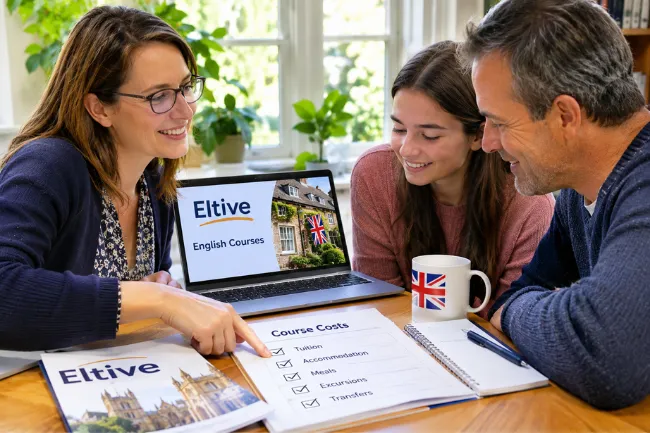
Eltive’s main course listings say “price on request” for the children’s, adults’, and school-experience programmes.
I would therefore avoid any website claiming to know a universal weekly rate without a dated quotation. Fees can vary according to course type, length, individual tuition, room requirements, transfers, and activities.
For a meaningful comparison, ask for a single written total that separates tuition, accommodation, meals, excursions, airport transfers, optional school days, and any extra one-to-one teaching.
Confirm whether admission charges and local transport are included, and whether a student must pay for unplanned personal activities.
There is another cost detail worth catching early.
Eltive’s online student handbook describes a 25% non-refundable booking deposit and later cancellation charges.
Because its handbook carries a 2023 date, I would request the latest contract and cancellation terms rather than assuming every published figure or policy remains unchanged.
Travel Documents, Insurance, and Arrival Arrangements
International visitors need to check the entry rules for their nationality, age, and exact course.
UK government guidance allows some study at accredited institutions under visitor conditions, while different arrangements apply to longer courses and certain students.
A school’s invitation or confirmation of enrolment does not itself guarantee permission to enter the country.
I recommend using the current GOV.UK visa guidance, not relying on an older student handbook for passport rules.
For minors, also clarify parental consent, who will meet the traveller, and how an unaccompanied-minor airline service fits with the arrival plan.
Eltive advises students to arrange personal travel and medical insurance.
Check cover for cancellation, illness, personal belongings, and interrupted travel, particularly if accommodation and lessons have been paid for in advance.
Emergency contact numbers should be saved both by the student and by a parent or nominated contact.
Five Questions I Would Ask Before Enrolling
First, who exactly will teach and host the learner?
Ask for qualifications, teaching experience, household information, and an explanation of how a student is matched with that host. A warm website description cannot tell you whether personalities and learning needs will align.
Second, how is progress assessed?
I would want a baseline, a realistic target, and an end-of-stay summary.
Third, what does “included” mean in the quotation?
Get exact details about weekly teaching hours, room sharing, activities, transport, and additional charges.
Fourth, what happens when something goes wrong?
Ask about illnesses, safeguarding concerns, a student feeling isolated, cancelled excursions, and a requested host change.
Fifth, what rules govern refunds and changes?
Obtain the current written policies before sending a deposit.
A Practical Way to Measure English Progress
One useful approach that is rarely explained in promotional course descriptions is to track four simple measures before, during, and after a stay.
I would record how long the learner can speak about a familiar topic, how many follow-up questions they can ask, how accurately they can explain a short instruction, and how comfortable they feel initiating conversation.
For example, a student could make a two-minute recording before travel, repeat a comparable topic after the first week, and make a final recording at home.
A teacher can add short observations about vocabulary, pronunciation, listening, and areas still requiring practice. These are informal learning indicators, not standardised test results.
Is Eltive Better Than an Ordinary Language School or Online Lessons?
I would not rank these formats without knowing the student’s needs.
Eltive may offer more everyday speaking opportunities than a conventional day school because the student lives in an English-speaking environment.
A large language college may provide broader course levels, dedicated exam preparation, and more classmates.
Online lessons remove travel costs and make consistent long-term study easier.
Eltive, Eltive ITMC, and Eletive: Are They the Same?
No. Similar search results can describe unrelated businesses.
The Eltive discussed here operates English immersion and homestay programmes in Sussex at eltive.com.
Eltive ITMC, found at gbtil.co.il, is an Israel-based corporate travel management business.
Eletive, spelled with an extra “e”, is a separate employee engagement and performance software platform.
How to Contact Eltive and Choose a Course
The provider lists its contact location as 10 Orchard Way, Sedlescombe, East Sussex, TN33 0RD, United Kingdom, and publishes an enquiry form on eltive.com.
Its listed email is louisa@eltive.com and the phone number is +44 (0)7811 326729.
When contacting the team, provide the learner’s age, current English level, goals, intended dates, desired course length, accommodation preferences, and any essential support needs.
Ask for a tailored quotation and a written outline of the intended home, teaching schedule, supervision, and payment terms before committing.
Final Thoughts on Eltive
Eltive offers a distinctive combination of English tuition, host-family living, cultural activities, and, for eligible pupils, exposure to British school life.
Its appeal is practical language use beyond the classroom, but results will depend on the host match, the student’s readiness, and the quality of support.
My suggested next move is simple: compare the published course options, request a current itemised quotation, and ask the safeguarding and learning-progress questions before paying.
That will give you a clearer basis for deciding whether this kind of English immersion is worth the investment.
Frequently Asked Questions About Eltive
What is Eltive?
Eltive is an English-language immersion and homestay provider in East Sussex, England, offering residential tuition, school experiences, and related guardianship services.
Where is Eltive located?
Eltive lists its address in Sedlescombe, East Sussex, near Battle and Hastings on England’s south coast.
Does Eltive offer English courses for adults?
Yes. Its adult family experiences advertise one-to-one or small-group tuition, with 10–20 formal lesson hours per week.
How much does an Eltive course cost?
Residential English course prices are supplied on request; ask for a current quotation covering tuition, accommodation, meals, activities, and transfers.
Is Eltive suitable for beginners?
Its family experience may suit beginners with appropriate support, but its English School Experience recommends at least B1 proficiency.

Liam Anderson is a travel research writer with 9+ years of experience covering destinations, travel planning, cultural experiences, and practical travel guides. He creates informative content to help readers discover places with better insights and preparation.