
Rare Carat is an online diamond and fine-jewelry retailer that helps shoppers compare certified diamonds, choose engagement ring settings, and buy finished jewelry. It sells both natural and lab-grown diamonds, with search filters for price, carat weight, shape, cut, color, and clarity. Although Rare Carat began as a diamond-comparison search engine, it now acts as the direct seller and merchant of record, handling payment, order fulfillment, and customer support. That distinction matters: you can compare a large selection without being passed between multiple retailers to complete your purchase.
I think its real attraction is not simply having thousands of diamonds on a screen. It’s the opportunity to understand what you’re paying for before committing to a purchase that may carry considerable financial and emotional weight. Here’s what I would check before ordering.
What Is Rare Carat, and Who Is Behind the Purchase?
Launched in 2016, Rare Carat originally positioned itself as a search tool for diamond prices. In 2021, its business evolved toward direct retail. Today, the company says it is the merchant of record for orders placed on its website, even though it sources stones through a network of diamond partners.
That arrangement combines a broad virtual inventory with one point of contact. Instead of negotiating separately with suppliers, shoppers deal with Rare Carat for checkout, shipping, returns, and service.
For me, the crucial question with any diamond marketplace is, “Who is responsible if something goes wrong?” Here, Rare Carat says that responsibility sits with its own team. That is more useful than a vague promise about finding the lowest price. Its business model and verification process are described on its website.
How Does Rare Carat Work?
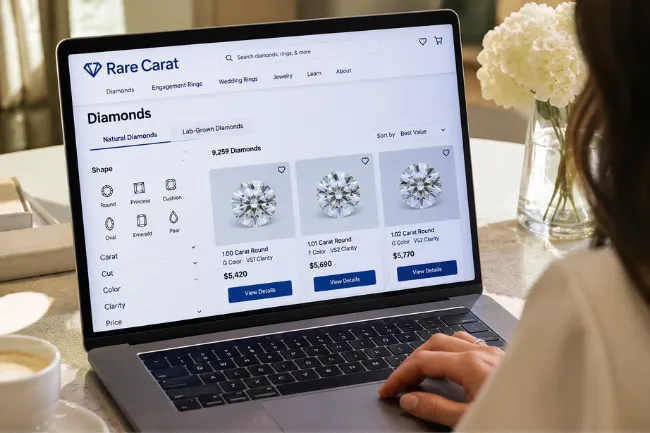
Search and compare diamonds
You begin by selecting natural or lab-grown diamonds, then narrowing the results according to your budget and preferences. Filters can include diamond shape, carat weight, color grade, clarity grade, and cut quality.
Individual listings provide specifications and, where available, magnified images or 360-degree videos.
I would save three to five promising stones rather than settle on the first high-ranking result. Diamonds that look almost identical on paper can differ in dimensions, inclusion placement, and overall appearance.
Choose a setting or buy a loose stone
You can purchase a loose diamond or pair it with an engagement ring setting. Metal choice and setting design also affect price, comfort, maintenance, and how securely a stone is held.
Rare Carat says its settings are made for the selected center stone. That means you should assess the complete ring, not just the loose diamond.
A delicate setting might look appealing online but may not suit someone whose daily routine is tough on jewelry.
Verification before delivery
After ordering, Rare Carat says the diamond goes to its facilities in New York or New Jersey. Its staff checks the laser inscription against the grading report under magnification before the stone is set or shipped.
I see this as an identity check, not a promise that every buyer will love a diamond’s sparkle. A report confirms documented characteristics; personal taste still determines whether the finished ring feels right.
Natural Diamonds vs. Lab-Grown Diamonds at Rare Carat
One of the first decisions is whether the center stone should be mined or laboratory-grown. Both are diamonds, not imitation stones.
The Gemological Institute of America explains that laboratory-grown diamonds have essentially the same chemical, physical, and optical properties as natural diamonds; their origin is what differs.
| Factor | Natural diamond | Lab-grown diamond |
|---|---|---|
| Origin | Forms through geological processes | Produced using controlled technology |
| Appearance | Diamond brilliance depends on cut and quality | Diamond brilliance also depends on cut and quality |
| Typical upfront cost | Usually higher for comparable characteristics | Usually lower for comparable characteristics |
| Main appeal | Natural origin, rarity, tradition | More size or quality within a fixed budget |
| Resale expectations | Uncertain; retail price is not guaranteed on resale | Often especially limited; do not assume meaningful resale value |
If natural origin matters deeply to the person wearing the ring, that preference is valid. If the goal is a larger, beautiful stone without overspending, lab-grown diamonds are compelling.
What I would avoid is treating either option as an investment. Jewelry is primarily a purchase for wearing and enjoying.
Resale offers can be considerably lower than retail prices, and no retailer’s original selling price guarantees what another buyer will pay later.
How to Judge Diamond Quality Without Overpaying
Rare Carat makes the traditional four Cs searchable, but knowing what those grades mean is far more valuable than simply selecting the highest numbers.
Cut: the feature I would prioritize first
Cut describes how effectively the facets interact with light. It influences brightness, flashes of color, and sparkle.
GIA’s cut guidance emphasizes proportions, symmetry, and polish, especially for round brilliant diamonds.
A well-cut diamond with slightly lower color or clarity grades may look more attractive than a poorly proportioned stone carrying impressive grades elsewhere.
For fancy shapes such as oval or emerald, I would examine video and measurements carefully because a single overall cut grade may not be available.
Color: consider the setting and your eyes
Color grades describe how close a diamond is to colorless. Higher grades generally command higher prices, but the visible differences between adjacent grades may be subtle when a stone is mounted.
Yellow or rose gold settings can make slightly warmer diamonds a practical choice. With white gold or platinum, some shoppers prefer a cooler appearance.
I would compare actual videos rather than pay automatically for a top color grade.
Clarity: look for visibility, not perfection
Clarity describes internal inclusions and external blemishes.
My practical target would be an eye-clean stone: one whose inclusions are not distracting to the naked eye at normal viewing distance.
Location matters. An inclusion near the center may be more noticeable than one partly hidden by a prong, even if the grades are similar.
Carat: weight is not face-up size
Carat measures weight, not diameter. Two one-carat diamonds can look different in size because their shapes and proportions distribute weight differently.
That’s why I would read the millimeter measurements alongside the carat figure.
A stone weighing 0.90 carat may also provide better value than a similar diamond crossing the popular one-carat threshold. I’d rather pay for a pleasing visible result than for a round number on the certificate.
Are Rare Carat Prices Competitive?
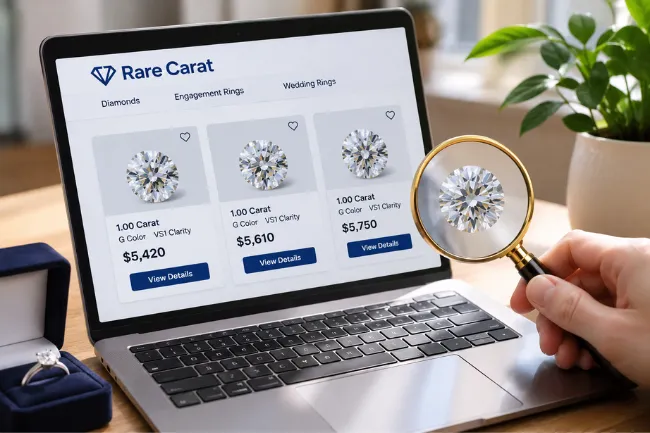
Rare Carat can be a useful place to compare diamond prices because its inventory includes stones across many quality levels.
But no online retailer is automatically cheapest for every diamond on every day. Prices can change with supplier inventory, promotions, and market conditions.
My approach is to compare the same grading report number across retailers, not merely two stones described as “one-carat, G color, VS1.”
Similar specifications do not make two diamonds identical. A matching report number gives you a much stronger basis for a direct price comparison.
How the Rare Carat price match works
Rare Carat publishes a diamond price-match policy, but it has specific conditions.
Requests must be submitted before purchase. The competing diamond must have the same grading report number, with a publicly visible US-dollar price and evidence that it is in stock.
Membership deals, clearance offers, and some promotions are excluded. Approved matches are not automatic, and price matching cannot be combined with other discounts.
Imagine finding one diamond listed at $2,400 on Rare Carat and $2,150 elsewhere. The $250 difference is worth investigating, but I would first confirm the report number, availability, and eligibility.
I would also compare each retailer’s final checkout total, not just its headline price.
One less-obvious trade-off: Rare Carat’s upgrade program excludes orders that previously received a price match.
A lower price today may therefore mean giving up a potential upgrade benefit tomorrow. I would decide which benefit actually matters before requesting the match.
Rare Carat vs. a Traditional Jewelry Store
Online diamond buying and in-store shopping solve different problems. I would compare them by the experience they provide, not assume one model wins on every measure.
| Buying consideration | Rare Carat | Traditional local jeweler |
|---|---|---|
| Comparing many stones | Extensive online filtering | Usually a smaller on-site selection |
| Seeing the ring in person before paying | Primarily digital photos, videos, and reports | Usually possible with showroom inventory |
| Advice | Remote gemologist support | Face-to-face conversations |
| Pricing | Easy to compare individual listings | May require individual quotes |
| After-sales help | Centralized support and shipping-based service | Often convenient for local visits |
| Best fit | Research-oriented shoppers comfortable online | Buyers who prioritize an in-person experience |
A local jeweler can provide reassuring hands-on guidance, while an online catalog makes it easier to compare specifications at your own pace.
Returns, Shipping, Warranty, and Resizing: Read the Details
Rare Carat advertises free insured shipping to the United States and Canada, with an adult signature required at delivery.
Its standard return window is 30 days from shipment, and returned items must meet the company’s condition and documentation requirements.
For the 2026 holiday season, its posted policy extends qualifying orders placed from November 1 through December 15, 2026, to January 15, 2027.
That deadline requires the return to reach Rare Carat, so I would verify the current wording before relying on it.
The resizing detail that can change your decision
Rare Carat offers one complimentary ring resize within the first year, subject to restrictions for certain jewelry styles.
However, its policy also states that items sent for resizing are no longer eligible for return.
I consider this one of the most practical details on the entire website.
If a ring arrives and you’re unsure about both the size and the overall design, assess whether you want to keep it before authorizing a resize. Otherwise, a fit adjustment could close your refund option.
What the lifetime warranty actually covers
Its lifetime jewelry warranty focuses on manufacturing defects. It does not broadly cover ordinary wear, loss, theft, or damage caused during use.
The company also says repairs by outside jewelers can void the warranty.
For daily-wear rings, I would separately consider insurance that covers loss or theft.
Is Rare Carat Legit? What Customer Reviews Reveal
Rare Carat is an established retailer with publicly stated policies, identifiable order responsibilities, and reviews on independent platforms.
In November 2026, its Trustpilot profile displayed a 5.0 TrustScore from more than 4,000 reviews.
Customers frequently discussed helpful service, selection, and easy ordering, while some reported concerns about product details or stones becoming loose.
I never treat an aggregate review score as proof that every order will be perfect. I look for patterns in recent feedback, especially how a company responds to delivery issues, repairs, and returns.
The sensible takeaway is that Rare Carat appears to be a legitimate buying option, but the same independent checks I would make with any expensive purchase still apply.
Who Should Consider Rare Carat—and Who Might Prefer Another Option?
I think Rare Carat suits buyers who enjoy researching diamonds, want to compare natural and lab-grown options, and appreciate having a gemologist available to answer technical questions.
It can also be useful for people who want to select a center diamond and ring setting separately.
I would lean toward a local jeweler if physically trying on several styles is the main priority, or if ongoing face-to-face service matters more than a wide digital inventory.
And for a proposal with an immovable date, I would confirm production and delivery timing before paying: ring settings can take time to make.
The company’s published shipping coverage centers on the United States and Canada, so shoppers elsewhere should not assume direct delivery is available.
My Pre-Purchase Checklist for a Better Diamond Deal
Before placing an order, I would work through a short comparison that covers value, appearance, and long-term ownership rather than getting distracted by a discount banner.
- Set a complete budget, including the center diamond, ring setting, applicable taxes, and any financing cost.
- Compare three to five stones of the same shape and similar proportions. Check their face-up measurements, not only carat weight.
- Open the grading report and confirm its number through the issuing laboratory’s official report-lookup service when available.
- Inspect the magnified video for visible inclusions, unusual darkness, and other appearance concerns; request gemologist feedback if uncertain.
- Confirm the exact price-match terms before purchasing. Decide whether a discount or future upgrade eligibility is more valuable to you.
- Read the return, resize, warranty, and insurance conditions together. Save a copy of the policies and the final order details.
Here’s my broader rule: evaluate a diamond in three layers.
The report tells you what has been graded; the images and measurements help you judge how it may look; the seller’s policies determine what happens if reality doesn’t match expectations.
A convincing purchase should make sense at all three levels.
Final Verdict: Is Rare Carat Worth Considering?
Rare Carat deserves a place on a serious diamond-shopping shortlist.
Its combination of certified diamond listings, comparison tools, remote gemologist guidance, and direct retailer accountability makes it especially useful for online research.
I wouldn’t buy simply because a listing appears to be a great deal.
Visit Rare Carat’s diamond catalog, build a shortlist, and ask for clarification on anything that affects the final decision.
Frequently Asked Questions About Rare Carat
Is Rare Carat a legitimate diamond retailer?
Yes. Rare Carat is an established online jewelry retailer that handles checkout, customer service, and fulfillment directly, with published purchasing policies.
Does Rare Carat sell real diamonds?
Yes. It sells natural diamonds and laboratory-grown diamonds, both of which are genuine diamonds; their origin differs.
Is Rare Carat cheaper than other diamond retailers?
Sometimes, but not always. Compare identical grading report numbers and final prices, and check whether a price match is eligible before ordering.
Can I return a ring bought from Rare Carat?
Its standard return period is 30 days from shipment, subject to conditions. Resized items are not eligible for return under its published policy.
Does Rare Carat ship internationally?
Rare Carat currently lists shipping to all 50 US states and Canada. Buyers in other countries should confirm whether any delivery options are available.

Ethan Caldwell is a business research writer with 9+ years of experience covering entrepreneurship, market trends, business strategies, and industry insights. He focuses on creating clear, data-informed articles that help readers understand modern business concepts.