
Amandeuce is the YouTube handle associated with InflightXperience, a channel dedicated to commercial aviation and the experience of flying as a passenger. Its videos document real airline journeys, from aircraft cabins and seating to routes, onboard service, and travel classes. If you’ve encountered the name on an older flight review or wondered whether Amandeuce and InflightXperience are different creators, they point to the same channel at youtube.com/@amandeuce.
What makes this account interesting isn’t a celebrity-style backstory. It’s the collection of journeys recorded across different airlines and years. I find the most useful way to understand Amandeuce is to look at the original videos, what their descriptions actually tell us, and where that evidence stops.
The result is a clearer picture of the creator’s work, without guessing about private details.
Amandeuce at a Glance
| Detail | Verified or qualified information |
|---|---|
| Online identity | Amandeuce |
| Public YouTube channel name | InflightXperience |
| Channel handle | @amandeuce |
| Main subject | Commercial aviation and passenger flight reports |
| Video categories | Economy-class and business-class reports |
| Documented historical coverage | Edelweiss Air in 2015; China Airlines in 2017; Virgin Atlantic in 2020 |
| Public audience estimate | Around 51,000 subscribers and 22 million views in a 2026 third-party listing; not a live count |
| Creator’s full legal name | Not independently verified |
| Where to watch | Official YouTube channel |
These facts answer the basic identity question, but they also establish a useful boundary: a public channel is not the same thing as a verified personal biography.
The videos tell us much more about the work than about the person behind the camera.
Are Amandeuce and InflightXperience the Same?
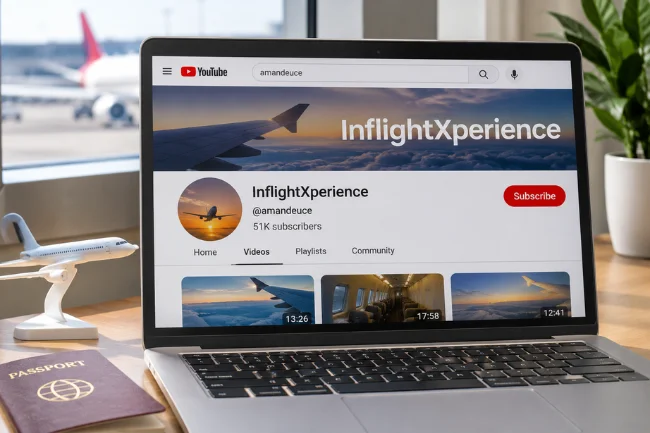
Yes. Amandeuce is the handle, while InflightXperience is the channel’s displayed name. That distinction explains why a video might carry an older username in its description even though the channel page now presents a more aviation-specific identity.
A YouTube handle works like an address. A display name works more like the sign above the door. One can remain recognizable while the other changes, and neither automatically tells us when or why a branding decision happened.
I would be cautious about articles that give an exact rebranding date or quote a reason for the change without linking to an announcement from the creator.
The name connection is easy to verify on YouTube; a detailed history of the naming decision is a different claim and needs its own evidence.
A History You Can Trace Through Flight Videos
Rather than inventing a complete career timeline, I prefer a few dated reference points that anyone can check. They show how the Amandeuce identity appeared in aviation content over time.
February 2015: Edelweiss Air and an Outside Credit
On February 8, 2015, World Airline News published an item about an Edelweiss Air Airbus A330-200 flight from Las Vegas to Zurich. It explicitly credited the video to Amandeuce.
That reference matters because it is a dated mention outside the channel itself. It confirms that the username was attached to recognizable aviation footage by early 2015, not merely repeated by recent profile websites.
February 2015: An Emirates A380 Business-Class Report
A separate Emirates video published February 20, 2015, covers the Zurich-to-Dubai leg of a wider itinerary.
The creator’s own description discusses the business-class seat, privacy, cabin amenities, food, and crew experience.
I like this example because it shows the difference between filming a plane and reviewing a passenger product. The route and aircraft identify the journey; the description adds a clearly personal assessment of one particular flight.
October 2017: China Airlines on an Airbus A350
The China Airlines business-class report, published October 5, 2017, documents travel from Singapore to Taipei. Its description comments on the experience and invites viewers to ask questions or share feedback.
That invitation makes the channel feel less like a catalogue of aircraft and more like a conversation among people who genuinely care about flying.
It also gives researchers an exact date, airline, route, and cabin class to work with.
April 2020: A Virgin Atlantic Economy-Class Journey
The Virgin Atlantic report, published April 12, 2020, identifies London Heathrow to Seattle in economy class on a Boeing 787-9.
It provides another point of comparison: a long-haul economy journey rather than a premium-cabin showcase.
What Kind of Content Does Amandeuce Make?
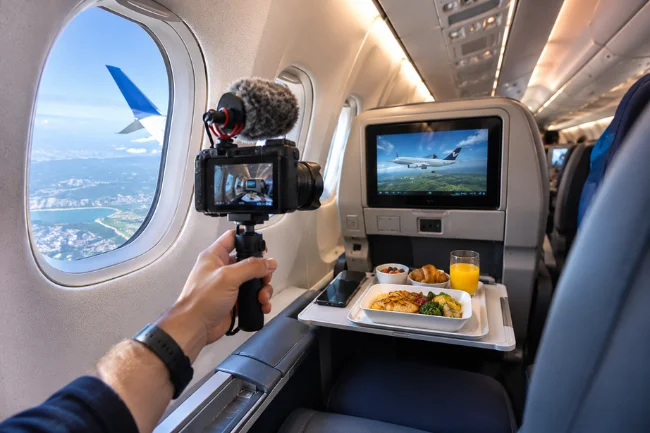
The central format is the passenger flight report. Unlike a plane-spotting video filmed from outside an airport fence, a flight report examines the journey from inside the travel experience.
Aircraft, route, seating and service all become part of the story.
The Passenger’s Point of View
A useful flight recording can show where a seat sits within a cabin, how the interior is arranged, and what a traveler might see around the aircraft.
These details are difficult to communicate with a single airline publicity photo.
The footage also preserves ordinary moments. A takeoff view, the appearance of a tray table, or the general cabin environment may seem minor, yet those are precisely the things curious passengers often want to see before flying.
Airlines, Aircraft, and Travel Classes
InflightXperience’s public video categories include business-class and economy-class reports.
The available titles range across multiple airlines and aircraft families, including Airbus wide-body jets and Boeing long-haul and short-haul aircraft.
Those distinctions are useful. A flight on an Airbus A350 is not interchangeable with a Boeing 737 journey, and even aircraft of the same type may contain different seat layouts.
An airline name alone is rarely enough to identify the cabin you’ll actually receive.
Selected Flight Reports and What They Can Tell You
I selected the following examples because their titles, dates or publication references are identifiable.
This is a small research sample, not a ranking of the channel’s best or most recent uploads.
| Flight report | Aircraft and class | Why it is worth examining |
|---|---|---|
| Edelweiss Air, Las Vegas–Zurich (2015) | Airbus A330-200; class not established by the cited news item | Dated third-party attribution to Amandeuce |
| Emirates, Zurich–Dubai (2015) | Airbus A380, business class | Creator’s first-person comments about seating and onboard service |
| China Airlines, Singapore–Taipei (2017) | Airbus A350, business class | A clearly identified regional route with premium-cabin commentary |
| Virgin Atlantic, London–Seattle (2020) | Boeing 787-9, economy class | A long-haul economy example for cabin-context research |
Notice what the table deliberately avoids. I haven’t assigned scores for cleanliness, punctuality, or seat comfort, because those would require a consistent firsthand evaluation of each recording.
A descriptive comparison is useful; a fabricated numerical ranking would not be.
If you’re new to the channel, the Emirates and Virgin Atlantic examples make an especially revealing pair.
One focuses on a premium seat and its amenities, while the other identifies a long-haul economy product. They illustrate different reasons passengers seek out aviation videos.
Economy Class Versus Business Class: What Changes?
Amandeuce’s archive makes sense to viewers with very different budgets.
Some want to see the standard cabin on an international route. Others are interested in lie-flat seats, privacy, or the small details that distinguish premium products.
For economy-class research, I focus on seat arrangement, visible legroom context, screen placement, storage, cabin lighting, and how the space feels when occupied.
A camera angle can’t prove an exact seat pitch, but it can make the layout easier to understand.
For business class, I pay attention to privacy dividers, direct aisle access, seat controls, storage, and how the service is presented.
Even here, the label “business class” isn’t a guarantee of the same seat on every route.
The fair comparison is not simply business versus economy. It’s the named airline, aircraft, cabin configuration, and date of the flight.
Leave one of those out and the conclusion can become misleading.
Small Details in the Original Descriptions That Other Profiles Miss
One of the most revealing parts of this research was looking beyond video titles.
Descriptions written by the creator sometimes contain information that a generic biography cannot provide.
A First Name Appears in a 2020 Sign-Off
The 2020 Virgin Atlantic video description ends with a sign-off using “Loris from inflightXperience.”
That’s a publicly visible way the creator introduced themselves in that context. It isn’t independent verification of a legal name, surname, age, or nationality.
This distinction matters. Saying that a description uses a first name is supported by the source.
Turning that into an elaborate biography would be speculation, and I don’t think readers benefit from it.
The Editing and Camera Equipment Were Also Disclosed
In the 2017 China Airlines video’s description, the creator listed a Sony DSC-HX90V and GoPro Hero 5 among camera equipment and said the videos were edited with iMovie.
The 2020 Virgin Atlantic description additionally listed a Canon SX740 HS as a 4K camera.
Those details are more informative than vague claims that the channel uses “professional equipment.”
They reveal specific tools the creator chose to mention at the time, although they do not establish what equipment is used now or which camera captured every shot.
To me, this is a useful lesson in assessing creator expertise: a documented production process tells us more than an unsupported label like “industry expert.”
It shows care in making and presenting aviation content, without pretending it proves airline employment or formal aviation qualifications.
Can You Trust These Videos When Booking a Flight?
Yes, for certain questions.
A flight report can be good evidence of how a particular cabin looked on a particular journey. It is much less reliable as a promise of what an airline will offer on a future ticket.
I use a simple three-date test when interpreting older airline footage.
First, identify when the flight took place, if that information is available. Second, check when the video was uploaded. Third, compare both with the date of the trip you’re actually planning.
The dates may differ. A creator can publish a report weeks or months after flying, and an airline can replace a seat design years after the footage was recorded.
A 2015 business-class review can be excellent aviation history while offering limited guidance for a 2026 booking.
Next, match the aircraft and cabin as closely as possible. Don’t assume that every Airbus A330, or every route operated by a particular airline, has an identical interior.
Airlines may use multiple configurations, and operational aircraft changes can happen.
Finally, separate observation from opinion. A video may show the seat design, food presentation, or cabin condition.
Whether the meal tasted excellent or the crew was unusually attentive is an individual assessment from one flight, not a measurable guarantee of future service.
For prices, baggage allowances, seat selection and the aircraft currently scheduled, I would always check the airline’s official booking information.
Videos supplement those details; they don’t replace them.
Why Older Aviation Footage Still Has Value
It’s tempting to call an old flight review outdated and move on. I think that misses half the appeal.
Airlines retire aircraft, replace interiors, adjust onboard service, and change route networks. Video archives preserve details that can disappear from official marketing pages.
An older Emirates A380 recording, for example, offers a snapshot of the cabin product described in its 2015 upload.
That is valuable for someone studying airline design, even if a traveler booking today needs newer material.
These recordings can also help enthusiasts compare experiences across eras.
What features did creators emphasize ten years ago? Which cabin conveniences were considered distinctive? How did video makers explain a premium seat to viewers who had never seen one?
For a current comparison, Emirates provides official Emirates A380 cabin information, while the 2015 flight report preserves an earlier passenger experience.
What Is Actually Known About the Person Behind Amandeuce?
The public evidence is strongest on the channel identity, video output and descriptions.
It is much weaker on the person’s private life. A complete legal name, birth date, family relationships, and professional credentials are not established by the sources used here.
The first-name sign-off mentioned earlier is a useful clue to how the creator presented themselves, but it doesn’t justify treating unrelated people with similar names as the same person.
Nor does appearing in a Swiss YouTube ranking prove citizenship or birthplace.
I also wouldn’t describe Amandeuce as a professional pilot without a verifiable statement or credential.
Someone can be knowledgeable about airlines, make detailed flight reports and build an audience without working in the cockpit.
Respecting that difference makes the profile more trustworthy, not less interesting.
Audience Reach and the Question of Current Activity
A 2026 SPEAKRJ listing of Swiss YouTube channels shows InflightXperience under @amandeuce at roughly 51,000 subscribers, 22 million views and 235 videos.
These are rounded figures from a third-party directory, not a live YouTube measurement or proof of present-day engagement.
For the latest activity, I recommend opening the channel’s Videos tab and sorting by newest.
Check the date on the newest public upload rather than assuming that an accessible archive means fresh videos are appearing every month.
How to Find the Most Relevant Amandeuce Video
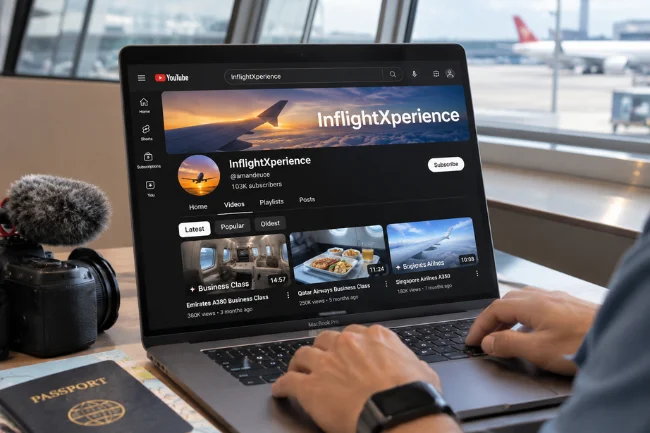
Start at the InflightXperience channel rather than an unofficial profile page.
You can browse the business-class and economy-class categories or search YouTube using the channel name alongside an airline, aircraft or route.
If you’re interested in a particular plane, use a specific phrase such as “InflightXperience A350 business class” instead of a general search for airline reviews.
If you’re preparing for a journey, add your departure or destination airport and the travel class.
I would also check the video’s description before judging it by the thumbnail.
Route information, publication dates, and the creator’s own comments often help explain what was recorded. Sometimes the description gives a better account of the experience than an enthusiastic title.
Final Thoughts
Amandeuce is best understood through InflightXperience’s identifiable aviation recordings, not an invented personal biography.
The channel connects airline enthusiasts with real flight reports, while older videos also preserve snapshots of cabin design and passenger service.
My recommendation is simple: open one of the original videos, check its date and aircraft, and read the description alongside the footage.
You’ll learn more from that evidence than from a page that confidently fills in details nobody has verified.
Frequently Asked Questions About Amandeuce
Who is Amandeuce on YouTube?
Amandeuce is the handle associated with InflightXperience, a YouTube channel featuring commercial flight reports and passenger-focused aviation videos.
Is Amandeuce the same as InflightXperience?
Yes. InflightXperience is the channel’s public display name, while @amandeuce is its YouTube handle.
What is Amandeuce’s real name?
A 2020 video description signs off with the first name Loris, but the creator’s full legal name has not been independently verified here.
Is Amandeuce a professional pilot?
No reliable public evidence reviewed for this article establishes professional pilot qualifications. The channel primarily documents flying from a passenger’s perspective.
Where can I watch Amandeuce flight reviews?
Visit youtube.com/@amandeuce and browse InflightXperience’s videos and cabin-class collections.

Liam Anderson is a travel research writer with 9+ years of experience covering destinations, travel planning, cultural experiences, and practical travel guides. He creates informative content to help readers discover places with better insights and preparation.