
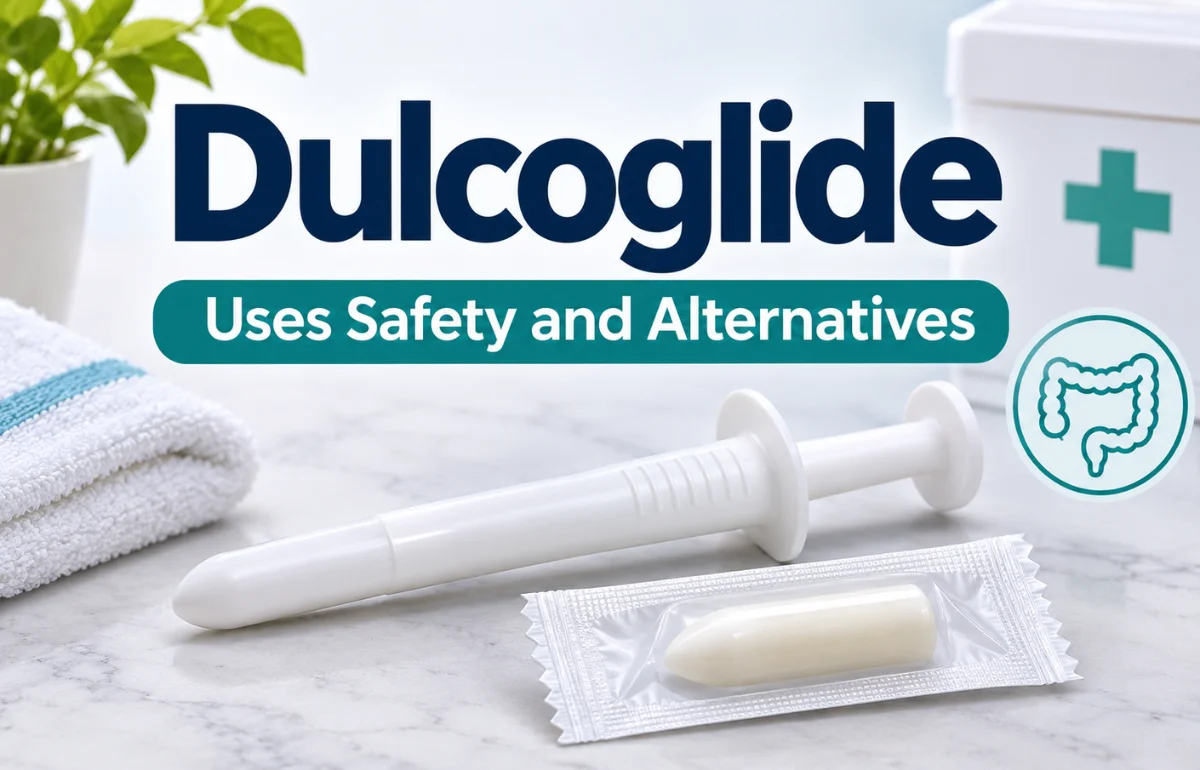
Dulcoglide is a disposable rectal suppository applicator designed to help place a compatible suppository into the rectum without pushing it in directly with a finger. It has been sold as a separate device and associated with Dulcolax suppository products. The distinction matters: Dulcoglide is an administration aid, not a laxative, and the applicator itself contains no bisacodyl or other medicine.
If you’re researching Dulcoglide, you probably want to know how it works, whether it is safe and where to find it. I separate the device from the medicine because their instructions and risks differ.
What Is Dulcoglide Used For?
Dulcoglide was developed to make rectal suppository administration more manageable. A suppository is a small, solid dose of medicine that is placed inside the rectum, where it melts or dissolves and releases its contents. Different suppositories contain different active ingredients and treat different conditions.
The Dulcoglide applicator has a barrel that holds a suitable suppository and a plunger that releases it. UK pharmacy product information describes a comfort-shaped design, individual wrapping and single-use construction. Those features tell you how it is intended to be handled; they do not prove that it is more effective or comfortable for every person.
People with limited reach or discomfort about direct insertion may ask about an applicator. But pain, restricted mobility or an existing rectal condition calls for individual advice, not an assumption that a device will help.
Is Dulcoglide the Same as Dulcolax?
No. The names are related, but they describe different things.
Dulcolax is a medicine brand that includes bisacodyl preparations for constipation. Bisacodyl is a stimulant laxative: it encourages bowel activity and helps make passing stool easier. Dulcoglide, by contrast, is the accessory used to administer a compatible rectal suppository. Historical product listings also refer to packs containing both applicators and medicated suppositories.
I check whether a listing sells the applicator, the medicine or both. A familiar brand photograph is not proof that suppositories are included.
A Quick Comparison
| Product | What it does | Contains bisacodyl? |
|---|---|---|
| Dulcoglide applicator | Holds and releases a compatible rectal suppository | No |
| Dulcolax bisacodyl suppository | Delivers a stimulant laxative through the rectum | Yes |
| Dulcolax bisacodyl tablet | Delivers a stimulant laxative by mouth | Yes |
| Combination pack, where available | Supplies medicine and an administration accessory | The suppository does; the applicator does not |
The difference affects almost every safety question. Cramps or diarrhoea, for instance, can come from bisacodyl, while discomfort from forceful insertion can arise from the administration method.
How Does the Dulcoglide Applicator Work?
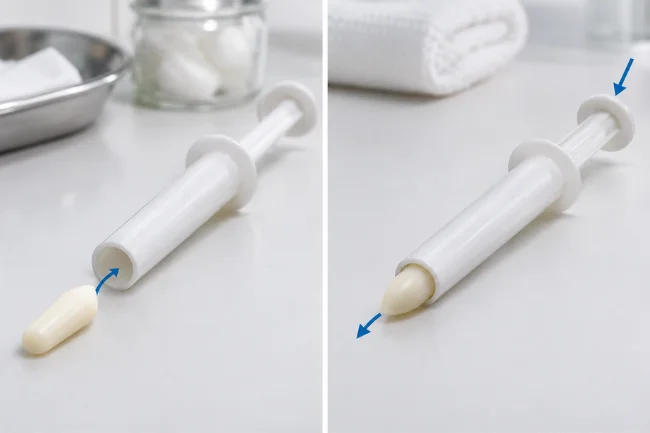
Its mechanism is mechanical rather than medicinal. An unwrapped, compatible suppository sits in the open end of the applicator barrel. The applicator is positioned as directed, and pressing the plunger releases the suppository. The applicator is then removed and discarded.
A detail easily missed is the direction in which the suppository is loaded. The historical Dulcoglide product instructions say to place its blunt end into the applicator barrel. Standard instructions for inserting certain bisacodyl suppositories by finger instead describe inserting the pointed end first. These are instructions for two different methods, not a reason to improvise. Follow the leaflet for the exact device and medicine you have.
Dulcoglide does not dissolve, increase the dose or accelerate the medicine’s action.
Before You Use an Applicator: Four Checks I Would Make
1. Confirm Compatibility
A product listing saying that an applicator can be used with “other suitable suppositories” is not permission to use it with every rectal medicine. Shape, size and manufacturer instructions matter. If the combination is not clearly supported, ask a pharmacist rather than forcing a suppository into the barrel.
2. Check the Wrapper and the Device
Use a new applicator in intact packaging. If the wrapper is open, the barrel cracked or the plunger faulty, do not attempt to repair it.
3. Read the Medicine Instructions Separately
Check the dose, age guidance, frequency and warnings. An applicator does not make an unsuitable medicine safe.
4. Choose a Comfortable, Private Setting
Have handwashing supplies and a waste bin ready. Stay near a toilet with a fast-acting laxative. Ask a healthcare professional about safe assistance if needed.
How to Use a Dulcoglide Applicator
The following explanation reflects instructions in a historical UK retail listing for the three-pack. It is not a substitute for the leaflet supplied with an actual product. If your packaging differs or you are uncertain about the technique, stop and check with a pharmacist.
Prepare and Load the Suppository
Wash your hands with soap and water. Open the single-use applicator wrapper, then remove the suppository’s separate wrapping. Place the blunt end of a compatible suppository into the open end of the barrel. The product directions say it should stop at the correct position; do not push it beyond that point.
Get Into the Recommended Position
The listed directions describe lying on your side with the lower leg straight and the upper leg bent towards your chest. Avoid painful positioning; seek advice if you cannot maintain that posture.
Insert Gently and Release
Hold the base of the barrel as described in the device instructions. Gently insert the applicator into the rectum. Once the flared tip is inside, press the plunger to release the suppository. Never force the device past resistance or continue if you experience sharp pain.
Remove and Dispose of the Device
Withdraw the applicator carefully. Discard it in household waste, never the toilet, and wash your hands. Cleaning does not make this single-use device reusable.
If there is bleeding, significant pain or difficulty removing the device, seek medical advice promptly. Do not attempt repeated insertion to “get it right.”
Dulcoglide Applicator vs Finger Insertion
An applicator is optional. Medicine leaflets commonly explain finger insertion, so I prefer comparing practical trade-offs over claiming one method suits everyone.
| Consideration | Dulcoglide-type applicator | Direct finger insertion |
|---|---|---|
| Contact with the suppository | Device holds and releases it | Finger places it directly |
| Equipment | Compatible, intact, single-use device required | Usually no separate applicator |
| Technique | Must follow the device’s loading and insertion instructions | Must follow the medicine leaflet |
| Comfort | May be preferred by some people; not guaranteed | May be simpler for others; not guaranteed |
| Waste and cost | Creates additional disposable waste and may add cost | No applicator purchase or disposal |
| Main limitation | Compatibility and safe handling must be established | May be difficult for someone with limited reach or dexterity |
Neither method should be forced. A pharmacist or nurse can advise people with limited dexterity, restricted movement or sensitive tissue.
How Long Does It Take to Work With a Bisacodyl Suppository?
If a Dulcoglide applicator delivers a bisacodyl suppository, it is the bisacodyl that stimulates a bowel movement. According to the NHS, bisacodyl suppositories usually work within 10 to 45 minutes. Bisacodyl tablets generally take 6 to 12 hours, which makes the two forms very different when planning your day.
Stay near a toilet after using a laxative suppository. The timing is a typical range, not a promise, and using an applicator has not been shown to accelerate the medicine’s effect. Do not take an extra dose just because you have not had a bowel movement as quickly as expected. Follow the leaflet or ask a pharmacist what to do next.
NHS guidance also advises against using bisacodyl every day for more than five days without medical advice. If constipation continues, the cause needs attention rather than increasingly frequent short-term treatment.
Benefits and Limitations of Dulcoglide
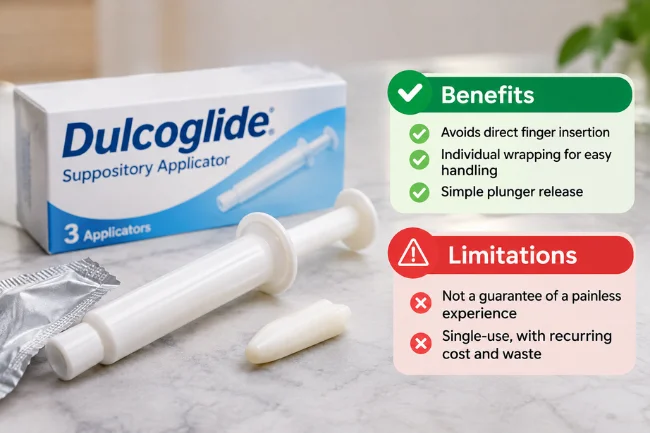
Dulcoglide avoids direct finger insertion. Individual wrapping can simplify handling, while the plunger provides a release mechanism.
Still, “comfort-shaped” is a design description, not a guarantee of a painless experience. There is no reason to assume that the device prevents irritation, works with all formulations or delivers more medicine than conventional insertion. A damaged applicator or an unsuitable suppository could create problems rather than solve them.
Single-use packaging also means recurring cost and waste. If you can comfortably use a suppository in accordance with its leaflet without extra equipment, you may not need an applicator at all. I would treat it as an administration choice, not an upgrade everyone should buy.
Safety: Separate Device Risks From Medicine Side Effects
Two different things can go wrong, and mixing them together makes advice less useful.
Risks Associated With the Applicator
Because it is inserted into sensitive tissue, incorrect positioning, excessive force or a damaged component could cause irritation or injury. Stop if there is unusual resistance, sharp pain or bleeding. The product is intended for rectal use only and must not be reused.
The UK retail instructions describe Dulcoglide as suitable for adults and children over 12 and expressly unsuitable for children under 12. That restriction belongs to the applicator itself; do not override it because a particular medicine has a different paediatric age range.
Risks Associated With Bisacodyl
Bisacodyl may cause abdominal cramps, nausea and diarrhoea. Its medicine information also discusses rectal discomfort, dehydration and the risk of fluid or electrolyte imbalance with excessive use. The NHS advises medical or pharmaceutical assessment before use in people with severe abdominal pain and vomiting, dehydration, bowel obstruction, inflammatory bowel disease or anal fissures.
Pregnancy and breastfeeding need separate consideration. NHS guidance says bisacodyl is not generally recommended during pregnancy without medical advice; it may be used during breastfeeding when needed, for the shortest suitable period. Do not rely on the safety of the plastic applicator to decide whether the medicine is appropriate.
For children, the NHS says those aged 12–17 should use bisacodyl only if a doctor or pharmacist recommends it, and younger children need a prescription. Always check the individual medicine’s age and dose instructions as well as any applicator restriction.
Get prompt medical advice for blood in the stool, persistent vomiting or troublesome side effects. Severe abdominal pain, heavy rectal bleeding or signs of a serious allergic reaction require urgent care. If symptoms are new or unexplained, treating them as routine constipation could delay the right diagnosis.
Is Dulcoglide Still Available in the UK?
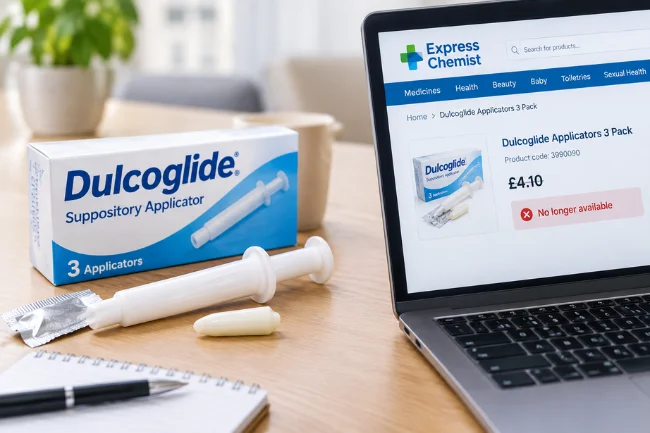
Availability is less clear than the product description. Express Chemist has a listing for a three-pack of Dulcoglide applicators, product code 3990090, with a displayed historical price of £4.10, but the page says the item is no longer available. That price should not be mistaken for a current offer, and one retailer’s status does not prove the product has been discontinued everywhere.
An outdated retailer listing cannot prove worldwide discontinuation. That would require reliable confirmation from a manufacturer or distributor.
If you are looking to buy Dulcoglide, ask a pharmacy whether it can source the original applicator or recommend a suitable alternative. Before ordering an unfamiliar product online, verify the seller, packaging, intended use, compatibility and age restrictions. A similarly shaped device is not automatically interchangeable.
What Are the Alternatives?
There are two separate questions here: “What else can help me administer a suppository?” and “What else can treat my constipation?” An alternative laxative is not the same as an alternative applicator.
| Your actual need | Option to discuss | What to check first |
|---|---|---|
| Insert an already prescribed suppository | Standard finger insertion, following its leaflet | Whether you can do so safely and comfortably |
| Need help with administration | A pharmacist-verified compatible applicator or healthcare assistance | Fit, device instructions and any physical limitations |
| Occasional constipation | Fibre, fluids, activity and improved toilet routine | Symptoms and whether self-care is appropriate |
| Medicine for constipation | Bulk-forming laxative such as ispaghula husk or osmotic laxative such as macrogol | Pharmacist advice, medical history and medicine suitability |
| Recurrent or persistent constipation | Assessment by a GP | Possible underlying causes and current medicines |
For everyday constipation, the NHS generally advises lifestyle measures first and may recommend bulk-forming or osmotic laxatives before stimulant options. A footstool that raises the knees while sitting on the toilet can also help some people with positioning, although it is not a substitute for evaluating persistent symptoms.
A mini enema is not an interchangeable applicator substitute; its contents and instructions differ.
Practical Questions Worth Asking Before You Buy
I use a simple decision test for products like this. First, am I trying to solve a medicine problem or an insertion problem? If the constipation treatment is unsuitable, a better applicator will not make it suitable. If the medicine is appropriate but insertion is difficult, administration support may be the real issue.
Next, can I verify exactly what comes in the pack and whether the device is compatible with the intended suppository? Is the packaging sealed? Do I have the correct instructions? Is the product appropriate for the user’s age and circumstances? If any answer is missing, I would pause the purchase and ask a pharmacist.
Finally, consider the pattern of symptoms. Repeated constipation, blood in the stool, unexplained weight loss, ongoing abdominal pain or a sudden change in bowel habits deserves a GP assessment. Getting that assessment is more useful than trying successive gadgets or laxatives without understanding the cause.
Final Thoughts
Dulcoglide is a single-use rectal suppository applicator, not a constipation medicine. Its appeal is practical, but safe use depends on verified compatibility, correct technique and the medicine’s own instructions. UK availability appears limited from the retailer evidence reviewed, although a universal discontinuation has not been established.
If insertion is difficult, show a pharmacist the device details and medicine packaging. Ask whether an applicator, another method or a treatment review is appropriate.
Frequently Asked Questions
Does Dulcoglide Contain a Laxative?
No. The applicator contains no active medicine; a separately supplied compatible suppository may contain a laxative such as bisacodyl.
Can Dulcoglide Be Reused After Washing?
No. The original UK product directions specify single use. Discard the applicator after use rather than cleaning and reinserting it.
Is Dulcoglide Suitable for Children?
The listed applicator is unsuitable for children under 12. The medicine has its own age rules, so ask a clinician or pharmacist before treating a child.
How Quickly Does Dulcolax Work With Dulcoglide?
Bisacodyl suppositories usually work within 10–45 minutes according to the NHS. The applicator itself does not make the medicine act faster.
Has Dulcoglide Been Discontinued in the UK?
Some UK retailers mark it unavailable, but that does not establish a complete discontinuation. A pharmacist can check current supply and suitable alternatives.
Medical Disclaimer
This article provides general information about Dulcoglide and is not a substitute for professional medical advice. Always follow the product instructions and consult a qualified healthcare professional before using a suppository or applicator, especially if you have an existing medical condition.

Claire Morgan is a health and wellness writer with 7 years of experience creating clear, research-informed content on nutrition, sleep, movement, preventive habits, and everyday wellbeing. She focuses on making reliable health information practical and easy to understand. Her articles are educational and do not replace professional medical advice.