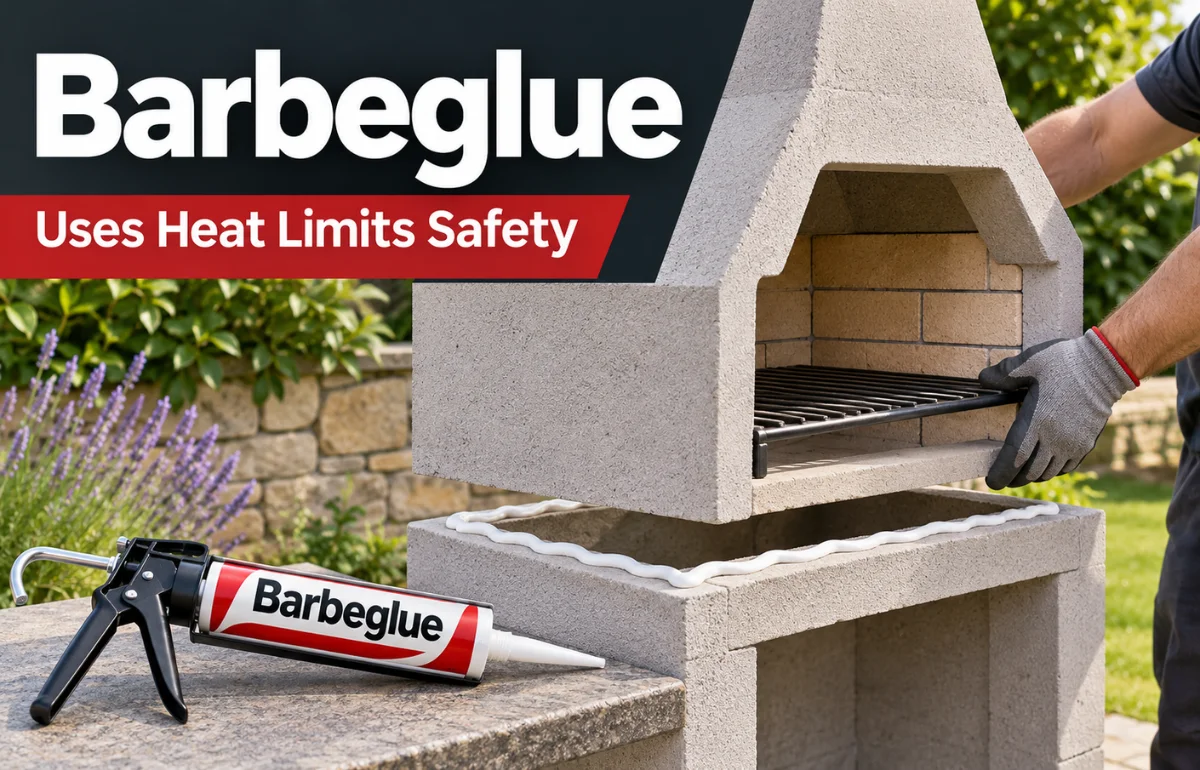
Barbeglue is a specialist adhesive used to assemble and repair certain prefabricated masonry barbecues. Sold under the Sarom Fuoco name, it bonds components such as concrete sections and suitable metal fittings while remaining flexible after curing.
The documented Barbeglue Isocoll ECO 6056 formulation is a ready-to-use, moisture-curing polymer adhesive-sealant, not ordinary silicone or fireproof cement.
That distinction matters: it is intended for specified barbecue joints, but its published temperature resistance does not make it suitable for direct flame contact.
If you’re assembling a garden barbecue or dealing with a loose section, I would start with the model’s assembly manual rather than picking an adhesive based on a “heat-resistant” label alone.
What Exactly Is Barbeglue?
Unlike the liquid glue I might use for a household repair, Barbeglue comes as a thick paste in a cartridge designed for a caulking gun.
Its job is to create a lasting bond between prepared surfaces without becoming completely rigid. This matters in an outdoor barbecue, where concrete and metal can move slightly as the weather and cooking temperatures change.
Sarom, the Italian barbecue manufacturer, specifically names Barbeglue in its assembly instructions for some of its concrete barbecue models.
The same instructions also permit suitable refractory mortar for particular assembly joints. They do not give permission to replace either material with whatever adhesive happens to be on the garage shelf.
One detail easily missed is that Barbeglue is a product name, not a universal classification. A tube described as “BBQ glue” by another seller may use different chemistry and have very different temperature limits.
How Does Barbeglue Work?
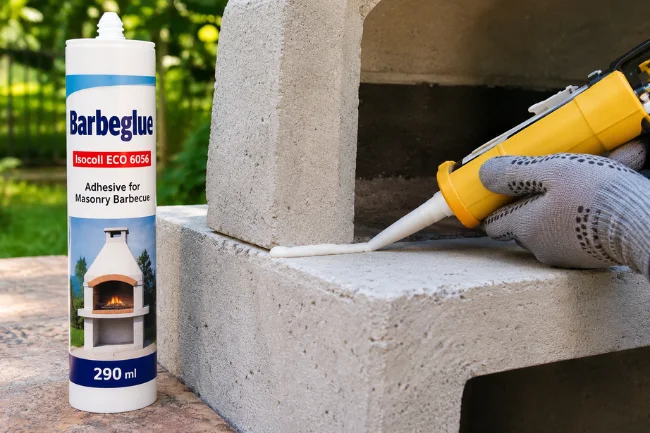
The Isocoll ECO 6056 data sheet identifies its chemistry as a one-component silyl-terminated polymer. Once squeezed from the cartridge, the adhesive reacts with moisture in the air and develops an elastic bond. There is no separate hardener to mix.
Think of the finished joint as firm enough to hold compatible surfaces together but capable of accommodating some small movement.
That flexibility helps accommodate movement, but it does not turn the product into structural reinforcement or make it a repair solution for a dangerously cracked firebox.
The same technical sheet describes the material as solvent-free and isocyanate-free, with UV and weathering resistance.
It can also be painted after curing, subject to paint compatibility. Those are useful outdoor properties, although the barbecue’s concrete surfaces may still require their own protective finish.
Barbeglue Technical Specifications
The figures below come from SAROM’s March 2021 technical sheet for Barbeglue Isocoll ECO 6056, version 04.
I would check the label and current documentation before applying them to a tube with a different formulation or packaging.
| Property | Published information |
|---|---|
| Adhesive type | One-part silyl-terminated polymer sealant |
| Appearance | White or grey paste |
| Cartridge size | 290 ml listed in the data sheet |
| Application temperature | +5°C to +50°C |
| Temperature resistance | −40°C to +100°C |
| Tack-free time | Approximately 30 minutes at 23°C and 50% relative humidity |
| Curing rate | Approximately 3 mm per 24 hours at 23°C and 50% relative humidity |
| Elongation at break | Approximately 400% |
| Storage period | Up to 24 months in original packaging, stored at 5°C–25°C |
These values describe a particular formulation under stated conditions. They are not a guarantee that every joint in every barbecue will behave identically.
The sheet also says it is not a contractual product specification.
Is Barbeglue Heat-Resistant or Fireproof?
This is the question I would settle before using any adhesive near a cooking fire. Heat-resistant and fireproof are not interchangeable descriptions.
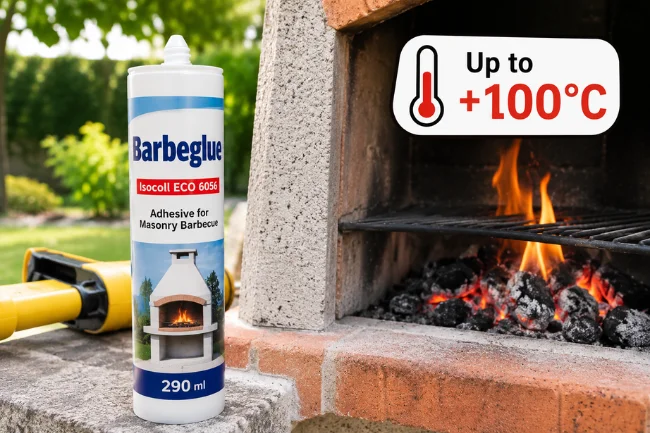
For Isocoll ECO 6056, the published upper temperature-resistance figure is +100°C.
A charcoal fire, exposed coals, and hot surfaces close to a flame may exceed that limit by a wide margin. I therefore would not apply this adhesive directly to a flame-exposed surface merely because the cartridge mentions barbecue use.
There is another wrinkle: SAROM’s assembly instructions identify approved locations for special adhesive or refractory mortar, including certain multi-piece hearth assemblies.
That does not mean every face of those components is a safe adhesive surface. The precise placement shown in the assembly diagram takes priority over a general temperature statement.
If a refractory plate is intended to sit loose, gluing it down can defeat the intended arrangement.
The manufacturer explicitly instructs owners of certain models to place refractory plates without a bonding material. For damaged fire-contact surfaces, seek model-specific guidance and use a product actually rated for the exposure.
Where Can You Use Barbeglue?
Joining Prefabricated Concrete Sections
Its clearest purpose is helping assemble compatible components of a masonry barbecue.
The manufacturer instructs users to build on a solid, level concrete base, join parts in the specified sequence, and check alignment with a spirit level.
An adhesive cannot compensate for a tilting foundation or badly fitted castings.
Attaching Side Shelves and Approved Fittings
Some SAROM assemblies use Barbeglue on side-table components together with metal corner brackets and screws.
The brackets are part of the design, not optional decoration. I would never treat a bead of glue as an automatic replacement for a mechanical fixing.
Sealing Minor Gaps and Reattaching Loose Pieces
Where the manufacturer allows a bonded joint, the adhesive may be useful for a small, clean separation.
First establish why it opened: a failed bond is different from a cracked concrete component.
If a part carries weight, moves, or has significant damage, stop using the barbecue until the assembly can be assessed.
Bonding Other Materials
The Isocoll ECO data sheet lists brick, cement, stone, steel, aluminum, wood, glass and other substrates.
That describes broad material compatibility, not universal approval for every hot cooking component.
Painted metal, treated surfaces, and unusual coatings deserve a small compatibility test and confirmation from the manufacturer.
Before Applying It, Check the Joint
I use three questions to decide whether a proposed repair makes sense.
First, is the joint actually supposed to be glued? Second, will the adhesive be exposed to temperatures within its published range? Third, is the material sound enough to hold a bond?
A hairline mark is not always a failed glue joint. A widening crack, rocking shelf, or displaced firebox panel may indicate something more serious.
Filling the visible gap without addressing the cause can conceal damage rather than fix it.
Keep the barbecue cold and completely out of use while inspecting it. Compare what you see with the model diagram, check any retaining brackets, and contact the seller or manufacturer when the repair affects stability or the cooking chamber.
How to Apply Barbeglue Correctly
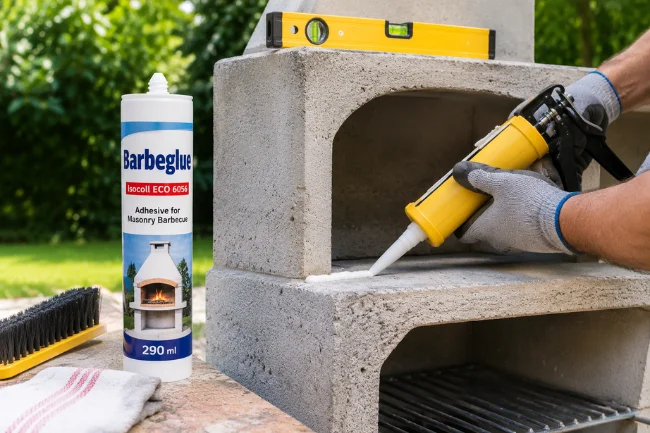
These practical instructions are suitable only for a joint approved for this adhesive.
Follow the cartridge and barbecue manual if they specify a different bead pattern, assembly order, or curing procedure.
- Prepare the location. Make sure the barbecue is cool, stable and positioned on a level foundation. Lay out the pieces in the order shown on the model diagram.
- Clean both surfaces. Brush away concrete dust and loose fragments. Remove grease, grime and rust from compatible metal surfaces. Let everything dry; the technical sheet calls for clean, dry substrates.
- Test the fit before opening the tube. Bring the components together without adhesive. Check that they sit correctly and that no bracket or removable refractory plate has been overlooked.
- Prepare the cartridge. Fit it into a suitable caulking gun and cut the nozzle to give the bead required for the actual joint. Avoid making the opening larger than necessary.
- Apply and assemble. Put the adhesive only where the diagram directs. Seat the pieces, check with a spirit level, and secure the specified brackets or supports. Do not load an unsupported joint before it has cured.
- Leave the assembly undisturbed. Clean stray material as instructed, avoid repositioning, and keep the barbecue unlit for the prescribed waiting period.
I would wear protective gloves, work in a ventilated outdoor area, and consult the product’s safety data sheet for specific handling advice.
A “solvent-free” description does not remove the need for sensible precautions.
Drying Time, Curing Time, and the First Fire
People often ask how long Barbeglue takes to dry, but there are two separate milestones.
“Tack-free” means the outer surface no longer feels sticky under a specified test. “Cured” means the moisture-driven reaction has progressed through the adhesive body.
For Isocoll ECO 6056, the technical sheet gives around 30 minutes to reach tack-free condition and a curing rate of roughly 3 mm per day under controlled conditions.
Thick beads, cooler conditions, and limited humidity access can alter the time needed. Thirty minutes is not a green light to light a fire.
SAROM assembly manuals instruct users to wait at least 48 hours before using an assembled barbecue.
I would treat that as the minimum assembly instruction, not as proof that every unusually thick adhesive joint has completely cured in precisely two days.
Follow any longer time stated for your model, the adhesive, or the weather conditions.
For the first firing, the manufacturer advises gradual heating rather than immediately building an intense fire. Sudden temperature changes can stress masonry even when the adhesive is correctly applied.
Barbeglue vs Refractory Mortar and Other Adhesives
I separate the main choices by intended use before checking the barbecue manual.
| Material | Main advantage | Main limitation | My selection rule |
|---|---|---|---|
| Barbeglue, specified formulation | Ready-to-use, elastic bonding for approved assemblies | Published Isocoll ECO 6056 limit is +100°C | Use only at manufacturer-approved joints |
| Refractory mortar | Made for specified high-temperature masonry applications | Mixing, application and cure requirements vary | Choose the mortar grade approved for the exact assembly |
| Ordinary silicone sealant | Convenient for suitable household sealing | SAROM warns against silicone glue for barbecue assembly | Do not substitute it for specified Barbeglue |
| General-purpose construction adhesive | Widely available for ordinary building repairs | Heat performance and substrate suitability vary | Avoid unless written technical approval covers the use |
Refractory mortar is not a single temperature rating either. One formulation may suit a particular firebrick joint while another may not.
Read its data sheet instead of assuming every product labeled refractory is appropriate for every repair.
SAROM explicitly warns against ordinary silicone glue and non-refractory mortar in its assembly instructions.
I would follow that restriction even if another product looks similar or promises strong bonding on concrete.
How Much Barbeglue Do You Need?
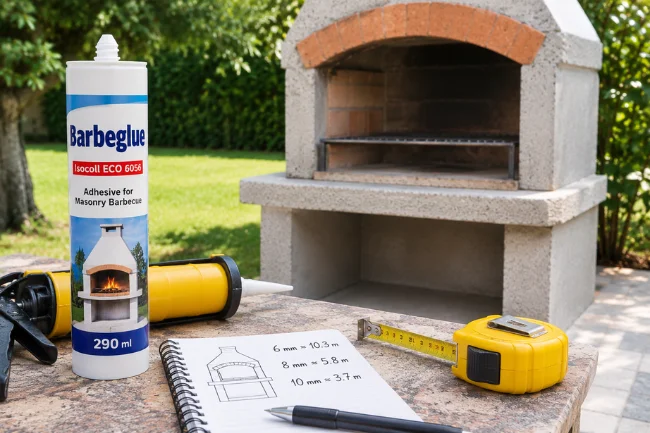
A 290 ml cartridge can go surprisingly far with a narrow bead, but the real requirement depends on how many joints the barbecue has and how the product must be applied.
A simple calculation can help with planning.
Assuming a perfectly round, continuous bead with no waste, a 290 ml cartridge provides approximately 10.3 metres at 6 mm diameter, 5.8 metres at 8 mm, or 3.7 metres at 10 mm.
These are geometry-based estimates, not the manufacturer’s coverage promises. Flattening and waste reduce usable coverage.
A retailer’s customer answers for two SAROM models illustrate why I wouldn’t rely on a universal cartridge count: Eurobrico advised one cartridge for an Ulisse assembly and two for a Prometeo model in April and May 2025.
Confirm your exact kit, package contents and current seller advice before ordering.
Buying, Identifying, and Storing the Product
Barbeglue appears at European barbecue and hardware retailers, sometimes under descriptions such as special masonry barbecue glue.
For example, Centro Piazzolla lists a SAROM 290 ml cartridge.
Some other listings use different volumes or casually call the product “silicone,” so I check the precise label and technical sheet rather than relying on a retailer’s short title.
Before buying, verify the manufacturer name, formulation, cartridge volume, intended use, expiry or batch information, and whether the barbecue kit already includes adhesive.
Check shipping and return terms too; a bargain is no bargain if a cartridge arrives damaged, hardened or out of date.
For Isocoll ECO 6056, the documented storage guidance is to keep unopened original packaging in a cool, dry place between 5°C and 25°C, away from heat sources, for no more than the stated 24-month storage period.
I would not assume a partly used, resealed tube has the same shelf life.
Preventing Problems After Assembly
A sound glue joint is only one part of a long-lasting masonry barbecue.
SAROM also calls for exterior protection of weather-exposed surfaces, while excluding the inside of the firebox in instructions where that distinction appears.
Use coatings approved for the actual surface and keep them away from food-contact and direct-flame areas unless their manufacturer expressly permits that use.
Prevent water collecting around the base, observe fuel limits, and heat masonry gradually. Cover the barbecue during long periods of nonuse.
These habits address moisture and thermal stress, two problems a strong adhesive cannot solve alone.
Finally, never assume a bonded component is safe simply because the gap has disappeared.
Inspect joints periodically, especially after winter, and discontinue use if a shelf loosens, the structure shifts, or cracks grow.
Is Barbeglue Worth Using?
For an approved SAROM masonry barbecue joint, Barbeglue offers a convenient, flexible alternative to mixing mortar.
Its value lies in compatibility with the assembly instructions, not in an unlimited promise of heat resistance.
I would choose it when the model specifies it, the surfaces are sound, and the exposure matches the product documentation.
Before your next assembly or repair, find the barbecue’s model number, compare the relevant diagram with the joint in front of you, and verify the exact cartridge data sheet.
That five-minute check is more useful than guessing with an ordinary adhesive.
Frequently Asked Questions
What is Barbeglue used for?
Barbeglue bonds approved concrete and other components in certain masonry barbecue assemblies. It can also seal compatible joints when the maker permits that use.
Can Barbeglue withstand direct flames?
Do not assume so. The Isocoll ECO 6056 data sheet lists resistance up to +100°C; direct-fire locations require the appliance maker’s specific guidance.
How long should Barbeglue dry before using a barbecue?
SAROM manuals call for at least 48 hours after assembly. Thick joints or different conditions may require longer curing under the applicable product instructions.
Can I use regular silicone instead of Barbeglue?
Not for SAROM joints that specify Barbeglue or refractory mortar. The company’s assembly manual explicitly rules out silicone glue.
Is Barbeglue waterproof and suitable outdoors?
The cited formulation offers weathering and UV resistance, but outdoor suitability depends on the joint and assembly. Protect the barbecue as its manual directs.

Olivia Parker is a home improvement research writer with 8+ years of experience covering home design, renovation ideas, maintenance tips, and practical living solutions. She creates easy-to-follow content to help readers make informed decisions about improving their homes.