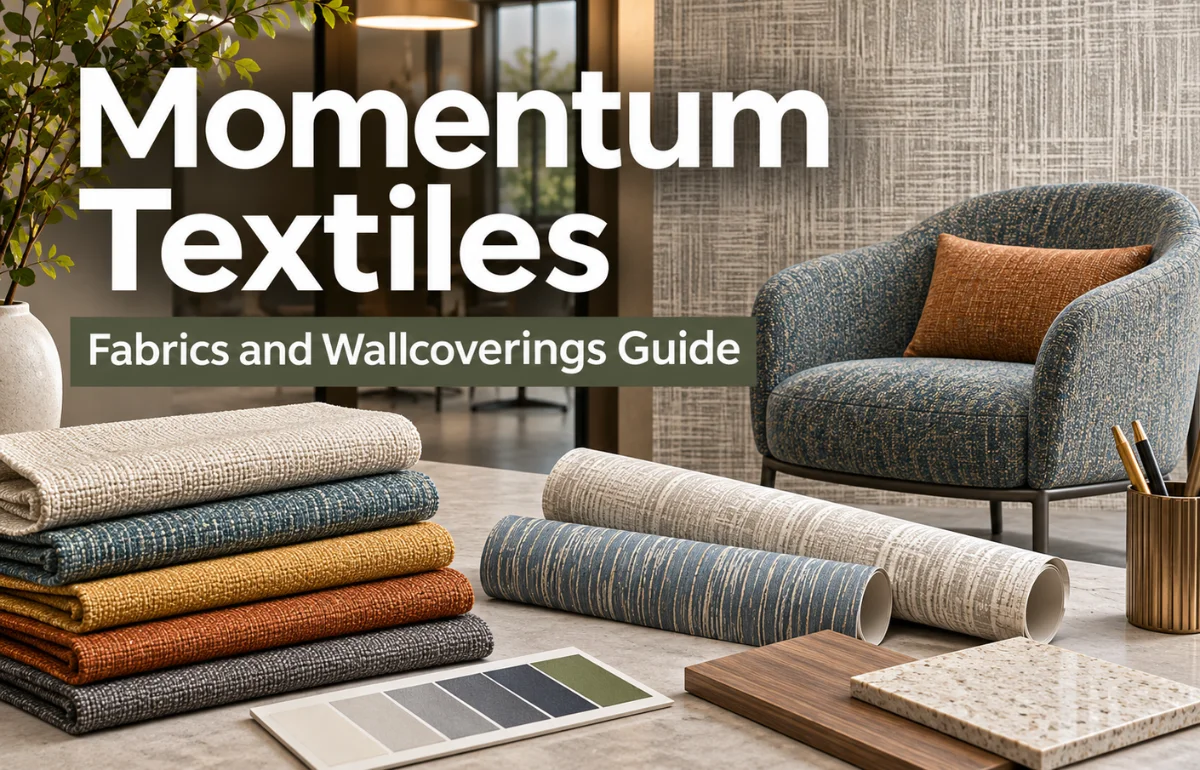
Momentum Textiles is a commercial interior materials brand best known for upholstery fabrics, performance textiles, and decorative wallcoverings used in offices, hotels, healthcare facilities, and educational spaces. Operating as Momentum Textiles & Wallcovering, the company supplies designers and furniture manufacturers with materials developed to balance appearance, durability, cleanability, and environmental considerations.
Its wider Momentum portfolio also includes acoustic treatments and architectural surfaces.
I think that distinction matters: these are primarily contract-grade products specified for particular applications, not simply decorative fabrics chosen by color.
If you are researching Momentum for a renovation, furniture project, or interior design specification, the most useful question is not whether the brand is popular. It is which material will perform best in your space.
What Is Momentum Textiles Known For?
Momentum has worked in commercial interiors for nearly four decades. Its product range covers woven and coated upholstery, wallcoverings, wall protection, drapery, sheers, and acoustics.
Unlike a typical fabric retailer, the company serves a specification-driven market. Interior designers, architects, facilities teams, and furniture manufacturers need information about abrasion resistance, fire testing, maintenance, chemical composition, and installation.
I find it helpful to think of Momentum as a materials partner rather than a single fabric collection.
You might use woven upholstery on lounge chairs, a wipe-clean coated textile in a patient waiting area, and a durable wallcovering along a busy corridor—all while maintaining a consistent color story.
The Main Momentum Textile and Surface Categories
Woven Upholstery Fabrics
Woven textiles are often the natural starting point for comfortable seating. Their interlaced yarns can create everything from subtle heathered solids to pronounced geometric textures.
Momentum offers performance woven upholstery in different fibers, constructions, and finishes.
But “woven” does not automatically mean stain-resistant or suitable for constant heavy use. I would check the exact pattern’s technical sheet, rather than assuming that all upholstery in the catalog has identical specifications.
Coated Upholstery and Silica
Coated textiles generally provide a more wipeable surface, which can be valuable in high-turnover environments.
Momentum’s range includes coated options such as EPU, Clean Vinyl, and Silica, along with other performance constructions.
Silica is one of the brand’s signature products. It uses a silicone-based surface with a polyester backing and is positioned as a PVC-free alternative for demanding upholstery applications.
Momentum describes its strengths as stain resistance, cleanability, and durability. Specific Silica products also carry environmental documentation, but those credentials should be checked at the pattern level.
Momentum’s Silica overview explains the material family.
Decorative Wallcoverings and Wall Protection
Momentum supplies commercial wallcoverings ranging from conventional Type II Clean Vinyl products to PVC-free and bio-based alternatives.
Decorative wallcoverings contribute pattern and depth; wall protection is designed for areas where carts, bags, equipment, or repeated contact can damage exposed surfaces.
Two examples illustrate the difference.
Circon is a bio-sourced Type II wallcovering promoted for its renewable content and recyclability. P3TEC is a wall protection solution intended to resist impacts and abrasion.
Acoustics, Drapery, and Other Surfaces
The broader Momentum offering includes acoustic products and drapery or sheer fabrics.
These are useful when a project needs more than upholstery: a meeting room may require sound absorption, while a hotel suite may need soft window treatments and coordinating seating.
| Material category | Best starting point for | Main specification question |
|---|---|---|
| Woven upholstery | Comfortable office and hospitality seating | Will it resist wear, pilling, and seam stress? |
| Coated upholstery | Seating needing frequent wipe-down cleaning | Which chemicals and cleaning methods are approved? |
| Type II wallcovering | Busy decorative wall areas | What are the substrate, fire rating, and installation needs? |
| Wall protection | Corridors and impact-prone zones | How much impact and abrasion can the system withstand? |
| Acoustic surfaces | Rooms with echo or speech-comfort concerns | What are the tested acoustic results in this assembly? |
How Durable Are Momentum Textiles?
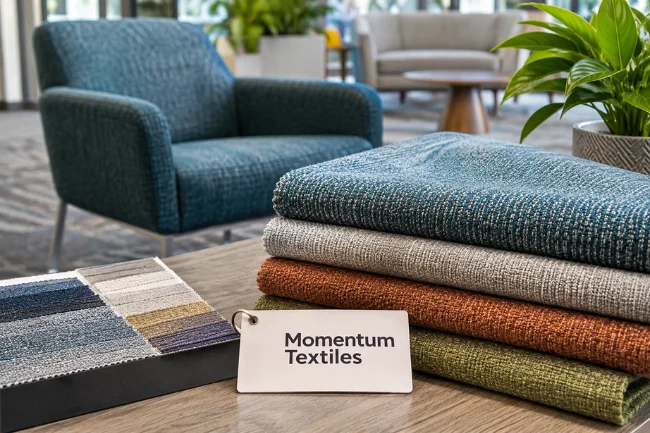
Durability is one of the biggest reasons buyers consider commercial upholstery.
Yet I would never judge performance using a single impressive number. A fabric’s lifespan depends on construction, furniture design, cleaning practices, sunlight, and the amount of daily contact.
Understanding Double-Rub Ratings
A Wyzenbeek double-rub test measures abrasion under laboratory conditions.
The Association for Contract Textiles (ACT) gives 30,000 double rubs as a voluntary high-traffic benchmark for woven indoor upholstery and 50,000 for coated indoor upholstery.
Martindale is a different abrasion test; its cycles should not be directly converted into Wyzenbeek rubs.
ACT also cautions that higher abrasion ratings do not necessarily mean a longer service life.
ACT’s abrasion guidance is worth reading before comparing products.
The Other Tests That Deserve Attention
For seating, I would also look for pilling resistance, seam slippage, tear or breaking strength, lightfastness, and color transfer data.
Where applicable, fire-performance documentation matters too.
In healthcare and hospitality, compatibility with the facility’s actual cleaning products can be just as decisive as abrasion results.
Is Momentum Textiles a Sustainable Choice?
Momentum gives sustainability substantial attention, and some claims are more concrete than vague “eco-friendly” labeling.
On its sustainability page, the company says 92% of its textiles use post-consumer recycled polyester or rapidly renewable materials, excluding hospitality textiles.
Recycled, Bio-Based, and PVC-Free Are Different
Recycled polyester uses existing material as feedstock. Bio-based products incorporate materials derived from renewable biological resources. PVC-free describes the absence of a particular plastic.
None of these terms alone proves that a product is recyclable locally, harmless under every condition, or lower-impact across its entire life cycle.
I would ask three separate questions: What is it made of? What evidence supports its environmental claims? What happens when the material is removed?
That framework is far more useful than treating every sustainability badge as equivalent.
Look for Product-Level Evidence
Momentum identifies certifications and disclosures across portions of its range, including GREENGUARD Gold, Environmental Product Declarations (EPDs), and Health Product Declarations (HPDs).
An EPD reports assessed environmental impacts; an HPD provides information about material contents and associated health considerations. GREENGUARD Gold addresses chemical emissions under its testing criteria.
Momentum also groups various lower-impact material options within its Better by Nature portfolio.
The company’s sustainability information is a helpful starting point, followed by the documentation for the specific product selected.
Longevity and Sample Waste Matter Too
One overlooked sustainability factor is avoiding unnecessary replacement.
A chair fabric that remains attractive and serviceable for years may reduce future material demand, installation labor, and disposal compared with an unsuitable alternative that quickly fails.
Momentum also reports a sample return and reuse program, including hundreds of thousands of samples returned for reuse.
Choosing Momentum Fabrics for Different Spaces
The right textile depends on the people using the room and the tasks happening there.
I prefer to define the maintenance and wear conditions before falling in love with a colorway.
Healthcare and Senior Living
For reception seating, examination-adjacent areas, and senior living lounges, cleaning frequency, moisture resistance, comfort, and facility-approved disinfectants often drive the decision.
Coated performance upholstery can make sense, but no product should be described as infection-proof. Infection-control requirements must be assessed separately.
Hotels and Restaurants
Hospitality interiors need a balance of atmosphere and resilience.
Textured upholstery can soften guest rooms, while harder-working finishes may be preferable in dining areas and heavily used lounges.
For wallcoverings, pattern matching, roll quantities, and repeat size can influence both cost and installation efficiency.
Offices and Educational Buildings
Workplace seating should support daily use without looking overly clinical.
Libraries, collaboration zones, and classrooms may need strong abrasion performance and forgiving colors.
| Environment | Priority I would assess first | Frequent oversight |
|---|---|---|
| Healthcare waiting area | Approved cleaning and moisture handling | Assuming all disinfectants are safe |
| Hotel guest room | Comfort, appearance, and maintainability | Ignoring pattern-repeat waste |
| Restaurant banquette | Soil removal, seam wear, and durability | Choosing by rub count alone |
| Office collaboration area | Abrasion, pilling, and color retention | Testing only a tiny swatch under artificial light |
| School corridor | Wall impact and cleanability | Using decoration where protection is needed |
How to Select the Right Momentum Textile
Start With the Actual Use, Not the Catalog Image
Decide whether the material is intended for a desk chair, bench, lounge seat, wrapped panel, or wall.
Think about daily users, food and drink exposure, direct sunlight, and whether staff will disinfect it regularly.
These details narrow the field faster than browsing hundreds of attractive patterns.
Request a Physical Sample
Colors on screens shift with lighting and display settings.
Ask for a sample and examine it in the room beside flooring, wood, paint, and furniture finishes.
I would view it in morning daylight and artificial evening light, then check texture from the distance at which visitors will normally see it.
For upholstery, bend the sample around a curved edge if possible.
Read the Full Specification Sheet
Confirm fiber or coating composition, width, repeat, abrasion method, applicable fire tests, cleaning codes, and certifications.
Ask the furniture manufacturer whether the textile is appropriate for the intended frame and upholstery method.
For walls, confirm substrate preparation, adhesive requirements, and installation instructions.
When evaluating bleach-cleanable materials, verify the approved dilution and contact procedure for the exact product.
A manufacturer’s bleach-cleanable claim is not permission to use undiluted bleach or any disinfectant without checking compatibility.
Compare Total Project Cost
A cheaper fabric can become expensive if it needs frequent replacement or creates extra installation waste.
Instead of looking only at price per yard, compare estimated installed cost, upkeep, and realistic service expectations.
As a practical exercise, divide the projected installed cost of a seating material by the number of seats and the planned years of service.
The result is not a warranty or a life-cycle assessment, but it gives procurement teams a more meaningful comparison than yard price alone.
Five Buying Details That Often Get Missed
First, dye lots can vary. If matching an existing installation is critical, request a cutting for approval rather than relying on an old sample.
Second, pattern repeats affect how much fabric or wallcovering must be ordered. Large repeats may create material waste, especially around doors, corners, and small upholstered panels.
Third, the upholstery maker matters. Incorrect seams, unsuitable cushioning, or poor tension can shorten the useful appearance of a perfectly capable textile.
Fourth, a cleaning plan should exist before installation. Ask who will clean the surface, which chemicals they use, and how often. I would put the approved care instructions into the facilities handover documents.
Fifth, stock and replacement availability need checking. A pattern that works beautifully today may not always be available in the same color or dye lot. For large projects, confirm supply and discuss sensible spare material with the representative.
Ordering, Pricing, and Warranty Considerations
Momentum’s website provides product browsing, samples, and ways to contact representatives, but project pricing is not something I would assume from a generic online figure.
Quotes can depend on the product, quantity, customization, freight, and purchasing arrangements. Check current availability and lead times before promising an installation date.
Its published terms state that prices may change and that buyers should verify materials before cutting or installing.
Returns vary by product, and certain made-to-order or customized goods cannot be returned. This is especially relevant for commercial projects where a small purchasing error can affect dozens of chairs or multiple wallcovering rolls.
Warranty terms also vary.
Momentum’s published terms describe a general three-year textile warranty, five years for certain higher-abrasion and coated textile categories, ten years for Silica upholstery, and five years for wallcoverings, subject to stated conditions and exclusions.
Never assume the longest warranty applies to the entire catalog.
Review the current terms and conditions for the specific product and application.
Is Momentum Textiles Worth Considering?
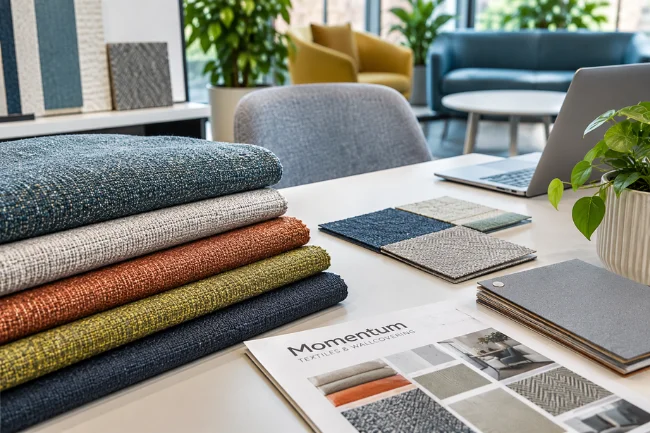
For a commercial project, I think Momentum deserves consideration when the goal is to coordinate design with documented performance and maintenance requirements.
Its wide material range can simplify the task of creating a consistent look across seating, walls, and acoustic surfaces.
That does not make every product the best option for every budget or room.
A well-chosen competitor’s textile may be more suitable for a specialized application, and some residential projects may not need contract-grade construction at all.
The fair comparison is always between specific materials, with equivalent test methods and real project requirements—not between brand names alone.
Frequently Asked Questions About Momentum Textiles
What is Momentum Textiles?
Momentum Textiles is a supplier of commercial upholstery, performance fabrics, wallcoverings, and related interior materials for workplaces, hotels, healthcare, and education.
Is Momentum Textiles suitable for high-traffic furniture?
Many products are designed for commercial use, but suitability depends on the individual fabric’s abrasion, construction, cleaning, and end-use specifications.
Does Momentum offer sustainable fabrics?
Yes. Its portfolio includes recycled-content, bio-based, and PVC-free options; verify the environmental documentation for the exact textile you are considering.
Can Momentum fabrics be cleaned with bleach?
Some performance materials are bleach-cleanable, but approved dilution and cleaning procedures vary by product. Always check the technical sheet.
Where can I buy or request Momentum Textiles samples?
Visit the official Momentum website to explore products, request samples where available, or connect with a sales representative.
Final Thoughts
Momentum Textiles offers more than decorative fabric: it provides a broad set of tools for designing attractive spaces that must withstand real use.
I would begin with a clear description of the room, shortlist two or three appropriate materials, and compare their samples, test data, cleaning instructions, and total installed costs.
That small amount of scrutiny can make a much bigger difference than choosing the trendiest pattern.

Olivia Parker is a home improvement research writer with 8+ years of experience covering home design, renovation ideas, maintenance tips, and practical living solutions. She creates easy-to-follow content to help readers make informed decisions about improving their homes.