
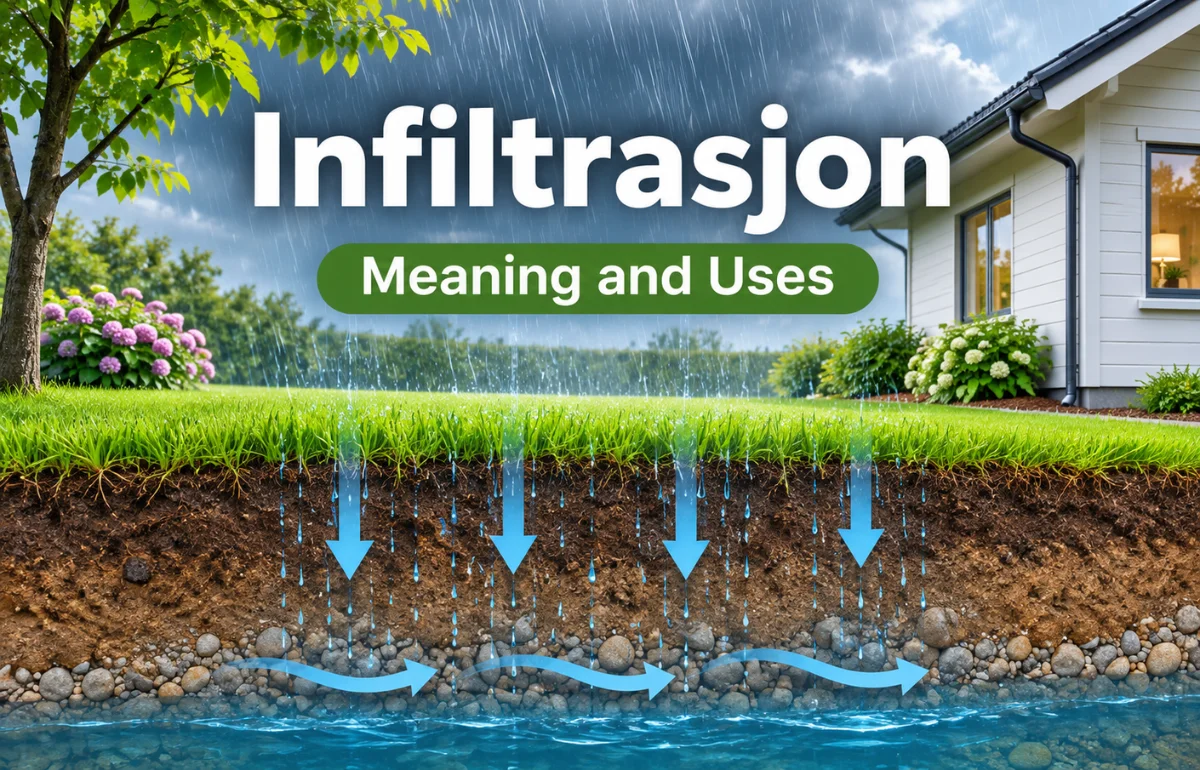
Infiltrasjon is the Norwegian word for infiltration: the process of something entering, penetrating, or spreading into another material, space, or group. In environmental science, it usually describes rainwater soaking into soil. In medicine, it can mean fluid or cells entering body tissue, or an intentionally administered local injection. In politics and security, it refers to gaining access to an organization or territory, often discreetly. The meaning changes with the setting, but the underlying idea stays consistent: something crosses a boundary and moves inside.
I find that simple definition more useful than treating every mention of infiltrasjon as a single technical process. To understand the term correctly, the first question is always: what is entering, and where is it going?
What Does Infiltrasjon Mean in English?
The direct English translation is “infiltration.” The Norwegian Bokmålsordboka dictionary recognizes uses involving physical penetration, medical tissue, and covert entry into organizations. That range explains why a search for infiltrasjon can lead to drainage advice, medical descriptions, or discussions of espionage.
The word itself is neutral. Water infiltrating healthy garden soil is generally useful; an IV solution leaking outside a vein is not. And an organization describing infiltration is talking about people or influence, not liquid.
Context determines whether the process is natural, helpful, deliberate, or harmful.
| Context | What enters what? | Typical meaning |
|---|---|---|
| Soil and hydrology | Rain or melting snow enters the ground | Water infiltration and groundwater recharge |
| Home drainage | Stormwater enters a designed soil or gravel system | Runoff management |
| Medicine | Fluid, cells, or an injected substance enter tissue | A tissue finding, treatment, or IV complication |
| Security and politics | People gain access to a group or protected area | Covert infiltration |
How Infiltrasjon Works in Soil and the Water Cycle
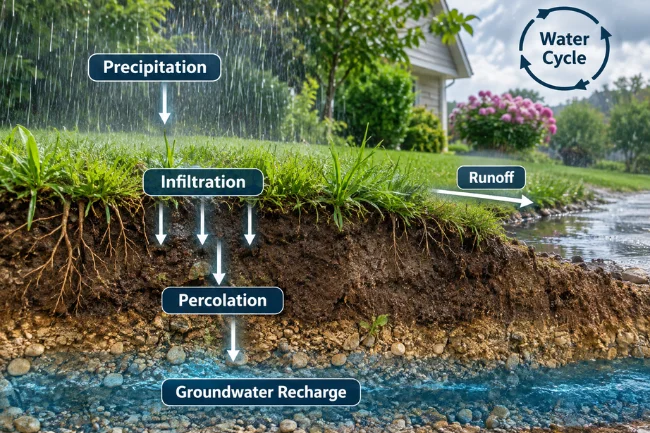
Imagine rain falling on a lawn. Some water stays on leaves and evaporates. Some runs downhill. Another portion crosses the soil surface and fills tiny spaces between soil particles. That entry is infiltration.
Once underground, water can remain near plant roots, move sideways, or travel deeper. Its downward movement through soil is often called percolation. Some eventually reaches an aquifer and contributes to groundwater recharge, although not every drop that enters soil travels that far.
The U.S. Geological Survey explains that precipitation, soil properties, ground cover, slope, and existing moisture all influence this process.
That is why the same rainfall can disappear into one yard but create puddles next door.
Infiltration vs. Percolation vs. Runoff
These terms describe different parts of a water journey.
Infiltration is water entering soil from above. Percolation is its continued movement through underground pores. Runoff is water moving across the surface when it cannot enter quickly enough or encounters an impermeable barrier.
I use a doorway comparison: infiltration gets water through the front door; percolation determines whether it can travel through the rooms beyond.
A lawn can accept water initially and still develop pooling if a dense layer below prevents further movement.
What Determines the Infiltration Rate?
The infiltration rate describes how quickly water crosses the soil surface, often measured in inches per hour or millimeters per hour.
There is no universal “good” rate: the suitable rate depends on rainfall, soil depth, landscaping, groundwater, and what the area needs to do.
Soil Texture and Structure
Sandy soils often admit water quickly because they have relatively large pores. Clay-rich soils commonly absorb it more slowly, although well-structured clay with cracks and biological channels can behave differently from compacted clay.
Texture matters, but pore connections matter just as much.
Compaction and Soil Cover
Foot traffic, parked vehicles, and heavy equipment can squeeze pore spaces closed. Grass roots, leaf litter, and stable soil aggregates may help maintain openings.
Bare soil may develop a surface crust that restricts entry even when the deeper soil drains reasonably well.
Existing Moisture and Rainfall Intensity
Dry soil often has more storage space at the beginning of a storm. As it wets, the infiltration rate may decline.
If rain arrives faster than the soil can accept it, excess water collects or runs downhill. Frozen ground, steep slopes, and shallow bedrock can complicate the picture further.
This is why I avoid judging drainage from soil color or a single dry-weather observation. Performance during and after rain tells a fuller story.
How to Check Soil Infiltration at Home
A simple field observation can reveal whether a proposed garden area drains readily, but it cannot replace a professional site investigation for a septic field, major earthwork, or engineered stormwater system.
First, watch the area during ordinary rainfall. Note where water comes from, where it collects, and whether puddles remain long after the storm ends.
Also look for hard-packed soil, downspouts that discharge into one spot, and nearby foundations.
For a rough screening test in a safe location, prepare a small test hole, wet the soil, then add a measured depth of water and record how far the water level falls over a known period.
For example, a one-inch drop in two hours suggests an observed drop rate of about half an inch per hour during that test. It is not a guaranteed long-term infiltration rate.
Repeat the observation after the soil has already been wetted. Initial dry-soil results can look much faster than later performance.
Use the same hole dimensions and starting water depth when comparing locations. The USDA Natural Resources Conservation Service’s soil-quality testing guidance describes why initial moisture and repeat measurements affect interpretation.
For construction decisions, a qualified professional should assess soil layers, seasonal groundwater, buried utilities, and local design requirements.
A backyard test cannot establish safe setback distances or wastewater treatment suitability.
Why Infiltrasjon Matters for Homes and Cities
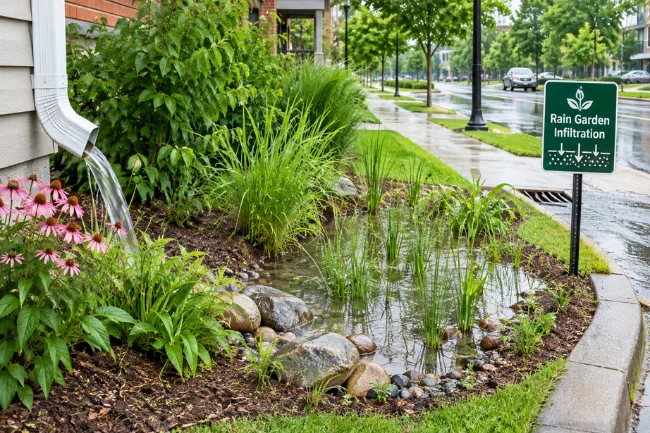
Where water goes after a storm affects more than wet shoes. Infiltration can reduce surface runoff, help support vegetation, and contribute to groundwater supplies.
When well designed, it may also reduce the volume of water entering storm drains during smaller storms.
Pavement changes that balance. Roofs, driveways, and streets send water away quickly, often toward gutters or low-lying properties.
A thoughtful landscape gives some water a safe place to slow down and enter the soil, while retaining a separate route for excess runoff.
I think the most useful design question is not “How can I absorb every drop?” It is “How much clean water can this site safely handle, and where will the rest go?”
The EPA’s green infrastructure guidance emphasizes site-specific soil and drainage conditions rather than one-size-fits-all solutions.
Common Infiltration and Drainage Options Compared
| Option | Best use | Important limitation |
|---|---|---|
| Rain garden | Capturing runoff from a roof or landscaped area | Needs suitable soils, safe siting, and overflow |
| Permeable pavement | Reducing runoff from a driveway or walkway | Surface can clog; subsoil must be evaluated |
| Infiltration trench | Storing and releasing runoff into surrounding ground | Poor choice near vulnerable foundations or contaminated soil |
| Swale with underdrain | Slowing and conveying runoff where infiltration is limited | May primarily drain water away rather than recharge groundwater |
A rain garden is not simply a hole filled with attractive plants. Its depression, soil, vegetation, and overflow route work together.
Likewise, porous pavers only perform as intended if the layers below can store or convey the incoming water.
When More Infiltration Is Not Better
A common mistake is assuming any water disappearing underground is automatically a success.
Water can move toward a basement, destabilize a slope, mobilize existing pollutants, or collect above a shallow water table.
For example, placing a deep soakaway beside a building may increase moisture pressure against the foundation.
The EPA’s rain garden planning resources give a common screening setback of at least 10 feet from foundations unless appropriate protective measures are provided. Actual requirements depend on the property and local code.
Water quality matters too. Runoff from an ordinary roof is different from water draining a vehicle repair yard.
The EPA’s groundwater protection guidance warns that infiltration in polluted locations may carry contaminants toward groundwater.
For homeowners, warning signs include repeated foundation dampness, unexplained pooling beside walls, soggy ground above a septic field, or drainage that worsens after new paving.
These are reasons to investigate the entire water route, not automatically dig a deeper pit.
Infiltrasjon in Wastewater and Septic Systems
Infiltration is also part of some on-site wastewater treatment systems. After solids settle in a septic tank, liquid effluent typically enters a drainfield.
There, unsaturated soil helps filter and treat it as water moves through the ground.
This is not the same as dumping untreated wastewater into a hole.
Proper separation from groundwater, appropriate soil conditions, loading rates, and maintenance are essential. An overloaded or saturated drainfield may produce surface sewage or backups inside the home.
The EPA’s explanation of septic systems makes the soil’s treatment role clear.
If a property has high groundwater or unsuitable soil, an alternative system may be needed. Never use a casual garden drainage test as proof that a septic installation will be safe or legally compliant.
What Does Infiltrasjon Mean in Medicine?
Medical usage is different enough to deserve its own explanation.
Here, infiltration describes substances or cells entering tissue. The term alone does not identify a disease, and it does not always mean something harmful.
Tissue Infiltration and Inflammation
In a pathology report, infiltration may refer to inflammatory cells accumulating in tissue.
A clinician interprets the finding alongside symptoms, examination results, imaging, and laboratory evidence. It is a description of what is happening in tissue, not a stand-alone diagnosis.
The term can also describe cancer cells growing into neighboring tissue.
The U.S. National Cancer Institute uses “infiltrating” and “invasive” for cancers that have grown beyond their original tissue layer.
But seeing the word infiltration by itself does not establish cancer.
Infiltration Anesthesia and Targeted Injections
In some procedures, clinicians intentionally inject local anesthetic into an area to numb tissue.
This is often called infiltration anesthesia.
Unlike abnormal tissue infiltration, the entry is planned and therapeutic. Local injections may also be used in selected pain treatments, depending on the diagnosis and medication.
IV Infiltration: A Complication to Recognize
During an intravenous infusion, fluid can sometimes leak outside the vein into surrounding tissue.
Swelling, tightness, discomfort, or pain near the IV site deserve immediate attention from the care team.
Leakage of medications capable of tissue damage is often discussed as extravasation, a related but clinically distinct concern.
The Cleveland Clinic advises patients to report these symptoms promptly.
Treatment depends on the substance involved; do not massage the area or choose heat or ice without medical direction.
Infiltrasjon in Politics, Security, and Organizations
Outside physical science and healthcare, infiltrasjon can describe someone gaining entry to a group while concealing their real purpose or affiliation.
This usage may appear in reporting on espionage, military operations, organized crime, or political influence.
The key difference is intention. Rain does not have a strategy, but covert organizational infiltration usually involves planning and deception.
Not every outsider joining a group is an infiltrator, however. A fair assessment requires evidence of concealed access or activity rather than suspicion based on identity or disagreement.
In cybersecurity discussions, the English word infiltration may loosely describe unauthorized entry into systems.
More precise terms such as intrusion, credential compromise, or unauthorized access are often better because they identify the actual technical problem.
A Practical Way to Interpret the Word Correctly
When I encounter an unfamiliar use of infiltrasjon, I ask four questions.
What is crossing the boundary? What boundary is it crossing? Is the entry intentional? What happens afterward?
Those questions produce very different answers.
For a lawn, the boundary is the soil surface and the outcome might be healthier roots.
For an IV line, the boundary is a vein and the outcome may be tissue swelling.
For a covert operation, the boundary may be organizational trust, with information access as the goal.
One further distinction makes the interpretation stronger: entry is not the same as successful transport.
Rainwater can enter the topsoil without reaching an aquifer; an injected medication can enter tissue without producing the intended relief.
Good explanations describe both the point of entry and the destination.
Mistakes Worth Avoiding
First, do not equate infiltration with filtration.
Filtration describes removing particles or contaminants as something passes through a medium. Infiltration describes entry. Soil may perform both functions, but the words are not interchangeable.
Second, do not assume that faster drainage is always safer.
Rapid water movement through fractured rock or highly permeable ground may leave less opportunity for some contaminants to be retained.
Safe infiltration is as much about water quality and location as speed.
Third, avoid treating one field test as a permanent soil property.
Seasonal saturation, root growth, compaction, sediment, and construction activity can alter results. Maintaining permeable surfaces and keeping sediment out of drainage features is part of keeping them useful.
Finally, never interpret medical infiltration without the surrounding clinical language.
A planned anesthetic injection, an IV leak, and cells described in a biopsy are unrelated situations despite sharing the same word.
Conclusion: Match the Meaning to the Setting
Infiltrasjon simply means infiltration, but its consequences depend on what enters, where it goes, and why.
For most homeowners, the practical issue is whether water can move safely into and through the soil without harming buildings or groundwater. In healthcare, the same term demands a completely different interpretation.
If you’re evaluating a drainage problem, start by mapping where the water comes from, where it collects, and where it can safely leave.
If you encountered infiltrasjon in a medical report, ask the clinician to explain the exact finding in context.
The right next step begins with the right meaning.
Frequently Asked Questions About Infiltrasjon
What does infiltrasjon mean in English?
Infiltrasjon is Norwegian for infiltration: something entering or penetrating soil, tissue, a space, or an organization.
What is water infiltration in simple terms?
It is the process of rainwater or melted snow soaking through the ground’s surface into the soil below.
What is the difference between infiltration and percolation?
Infiltration is water entering soil; percolation is its movement deeper through the soil after entry.
Is infiltration good or bad for a house?
Controlled infiltration can reduce runoff, but poorly placed systems may increase moisture near foundations or basements.
What does infiltration mean in a medical report?
It generally describes cells or fluid entering tissue; the significance depends on the report, symptoms, and clinical context.

Olivia Parker is a home improvement research writer with 8+ years of experience covering home design, renovation ideas, maintenance tips, and practical living solutions. She creates easy-to-follow content to help readers make informed decisions about improving their homes.