
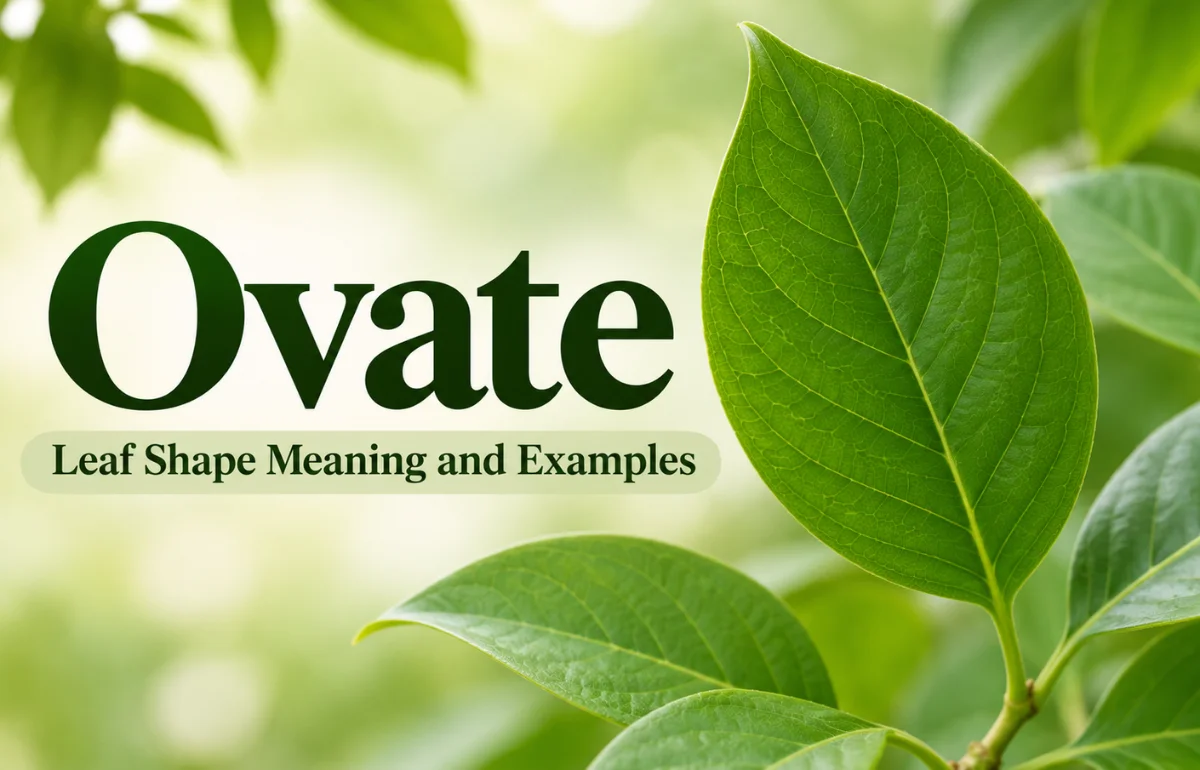
Ovate is a botanical term that describes an egg-shaped outline, with the widest part near the base and a narrower end toward the tip. It is most commonly used to describe leaves, although it can also apply to petals, sepals, and other plant structures. An ovate leaf typically has a broad, rounded lower portion that gradually tapers upward.
The word comes from the Latin ovum, meaning “egg.” In botany, it describes the outline of a plant part rather than its color, texture, or function.
I find that the easiest way to understand an ovate shape is to picture an egg standing upright, with its wider end at the bottom.
However, not every oval-looking leaf is ovate. The position of its widest point makes the difference.
Understanding this distinction can help gardeners, students, and nature enthusiasts identify plants more accurately and interpret botanical descriptions with confidence.
What Does Ovate Mean in Botany?
In botany, ovate refers to a flat, egg-shaped structure that is broader toward its point of attachment and becomes narrower toward its opposite end.
The term is particularly useful in plant morphology, the scientific study of plant forms and structures.
Botanists use descriptive words such as ovate, elliptic, lanceolate, and obovate to distinguish between different leaf outlines.
These terms allow researchers to communicate plant characteristics precisely without relying entirely on photographs or illustrations.
For example, describing a leaf as “green and oval” provides limited information. Calling it “ovate with a serrated margin and an acute apex” communicates several identifiable features.
According to the New York Botanical Garden’s botanical glossary, a typical ovate outline has its widest portion below the midpoint and a length-to-width ratio between 1.5:1 and less than 2:1.
However, broader and narrower variations also exist.
Where Does the Word Ovate Come From?
Ovate originates from the Latin word ovum, meaning egg, and the related Latin adjective ovatus.
Its meaning reflects the resemblance between the outline of an egg and certain plant structures.
This relationship explains several related botanical terms, including ovoid and obovate.
Although these words share an origin, they describe different shapes.
Ovate generally describes a two-dimensional outline, while ovoid is more commonly used for a three-dimensional, egg-shaped object.
What Does an Ovate Leaf Look Like?
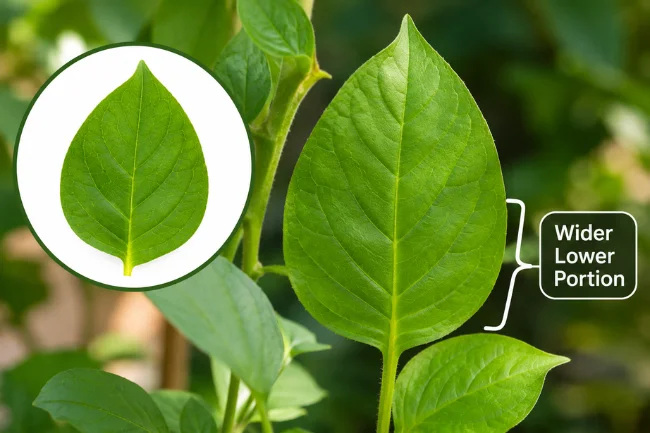
An ovate leaf resembles an egg viewed lengthwise, with the broadest portion positioned toward the stem.
Its appearance can vary considerably between plant species, but several characteristics help distinguish it from other leaf shapes.
1. A Wider Lower Portion
The most recognizable feature is the location of the maximum width.
In an ovate leaf, the broadest section occurs below the middle of the leaf blade.
This creates a fuller lower half and a comparatively narrower upper half.
I consider this feature more useful than simply judging whether the entire leaf looks rounded.
2. A Gradually Narrowing Upper Portion
The sides generally taper from the broad lower region toward the leaf tip, also called the apex.
The tip may be pointed, blunt, or rounded, depending on the species.
An ovate leaf does not necessarily have a sharply pointed end. Its overall outline determines the classification.
3. A Rounded or Tapering Base
The base is where the leaf blade joins its stalk, or petiole, when one is present.
Although an ovate outline is broadest toward this region, the actual base can have different shapes.
Some leaves have rounded bases, while others narrow toward the attachment point.
4. A Generally Balanced Outline
Many ovate leaves appear approximately symmetrical on either side of the midrib, the prominent central vein.
However, perfect symmetry is not required.
Some plants have slightly uneven leaf blades while still retaining an overall ovate outline.
Ovate vs. Obovate, Elliptic, Oval, and Other Leaf Shapes
Botanical terms can seem confusing because several describe leaves with curved, elongated outlines.
The easiest way to distinguish them is to examine where the leaf reaches its greatest width.
| Leaf shape | Main characteristics | Key difference |
|---|---|---|
| Ovate | Egg-shaped and broadest below the middle | Wider toward the base |
| Obovate | Inverted egg-shaped outline | Wider toward the tip |
| Elliptic | Elongated and widest near the center | Tapers toward both ends |
| Oval | General rounded, elongated outline | Less specific in everyday usage |
| Lanceolate | Long, narrow, and lance-shaped | Much longer relative to its width |
| Cordate | Heart-shaped with basal lobes | Distinctive notch at the base |
| Oblong | Elongated with nearly parallel sides | Width remains relatively consistent |
| Ovoid | Three-dimensional egg shape | Describes a solid form rather than a flat outline |
Ovate vs. Obovate
These two terms are frequently confused.
An ovate leaf has its widest part toward the base, while an obovate leaf has its widest part toward the tip.
I remember the difference by focusing on the prefix “ob-,” which indicates reversal in botanical terminology.
Ovate vs. Elliptic
An elliptic leaf is widest around its center and tapers toward both ends.
An ovate leaf has more of its width concentrated below the center.
This small distinction becomes particularly useful when identifying plants with similarly sized leaves.
Ovate vs. Cordate
Cordate leaves resemble hearts, usually with two rounded basal lobes separated by a notch.
Ovate leaves do not require this heart-shaped indentation.
Both can be broad near the base, but their basal outlines differ.
Types of Ovate Leaf Shapes
Not every ovate leaf has identical proportions.
Botanists use descriptive variations to distinguish relatively broad leaves from longer, narrower ones.
One common approach compares the length of the leaf blade with its maximum width.
| Shape classification | Length-to-width ratio | Appearance |
|---|---|---|
| Very widely ovate | 1:1 or less | Extremely broad egg-shaped outline |
| Widely ovate | 1.2:1 to less than 1.5:1 | Broad and relatively short |
| Ovate | 1.5:1 to less than 2:1 | Typical elongated egg shape |
| Narrowly ovate | 2:1 to less than 3:1 | Longer and slimmer |
These ranges follow the terminology used by the New York Botanical Garden. Different botanical identification systems may apply slightly different boundaries.
How to Calculate the Length-to-Width Ratio
Suppose a leaf measures 8 centimeters long and 5 centimeters across its widest point.
Its ratio is:
8 ÷ 5 = 1.6
Because 1.6 falls within the typical ovate range, the leaf’s proportions are consistent with an ovate classification.
However, the calculation alone is insufficient.
I would also check whether the widest point lies below the middle. An elliptic or obovate leaf could have the same measurements.
This combination of proportion and shape provides a more reliable description.
Common Examples of Plants With Ovate Leaves
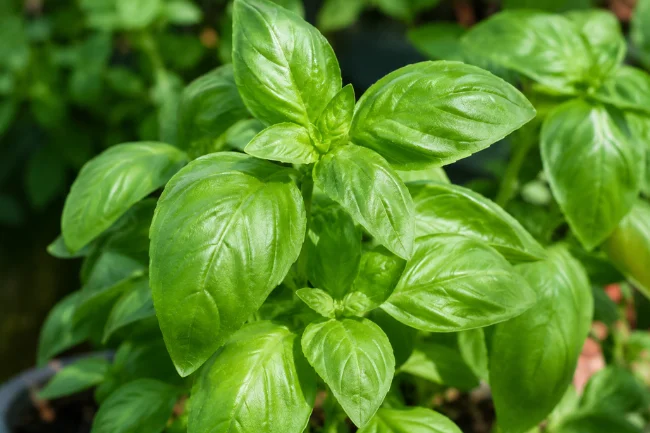
Ovate leaves occur in herbs, flowering shrubs, fruit trees, and ornamental plants.
Their presence is not restricted to a particular botanical family or growing environment.
Here are several familiar examples.
1. Sweet Basil (Ocimum basilicum)
Sweet basil is a popular culinary herb belonging to the mint family.
Its leaves are commonly ovate to elliptic, with smooth margins and a distinctive fragrance.
Basil also has an opposite leaf arrangement, meaning leaves occur in pairs along the stem.
These characteristics make it a useful example for learning how leaf shape differs from leaf arrangement.
2. Japanese Camellia (Camellia japonica)
Japanese camellia is an evergreen ornamental shrub known for its attractive flowers and glossy foliage.
Its leaves are generally ovate to elliptic, with leathery surfaces and finely serrated edges.
I particularly like this example for understanding why leaf margin and overall shape should be described separately.
An ovate leaf can have toothed edges without losing its egg-shaped outline.
3. Apple Tree (Malus domestica)
Apple trees commonly produce simple leaves with ovate or elliptic outlines.
Their leaves generally have noticeable veins and can vary in size and shape between cultivars.
This variation demonstrates why botanical descriptions often use more than one shape term for a species.
The leaf outline is helpful for identification, but it should be considered alongside the tree’s growth habit, flowers, fruit, and other features.
4. Bigleaf Hydrangea (Hydrangea macrophylla)
Bigleaf hydrangeas are ornamental shrubs valued for their large flower clusters.
Their leaves can be broadly ovate, elliptic, or occasionally obovate, depending on the variety and individual leaf.
The leaf blades are often relatively large, with toothed margins and conspicuous veins.
Hydrangeas demonstrate that shape categories describe recognizable patterns rather than perfectly identical structures.
These examples are documented in the North Carolina State Extension Plant Toolbox, a useful reference for checking botanical characteristics.
Ovate Leaf Shape, Margins, and Venation: Understanding the Differences
A common mistake is assuming that ovate describes every visible characteristic of a leaf.
It does not.
The word describes overall outline, while other botanical terms communicate different structural features.
Leaf Margins
The margin is the outer edge of a leaf blade.
An ovate leaf may have an entire margin, meaning its edge is smooth.
It may also have a serrated margin with saw-like teeth, a crenate margin with rounded teeth, or another edge pattern.
Consequently, two ovate leaves can look noticeably different even when their basic outlines are similar.
Leaf Venation
Venation describes the arrangement of veins throughout a leaf.
Some leaves exhibit pinnate venation, with smaller veins branching from a central midrib.
Others show palmate venation, with several prominent veins originating near the base.
The word ovate does not establish which venation pattern a leaf possesses.
Leaf Arrangement
Arrangement refers to how leaves grow along a stem.
Common categories include alternate, opposite, and whorled arrangements.
A plant can have ovate leaves arranged alternately, while another may have ovate leaves growing in opposite pairs.
This distinction becomes valuable when identifying plants that have similar leaf shapes.
How to Identify an Ovate Leaf Accurately
I prefer a simple observation-based approach rather than guessing from a photograph.
The process begins with the leaf’s overall outline and becomes more detailed when necessary.
Examine a Fully Developed Leaf
Choose a mature, healthy leaf that is representative of the plant.
Very young leaves may not have developed their typical proportions.
Damaged, folded, or unusually distorted leaves can also produce misleading impressions.
If possible, examine several leaves from different parts of the plant.
Locate the Base and Tip
Identify the point where the leaf blade attaches to its stalk or stem.
Next, locate the opposite end, or apex.
Orienting the leaf correctly is essential because ovate and obovate describe opposite distributions of width.
Find the Widest Point
Imagine a line running from the leaf base to its tip.
Determine where the blade is widest along this line.
If the maximum width occurs below the midpoint and the outline narrows upward, the leaf may be ovate.
If the widest region is near the center, elliptic may be more appropriate.
If it occurs above the midpoint, consider obovate.
Record Additional Characteristics
After identifying the outline, look for other useful features.
I would examine the leaf margin, venation, texture, surface hairs, and arrangement on the stem.
Recording these details prevents the shape description from becoming the only evidence used to identify a plant.
Compare Several Leaves
One unusual leaf does not always represent an entire species.
Check multiple healthy leaves and look for the most consistent shape.
When the plant has naturally variable foliage, a description such as “ovate to elliptic” may be more accurate than forcing every leaf into one category.
Why Is Ovate Leaf Shape Important in Plant Identification?
Leaf shape is one of the most accessible characteristics used in botanical identification.
Unlike flowers or fruits, leaves are often available for observation throughout much of a plant’s growing season.
This makes them particularly useful for gardeners and people identifying unfamiliar vegetation.
Botanical Classification and Field Guides
Plant identification guides frequently use technical descriptions to distinguish species.
A phrase such as “simple, ovate leaves with serrated margins” helps readers narrow down possible matches.
Professional identification keys often combine leaf shape with arrangement, venation, buds, flowers, or reproductive structures.
An ovate outline alone rarely identifies a species conclusively.
Gardening and Horticulture
Understanding leaf terminology helps gardeners interpret plant descriptions from nurseries, extension services, and reference books.
It can also improve communication when discussing ornamental plants or comparing similar varieties.
For example, two shrubs may produce similarly colored leaves but have different blade shapes and arrangements.
Recognizing those differences can make identification easier.
Botanical Research and Documentation
Researchers use standardized morphological terms when recording plant characteristics.
Descriptions of leaf shapes help support herbarium records, biodiversity surveys, taxonomic studies, and comparisons between plant populations.
Consistent terminology allows observations made in different locations to be compared more meaningfully.
Does Ovate Leaf Shape Have a Special Function?
Leaf shape can be associated with how plants interact with their surroundings, including light, water, and temperature.
However, I would avoid claiming that every ovate leaf has a particular environmental advantage.
Plant function depends on many interacting characteristics, including blade area, thickness, orientation, venation, and surface properties.
A broad leaf may intercept substantial light, but its actual performance depends on where and how it grows.
Similarly, water movement across a leaf’s surface is influenced by more than its outline.
An ovate shape does not automatically indicate drought tolerance, shade preference, or superior photosynthetic performance.
The most scientifically useful interpretation is that ovate describes a structural characteristic, not a guaranteed physiological ability.
Can Ovate Leaves Change Shape?
Yes. Leaves can vary in shape within a species and sometimes even on the same plant.
Developmental stage, genetics, environmental conditions, and the position of a leaf on the plant can influence its appearance.
For instance, leaves produced in shaded conditions may differ in size and proportions from leaves exposed to stronger sunlight.
Juvenile and mature foliage can also display different characteristics in certain species.
This does not mean every leaf changes from ovate to another recognizable shape.
Rather, botanical descriptions often represent the typical range of variation found within a plant.
I find it useful to treat leaf-shape terminology as a careful description of observable structures, not a rigid rule that every specimen must satisfy perfectly.
Common Mistakes When Identifying Ovate Leaves
Several misunderstandings can lead to incorrect identification.
Confusing Ovate With Every Oval Leaf
An ordinary oval outline is not automatically ovate.
A botanist examines the location of the widest point rather than relying on the general resemblance to an egg.
Ignoring Leaf Orientation
Holding a leaf upside down can cause confusion between ovate and obovate.
Always identify the attachment end before classifying the shape.
Assuming Ovate Leaves Have Smooth Edges
The outline and margin are separate characteristics.
An ovate leaf can have smooth, toothed, or otherwise modified edges.
Depending Entirely on Measurements
A suitable length-to-width ratio does not prove that a leaf is ovate.
The location of the maximum width must also match the description.
Identifying a Plant From One Leaf
Many unrelated plants share similar leaf shapes.
For reliable identification, examine multiple characteristics and compare them with a trustworthy botanical reference.
What Does Ovate Mean Outside Botany?
Although the botanical meaning is the most relevant in plant identification, ovate also appears in other contexts.
Ovate in General Shape Descriptions
The word may be used to describe an egg-shaped outline outside a formal botanical setting.
However, terms such as oval and egg-shaped are more familiar in everyday English.
Ovate remains especially useful when a precise morphological description is needed.
Ovate in Druidry
Ovate also has a separate meaning in Druidic traditions.
Within some modern Druid organizations, an Ovate refers to a person associated with a particular area or stage of spiritual study.
The role may involve studying nature, healing traditions, divination, and the cycles of life.
For example, the Order of Bards, Ovates and Druids recognizes Ovate as a distinct area of training.
This spiritual meaning should not be confused with the botanical adjective. The two uses belong to different contexts.
Why Understanding Ovate Matters
Ovate may seem like a small technical term, but it provides a valuable introduction to botanical observation.
Once I understand where a leaf is widest, I can distinguish its outline from several similar shapes much more confidently.
The real value comes from combining that observation with other characteristics rather than depending on a single feature.
Whether you are studying botany, identifying a garden plant, or reading a scientific description, understanding ovate makes plant terminology clearer and more practical.
The next time you encounter an unfamiliar leaf, examine its base, midpoint, and tip. That simple comparison is an excellent starting point for a more accurate identification.
Frequently Asked Questions About Ovate
1. What does ovate mean?
Ovate means egg-shaped, with the widest part toward the base and a narrower portion toward the tip. It commonly describes leaves and other flat botanical structures.
2. What is an example of an ovate leaf?
Sweet basil is a familiar example. Its leaves are commonly ovate to elliptic, with relatively broad lower portions and smooth margins.
3. What is the difference between ovate and obovate?
Ovate leaves are widest toward the base, while obovate leaves are widest toward the tip. Obovate describes the reversed egg-shaped outline.
4. Are ovate and oval the same?
Not exactly. Oval is a general shape description, while ovate is more specific and identifies an egg-shaped outline that is broader toward the base.
5. What is the difference between ovate and ovoid?
Ovate generally describes a flat, two-dimensional egg-shaped outline. Ovoid refers to a three-dimensional object with an egg-like form.

Olivia Parker is a home improvement research writer with 8+ years of experience covering home design, renovation ideas, maintenance tips, and practical living solutions. She creates easy-to-follow content to help readers make informed decisions about improving their homes.