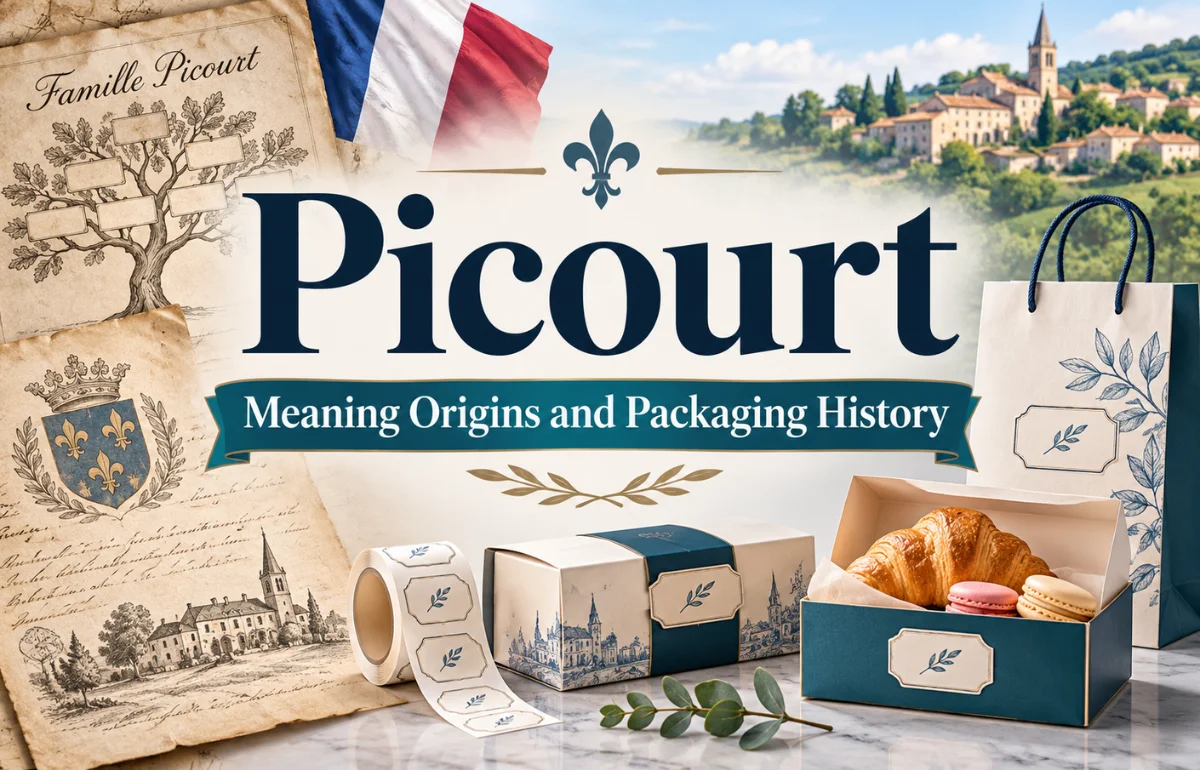
Picourt is a rare French surname and a name associated with French printing and packaging businesses. As a surname, it is associated with northern France, especially Picardy and Artois. In business, it can refer to Groupe Picourt, a printing and packaging specialist, or Picourt-Cabis, a maker of food-presentation packaging.
These uses share a name, but they should not automatically be treated as one company or a single documented family lineage.
If you have encountered Picourt on a product, in an archive, or during a company search, identifying the context is the quickest way to understand what it means.
What Does Picourt Mean?
The clearest starting point is the surname. French genealogy source Filae describes Picourt as a family name associated with Artois and Picardy, and suggests an occupational meaning connected with pic court, literally a short pick or pick-like tool.
Under that interpretation, the name may originally have identified someone who used such an implement in their work.
I would treat that explanation as a credible lead, not a certified origin story for every person with the name. Spellings change, and an etymology cannot identify a specific founding ancestor.
Although court is an English word, Picourt should be interpreted in its French linguistic context. One family’s origin may be confirmed by records while another remains uncertain.
Why the Regional Connection Matters
Picardy and Artois are historical areas of northern France with long traditions of agriculture, crafts, commerce, and regional dialects.
Occupational nicknames often became hereditary surnames, especially as communities needed dependable ways to distinguish people who shared common given names.
That background makes the tool-related explanation understandable.
However, I would not infer that every early Picourt was a miner, farm worker, or metalworker. The proposed etymology identifies a possible tool association, not a documented job description for a specific ancestor.
How Rare Is the Picourt Surname?
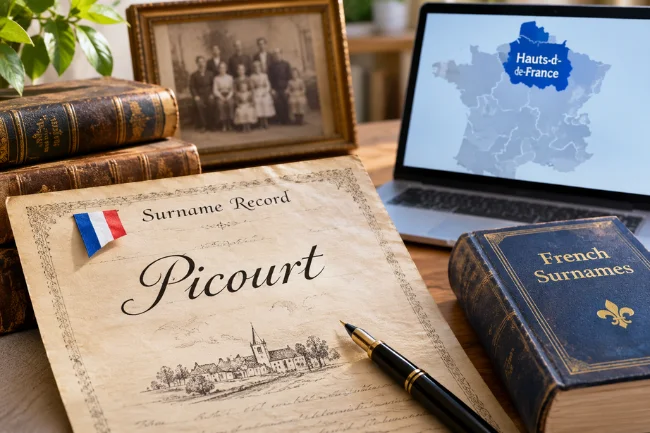
Picourt is uncommon, but online figures need careful reading.
Forebears estimates approximately 39 living bearers worldwide in its database, with 35 recorded in France. Its geographical breakdown points mainly to Hauts-de-France, followed by smaller concentrations elsewhere in France.
A different type of statistic appears on Filae: it reports 42 births with the surname in France across the periods from 1891 to 1990.
Another French surname directory, Linternaute, reports 46 births for 1891–2000.
These numbers are not automatically contradictory. They measure different periods, depend on different underlying datasets, and may be updated at different times.
I would never combine historic births, living-population estimates, and family-tree entries into one count. Archives include deceased people, duplicates, and variant spellings.
Picourt at a Glance
| Question | What the available evidence suggests |
|---|---|
| Type of name | Uncommon French surname |
| Strongest geographic association | Northern France, especially the Picardy–Artois area |
| Proposed meaning | An occupational nickname associated with a short pick or tool |
| Modern geographic presence | Primarily France, with scattered records elsewhere |
| Certainty of one shared ancestor | Not established merely by sharing the surname |
This distinction matters if you’re investigating family history.
A rare name can narrow a search, but rarity alone cannot demonstrate that two modern people are relatives.
How to Research Picourt Family History
Genealogy becomes far more reliable when I move away from broad surname websites and toward individual records.
If I were investigating a Picourt ancestor, I would start with the earliest confirmed person, rather than searching for a dramatic origin story.
Begin With a Specific Person and Place
Record the person’s full given names, approximate birth or marriage year, town, and known relatives.
Even an imperfect date is useful when paired with a location. For a northern French family, I’d begin with the Somme departmental archives.
The family-history database Geneanet lists historical Picourt entries, including marriage references associated with Paris in the nineteenth century.
Such entries are research leads, not proof that a particular record belongs to your family.
Before adding anyone to a family tree, check the underlying document and relationships.
Use Original Civil and Parish Records
French civil-registration records can connect parents, spouses, occupations, and places of residence.
For earlier generations, parish registers may hold baptisms, marriages, and burials. Ten-year indexes, commonly called tables décennales, can help identify the right register when an exact date is unknown.
I would search variant spellings cautiously.
A handwritten surname can be misread by an indexer, especially when old letterforms or damaged pages are involved.
Try likely spelling alternatives only as search aids; never quietly replace a name shown clearly in the original record.
Build a Timeline Instead of Collecting Matching Names
For each possible ancestor, put dated events in order: birth, marriage, children’s births, addresses, occupation, and death.
Then ask whether the facts fit one person. Two people named Picourt living near each other are not necessarily father and son.
A useful rule is to require at least one strong link—such as a birth record naming parents or a marriage record identifying family members—before connecting generations.
That prevents unsupported family-tree connections.
Respect Privacy and Access Rules
Not every record about a recent generation is freely available.
French rules distinguish between archival materials and contemporary civil-status documents, and access may depend on the record’s age and your relationship to the person concerned.
The French government’s Service-Public website explains relevant access conditions.
If you’re researching living relatives, avoid publishing private addresses, identification details, or sensitive family information without permission.
Good genealogy should be accurate without being intrusive.
What Is Groupe Picourt?
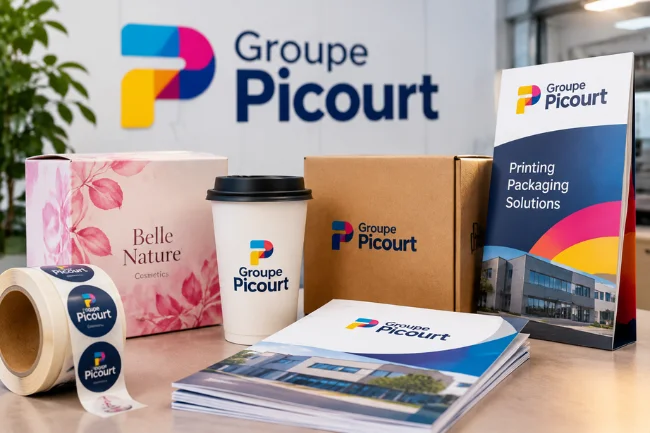
Groupe Picourt is a French printing and packaging group serving brands and organizations that need labels, cartons, printed marketing materials, or customized packaging.
Its official website describes capabilities in flexographic, offset, screen, and digital printing, as well as work for food, cosmetics, pharmaceuticals, industry, and other sectors.
To me, the useful feature of this business model is not simply that it prints many products.
It is the possibility of coordinating multiple printed items—say, an adhesive label, a folding carton, and an in-store display—through one production relationship.
That can make branding and color consistency easier to manage, although the result still depends on specifications and proofing.
How the Group Developed
According to its official history, Olivier Picourt founded the business in the early 1980s.
Picourt Packaging was created in Frucourt, near Abbeville, in 2009, specializing in compact-cardboard packaging and labels.
The group expanded through acquisitions.
Tech New Label, later associated with the PICXCELL premium business, joined in 2017. Etiq’Alp joined in 2021, adding capabilities suited to smaller digital-print runs and prototypes.
Imprimerie Rimbaud and Imprimerie Orsi followed in 2022, while Imprimerie Valmy joined in 2023.
In 2024, the company announced its acquisition of Groupe TAURRUS and further printing-equipment investments.
I see complementary specialization: prototypes, premium finishes, cartons, and commercial printing serving different needs.
These dates are business milestones, not surname history.
Products and Printing Services
The group markets self-adhesive labels, cardboard labels, folding cartons, flexible packaging, personalized paper cups, brochures, catalogues, and premium printed materials.
Available finishes include techniques such as embossing, decorative varnishes, and metallic effects, depending on the application.
A cosmetic box needs legible information and reliable folding.
A food label must withstand expected storage conditions. A catalogue requires different paper, binding, and image-quality decisions.
A Notable 2026 Quality Development
In July 2026, Groupe Picourt announced that its Picourt Packaging facility had obtained BRCGS Packaging Materials certification.
The company identified adhesive labels, cardboard labels, and personalized paper cups within the stated certification scope.
That is a meaningful point for buyers in food and other sensitive markets because the standard addresses packaging-related quality and safety systems.
Still, I would check the actual certificate, its current validity, the facility, and the exact products covered before assuming every company or product in the wider group carries the same certification.
What Is Picourt-Cabis?
Picourt-Cabis is another French name associated with packaging, especially the presentation of pastries, confectionery, catering products, and other foods.
Its official history traces the original Picourt business to Paris in 1886, much earlier than the corporate history published by Groupe Picourt.
According to Picourt-Cabis, the early company supplied the Russian tsars, the British royal household, and the White House.
These are statements from the company’s own historical account; I would attribute them as such rather than present them as independently verified archival findings.
From Decorative Tradition to Customized Packaging
Picourt-Cabis says that, in 1987, it developed a specialized machine called Baccara at the request of French pastry chef Gaston Lenôtre.
The machine produced intricate decorative paper lace, or dentelles, used to elevate food presentation.
The business identifies the project as an important moment in its craftsmanship history.
Cabis, a company specializing in paper baking and presentation cups, joined in 1995.
Picourt and Cabis later merged in 2013 under the SOMAFI group.
Today, Picourt-Cabis promotes standard and custom packaging, including paper products, cartons, decorative food presentation materials, and display solutions.
When I look at this business, the central theme is food presentation rather than printing alone.
Packaging can act as a visual frame for a pastry, chocolate selection, or catered dish. Its appearance, food suitability, and ease of handling all influence how the final product is experienced.
Groupe Picourt vs. Picourt-Cabis: What’s the Difference?
These names are easy to confuse, particularly because both operate around printed or physical packaging.
Their publicly presented histories, however, describe different business trajectories.
| Feature | Groupe Picourt | Picourt-Cabis |
|---|---|---|
| Historical starting point | Business founded by Olivier Picourt in the early 1980s | Original Picourt business founded in Paris in 1886 |
| Primary focus | Labels, cartons, printing, paper cups, premium print | Packaging and presentation products for food professionals |
| Typical needs served | Brand labels, retail boxes, marketing print, industrial packaging | Pastry, confectionery, catering, and luxury-food presentation |
| Notable historical milestones | Picourt Packaging established in 2009; later acquisitions | Baccara machine in 1987; Picourt–Cabis merger in 2013 |
| Best place to verify details | groupe-picourt.com | picourt-cabis.com |
I found no basis in the cited public histories to describe the two companies as the same legal entity.
A shared name and overlapping market are not enough to establish common ownership.
Anyone researching contracts, investment, employment, or company history should check the exact legal name and registration details before drawing conclusions.
Why Picourt Matters in Today’s Packaging Market
Packaging involves many decisions before a product reaches customers.
The label communicates. The carton protects. A premium finish affects perception.
The materials and printing processes influence cost, handling, and waste.
Brand Identity Is More Than a Logo
A consistent visual system needs accurate color reproduction, readable type, appropriate material, and a finish suited to the product.
For a premium fragrance, tactile effects may be worthwhile. For a high-volume food product, production reliability and clear information may matter more.
I would judge packaging by the experience it creates in ordinary use, not just by how a sample looks under studio lighting.
Can a customer open it comfortably? Does the label remain legible? Can the product be transported without damage?
Those questions reveal value that marketing photographs cannot.
Sustainability Claims Need Evidence
Groupe Picourt has publicized paper-based packaging developments, including a heat-sealable, compostable paper flow-wrap concept.
Picourt-Cabis also describes environmental initiatives and supplier considerations on its website.
These are relevant directions, but I avoid treating “paper,” “recyclable,” and “compostable” as interchangeable words.
A claim can depend on coatings, local collection systems, testing standards, and the precise version of a material.
Businesses should request documentation for the exact packaging specification, not rely only on a broad sustainability slogan.
Printing Method Affects the Outcome
Flexography can suit repeatable label and packaging work; offset printing often delivers strong quality for cartons and printed publications; digital printing can make prototypes and shorter runs easier; screen printing can produce distinctive effects for selected designs.
There is no universal winner.
I would ask a supplier to recommend a process only after sharing the quantity, substrate, colors, finish, delivery schedule, and intended use.
That is more useful than choosing a technique based on its name.
How to Evaluate a Picourt Packaging Supplier
If your search is commercial rather than genealogical, begin by deciding which business actually matches your needs.
A food-service operator sourcing pastry supports may be looking for something different from a cosmetics company developing decorated folding cartons.
Before requesting a quotation, I would prepare a concise specification: product dimensions, expected volumes, materials, print colors, artwork, finishes, delivery location, and any food-contact or other compliance requirements.
Also ask whether the company can provide physical samples or prototypes.
Then compare the full proposition, not only the unit price.
Production minimums, setup charges, lead times, proof approval, consistency between reorders, and transport all affect total cost.
For regulatory or safety-sensitive packaging, ask for written evidence of applicable testing and certifications.
One more useful check is whether the supplier has handled the specific application before.
A printer experienced with luxury labels may still need different controls for food-contact packaging.
Experience should be relevant to the project, not merely impressive in general terms.
Common Misunderstandings About the Name
The biggest mistake is assuming that every online result for Picourt describes the same thing.
A surname entry, a French packaging group, and a company with a nineteenth-century history may appear side by side in search results.
Another mistake is treating surname estimates as a definitive census.
Digital collections differ in scope, and a name may appear hundreds of times in historical records without representing hundreds of people alive today.
Finally, I would not assume that all similar-looking names—such as Picot, Picort, or Pécourt—are simply alternative spellings of Picourt.
They may be useful search leads, but each proposed connection requires evidence from records.
Frequently Asked Questions About Picourt
What is Picourt?
Picourt is an uncommon French surname also used in the names of French packaging businesses, notably Groupe Picourt and Picourt-Cabis.
What is the origin of the Picourt surname?
It is associated with northern France, particularly Picardy and Artois; one genealogy source links it to a short pick-like tool.
Is Picourt a common last name?
No. Available surname databases describe Picourt as rare, with most recorded modern bearers living in France.
Are Groupe Picourt and Picourt-Cabis the same company?
Their published histories describe different corporate origins. A direct legal or ownership connection should not be assumed without verification.
What products does Groupe Picourt make?
Its offerings include printed labels, cardboard packaging, flexible packaging, customized paper cups, and commercial print materials.
Final Thoughts
Picourt has more than one meaningful identity: a rare surname rooted in French records and a name visible in established packaging businesses.
For a family-history question, I would follow original birth, marriage, and archival records.
For a supplier question, I would compare the exact company, its capabilities, and its documented quality standards.
Start with the context in which you encountered the name, then use the relevant original source.
That one choice will make your research more accurate, efficient, and useful.

Ethan Caldwell is a business research writer with 9+ years of experience covering entrepreneurship, market trends, business strategies, and industry insights. He focuses on creating clear, data-informed articles that help readers understand modern business concepts.