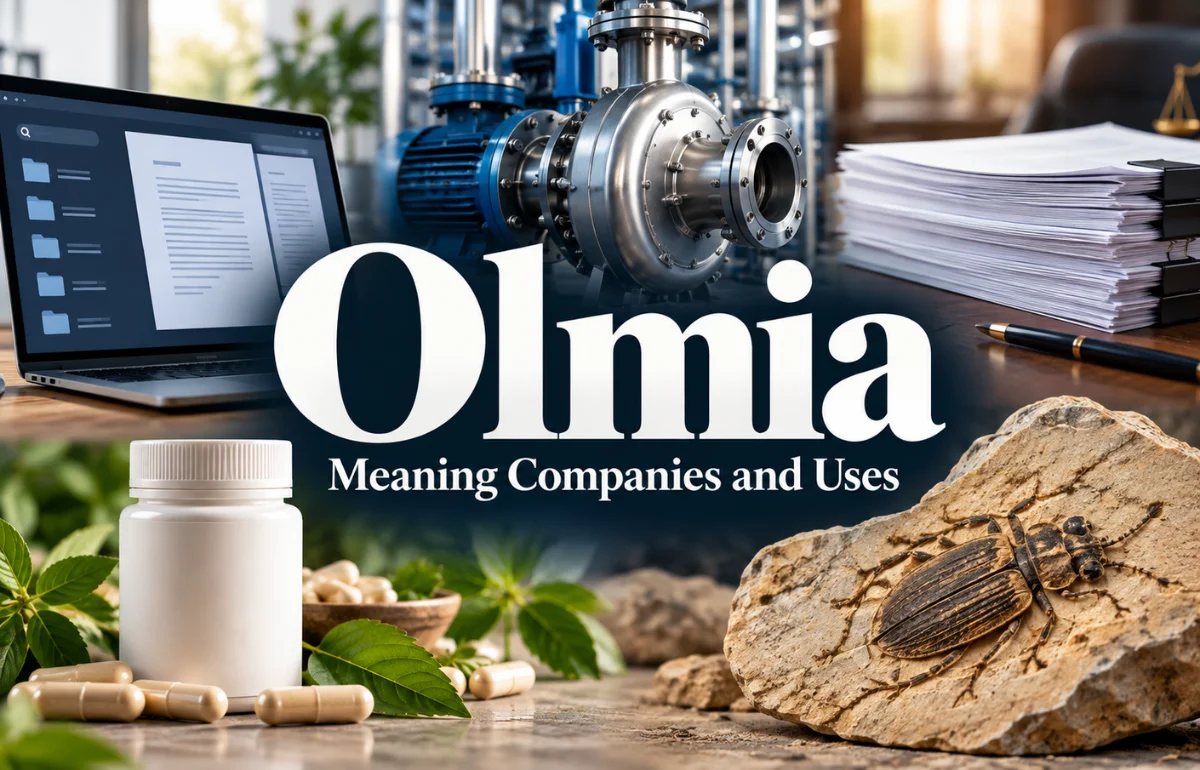
Olmia is a name used by several unrelated businesses and, separately, by a genus of fossil beetles. It does not describe one universally recognized product, technology, or organization. Depending on the context, Olmia can mean a Swedish digital archiving and information-management company, a Dutch industrial process-technology supplier, a Spanish legal practice, or a US-focused wellness supplement brand.
The name also appears in the history of Italian construction-equipment distribution. I checked official company information and scientific research to distinguish these meanings. If you’ve seen Olmia on a website, product label, invoice, or search result, the quickest way to understand it is to identify the industry, country, and website associated with the name.
Why Does the Name Olmia Have Different Meanings?
A business name isn’t necessarily exclusive around the world. Organizations in different countries and industries may use the same word without offering similar products or sharing ownership. Search engines can display those organizations together because they match the same query.
That’s exactly what happens here. A person researching electronic records may be looking for Olmia AB. Someone pricing industrial pumps may mean Olmia Procestechniek. A customer checking supplement ingredients has an entirely different business in mind.
I wouldn’t treat a search result, logo, or short company description as sufficient identification. The domain name and registered business details usually tell a more reliable story.
Olmia at a Glance: Which One Are You Looking For?
| Name or reference | Main field | Location or context | What to look for |
|---|---|---|---|
| Olmia AB | Digital archiving and information management | Sweden | E-archives, digitization, cloud and on-premises systems |
| Olmia Procestechniek | Industrial process technology | Netherlands | Pumps, sensors, valves, pneumatic parts, engineering |
| Olmia Legal | Business and tax law | Barcelona, Spain | Corporate advice, taxation, succession planning |
| Olmia wellness brand | Dietary supplements | US-focused online store | Collagen, creatine, magnesium, gummies |
| Historical OLMIA | Agricultural and construction machinery | Vercelli, Italy | Early Caterpillar distribution; later CGT history |
| Olmia (beetle genus) | Paleontology and taxonomy | Eocene Rovno amber | Fossil species Olmia drevlyanica |
These are separate references, not divisions of one international company. I find that distinction more useful than any vague explanation claiming Olmia is simply a “modern platform” or “lifestyle concept.”
Olmia AB: Digital Archiving and Information Management in Sweden
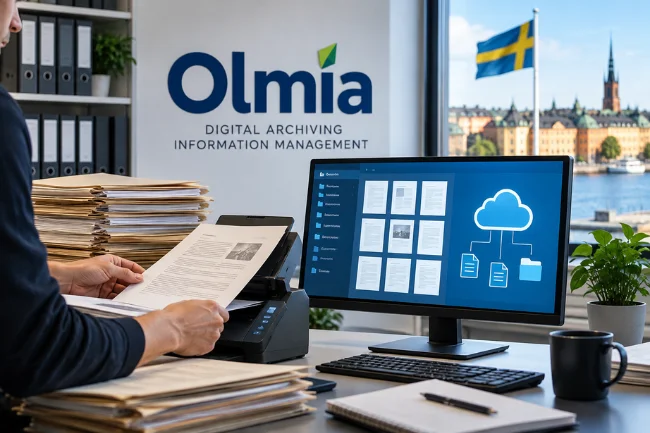
Olmia AB provides technology and services for organizations that need to capture, organize, preserve, and retrieve information. Its official website describes solutions for digitization, electronic archives, data access, system integration, and consulting.
Think of a business with decades of paper documents, older databases, and records spread across multiple systems. Finding one contract may take longer than it should. Worse, some files may become difficult to open when the software that created them is retired.
That is the kind of information-management problem this Swedish company addresses. Its offering isn’t merely extra online storage; it concerns the long-term usability and accessibility of records.
Turning Physical Records Into Searchable Information
Olmia describes a digitization product line called D-Ceid, intended to help convert material such as paper, microfilm, photographs, and microfiche into electronic information. The broader objective is to move information into workflows where authorized staff can find and use it.
Scanning is only the beginning. For a digital archive to be useful, organizations also need meaningful metadata, document identifiers, retention rules, and controls over who can see sensitive content. I would ask about those details before judging any digitization project by the number of pages scanned.
Preserving Records With Electronic Archives
The company’s D-Safe offering is described as an electronic-archiving platform supporting storage, retrieval, formatting, display, transformation, and lifecycle management. Olmia says the system is aligned with the OAIS archival model.
OAIS is a framework for organizing long-term digital preservation. It doesn’t mean a file is automatically safe forever. Successful preservation still depends on operating procedures, compatible formats, access controls, backups, and regular checks that records remain usable.
For a prospective customer, the practical question is straightforward: can the organization retrieve an authentic, readable record several years after the original application disappears?
Cloud, On-Premises, and Hybrid Considerations
Olmia offers cloud-based and installed solutions. Its website states that its cloud operations, data transport, and storage remain within Sweden. That is a provider statement worth confirming contractually for a specific service and deployment.
| Deployment approach | Potential advantage | Question I would ask |
|---|---|---|
| Cloud or SaaS | Less infrastructure to maintain internally | Where are data, backups, and support access located? |
| On-premises | More direct control of local systems | Who handles upgrades, resilience, and monitoring? |
| Hybrid | Can combine hosted services with internal archives | Which party controls each part of the data flow? |
I wouldn’t automatically call one approach more secure than another. Security depends on implementation, operational discipline, legal obligations, and the capabilities of the people managing it.
Olmia Procestechniek: Industrial Solutions in the Netherlands

Another prominent use is Olmia Procestechniek, a company based in Tiel, the Netherlands. It supplies equipment and expertise for industrial processes, with particular emphasis on pumps, components, and engineering support.
Its website presents product categories including diaphragm pumps, peristaltic pumps, rotary-vane pumps, pneumatic components, valves, fittings, and related accessories. It also highlights co-engineering, where products are combined or adapted for a customer’s particular application.
What Does Process Technology Mean in Practice?
Process technology deals with moving, measuring, controlling, or treating materials in a repeatable way. A pump might transfer liquid, a valve might direct flow, and a sensor might report whether pressure or temperature is within the desired range.
Consider a manufacturer that needs to dose a liquid into a production line. Buying a pump based solely on its maximum output could be a costly mistake. The liquid’s chemical properties, required accuracy, operating time, pressure, and maintenance environment all matter.
That’s where a technical supplier may add value beyond the catalog. I would want to know whether a proposed setup has been checked against the actual duty cycle and whether the supplier can explain its component choices.
Why Co-Engineering Matters
Olmia’s own description emphasizes collaboration in designing and assembling combinations of pumps, sensors, and control technology. This is useful when a standard component alone does not solve the operating problem.
Before contacting a process-technology provider, I would prepare a short specification covering the material being handled, flow range, pressure, power source, installation space, cleaning needs, and required certifications. It makes the discussion much more productive and helps prevent avoidable purchasing errors.
Olmia Legal: Business and Tax Advice in Spain
Olmia Legal is a boutique law firm in Barcelona. Its official website identifies business law as a key focus and lists services involving taxation, corporate transactions, restructuring, tax disputes, estate and succession planning, and international mobility.
The firm also describes work for family-owned businesses, high-net-worth individuals, family offices, athletes, artists, and sports-related organizations. Its published legal notice identifies the business as Olmia Legal Abogados, S.L.P.
These services address a very different type of need from those handled by the technology and engineering businesses. A family enterprise planning a change in ownership, for example, might require corporate, tax, and succession advice at the same time.
If I were comparing legal advisers, I would examine the actual professionals assigned to the matter, relevant jurisdictional experience, fee arrangements, and conflicts-of-interest procedures. A firm’s specialization is a starting point, not a substitute for verifying qualifications and discussing the specific case.
Olmia as a Wellness and Supplement Brand
The name also belongs to a consumer wellness brand operating through olmiashop.com. Its website promotes straightforward daily supplement routines and lists products such as creatine monohydrate, collagen peptides, magnesium glycinate, and hair, skin, and nails gummies.
The store’s legal notice identifies Crecimiento Estudio LLC as the operator and says its supplements are made and shipped to order through a US fulfillment partner. These are details about that brand, not the Swedish, Dutch, or Spanish businesses.
What Should Shoppers Check?
I would start with the actual Supplement Facts panel rather than the promise on the front of a bottle. Ingredient amounts, serving sizes, allergens, instructions, and interactions with medications matter more than polished marketing language.
I would also look for independently verifiable quality testing where relevant. A statement that a facility is FDA-registered should not be mistaken for FDA approval of a supplement’s safety or effectiveness. The seller itself states that its product claims have not been evaluated by the FDA and that the products are not intended to diagnose, treat, cure, or prevent disease.
Supplements aren’t automatically necessary because they fit an appealing routine. Anyone who is pregnant, managing a medical condition, or taking prescription medication should discuss suitability with a qualified clinician before starting something new.
Two Lesser-Known Uses of Olmia
The Name in Italian Machinery History
The TESYA Group’s corporate history traces part of its roots to an OLMIA company in Vercelli, Italy. According to TESYA, that business began importing and selling Caterpillar machines in northern Italy in 1934, after working in agricultural machinery.
The historical account explains that the business later passed through the names IMAI and Compagnia Generale Trattori, commonly abbreviated CGT. This is a historical connection, not evidence that today’s unrelated businesses with the same name have a relationship with Caterpillar.
A Fossil Beetle Genus Called Olmia
In scientific usage, Olmia is also the name of an extinct beetle genus. A paper published in Ecologica Montenegrina describes Olmia drevlyanica, a species found in late Eocene Rovno amber and assigned to the hairy fungus beetle family Mycetophagidae.
The researchers distinguished the new genus using anatomical characteristics, including the arrangement of middle-leg cavities and a particularly long final antennal segment. Here, Olmia is a taxonomic name, not a brand, service, or consumer product.
Does Olmia Have One Official Meaning or Origin?
I couldn’t verify a single etymology that applies to all these uses. That matters because explanations of brand names sometimes turn a guess into an apparent fact.
A word can be memorable, commercially useful, or personally meaningful to a founder without having a standard dictionary definition. Different organizations may arrive at similar names independently. Unless a company publishes a reliable origin story, I would avoid claiming its name comes from a particular language or symbolizes a particular value.
For practical purposes, the exact company identity is more informative than a speculative translation. Search for a full name, registered entity, or specific product rather than assuming that one definition covers everything.
How to Identify the Right Olmia Online
When a name is shared, a little context saves a surprising amount of time. I use five checks to separate credible matches from unrelated results.
- Read the web address. Olmia’s Swedish information-management business uses olmia.se, the Dutch process-technology company uses olmia.nl, Olmia Legal uses olmialegal.com, and the supplement store uses olmiashop.com.
- Look for the industry. Words such as e-archive and data migration suggest information management; pumps and valves suggest engineering; taxation suggests legal services; supplement labels suggest retail wellness.
- Check the legal entity. Look for a company registration, a legal notice, or an official contact page. Similar names don’t establish common ownership.
- Confirm the country and scope. The location helps identify the business, but service availability and regulatory requirements still need confirmation.
- Follow the original source. A company’s published product page, official register, or peer-reviewed paper is better evidence than a recycled search snippet.
I also watch for a common warning sign: an article that combines details from two Olmia businesses into one imaginary company. For example, a digital archiving provider should not suddenly be described as manufacturing supplements without an independently verified connection.
What to Ask Before Buying a Product or Service
Finding the correct Olmia is only the first decision. The next is whether that particular product or service fits your requirements.
For digital archiving, I would ask for a demonstration using realistic files. Can users search the records they need? Are permissions appropriately restricted? How are migrations verified, records exported, and incidents handled? Written service terms matter more than a broad promise of security.
For industrial equipment, I would request technical specifications and confirmation that the materials and operating conditions match the application. I would also check spare-parts availability, warranty coverage, maintenance intervals, and responsibility for integrating the equipment into existing machinery.
For legal services, I’d clarify the scope of the engagement, lawyer qualifications, estimated fees, communication arrangements, and any jurisdictional limits before sharing sensitive information.
For wellness products, I’d review ingredient amounts and warnings, seller policies, independent testing information, and the quality of evidence for the intended use. A customer testimonial is not the same thing as clinical proof.
Across all four areas, one principle holds: ask for documentation relevant to the actual purchase. A trustworthy evaluation compares verifiable promises, limitations, and total costs rather than relying on the name alone.
Why the Difference Matters for Search Results
The query “Olmia” has mixed search intent. A researcher may want a definition, a procurement manager may need a vendor, and a shopper may be searching for an ingredient list. Those goals require different answers.
Adding a second term usually helps: “Olmia AB archiving,” “Olmia pumps Netherlands,” “Olmia Legal Barcelona,” or “Olmia supplements.” More specific searches reduce the risk of visiting the wrong site, confusing product claims, or contacting an unrelated organization.
I think the most useful overview is one that makes those distinctions visible immediately and then gives readers enough context to pursue the correct source.
Frequently Asked Questions About Olmia
What Is Olmia?
Olmia is a name used by unrelated businesses in technology, engineering, law, and wellness; it is also a fossil beetle genus. Its meaning depends on context.
Is Olmia a Technology Company?
Olmia AB in Sweden provides digital archiving and information-management solutions. Other businesses using the name work in different industries.
Where Is Olmia Located?
There is no single location. Notable examples are based in Sweden, the Netherlands, and Barcelona, while a wellness store targets US shoppers.
Does Olmia Sell Supplements?
Yes. A wellness brand using olmiashop.com sells supplements, but it is distinct from businesses named Olmia in other sectors.
Is Olmia a Real Scientific Name?
Yes. Olmia is a genus of extinct hairy fungus beetles described from Eocene Rovno amber, with Olmia drevlyanica as its type species.
Final Thoughts
Olmia isn’t one business or one fixed definition. The name spans multiple industries and even scientific classification. Once you match it to the correct website, location, and field, the confusion clears up. If you’re researching a vendor or product, use the relevant official source and verify the details that matter for your decision before you commit.

Ethan Caldwell is a business research writer with 9+ years of experience covering entrepreneurship, market trends, business strategies, and industry insights. He focuses on creating clear, data-informed articles that help readers understand modern business concepts.